

Introduction
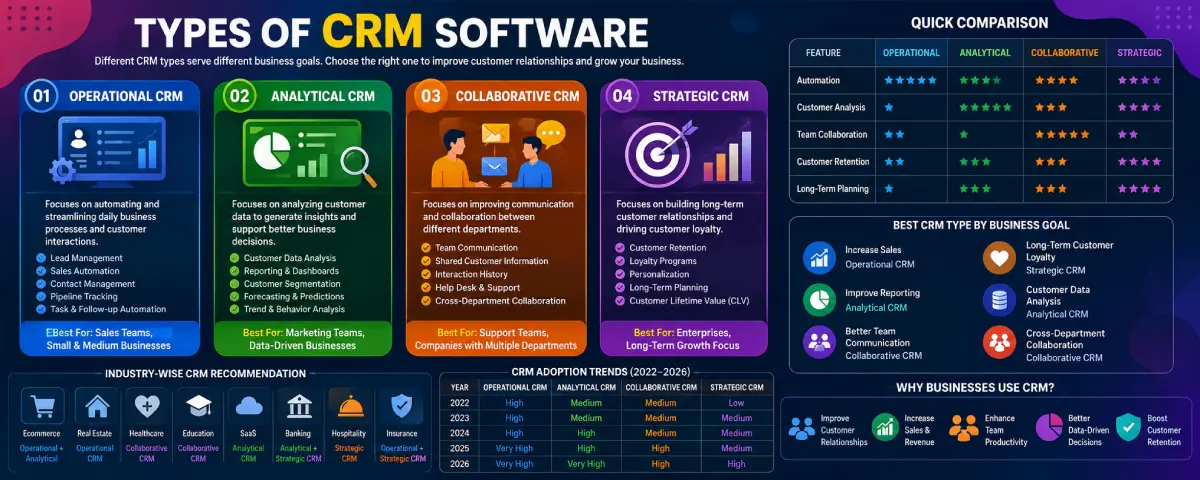
Types of CRM Software Explained is perhaps the most crucial subject for companies trying to make a decision on their future CRM system choice. Despite the fact that the primary aim of every CRM solution is to manage relationships with customers, there are several different types of CRM that serve different purposes.
While some CRMs provide functionalities aimed at automating sales processes and managing leads, others are focused on customer analytics or collaborative work, or customer retention. Selecting a type of CRM software that doesn’t match your objectives could mean wasting money on unused software features.
Knowing about the types of CRM software will allow you to find out which CRM software type fits your needs best. In this article, we’ll give you a look at what four of these CRM types include: Operational CRM, Analytical CRM, Collaborative CRM, and Strategic CRM.
Types of CRM from our what is CRM software pillar.
Which type of CRM should a business choose?
- Operational CRM
- Analytical CRM
- Collaborative CRM
- Strategic CRM
Knowing the differences between them will enable you to choose one which doesn’t charge you with features that you will probably not even use as your business progresses.
Why CRM Software Comes in Different Types
Imagine four different businesses:
- A startup trying to manage leads
- An ecommerce store studying customer buying habits
- A customer support company handling thousands of inquiries
- A global enterprise focusing on customer loyalty
Would all four need the same CRM?
Probably not.
Each business has different priorities.
Foundation in our CRM software basics guide.
Simple CRM Type Comparison
| Business Goal | Best CRM Type |
| Automate sales and follow-ups | Operational CRM |
| Analyze customer behavior | Analytical CRM |
| Improve teamwork | Collaborative CRM |
| Build long-term loyalty | Strategic CRM |
What Are the Main Types of CRM Software?
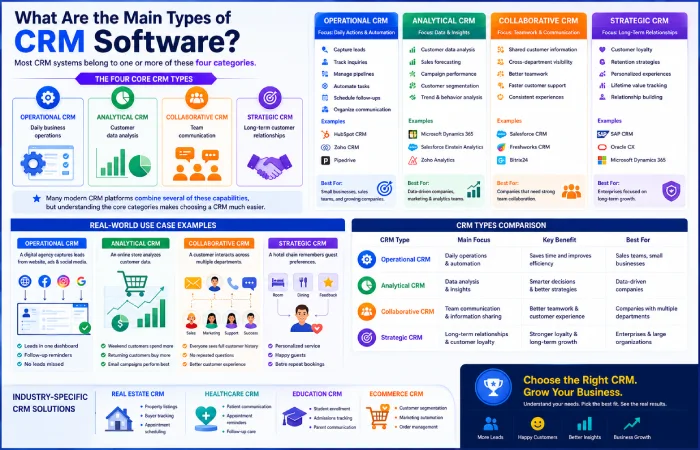
Most CRM systems belong to one or more of these four categories.
The Four Core CRM Types
| CRM Type | Main Focus |
| Operational CRM | Daily business operations |
| Analytical CRM | Customer data analysis |
| Collaborative CRM | Team communication |
| Strategic CRM | Long-term customer relationships |
Most CRM systems that exist today incorporate a few of these aspects into their software, but knowledge of the major types will definitely help you choose one.
Operational CRM Software Explained
For most companies, the first kind of CRM system used is Operational CRM.
Operational CRM helps to make work with customers simpler and more efficient for a company’s employees.
Think of it as the “action” side of CRM.
Many of these automation capabilities are considered essential CRM functions and are covered in our guide on Best CRM Software Features to Look For.
What Does Operational CRM Actually Do?
Operational CRM helps businesses:
- Capture leads
- Track customer inquiries
- Schedule follow-ups
- Manage sales pipelines
- Automate repetitive tasks
- Organize customer communication
HubSpot CRM helps businesses organize contacts, track leads, and automate sales and customer interactions.
Real Business Example
A small digital marketing agency receives leads from:
- Website forms
- Facebook ads
- Instagram messages
- Google Ads
Without CRM:
Employees manually track everything.
With Operational CRM:
Every lead enters one dashboard automatically.
The system reminds employees when follow-ups are needed.
Nothing gets missed.
Why Small Businesses Like Operational CRM
This is one reason why many startups and growing companies invest in the Best CRM Software for Small Business solutions available today.
Operational CRM helps them do more work without hiring more employees.
Advantages of Operational CRM
| Benefit | Why It Matters |
| Automation | Saves time |
| Lead management | Improves organization |
| Faster follow-ups | Increases conversions |
| Centralized records | Reduces confusion |
Possible Limitations
Operational CRM focuses more on action than deep analysis.
If your main goal is understanding customer behavior, another CRM type may be more suitable.
Analytical CRM Software Use Cases
Some companies focus less on automation and more on the customers’ actions.
That is where Analytical CRM becomes valuable.
Analytical CRM focuses on data.
It helps businesses answer questions such as:
- Which products sell best?
- Which customers spend the most?
- Which marketing campaigns perform well?
- Why are customers leaving?
How Analytical CRM Works
Every customer interaction creates data.
Analytical CRM collects and studies that information.
The goal is to help businesses make smarter decisions.
Ecommerce Example
An online store analyzes customer purchases.
The CRM discovers:
- Weekend customers spend more money.
- Returning customers purchase more frequently.
- Email campaigns outperform social media ads.
The firm leverages such knowledge to optimize the efficiency of their marketing strategies.
Benefits of Analytical CRM
- Better forecasting
- Improved marketing decisions
- Customer segmentation
- Stronger business planning
Industries That Commonly Use Analytical CRM
| Industry | Main Purpose |
| Ecommerce | Customer insights |
| Banking | Customer behavior analysis |
| Retail | Sales forecasting |
| SaaS | Subscription analytics |
Collaborative CRM Software Benefits
As companies grow, communication becomes more difficult.
Sales teams may have information that support teams cannot see.
Marketing teams may not know what customer service teams are hearing from customers.
This creates communication gaps.
Collaborative CRM was developed to solve this problem.
The Main Purpose of Collaborative CRM
Cooperative CRM ensures that various departments work together using customer knowledge.
Everyone sees the same customer history.
Example
A customer:
- Clicks an email campaign
- Contacts sales
- Purchases a product
- Opens a support ticket
With Collaborative CRM:
Every department can see the complete journey.
The customer does not need to repeat information.
Benefits of Collaborative CRM
- Better teamwork
- Faster customer service
- Improved communication
- Consistent customer experience
Strategic CRM Software for Enterprises
Strategic CRM is different from the other CRM categories.
It does not focus on sales generated from its efforts on the day but rather emphasizes establishing relationships with its customers over time.
The goal is simple:
Keep customers happy for as long as possible.
Why Enterprises Use Strategic CRM
Big companies recognize that it is cheaper for them to retain their customers than to discover new customers.
Strategic CRM helps businesses:
- Improve loyalty
- Increase repeat purchases
- Build long-term trust
- Personalize customer experiences
Example
A luxury hotel chain tracks guest preferences.
The next time that same customer books a room with them, the organization already knows:
- Room preferences
- Dining preferences
- Previous feedback
This creates a more personalized experience.
Industry-Specific CRM Software Types
Businesses evaluating industry-specific solutions should also understand the key CRM Software Benefits for Businesses before selecting a platform.
Some industries require specialized features.
Real Estate CRM
Used for:
- Property listings
- Buyer tracking
- Appointment scheduling
Healthcare CRM
Used for:
- Patient communication
- Appointment reminders
- Follow-up care
Education CRM
Used for:
- Student enrollment
- Admissions tracking
- Parent communication
Ecommerce CRM
Used for:
- Customer segmentation
- Marketing automation
- Order management
CRM Adoption Trends by Type (2022–2026)
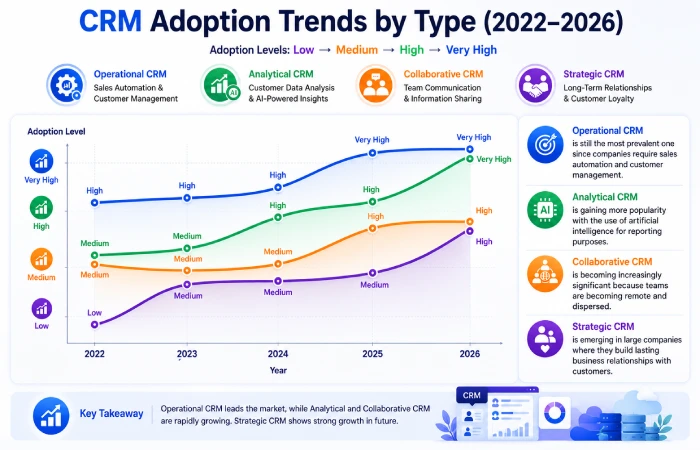
This can be added after “Types of Industry-Specific CRM Software.”
| Year | Operational CRM | Analytical CRM | Collaborative CRM | Strategic CRM |
| 2022 | High | Medium | Medium | Low |
| 2023 | High | Medium | Medium | Medium |
| 2024 | High | High | Medium | Medium |
| 2025 | Very High | High | High | Medium |
| 2026 | Very High | Very High | High | High |
- Operational CRM is still the most prevalent one since companies require sales automation and customer management.
- Analytical CRM is gaining more popularity with the use of artificial intelligence for reporting purposes.
- Collaborative CRM is becoming increasingly significant because teams are becoming remote and dispersed.
- Strategic CRM is emerging in large companies where they build lasting business relationships with customers.
CRM Type Comparison
| Feature | Operational | Analytical | Collaborative | Strategic |
| Automation | High | Medium | Medium | Medium |
| Customer Analysis | Low | High | Medium | High |
| Team Collaboration | Medium | Low | High | Medium |
| Customer Retention | Medium | Medium | High | Very High |
| Long-Term Planning | Low | Medium | Medium | High |
CRM Types Based on Business Goals
Place this section after “CRM Type Comparison Table.”
| Business Goal | Best CRM Type |
| Increase Sales | Operational CRM |
| Improve Reporting | Analytical CRM |
| Better Team Communication | Collaborative CRM |
| Long-Term Customer Loyalty | Strategic CRM |
| Customer Data Analysis | Analytical CRM |
| Cross-Department Collaboration | Collaborative CRM |
CRM Type Selection by Business Size
Place this section before “How to Choose the Right CRM Software Type.”
| Business Size | Recommended CRM Type |
| Freelancer | Operational CRM |
| Startup | Operational CRM |
| Small Business | Operational + Collaborative CRM |
| Medium Business | Operational + Analytical CRM |
| Enterprise | Strategic + Analytical CRM |
| Global Company | Strategic CRM |
This helps beginners quickly identify which CRM type fits their business.
Can Businesses Use Multiple CRM Types Together?
Modern cloud platforms often combine multiple CRM categories within a single system, which is why understanding Cloud-Based CRM Software Explained can be helpful. In reality, modern CRM platforms often combine multiple CRM capabilities.
For example, a growing company may use:
- Operational CRM for sales automation
- Analytical CRM for customer insights
- Collaborative CRM for team communication
- Strategic CRM for long-term customer retention
Example
| Department | CRM Type |
| Sales | Operational CRM |
| Marketing | Analytical CRM |
| Customer Support | Collaborative CRM |
| Management | Strategic CRM |
How to Choose the Right CRM Software Type
If you are still uncertain about the solution you should be adopting, then check out our comprehensive guide on “How to Choose the Right CRM Software for Your Business” that takes you through the process.
Choose Operational CRM If
You need:
- Lead tracking
- Automation
- Sales management
Choose Analytical CRM If
You need:
- Customer insights
- Forecasting
- Data-driven decisions
Choose Collaborative CRM If
You need:
- Better teamwork
- Shared customer information
- Faster communication
Choose Strategic CRM If
You need:
- Customer loyalty
- Retention programs
- Long-term growth
Signs You Are Using the Wrong CRM Type
Some businesses choose their CRM software without really knowing what they need.
Common warning signs include:
- Employees avoid using the CRM system
- Reports are not useful
- Customer information is difficult to find
- Sales opportunities are missed
- Departments struggle to collaborate
- Customer retention is declining
If several of these problems exist, a different CRM type may be more suitable.
Common Problems and Better CRM Choices
| Problem | Better CRM Type |
| Missed follow-ups | Operational CRM |
| Poor reporting | Analytical CRM |
| Communication issues | Collaborative CRM |
| Low customer loyalty | Strategic CRM |
Operational CRM vs Analytical CRM
During the evaluation process, businesses also compare CRM solutions with other enterprise systems such as ERP platforms through CRM Software vs ERP Software comparisons.
While both types of CRM deal with customer data, their intentions are different.
| Feature | Operational CRM | Analytical CRM |
| Lead Management | High | Medium |
| Sales Automation | High | Low |
| Reporting | Basic | Advanced |
| Customer Insights | Limited | Extensive |
| Forecasting | Basic | Advanced |
Which One Should You Choose?
Operational CRM should be chosen by those who wish to enhance their sales and customer management practices.
Analytical CRM should be selected if understanding the customer behavior is your intention.
Collaborative CRM vs Strategic CRM
These two CRM types are often confused, but they serve different purposes.
| Feature | Collaborative CRM | Strategic CRM |
| Team Communication | High | Medium |
| Customer Retention | Medium | Very High |
| Long-Term Planning | Medium | High |
| Customer Experience | High | Very High |
| Loyalty Programs | Low | High |
The Collaborative CRM is about internal communication. Strategic CRM helps create strong customer relations in the future.
Best CRM Type for Different Industries
Different industries often have different CRM requirements.
| Industry | Recommended CRM Type |
| Ecommerce | Operational + Analytical |
| Real Estate | Operational CRM |
| Healthcare | Collaborative CRM |
| Education | Collaborative CRM |
| SaaS | Analytical CRM |
| Banking | Analytical + Strategic CRM |
| Hospitality | Strategic CRM |
| Insurance | Operational + Strategic CRM |
CRM Trends in 2026
CRM technology continues evolving rapidly.
Major trends include:
- AI-powered automation
- Predictive analytics
- Voice-enabled CRM tools
- Mobile-first CRM platforms
- Hyper-personalized customer experiences
- Real-time customer insights
Future CRM Predictions (2026–2030)
| CRM Trend | Growth Outlook |
| AI CRM | Very High |
| Predictive CRM | Very High |
| Mobile CRM | High |
| Voice CRM | High |
| Traditional CRM | Declining |
There could be an advantage for some of the early users of these technologies in this respect.
Which CRM Type Is Best for Beginners?
Operational CRM is normally the simplest to start off with for most beginners.
It focuses on practical activities such as:
- Contact management
- Lead tracking
- Sales pipelines
- Follow-up automation
Learning Difficulty Comparison
| CRM Type | Difficulty Level |
| Operational CRM | Easy |
| Collaborative CRM | Easy |
| Analytical CRM | Medium |
| Strategic CRM | Advanced |
F&Q
Types of CRM Software
There are four different kinds of CRM software. These include Operational CRM, Analytical CRM, Collaborative CRM, and Strategic CRM. Each has its own function.
What type of CRM should a small business implement?
Operational CRM is generally more applicable for small businesses. This CRM helps them deal with their leads and customer database management.
Is it possible to implement several types of CRM in business operations?
Yes, businesses tend to implement various types of CRM. They help to manage the sales process and other business aspects.
What are the advantages of Analytical CRM?
Analytical CRM helps organizations understand the behavior of the customer and make decisions based on customer information analysis.
How do I choose the best CRM software type for my organization?
The selection of CRM should be based on the objectives of the organization. Organizations that have objectives related to selling use operational CRM.
Modern stack: see our cloud-based CRM software guide.
Conclusion
CRM application selection may be considered one of the most important decisions to make for attaining success through customer management and business development. Some examples of contributions that CRM types can make are operational CRM streamlining of all business processes and sales, analytical CRM provision of valuable information about customers, collaborative CRM ensuring teamwork, and strategic CRM management of customer relations.
It should be noted that there is no CRM model suitable for everyone in particular because each case requires a different CRM approach. Thus, Operational CRM works well for small companies, and the use of several CRM types at once can benefit big companies with their future expansion. Understanding CRM types is vital in terms of its further development and implementation.
With technological advances such as AI, automation, predictive analysis, and personalization of the customer experience, an understanding of CRM types is crucially important. It will help choose a suitable CRM for business improvement in terms of efficiency, enhanced customer relations, more sales, and long-term success.