

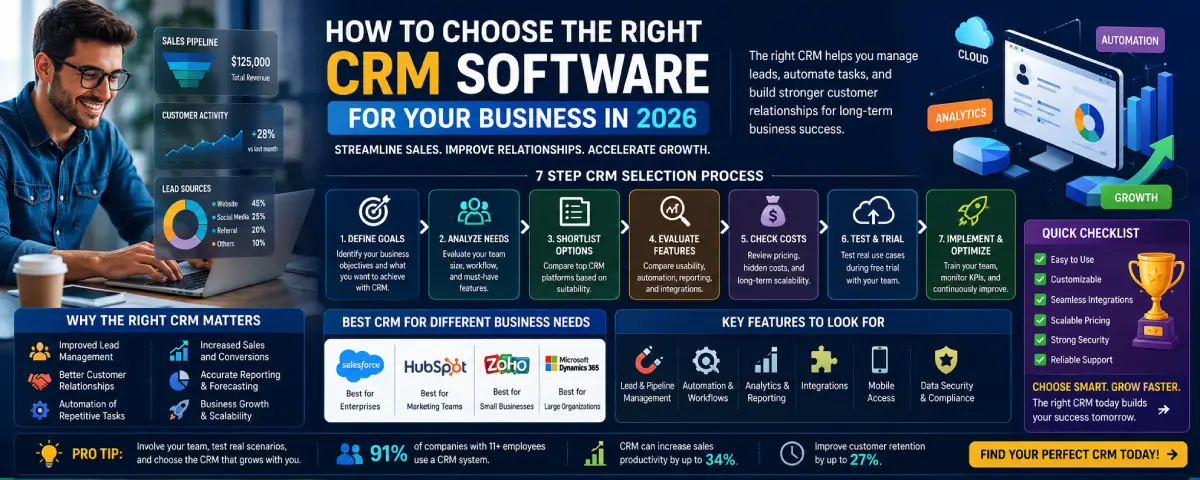
Choosing the right CRM software is one of the most strategic decisions for any business in 2026. If you’re new to CRM systems, start with What is CRM Software and CRM Software Basics for Beginners before evaluating different solutions. A good CRM system can really help your sales team do better. It helps you build relationships, with your customers. It also makes some tasks automatic, which is nice. This can help your business grow over time.
According to Salesforce CRM Guide, CRM helps businesses manage customer relationships, improve sales processes, and increase customer satisfaction
It could be a waste of money choosing the wrong CRM application because few people will use it. It could slow down some processes.
With literally so many options for choosing CRM software, it becomes extremely important for organizations to be able to pick out the best for themselves.
Following are the steps that must be taken when trying to choose the best CRM for an organization.
CRM selection guide from our what is CRM software pillar
Why Choosing the Right Customer Relationship Management Matters
A Customer Relationship Management system is not a computer program. It is the main center of your sales team your marketing team and your customer support team. The Customer Relationship Management system is really important because it helps these teams work together. The Customer Relationship Management system is, like the heart of your business.
A good CRM helps you:
- Manage leads efficiently
- Track customer interactions
- Automate repetitive tasks
- Improve team collaboration
- Increase conversion rates
- Forecast revenue accurately
Features resulting from the development of artificial intelligence technologies have been incorporated in the newly developed CRMs, for example, predictive analysis, smart lead generation, and automated interaction with customers.
Step-by-Step CRM Software Selection Process
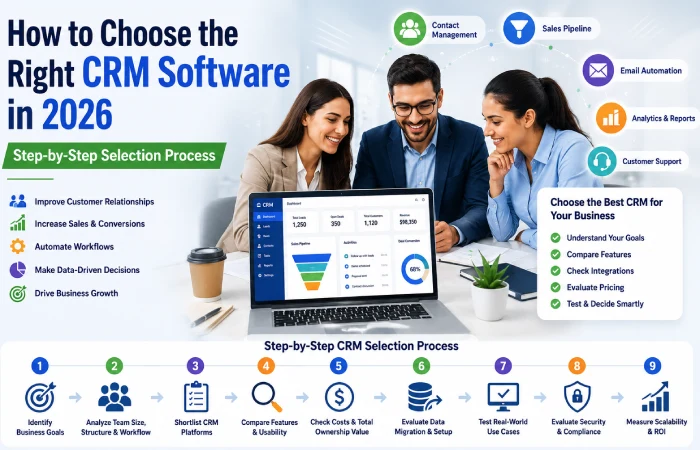
The selection of the appropriate CRM should always be a systematic effort rather than haphazard comparison. Companies that adopt a systematic method for selecting CRM systems tend to succeed in terms of high adoption rate, ROI, and workflow integration.
This section highlights some steps that may prove helpful in determining the appropriate CRM system in 2026.
Identify Business Goals (The Most Important Task)
When considering the use of any CRM system, first identify the goals your business truly has.
Common business goals include:
- Better conversion rates via improved lead management
- Marketing automation for tasks such as email campaigns
- Better customer service response times and issue handling
- Centralized customer information repository
- Improved reporting capabilities
Businesses should first understand the Types of CRM Software Explained because different CRM categories serve different operational needs.
Why this matters:
CRM failures are typically attributed to the selection of solutions based on feature sets rather than business goals.
Without clearly defined objectives, even an advanced CRM system like Salesforce or HubSpot seems complicated.
Analyze Team Size, Structure, and Workflow
When you are looking at the Team Size, Structure and Workflow you have to think about how your team works every day. The CRM you choose should be a fit for your team not just for the size of your company.
Small Businesses:
- Need simple setup
- Easy interface
- Basic automation
- Quick onboarding
Mid-Sized Companies:
- Need workflow automation
- Sales pipeline tracking
- Integration with marketing tools
- Role-based access control
Large Enterprises:
- Require advanced customization
- Multi-department workflows
- AI analytics and forecasting
- High-level data security
Key insight:
When you are looking at the Team Size, Structure and Workflow you have to think about how your team works every day. The CRM you choose should be a fit for your team not just for the size of your company.
Shortlist CRM Platforms According to True Suitability
Rather than going through all the available options and comparing them, try shortlisting 3–5 CRM platforms that will suit you best.
Considerations include:
- Functionality (sales, marketing, support)
- Integration capabilities (email, ERP, accounting software)
- Scalability in terms of growth
- Pricing (monthly or per-user pricing model)
- User-friendliness and ease of learning
Reading the article The Best CRM Software Features to Look For will aid in making the right choice.
Commonly shortlisted CRMs:
- Salesforce (enterprise-grade customization)
- HubSpot CRM (user-friendly inbound marketing focus)
- Zoho CRM (budget-friendly all-in-one system)
- Microsoft Dynamics 365 (strong enterprise integration)
To compare essential capabilities before making a shortlist, review our CRM Software Features Guide
Compare Features, Usability, and Real Performance
Instead of just reading feature lists, focus on real usability.
Important evaluation areas:
These capabilities are among the most important CRM Software Features to Look For when comparing vendors.
Lead Management
- How easily leads are captured
- Automation of lead assignment
- Follow-up tracking efficiency
Sales Pipeline Tracking
- Visual pipeline clarity
- Stage customization
- Deal progress tracking
Automation Capabilities
- Email sequences
- Task reminders
- Workflow triggers
Reporting & Analytics
- Custom dashboards
- Sales forecasting accuracy
- Performance tracking
Mobile Accessibility
- Mobile app quality
- Remote access capabilities
AI Features (2026 trend)
- Smart lead scoring
- Predictive sales insights
- Automated recommendations
Check Hidden Costs and Total Ownership Value
Many businesses make the mistake of only checking monthly pricing.
You should also evaluate:
- Setup and onboarding fees
- Cost of premium integrations
- Add-on charges for extra users or storage
- Training and support costs
- Upgrade pricing as business scales
Key insight:
Low-cost CRM tools can become expensive over time due to hidden scaling costs.
Evaluate Data Migration and Implementation Ease
Switching CRMs is often difficult if migration is not smooth.
Check:
- Can existing customer data be imported easily?
- Does the CRM support CSV/API migration?
- Is technical support available during setup?
- How long does full implementation take?
A CRM with poor migration support can delay operations for weeks or months.
CRM Implementation Timeline
Typical CRM setup timeline:
- Week 1: Setup & configuration
- Week 2: Data migration
- Week 3: Team training
- Week 4: Full deployment
Test Real-World Use Cases During Free Trial
Free trials should not be used just for browsing features.
Instead, simulate real business scenarios:
- Add and track actual leads
- Run a full sales pipeline cycle
- Test email automation workflows
- Generate real reports
- Check team collaboration features
Pro tip:
Include sales and marketing team members during testing. Their reviews carry more credibility than technical analysis only.
How to Measure CRM Success (KPIs)
After implementation, track:
- Lead conversion rate
- Sales cycle length
- Customer retention rate
- Response time
- Revenue per customer
Evaluate Security, Compliance, and Data Protection
Customer data is highly sensitive, so security is critical.
Check for:
- Data encryption standards
- GDPR or regional compliance
- User access control levels
- Backup and recovery options
- Audit logs and activity tracking
This applies particularly to the financial, healthcare, and corporate sectors.
Measure Long-Term Scalability and ROI
New CRM must address current issues as well as allow for growth in the future.
Ask:
- Can it support more users in the future?
- Can it handle increased data volume?
- Does it support advanced automation later?
- Will ROI improve as usage increases?
CRM Selection by Industry
Different industries need different CRM priorities:
Businesses should also compare the Types of CRM Software Explained to identify which CRM category best matches their industry requirements
SaaS Companies
- Focus on automation + subscription tracking
- Strong analytics & reporting
Real Estate
- Lead tracking + property management fields
- WhatsApp/email integration
E-commerce
- Customer segmentation
- Marketing automation + abandoned cart tracking
Healthcare
- Security + compliance (HIPAA/GDPR)
- Patient data tracking
It makes the application more relevant and useful from an SEO point of view.
The CRM selection process should not focus on popularity but rather on finding the tool that will be most relevant to your company’s business.
Companies that follow the above process will be able to improve their efficiency and get better results.
CRM Requirements by Industry
| Industry | Key CRM Requirement | Important Features |
| SaaS | Customer retention | Automation, analytics |
| Real Estate | Lead management | Property tracking, follow-ups |
| Ecommerce | Customer segmentation | Marketing automation |
| Healthcare | Compliance | Security, patient records |
| Education | Student engagement | Communication tracking |
| Banking | Customer management | Security, reporting |
| Insurance | Policy management | Claims tracking |
| Hospitality | Customer experience | Personalization |
CRM Buying Checklist for Businesses
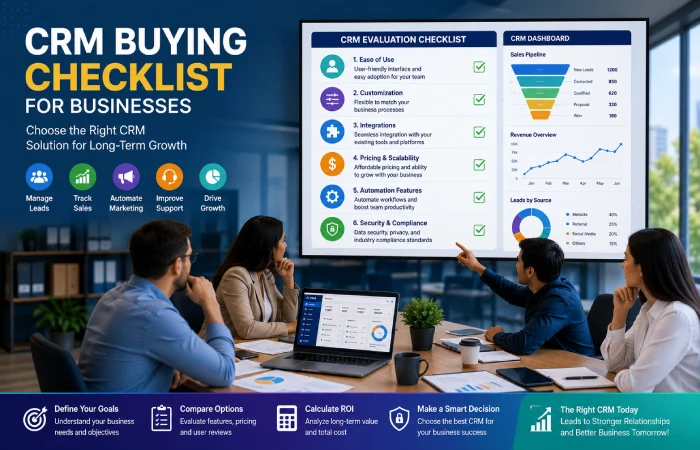
Before choosing a CRM solution, companies need to make use of the following checklist to prevent making expensive and unnecessary errors. This is because CRM is more than a mere tool; it becomes the very essence of your company’s sales, marketing, and customer support efforts.
A number of these factors are closely linked with the benefits that companies will receive from CRM software.
Below is an effective checklist based on academic research.
Prior to making any investment in a CRM solution, organizations must follow a certain checklist so as to not make any costly errors. A CRM isn’t just a software; it becomes the center of your selling, marketing, and customer service processes.
Several of the aforementioned considerations are actually linked to the CRM Software Benefits for Businesses.
There are a few practical factors that have been exhaustively studied below.
1. Ease of Use (User Adoption Factor)
A CRM system shouldn’t be complex for you and your team to use every day.
What to look for:
- Clean and intuitive user interface
- Easy navigation between modules (leads, contacts, deals)
- Minimal training required for new users
- Drag-and-drop pipeline management
- Mobile-friendly dashboard
Why it matters:
Many CRM implementations have failed due to poor adoption of the system by the users. If the system itself is difficult for the users, then the latter will be reluctant to use it, resulting in incorrect collection of information and ultimately a poor ROI.
2. Customization Capabilities (Business Fit)
All companies are unique in nature; hence, it is essential to select the solution that is tailored to meet your needs, and not vice versa.
Check for:
- Custom fields for leads and contacts
- Editable sales pipelines
- Personalized dashboards and reports
- Role-based access control
- Workflow customization (approval flows, deal stages)
Example:
A real estate company may need property tracking fields, while a SaaS company may need subscription lifecycle stages.
3. Integration Capabilities (Ecosystem Strength)
A CRM should not work in isolation. Companies comparing business systems should also understand the differences between CRM Software vs ERP Software before making a technology investment.
It must connect with your existing business tools.
Essential integrations include:
- Email platforms (Gmail, Outlook)
- Marketing automation tools
- Accounting software (QuickBooks, Zoho Books, etc.)
- Customer support tools (ticketing systems, chat apps)
- Payment gateways and billing systems
Why it matters:
Good integrations mean no manual intervention is necessary and information sharing is ensured among departments.
4. Pricing & Scalability (Long-Term Cost Planning)
Businesses tend to concentrate on initial costs but often overlook rising costs in the long run.
Evaluate:
- Monthly vs yearly pricing structure
- Per-user pricing model
- Free vs paid feature limitations
- Upgrade costs for advanced features
- Storage and API usage limits
Scalability factors:
- Ability to add more users easily
- Performance with large datasets
- Enterprise upgrade availability
- Multi-team or multi-branch support
Key insight:
The CRM solution that may appear inexpensive at first can become costly in the long run as your organization expands. It is especially important when selecting the Best CRM Software for Small Business.
5. Automation Features (Productivity Boost)
Modern CRM systems are expected to reduce manual work through automation.
Look for:
Workflow Automation:
- Auto-assign leads to sales reps
- Trigger follow-up tasks automatically
Email Automation:
- Drip email campaigns
- Personalized email sequences
- Auto-responses based on user behavior
Task Management:
- Automatic reminders for follow-ups
- Deadline alerts for deals
AI-Based Features (2026 trend):
- Predictive lead scoring
- Smart recommendations for next actions
- Sales forecasting insights
Why does it matter?
Automation results in efficiency and ensures that no detail will be missed.
6. Security and compliance (data protection is paramount)
Since the CRM system holds client and firm’s data, it is an important aspect.
Check for:
- End-to-end data encryption
- Multi-factor authentication (MFA)
- Role-based access restrictions
- Regular data backups
- Compliance with standards like GDPR or ISO certifications
Why does it matter:
A breach of data can destroy the company’s reputation and bring about legal and financial trouble.
When purchasing a CRM, all these factors – usability, flexibility, connectivity, cost, automation, and security – must be considered. Companies which do follow this checklist will definitely end up choosing a CRM that helps them grow and increase their efficiency.
CRM Evaluation Scorecard
| Evaluation Criteria | Importance | Questions to Ask |
| Ease of Use | High | Can employees learn it quickly? |
| Customization | High | Can workflows be customized? |
| Integrations | High | Does it connect with existing tools? |
| Automation | High | Does it automate repetitive tasks? |
| Security | High | Does it offer encryption and MFA? |
| Pricing | Medium | Are there hidden costs? |
| Support | Medium | Is customer support reliable? |
Top Questions to Ask CRM Vendors
Before making a purchase decision, ask vendors the following:
- Is this CRM right for my industry?
Industries have unique processes and requirements.
- How flexible will the solution be?
Will it support scalability from 10 users to over 500 users?
- What integrations does it offer?
Compatibility with your current systems should be ensured.
- How much technical support is included?
Technical Support may be a high priority for large organizations.
- How is data migration handled?
Switching from old systems should be smooth.
- Are there hidden costs?
Ask about:
- Setup fees
- Add-on costs
- Storage limits
Free Trial Tips for CRM Software
Free trials are one of the most important evaluation stages.
Test Real Business Scenarios
Instead of exploring features randomly, test:
- Lead capture process
- Sales pipeline movement
- Email automation workflows
- Reporting accuracy
Involve Your Team
Get feedback from:
- Sales teams
- Marketing teams
- Customer support teams
Evaluate Usability
Ask:
- Is it easy to navigate?
- Can tasks be completed quickly?
- Is training required?
Test Integrations
Check how well it connects with your existing tools.
Best CRM Software Comparison 2026
Choosing the right CRM depends on your business size and needs.
CRM Software Feature Comparison
| CRM Platform | Best For | Ease of Use | Automation | Scalability | Pricing |
| Salesforce | Enterprises | Medium | Excellent | Excellent | High |
| HubSpot | Marketing Teams | Excellent | Very Good | Good | Medium |
| Zoho CRM | Small Businesses | Good | Good | Good | Affordable |
| Microsoft Dynamics 365 | Large Organizations | Medium | Excellent | Excellent | High |
Key Comparison Factors
When comparing CRM platforms, focus on:
- Ease of implementation
- AI and automation capabilities
- Pricing transparency
- Customization options
- Long-term scalability
- Customer support quality
Common Mistakes to Avoid When Choosing CRM
Many businesses fail because they:
- Choose based only on price
- Ignore scalability
- Skip free trial testing
- Overlook integration needs
- Fail to train employees properly
Avoiding these mistakes improves CRM success rate significantly.
Future of CRM Systems (2026 and Beyond)
Modern CRM systems are evolving rapidly with:
- AI-driven sales forecasting
- Automated customer journeys
- Voice-based CRM commands
- Predictive analytics
- Hyper-personalized marketing
Businesses adopting AI-powered CRM early will have a strong competitive advantage.
FAQ
Which is the best CRM software for 2026?
It depends on the size of the business since Salesforce CRM is the best software for large companies, whereas Hubspot and Zoho are the best for SMEs.
How can I choose the best CRM software for my business?
Considerations such as goals, budget, scalability, and ease of use should be taken into account.
What is the most common error when choosing CRM software?
Picking it by price only.
Conclusion
A good CRM is not only useful in managing contacts but also offers a mechanism to scale up the growth of your business. Proper CRM implementation ensures efficiency in sales, improves relations with customers, and generates income.. Companies that apply structured analysis, testing, and long-term strategy always perform better than companies using CRM based solely on its popularity or price.
Justify ROI with our CRM software benefits guide