

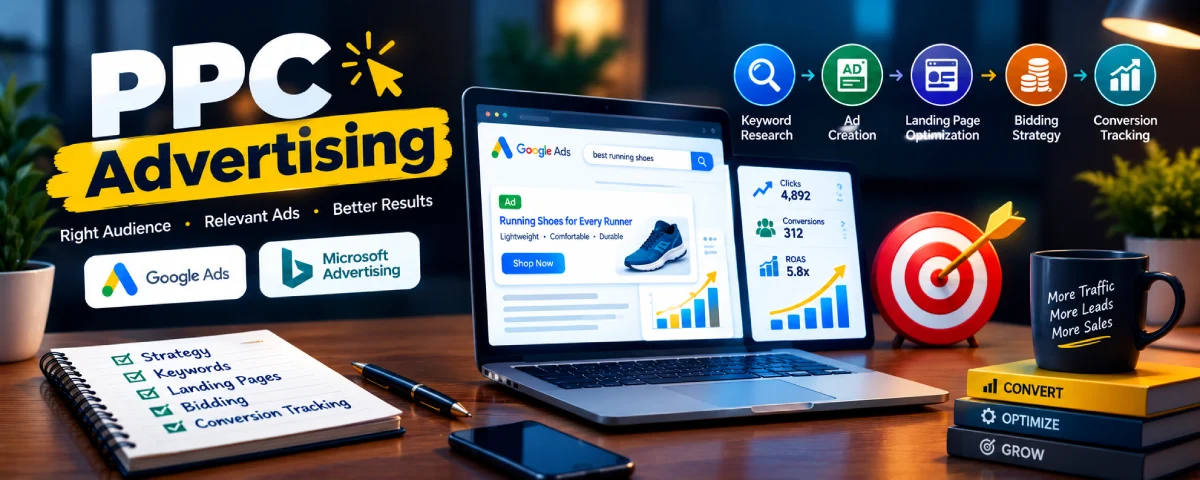
However, PPC advertising is still among the fastest ways of generating traffic, leads and sales for any company. Even though organic advertising will take quite some time to yield results, PPC advertising can give your website visitors within hours after launching your advertising campaign.
However, time alone isn’t everything. Too many companies spend lots of money on ineffective campaigns, poor keywords, bad landing pages or wrong bids. Those advertisers who earn well see PPC advertising as a full system – strategy first, then execution, tracking, and optimization.
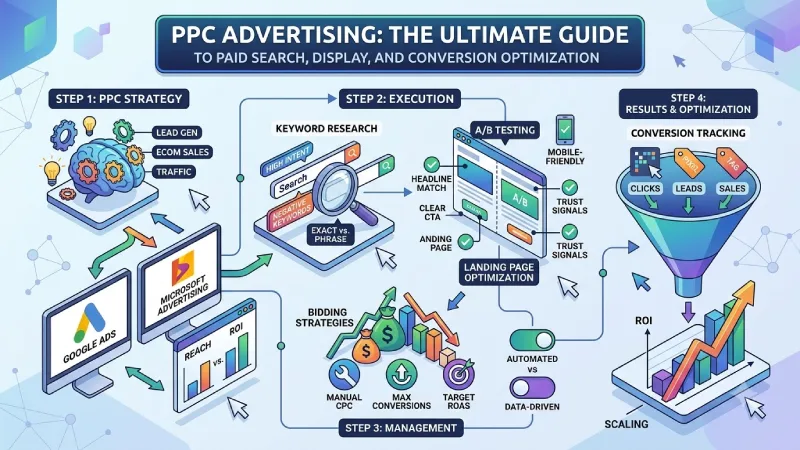
This article is written in full pillar format on the topic of PPC advertising. It contains details of campaign strategy, differences between Google and Bing Ads, keyword research, landing page optimization, and bidding strategy. You will get all the information on the subject matter here but will also be provided with links to learn more on other related subjects like Google Ads creation, remarketing, ad writing, and conversion tracking.
PPC Advertising Resource Center
Explore our complete collection of PPC advertising guides covering Google Ads, Facebook Ads Manager, retargeting, ad copywriting, conversion tracking, and Quality Score optimization.
PPC Campaign Strategy
Strategic planning makes sure that the money does not go to waste.
Start with the right goals
Determine your definition of success before doing anything. PPC objectives may include:
- Generating leads
- Driving online sales
- Increasing website traffic
- Building brand awareness
- Supporting product launches
- Retargeting previous visitors
Most successful campaigns normally have a single objective in each campaign as opposed to attempting to do everything at once.
Understand your customer journey
- Plot out how people usually progress from initial recognition to buying something. This will help you determine:
- Which kinds of campaigns you will require (Search, Display, Remarketing, etc.)
- What messages make sense at each stage
- Where to allocate budget
Build a simple campaign structure
A practical structure for most businesses looks like this:
- Brand campaigns (protect your name)
- High-intent search campaigns (target people ready to buy or enquire)
- Competitor or comparison campaigns (optional)
- Remarketing / retargeting campaigns
- Prospecting campaigns (Display, Demand Gen, or social)
Stay structured. There are far too many campaigns with low budget and far too few campaigns with high budget that have succeeded.
Budget allocation principles
- Give enough budget to high-intent campaigns first
- Reserve part of the budget for testing
- • Scale the things that work and remove the things that don’t
- • Perform reviews either weekly or bi-weekly
Key strategic questions to answer
- Who is your ideal customer?
- What problem are they solving?
- What keywords or audience segments show high intent?
- What is a realistic cost per lead or cost per acquisition?
- How will success be measured?
When there is an excellent strategy, all other aspects of PPC become easier.
Example Budget Allocation by Business Type
| Business Type | High-Intent Search | Remarketing | Brand Protection | Testing / Prospecting | Notes |
| Ecommerce | 40–50% | 25–30% | 10% | 15–20% | Focus on shopping & high-intent keywords |
| Lead Generation | 50–60% | 20–25% | 10% | 10–15% | Prioritise conversion-focused campaigns |
| Local Business | 45–55% | 15–20% | 15% | 15% | Strong focus on location-based keywords |
| SaaS | 40–50% | 20% | 10% | 20–30% | More budget for testing & remarketing |
These percentages are starting points. Adjust based on your margins, conversion rates, and business goals.
Campaign Structure by Business Stage
Your campaign structure should grow as your experience and data grow. A setup that works for a complete beginner is different from what an experienced advertiser needs.
| Stage | Recommended Campaign Structure | Main Focus | Typical Number of Campaigns |
| Beginner | Brand + High-Intent Search + Remarketing | Learning and getting first conversions | 3–4 |
| Intermediate | Brand + High-Intent + Competitor + Remarketing + Testing | Improving efficiency and volume | 5–7 |
| Advanced | Full funnel (Brand, High-Intent, Competitor, Remarketing, Prospecting, Audience) | Scaling and protecting performance | 7–12 (well organised) |
Keep it simple. A mistake made by most novice advertisers is that they make numerous campaigns but each with little budget. It is advisable to have three well-funded campaigns rather than eight underfunded campaigns.
Recommended Campaign Types by Business Goal
| Business Goal | Priority Campaigns | Secondary Campaigns |
| Generate Leads | High-Intent Search + Brand | Remarketing + Competitor |
| Increase Online Sales | High-Intent Search + Shopping / Performance Max | Remarketing + Brand |
| Build Brand Awareness | Display / Demand Gen + Video | Remarketing later |
| Support Product Launch | High-Intent Search + Prospecting | Remarketing after traffic builds |
| Reduce Cost per Acquisition | Brand + Remarketing + High-Intent | Carefully tested competitor campaigns |
Align the kinds of campaigns you plan to conduct with your ultimate goal rather than trying to conduct all kinds of campaigns straightaway.
How Long Before a New Campaign Stabilises?
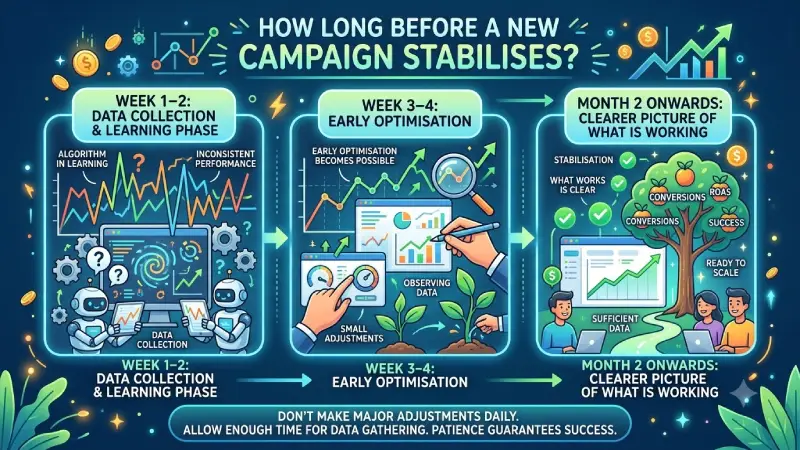
New PPC accounts require some time to have trustworthy statistics. Within the first 7 to 14 days, the algorithm is in the learning phase, particularly when using Smart Bidding, and therefore the performance might appear inconsistent.
A realistic expectation is:
- Week 1–2: Data collection and learning phase
- Week 3–4: Early optimisation becomes possible
- Month 2 onwards: Clearer picture of what is working
Don’t try to make any major adjustments every other or third day. Allow enough time for your campaign to gather sufficient data. The patience that is exercised during the beginning phase normally guarantees success later on.
How to Set Realistic Target CPA or ROAS
Too often beginners try to aim too high and are surprised when volume suffers. The way to do it is:
- Calculate what you are paying now per lead/purchase even if it’s through other channels.
- Determine what’s the maximum you could spend while remaining profitable.
- Set a CPA goal above your average to give the system some leeway.
- Gradually decrease the goal after having conversion statistics.
The fastest way to kill campaign volume is by setting an unrealistically low CPA goal.
Common Strategy Mistakes Beginners Make
- Spreading budget across too many campaigns
- Mixing different goals in one campaign
- Ignoring brand keywords
- Launching without clear conversion tracking
- Changing strategy every few days before data has accumulated
- Copying a competitor’s structure without understanding why it works
A straightforward and concentrated approach will always do better than a complicated one when you are beginning.
Google Ads vs Bing Ads
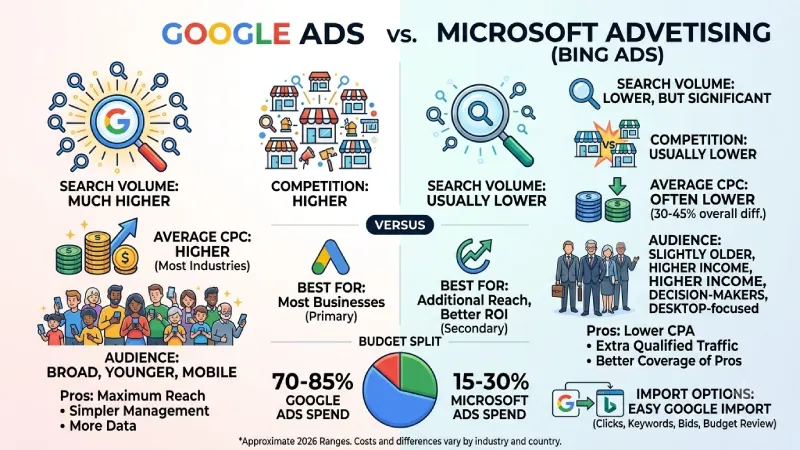
All advertising campaigns start with Google Ads since it is obvious that Google has the largest number of searches. But Microsoft Advertising (previously Bing Ads) must not be ignored either.
Quick comparison
| Factor | Google Ads | Microsoft Advertising (Bing Ads) |
| Search volume | Much higher | Lower, but still significant |
| Competition | Higher | Usually lower |
| Average CPC | Higher in most industries | Often lower |
| Audience | Broad | Slightly older, higher income in many markets |
| Import options | — | Can import campaigns from Google |
| Best for | Most businesses as primary platform | Additional reach and often better ROI |
When to use Google Ads
- You want maximum reach
- You are just starting with PPC
- Your audience actively searches on Google
When to add Microsoft Advertising
- You have campaigns that already work on Google
- You want to reduce overall cost per acquisition
- Your audience includes professionals or higher-income demographics
- You want extra volume without starting from zero
Most marketers observe that Bing Ads offer better CPC rates and conversion rates once the campaign is properly configured. “Import from Google and then optimize” is the fastest way to start your campaigns on Bing Ads.
Average CPC Differences by Industry (Approximate 2026 Ranges)
| Industry | Google Ads Avg CPC | Microsoft Ads (Bing) Avg CPC | Typical Difference |
| Legal Services | $5.80 – $8.50 | $3.10 – $5.70 | 35–45% lower |
| Finance / Insurance | $3.80 – $5.20 | $2.50 – $3.00 | 30–40% lower |
| B2B / SaaS | $3.30 – $5.00 | $2.10 – $3.00 | 30–40% lower |
| Ecommerce / Retail | $1.30 – $2.00 | $0.90 – $1.40 | 25–35% lower |
| Overall Average | $2.70 – $5.40 | $1.50 – $2.70 | 30–45% lower |
There may be fluctuations in the cost depending on the country, competition, and even the keywords used, but the general trend is that Microsoft Ads will always cost less.
Audience Differences That Matter
Google reaches a much larger and broader audience. Microsoft Advertising (Bing) reaches a smaller but often higher-quality group of users. The Bing audience tends to be older (strong representation in the 35–64 age range), more likely to search on desktop, and has a higher average household income in many markets.
One of the reasons that make Microsoft Ads effective in the above categories is the higher probability of reaching decision-makers with greater purchasing power. Even though the amount of traffic on searches is lower compared to that on Google, this platform has proven to be more effective for the aforementioned categories.
Pros & Cons: Running Both Platforms vs Google Only
| Approach | Pros | Cons | Best For |
| Google Ads only | Maximum reach, simpler management, more data | Higher CPCs, more competition | Beginners, low budgets, broad audiences |
| Google + Microsoft Ads | Lower average CPC, extra qualified traffic, better coverage of professional users | Slightly more work to manage two platforms | Businesses with proven Google campaigns, B2B, higher-ticket offers |
Practical Budget Split in 2026
Most advertisers that have achieved success with both platforms generally spend the largest share of their search budget on Google and use Microsoft Ad Center as a powerful secondary platform. One popular split is:
- 70–85% of search budget on Google Ads
- 15–30% on Microsoft Advertising
This method will provide you with the volume of Google, as well as access to the more affordable and often more qualified traffic found in Bing. Most advertisers have discovered that once their Google campaigns become profitable, then it is easy to add Microsoft Ads.
When it makes sense to run both platforms vs only Google
- Advertise with Google only when your budget is low, you are a beginner, or your audience is mobile and young.
- In situations where one has a profitable campaign on Google or when you want to reduce cost per acquisition or when your target market consists of professionals and high-income individuals, allocate some funds for Microsoft and Google advertising.
- Many advertisers invest 70-85% of their budget on Google Ads and the rest on Microsoft Advertising campaigns.
How easy is it to import campaigns from Google to Bing?
Incorporating Microsoft Advertising into your campaigns makes this incredibly easy. You have the option of importing whole campaigns, campaign groups, keywords, and even your ads right from Google Ads with just a few clicks. Once imported, all you basically need to do is go through the bids, budget, and locations before letting them run.
Keyword Research for PPC
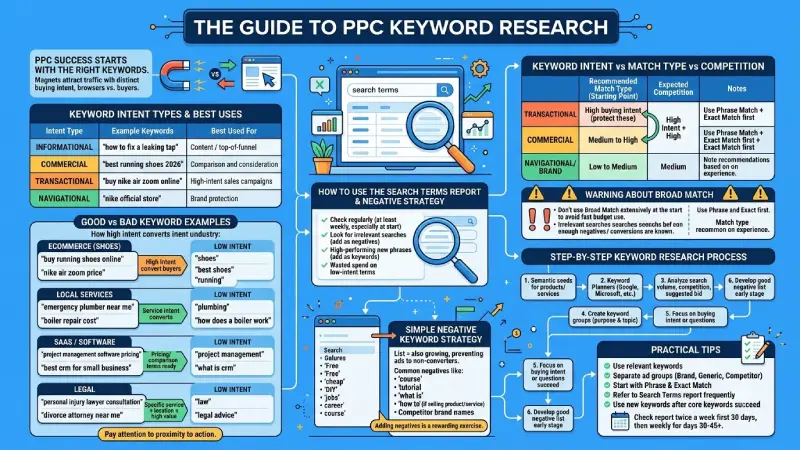
Search marketing campaigns are built on keywords. The success or failure in picking the appropriate keywords will determine whether you attract people with intentions to purchase or not.
Types of keywords by intent
| Intent Type | Example Keywords | Best Used For |
| Informational | “how to fix a leaking tap” | Content / top-of-funnel |
| Commercial | “best running shoes 2026” | Comparison and consideration |
| Transactional | “buy nike air zoom online” | High-intent sales campaigns |
| Navigational | “nike official store” | Brand protection |
Good vs Bad Keyword Examples
| Industry | Good Keywords (High Intent) | Bad Keywords (Low Intent / Too Broad) | Why the Difference Matters |
| Ecommerce (Shoes) | “buy running shoes online”, “nike air zoom price” | “shoes”, “best shoes”, “running” | Broad terms bring browsers, not buyers |
| Local Services | “emergency plumber near me”, “boiler repair cost” | “plumbing”, “how does a boiler work” | Service intent converts much better |
| SaaS / Software | “project management software pricing”, “best crm for small business” | “project management”, “what is crm” | Pricing and comparison terms show readiness |
| Legal | “personal injury lawyer consultation”, “divorce attorney near me” | “law”, “legal advice” | Specific service + location = higher value |
Pay attention to keywords that clearly demonstrate the individual’s nearness to taking an action.
How to Use the Search Terms Report Effectively
Search Terms reports give you the exact keywords that users typed prior to clicking on your ad. This report should be checked regularly (at least once per week when campaigns are just starting out).
Look for:
- Irrelevant searches → add them as negative keywords
- High-performing new phrases → add them as keywords
- Wasted spend on low-intent terms
This report is one of the fastest ways to improve campaign efficiency.
Simple Negative Keyword Strategy
Negatives prevent your ads from appearing to those who won’t convert. Create a list of negatives and grow it.
Common negatives to begin with:
- Free, cheap, DIY, jobs, career, course, tutorial, what is, how to (when you sell a service or product)
- Competitor brand names (unless you want to target them)
- Related but irrelevant topics
Add negatives at campaign or ad group level depending on how broad the issue is. Looking into keywords and adding negative keywords is among the most rewarding exercises in PPC.
Match Type Recommendations
| Experience Level | Recommended Starting Match Types | When to Use Broad Match |
| Beginners | Phrase Match + Exact Match | Only after you have strong negatives and conversion data |
| Intermediate | Phrase + Exact, test Broad carefully | In separate campaigns with good tracking |
| Advanced | Mix of all three with smart negatives | Broad Match + Smart Bidding can work well |
Newcomers to PPC usually do much better and save money when using Phrase Match and Exact Match first. Later on, Broad Match might reveal some opportunities, but it requires more control.
Keyword Intent vs Match Type vs Competition
| Keyword Intent | Recommended Match Type (Starting Point) | Expected Competition | Notes |
| Transactional | Exact Match + Phrase Match | High | Highest buying intent – protect these tightly |
| Commercial | Phrase Match first, then Exact | Medium to High | Good balance of volume and intent |
| Informational | Phrase Match (use carefully) | Medium | Usually lower conversion – watch closely |
| Navigational / Brand | Exact Match | Low to Medium | Important for brand protection |
The correct match type, corresponding to the level of intention, will help keep costs down and provide better quality traffic..
How Often to Check the Search Terms Report (First 30 Days)
During the first month of the new campaign, it is important to check the Search Terms report twice a week. It is the time when the most unrelated searches can be found. The use of negative keywords during this time will save money and make the campaign more effective. In the following 30–45 days, it is possible to reduce the number of checks to once a week.
Warning About Broad Match
Do not use Broad Match extensively at the beginning of your campaign. The reason for this is that using Broad Match extensively early in your campaign will cause budget to be used up fast, because of irrelevant searches before you know enough about your negative keywords and conversions. It is generally better to use Phrase Match and Exact Match first.
How to do keyword research for PPC
- Semantic seeds can be used for your products and/or services.
- The use of Google and Microsoft Keyword Planners and others.
- Analyzing search volume, competition, suggested bid.
- Creating groups of keywords based on their purpose and topic.
- Concentrating on keywords that express intention to buy or ask questions.
- Development of a good negative keyword list during the early stage.
Practical tips
- Use keywords that match your offerings.
- Use brand, generic and competitor keywords in separate ad groups.
- Use Phrase Match and Exact Match from the start.
- Refer to the Search Terms report frequently.
- Use new keywords only after the core keywords have been successful.
Keyword research should not involve trying to find out high volume keywordsNot so much as that. Everything revolves around the keyword identification process that will generate profitable clients with affordable costs.
Landing Page Optimization
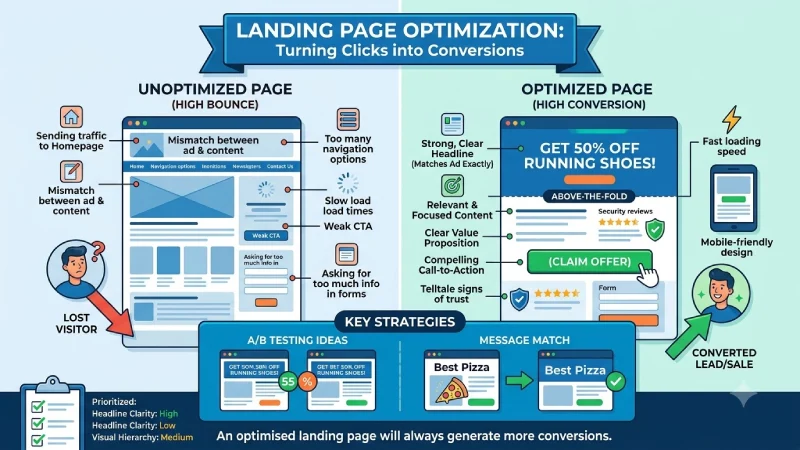
Conversion to either lead or sale can be achieved only when click-through is done in the landing page. A good advertisement design becomes useless with poor landing page design.
Key elements of an effective PPC landing page
- Strong, clear headline that matches the ad
- Relevant and focused content
- Clear value proposition
- Compelling call-to-action
- Telltale signs of trust (recommendations, testimonials, security symbols, guarantees
- Fast loading speed
- Mobile-friendly design
- Minimal distractions
Landing Page Optimisation Checklist
| Element | What to Check | Priority |
| Message Match | Does the headline and offer match the ad exactly? | High |
| Headline Clarity | Can someone understand the offer in 3 seconds? | High |
| Call-to-Action | Is there one clear primary button above the fold? | High |
| Page Speed | Does it load quickly on mobile? | High |
| Mobile Experience | Is the page easy to use on a phone? | High |
| Trust Signals | Are there reviews, guarantees, or security badges? | Medium |
| Form Length | Are you asking only for necessary information? | Medium |
| Distractions | Is navigation minimal or removed? | Medium |
| Visual Hierarchy | Does the eye naturally go to the main offer? | Medium |
This checklist needs to be followed every time you make an optimized landing page for paid traffic.
Above-the-Fold Elements That Matter Most
The visible portion of the web page is extremely important. Visitors make up their mind about whether to remain on the site or leave within seconds. Ensure that the following are effective above the fold:
- Clear headline that matches the ad
- Short supporting text that explains the benefit
- Prominent call-to-action button
- Relevant image or short video
- Trust indicators (if space allows)
If the main offer and next step are not obvious immediately, many paid visitors will leave.
How Message Match Affects Conversion Rate
Message match refers to the situation whereby the landing page maintains the exact promise contained in the advertisement. If the headline, offer, and messaging appear consistent, consumers are more assured that they have landed in the right location. The mismatch of messages has been one of the main causes for poor conversions from PPC traffic. Any small difference in messaging, offer, or even the landing page will cause a significant reduction in conversions.
Simple A/B Testing Ideas for Landing Pages
Start with one change at a time so you know what made the difference:
- Test two different headlines
- Test a short form vs a longer form
- Test different call-to-action button text (e.g. “Get the Guide” vs “Download Now”)
- Test with and without testimonials above the fold
- Test a single long page vs a shorter, focused page
Run the test until you have enough traffic to trust the results, then keep the winner and test something new.
Common landing page mistakes
- Sending traffic to the homepage instead of a dedicated page
- Mismatch between ad message and page content
- Too many navigation options
- Slow load times
- Weak or unclear call-to-action
- Asking for too much information in forms
Optimisation process
- Align the page message with the ad and keyword.
- Make the desired action obvious.
- Improve speed and mobile experience.
- Try out various headlines, offers, and forms.
- Use heat maps and session recordings whenever possible to gaugeuser behavior.
- Monitor conversion rates, not just traffic.An optimised landing page will always generate more conversion compared to a regular web page.
PPC Bidding Strategies
“Bidding determines what you are ready to pay for something and how Google and Microsoft will display your advertisements. Your choice will depend on the strategy that you select and the available conversion information.”
Common bidding strategies
| Strategy | Best For | When to Use |
| Manual CPC | Full control | Beginners or when testing new campaigns |
| Maximize Clicks | Driving traffic | Early stages with limited conversion data |
| Maximize Conversions | Getting more conversions | When you have steady conversion volume |
| Target CPA | Controlling cost per acquisition | After you know your target CPA |
| Target ROAS | Revenue-focused campaigns | Ecommerce with reliable conversion values |
| Enhanced CPC | Hybrid control | When you want some automation with limits |
Practical bidding advice
- Begin with Manual CPC or Maximize Clicks for lack of conversion data.
- Go for automated strategies like Maximize Conversions, Target CPA, and Target ROAS when there are sufficient conversions (generally 15-30+ per month per campaign).
- Be realistic about your objectives. Extremely ambitious Target CPA or ROAS targets might restrict volume.
- Check performance constantly and tweak settings.
- Adopt portfolio strategies when running several campaigns with identical objectives.
Conversion tracking needs to be precise if one wants to have efficient bidding. Otherwise, any strategy will not work well despite being perfect.
When to Switch from Manual CPC to Automated Bidding
Stick with manual CPC or maximize clicks as long as your campaign is in its initial stage and there is not much data available for conversions. A general practice is that you should stay with these options until you get a minimum of 15-30 conversions in the last 30 days. Otherwise, going into automated options such as maximize conversions or target cost-per-acquisition will likely result in unstable data since the system will not be able to learn anything.
Recommended Bidding Strategy by Goal and Data Volume
| Campaign Goal | Low Conversion Data (Under 15–30/month) | Steady Conversion Data (30+/month) |
| Get more traffic | Maximize Clicks (with CPC cap) | Maximize Clicks or Target Impression Share |
| Generate leads or sales | Manual CPC or Maximize Clicks | Maximize Conversions or Target CPA |
| Control cost per result | Manual CPC | Target CPA |
| Maximise revenue (Ecommerce) | Manual CPC or Maximize Clicks | Target ROAS |
| Brand protection | Manual CPC or Target Impression Share | Target Impression Share |
Start simple and move to more advanced strategies only when the data supports it.
Common Bidding Mistakes That Increase Costs
- Setting a Target CPA or Target ROAS that is too aggressive too soon
- Using automated bidding without proper conversion tracking
- Changing bidding strategies too frequently
- Ignoring search term reports while using Smart Bidding
- Setting very high maximum CPCs without monitoring results
- Starting various campaigns with differing aims and having them compete with each other
If you can avoid making such errors, then cost predictability will be maintained along with improved performance.
Building a Complete PPC System
Strong PPC performance usually comes from getting the fundamentals right across the whole system:
- Clear campaign strategy and goals
- Smart platform selection (Google first, then Bing or others)
- Careful keyword research and organisation
- Relevant, high-converting landing pages
- Appropriate bidding strategies
- Accurate conversion tracking
- Regular testing and optimisation
PPC advertising is not a “set-and-forget” strategy. People who succeed with PPC view it as a cycle of constant testing, learning, and optimization..
Begin with having a well-defined structure of your PPC campaigns. Everything that counts should be measured. What works should be done more, and what doesn’t should be stopped altogether. This will prove much more effective than always running after new tactics.
A combination of strategy, execution, and measurement leads to making PPC one of the most effective growth marketing channels out there.
Frequently Asked Questions
Is PPC still worth it in 2026?
Yes. PPC will continue to work well as long as it is managed properly and it will produce results fast. It works well especially when used in conjunction with well-made landing pages and analytics.
How big a budget should I allocate to start my PPC campaign?
You will need to spend at least some amount every day on PPC, but the amount must be large enough for you to collect good data in a short while.
Should I run Google Ads or Bing Ads first?
Most advertisers should start with Google Ads because of higher search volume. Microsoft Advertising is an excellent second platform once you have winning campaigns.
What is more important — keywords or landing pages?
Both matter. Good keywords bring the right people. Good landing pages convert them. Weakness in either area limits results.
What is the time period after which PPC campaigns start giving good results?
You will start receiving traffic within a short while, but optimisation will take a few weeks or even months to be done properly.
Conclusion
PPC advertising favors efficiency and precision. Begin with a good strategy, select the correct medium, target high-intent keywords, drive traffic to optimized landing pages, and utilize bids that align with your analytics and objectives. Measure your progress effectively and continually improve.
Once you combine all these elements, you will end up with a reliable formula for getting customers and sales through PPC advertising, rather than with something that drains your marketing budget. Stick to the basics, test constantly, and let the data dictate your moves.