

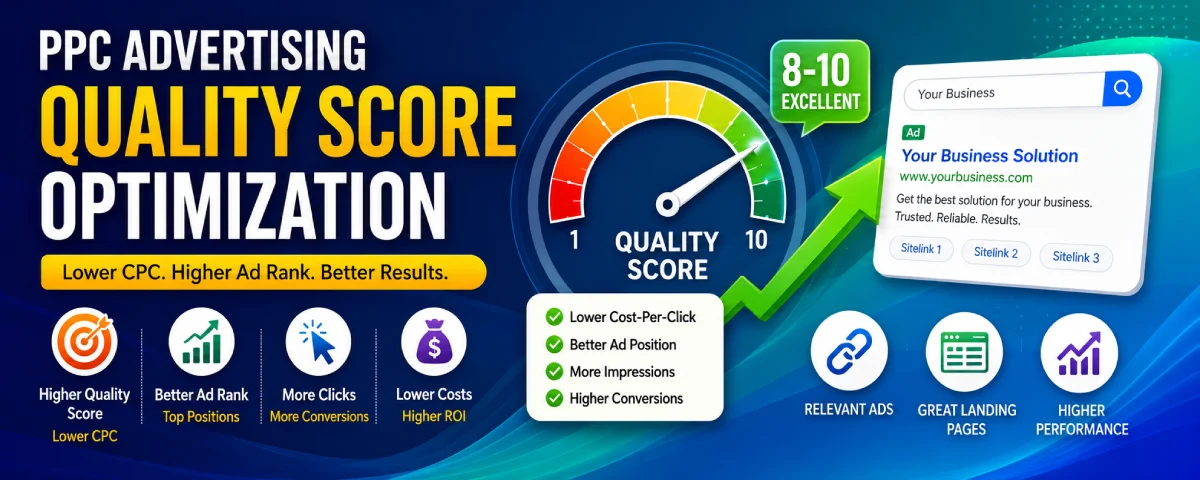
Quality Score is the most crucial measure in the entire Google Ads. The Quality Score determines both the cost per click and how often your advertisements are shown. The Quality Score will help you lower your costs while improving your ad’s position without having to increase your bids.
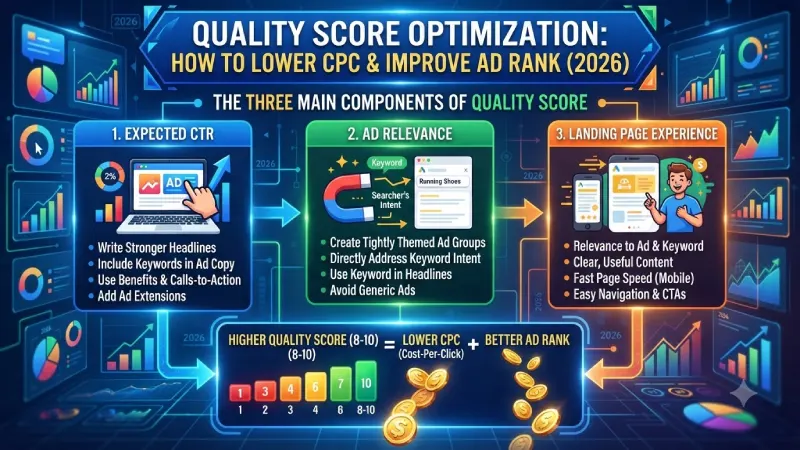
Advertisers start worrying about their quality score when they notice higher costs. The most appropriate action is to determine the factors that affect the quality score and try to improve them. This manual will provide you with all the necessary information on Quality Score, its improvement, and monitoring.
For the overarching strategy, read our complete guide on PPC Advertising
Quality Score Factors Explained
Quality Score is a rating on a scale of 1 to 10 assigned to your keywords by Google. It tells you the relevance and utility of your ads and webpages related to these keywords.
The three main components of Quality Score
| Component | What It Measures | Impact on Score |
| Expected Click-Through Rate (CTR) | How likely people are to click your ad when it shows | Highest impact in many cases |
| Ad Relevance | How closely your ad matches the intent of the keyword | High impact |
| Landing Page Experience | How useful and relevant your landing page is | High impact |
Google considers other signals as well, including past performance, but these three are the key ones that you can actually affect.
Why Quality Score matters
- Higher Quality Score → lower cost-per-click (CPC)
- Higher Quality Score → better Ad Rank
- Better Ad Rank → more impressions and better positions
- Over time, this compounds into significant savings and more conversions
The keyword that has a QS of 8 to 10 can be significantly cheaper than the keyword with a QS of 4 to 5.
Improving Expected CTR
Expected CTR is Google’s prediction of how likely people are to click your ad. It is based on the past performance of your ads and similar ads.
Ways to improve expected CTR
- Develop stronger, more specific headlines
- Insert the keyword (or similar) into the ad copyOffer
- and calls to action
- Provide all ad extensions that apply
- Test various ad versions frequently
- Discontinue low-CTR ads while retaining top performers
- Work on all aspects of Quality Score simultaneously (relevance improves CTR as well)
Practical tips
- Write a very relevant headline for the keyword.
- If numbers or questions fit, use them.
- Do not put more than one offer or idea into an ad.
- Make sure the ad matches what the searcher wants to do.
Increasing the click-through rate usually brings the quickest improvement to Quality Score due to its significant weightage.
Ad Relevance Optimization
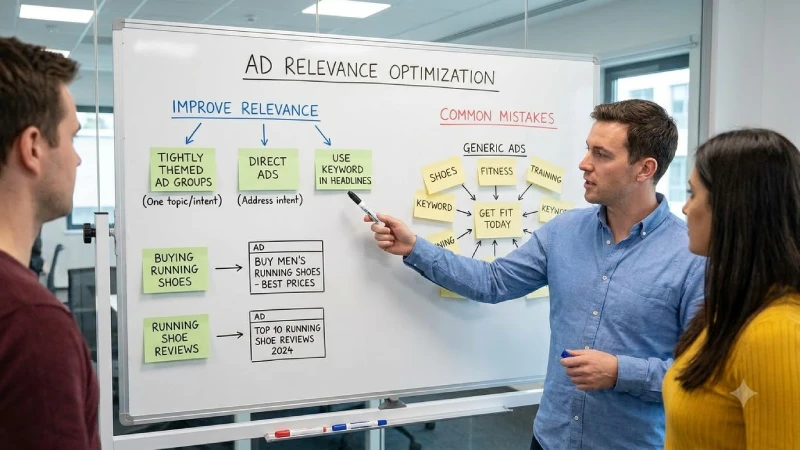
Relevance of the Ad is how well your ad fits in with the keyword.
How to improve ad relevance
- Create tightly themed ad groups (one main topic or intent per ad group)
- Write ads that directly address the keyword’s intent
- Use the keyword or close variants in headlines and descriptions
- Avoid generic ads that could apply to many different keywords
- Separate different intents (for example, “buy” vs “review” vs “pricing”) into different ad groups
Common relevance mistakes
- Putting too many different keywords into one ad group
- Using the same ads across unrelated keywords
- Writing vague ads that do not speak to the specific search
Tight structure and specific ads almost always improve relevance scores.
Landing Page Experience
Your ad can be fantastic but if your landing page is substandard, it will negatively affect Quality Score and conversions.
What Google looks for in landing page experience
- Relevance to the keyword and ad
- Clear and useful content
- Transparency and trustworthiness
- Ease of navigation
- Mobile-friendliness
- Page load speed
- Original, valuable content
How to improve landing page experience
- Make sure the landing page delivers exactly what the ad promises
- Keep the main message and offer consistent with the ad
- Improve page speed (especially on mobile)
- Make the page easy to read and navigate
- Use clear calls-to-action
- Reduce distractions and unnecessary elements
- Ensure the page works well on all devices
- Build trust with clear contact information, policies, and professional design
A good landing page is beneficial for both Quality Score and conversion rate. It has been found that many advertisers get more benefit from optimizing their landing page rather than ads.
Quality Score Reporting and Tracking
You can’t get better if you can’t measure it.
How to view Quality Score in Google Ads
- Go to your Keywords report.
- Click the columns icon.
- Add the Quality Score columns:
- Quality Score
- Landing page experience
- Ad relevance
- Expected CTR
You can also look at historical Quality Score to see changes over time.
What to track
- Quality Score distribution across your main keywords
- Which component is weak (Expected CTR, Ad Relevance, or Landing Page Experience)
- Changes after you make optimisations
- Relationship between Quality Score and CPC or conversion performance
Practical review process
- Check Quality Score for high-volume and high-cost keywords regularly.
- Identify keywords with scores of 5 or below.
- Diagnose which component is dragging the score down.
- Take focused action on that component.
- Re-check after a few weeks of data.
Concentrate on those keywords that spend more money. Even slight changes made to such keywords will produce the greatest results.
Building a Quality Score Improvement System
A simple and effective approach looks like this:
- Diagnose current Quality Scores and components.
- Fix the biggest problems first (usually low Expected CTR or poor landing pages).
- Improve ad group structure and ad relevance.
- Continuously test better ad copy.
- Align landing pages with keywords and ads.
- Monitor scores and costs over time.
Time is needed for Quality Score improvement as it always involves changing something. As soon as you begin working on all three key areas, you will experience reduced CPCs, increased ad ranks, and successful campaigns.
It is necessary to understand that Quality Score is not a vanity metric. The advertisers, who take care of their Quality Scores, pay less for performing equally or even better.
Frequently Asked Questions
- What is a good Quality Score?
7 or higher is solid. 8–10 is excellent. Scores of 5 and below usually need attention, especially on important keywords. - How quickly can Quality Score improve?
Some improvements (like relevance of ad and CTR) will be visible in just a few days or weeks. Landing page improvements may take longer to fully reflect. - Does Quality Score affect Performance Max or other campaign types?
The classic 1–10 Quality Score is mainly a Search campaign concept. Other campaign types use different relevance and quality signals. - Should I pause keywords with low Quality Scores?
Not always. First try to improve them. In case the keyword was highly valuable for conversions, but scored poorly, then it will be advisable to fix its weaknesses rather than blocking it. - Are there any other factors besides Quality Score that affect the CPC?
No. Bids, competition, and ad rank still matter. But higher Quality Score makes it easier and cheaper to achieve strong positions.
Conclusion
Despite all changes Google made throughout its lifetime, the Quality Score continues to be one of the most effective ways to influence campaign performance in Google Ads. It influences not only your cost per click but also determines your visibility. The thing about advertisers who do not consider it is that they are going to pay more for the same thing.
In contrast, improving your Quality Score is an easy task. The gist of it is that you will have to raise your expected click-through rate, ad relevance, and the experience on the landing page. Just group your ad groups properly, produce more specific ads, and provide an excellent landing page and you will benefit from the above mentioned advantages. Analyze the Quality Scores of the keywords that you care about and pay your attention to the worst of them.
It may take some time, but you will see the result in the end. As you make your Quality Scores better, your CPCs and your Ad Rank will also fall. Therefore, consider this aspect as one of the most important aspects of managing your campaign.
To take the next step, see our detailed guide on Google Ads for Beginners.