

Business Planning in 2026: The Complete Guide to Creating a Winning Business Plan for Any Stage
A business plan is one of the key processes that should be developed by everyone who wants to start, manage, and develop his/her business.
Business planning helps entrepreneurs turn their idea into a business. It helps them see how the business will work, who the customers are, what they want to achieve how to use what they have and what problems might come up.
In 2026 business planning will be very important. The markets are changing fast new technologies are changing how industries work and people have choices, than ever. Companies need to be able to change and think ahead at the time. A good business plan will enable businesses to define their strategy and goals without becoming too inflexible.
Both first-time founders and small business owners as well as experienced entrepreneurs launching their next business will find business planning useful as it helps to make decisions, evaluate business opportunities before investing time and money into their implementation, and measure the results of your actions.
In this comprehensive guide, we will provide you with the basics of business planning, business plan writing process, types of plans, and changes in business planning on the different stages of development.
Business Planning Resource Center
Explore our complete collection of guides covering business plan templates, writing a business plan, startup market research, financial projections, the business model canvas, and pitch deck creation.
What is Business Planning?
Business planning is the process of identifying the objectives, strategies, target market, activities, finances, and future objectives of a business organization.
Business planning takes the form of a business plan that explains the objectives, strategies, target market, sources of income generation, and resource requirements of the business.
The importance of business planning is not only for newly started ventures. Existing businesses also undertake business planning to:
- Enter new markets
- Launch new products
- Expand operations
- Raise funding
- Improve profitability
- Respond to changing customer needs
- Manage business risks
- Set new growth targets
The most effective business plans are not static documents. They should be reviewed and updated as the business, market, and competitive environment change.
The Importance of Business Planning
Even though a business idea seems to be great, its implementation is another matter that requires detailed planning.
Business planning enables entrepreneurs to transition from assumptions to decisions. Rather than just relying on hopes for the success of their venture, they can assess the situation and prepare a plan that will take possible obstacles into account.
Key benefits of business planning include:
| Benefit | How It Helps |
| Clear direction | Defines where the business is going |
| Better decision-making | Provides a framework for evaluating opportunities |
| Market understanding | Helps identify customers and competitors |
| Financial awareness | Clarifies costs, revenue, and funding requirements |
| Risk management | Identifies potential challenges before they become serious |
| Team alignment | Gives employees and partners shared goals |
| Funding preparation | Helps communicate the business opportunity to investors and lenders |
| Performance tracking | Creates measurable objectives and milestones |
A good business plan does not mean you will be successful.. It can help you feel more sure, about what you are doing and make better choices when you start your own business.
Business Planning vs. Business Plan
While business planning and business plan have a very close relationship, they are not one and the same thing.
Business planning is a continuous activity involving consideration and management of the direction of the business.
On the other hand, the business plan is the document in which all these considerations and plans get documented.
For instance, an entrepreneur can engage in business planning by spending many weeks analyzing the customer base, competitors, price tests, and various models of businesses. These constitute business planning.
The document that presents this information in a well-structured form is what is known as a business plan.
In conclusion, business planning can be described as the process while a business plan can be considered to be the end result of the process.
Types of Business Plans
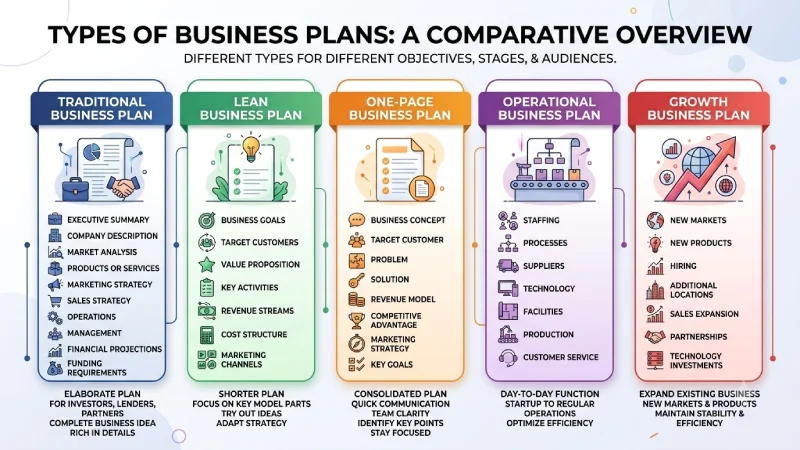
Each type of business does not require the same kind of plan. It all depends on the objective, stage, audience, and level of complexity of the business plan.
Traditional Business Plan
A traditional business plan is an elaborate plan that addresses the main aspects of the company.
It typically includes:
- Executive summary
- Company description
- Market analysis
- Products or services
- Marketing strategy
- Sales strategy
- Operations
- Management
- Financial projections
- Funding requirements
When you need money from people or you want to show them your complete business idea traditional plans are really helpful. These plans are good for showing to investors, lenders or business partners. Traditional plans are useful, for this because they have a lot of details.
Lean Business Plan
A lean business plan is shorter and focuses on the most important parts of a business model.
It may include:
- Business goals
- Target customers
- Value proposition
- Key activities
- Revenue streams
- Cost structure
- Marketing channels
This structure can help entrepreneurs when they want to try out their ideas and adapt their strategy according to the response of the market.
One-Page Business Plan
The one-page business plan is the consolidation of the essential components of the business into one page.
It can include:
- Business concept
- Target customer
- Problem
- Solution
- Revenue model
- Competitive advantage
- Marketing strategy
- Key goals
A one page plan can prove to be very useful in situations where quick communication of an idea needs to take place or where there needs to be clarity regarding some path within the team. It enables people to grasp what is going on without any complexities of information. One page plan proves to be particularly useful, as it keeps things simple and straightforward. It helps in making it easy to identify the key points and stay focused. One page plan is all about making sure that everyone is on the right path.
Operational Business Plan
An operational plan focuses on how the business will function day to day.
It may cover:
- Staffing
- Processes
- Suppliers
- Technology
- Facilities
- Production
- Customer service
This type of planning is especially valuable for businesses that are moving from an early startup stage into regular operations.
Growth Business Plan
A growth plan focuses on expanding an existing business.
It may address:
- New markets
- New products
- Hiring
- Additional locations
- Sales expansion
- Partnerships
- Technology investments
The objective is to determine how the company can grow while maintaining financial stability and operational efficiency.
How to Create a Business Plan Step by Step
Making a business plan does not have to be hard. The task gets simpler when you take it in a way.
Step 1: Define Your Business Idea
Start by clearly explaining what your business does.
Ask yourself:
- What product or service will you offer?
- What problem does it solve?
- Who will buy it?
- Why will customers choose your business?
- How will the business make money?
Your answers should create a simple and understandable description of your business concept.
Step 2: Define Your Business Goals
Determine what you want your business to accomplish.
Goals may include:
- Reaching a specific number of customers
- Generating a certain level of revenue
- Launching a new product
- Entering a new market
- Hiring employees
- Reaching profitability
Try to make your goals specific and measurable.
Instead of saying:
“I want to grow my business.”
You could set a goal such as:
We need to grow our recurring revenue by twenty percent over the next twelve months. That means we have to find ways to bring in consistent income every month. It will take focus and effort. It’s possible.
Clear goals make it easier to measure progress.
Step 3: Identify Your Target Market
A business cannot effectively serve everyone.
Define your ideal customer based on factors such as:
- Age
- Location
- Income
- Industry
- Buying behavior
- Needs
- Problems
- Preferences
It is essential to be informed of the market segments to which you are appealing to enable you to design better products and promotions, pricing, and customer experiences.
Step 4: Research the Market
Market research will tell you if there is really an opportunity for your business.
Research should help you understand:
- Market demand
- Customer needs
- Industry trends
- Competitors
- Pricing
- Market size
- Potential barriers
Utilize both industry information and customer feedback when available.
It is not, about showing that your idea can work. Strong research will also find any problems or dangers that come with it.
Step 5: Analyze Your Competition
Identify businesses that already serve your target customers.
Study:
- Their products
- Pricing
- Marketing
- Strengths
- Weaknesses
- Customer reviews
- Market positioning
Then determine how your business can compete.
Your competitive advantage might come from:
- Better pricing
- Higher quality
- Faster service
- Better customer experience
- Specialized expertise
- Unique technology
- Stronger branding
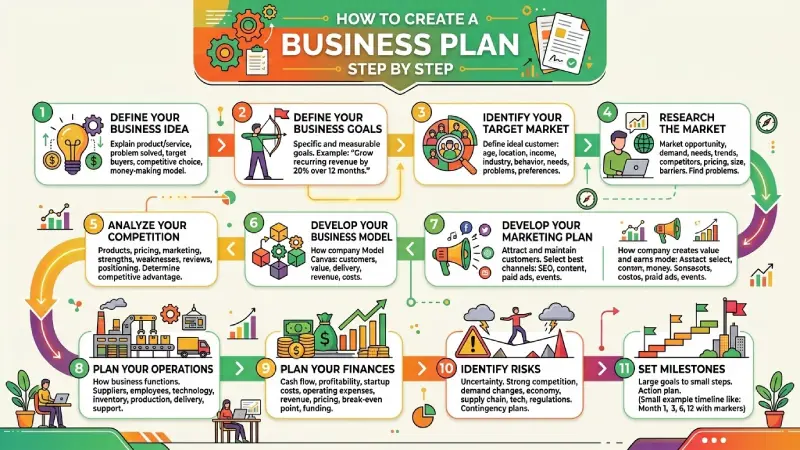
Step 6: Develop Your Business Model
The business model describes how the company creates value and earns money
Consider:
- Who are your customers?
- What value do you provide?
- How will customers find you?
- How will you deliver your product or service?
- How will you earn revenue?
- What are your biggest costs?
For new ventures, techniques like the Business Model Canvas will be helpful in illustrating and validating these aspects before formulating an elaborate business plan.
Step 7: Develop Your Marketing Plan
The marketing plan details your efforts to attract and maintain customers..
Consider channels such as:
- Search engine optimization
- Content marketing
- Social media
- Email marketing
- Paid advertising
- Partnerships
- Influencer marketing
- Referral programs
- Events
Select channels according to where your target audience resides rather than attempting to utilize all possible channels.
Step 8: Plan Your Operations
Your operational plan explains how the business will function.
Depending on your business, this may include:
- Suppliers
- Employees
- Equipment
- Technology
- Inventory
- Production
- Delivery
- Customer support
An effective operational plan will ensure that your company is capable of fulfilling the promises made in your marketing strategy.
Step 9: Plan Your Finances
Financial planning is essential as even profitable companies can face the problem of cash flows.
Consider:
- Startup costs
- Operating expenses
- Revenue expectations
- Pricing
- Cash flow
- Break-even point
- Funding requirements
Financial forecasts must be based on sound assumptions.
Financial planning is of utmost importance for start-ups since founders have to figure out the amount of capital needed..
Step 10: Identify Risks
Every business faces uncertainty.
Potential risks may include:
- Strong competition
- Changing customer demand
- Economic conditions
- Rising costs
- Supply chain problems
- Technology changes
- Regulatory changes
- Dependence on a small number of customers
Identify the most important risks and develop contingency plans.
Step 11: Set Milestones
Break your larger goals into smaller milestones.
For example:
| Time Period | Example Milestone |
| Month 1 | Complete market research |
| Month 2 | Build minimum viable product |
| Month 3 | Launch initial marketing |
| Month 4 | Acquire first 50 customers |
| Month 6 | Review performance |
| Month 12 | Reach profitability target |
It transforms a business plan into an action plan rather than allowing it to remain a useless paper.
Key Sections of a Business Plan
A comprehensive business plan generally contains several important sections.
Executive Summary
The executive summary provides a quick overview of the business.
It should explain:
- What the business does
- The problem it solves
- Target customers
- Business opportunity
- Competitive advantage
- Financial highlights
- Funding requirements, if applicable
Although it appears first, many entrepreneurs write the executive summary last.
Company Description
This section explains who the company is and what it aims to achieve.
It may include:
- Company history
- Mission
- Vision
- Business structure
- Location
- Founders
- Core objectives
It is vital that the company description give clear details about the identity of the company.
Products or Services
Explain what you sell and why customers need it.
Describe:
- Main products
- Services
- Key features
- Customer benefits
- Pricing approach
- Competitive differentiation
It is not, about showing that your idea can work. Strong research will also find any problems or dangers that come with it.
Market Analysis
The market analysis explains the environment in which your business will operate.
It should consider:
- Target market
- Market size
- Customer needs
- Industry trends
- Competitors
- Opportunities
- Threats
By doing the research in the market, one discovers whether your idea exists in reality or not.
Marketing and Sales Strategy
Explain how you will reach customers and convert them into buyers.
Your strategy may include:
- Brand positioning
- Marketing channels
- Customer acquisition
- Sales process
- Pricing
- Promotions
- Customer retention
Your marketing strategy should connect directly to your target audience.
Operations Plan
The operations section explains how the business will deliver its products or services.
It may cover:
- Suppliers
- Employees
- Technology
- Facilities
- Production
- Logistics
- Customer support
Management and Team
Explain who is responsible for running the business.
Include relevant:
- Founder experience
- Leadership roles
- Employee responsibilities
- Skills
- Advisors
- External partners
Investors and business partners often have a need to determine whether your group has the necessary skills to implement your strategy.
Financial Plan
The financial section explains how the business expects to perform financially.
It may include:
- Revenue forecasts
- Expense estimates
- Cash flow projections
- Profit and loss statements
- Break-even analysis
- Funding requirements
The numbers should be supported by realistic assumptions.
Business Planning for Startups
Starting a business is different, from planning for a company that is already running.
A startup usually works with little information and unclear customer needs. Because of this the first plan should be seen as a group of guesses that need to be checked.
Startup founders should focus on:
- Identifying a real customer problem
- Validating demand
- Understanding the target market
- Testing the business model
- Building a minimum viable product
- Measuring customer feedback
- Managing cash carefully
- Creating realistic financial assumptions
- Setting short-term milestones
- Preparing for multiple scenarios
The main thing is not to make a plan before you start something. Founders should make a plan that helps them make decisions but they should also be able to change things when they get new information. This way founders can use the plan to help them. They can also make changes when they need to which is important, for founders.
Business Planning for Beginners
Business planning can feel overwhelming when you are starting your first business.
The best approach is to start simple.
Begin by answering five basic questions:
1. What will you sell?
Clearly define your product or service.
2. Who will buy it?
Identify your ideal customer.
3. What problem will you solve?
Explain why customers need your solution.
4. How will you make money?
Define your revenue model and pricing strategy.
5. How will customers find you?
Choose the main marketing and sales platforms for yourself.
Having got answers to all those questions, you will be able to form a more thorough plan.
For first-time entrepreneurs, there is no sense in wasting many months developing a plan built only on guesses. Always try to test your ideas on real people.
Business Planning at Different Stages
Business planning changes as a company grows.
| Business Stage | Main Planning Focus |
| Idea Stage | Validate the problem and opportunity |
| Pre-Launch | Define the business model and go-to-market strategy |
| Early Startup | Acquire customers and test assumptions |
| Growth Stage | Scale operations and improve profitability |
| Established Business | Optimize performance and expand |
| Expansion Stage | Enter new markets or launch new products |
| Mature Business | Maintain competitiveness and long-term growth |
The business plan has to grow together with the firm.
The main objectives of the business idea owner are totally different from those of an enterprise with dozens of employees. That is why business planning has to correspond to the present state and future prospects of the firm.
Common Business Planning Mistakes to Avoid
A business plan can fail even if it is really detailed. This happens when the plan is based on ideas that’re not realistic.
Here are some common mistakes that people make when they are planning their business.
* Overestimating Revenue
Many people who start their business think that they will sell more than they actually can. They need to be more careful and think about what might happen. They should consider different possibilities.
* Ignoring Competition
Sometimes people say that their business does not have any competitors. This is usually not true. People are always finding ways to solve their problems. They might not be using a product that’s similar to yours right now.. They are still solving their problems in some way.
* Writing for Too Long
A business plan should have details to be useful.. It should not be too long and have unnecessary information. The plan should be clear and easy to understand.
* Using Unrealistic Financial Projections
When you make forecasts you need to think about many things. You need to think about how much you will charge for your product, who your customersre how many people will buy your product what your expenses are and how fast your business will grow.
* Treating the Plan as Permanent
Things change fast. Your business plan should not be set in stone. You should look at your plan often. Make changes when you get new information.
* Focusing on the Idea
Having a great idea is not enough to make your business successful. You need to think about other things. These things include how you will run your business what customers want how much you will charge, how you will market your product how you will make your product and how you will manage your money.
* Not Defining Goals
If your goals are not clear it is hard to know if you are making progress. You need to set goals and think about how you will measure your progress. This way you can see if you are getting closer, to what you want to achieve.
How to Keep Your Business Plan Updated
Business planning should be an ongoing process.
Review your plan regularly and compare your assumptions with actual performance.
Ask:
- Are we meeting our revenue goals?
- Are customer acquisition costs increasing?
- Has the market changed?
- Are customers responding as expected?
- Are competitors changing their strategies?
- Are our expenses under control?
- Do we need to change our priorities?
A quarterly review can be useful for many businesses, while rapidly changing startups may need to review important assumptions more frequently.
The purpose of updating your plan is not to rewrite the entire document every time something changes. Instead, focus on the areas that have been affected by new information.
Business Planning Tools and Frameworks
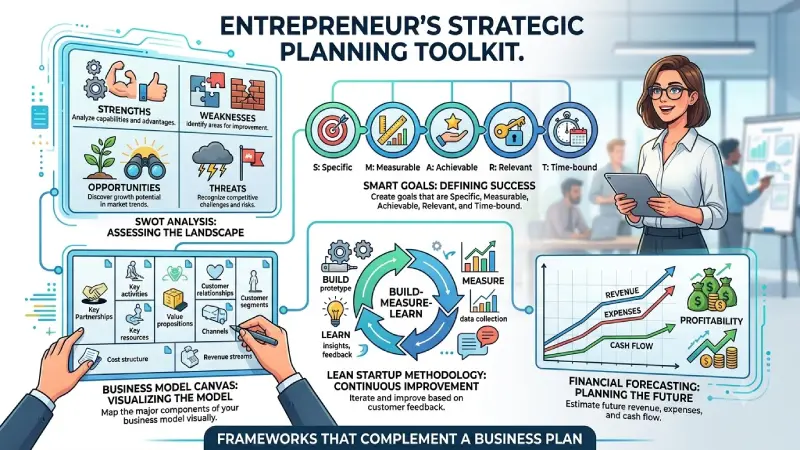
Entrepreneurs can use different frameworks to organize their thinking.
Some popular approaches include:
SWOT Analysis
Helps identify:
- Strengths
- Weaknesses
- Opportunities
- Threats
SMART Goals
Helps create goals that are:
- Specific
- Measurable
- Achievable
- Relevant
- Time-bound
Business Model Canvas
Provides a visual way to map the major components of a business model.
Lean Startup Methodology
Encourages entrepreneurs to build, measure, learn, and improve based on customer feedback.
Financial Forecasting
Helps businesses estimate future revenue, expenses, cash flow, and profitability.
These frameworks can complement a business plan and help entrepreneurs make better strategic decisions.
How Technology Is Changing Business Planning in 2026
Technology is making business planning faster and more data-driven.
Entrepreneurs can now use digital tools to:
- Analyze market trends
- Research competitors
- Organize customer data
- Build financial models
- Create business documents
- Automate repetitive tasks
- Analyze business performance
- Test marketing campaigns
Furthermore, artificial intelligence will also help the entrepreneurs in coming up with ideas, summarizing information, analyzing data, and editing documents. However, it should also be noted that all such results should be analyzed and verified.
Technology can be utilized by the entrepreneurs for planning and organizing; however, technology cannot replace the thinking processes. The entrepreneur should know his/her customers and evaluate all risks on the basis of facts.
Business Planning Checklist
Before launching or expanding a business, use this checklist to review your plan.
Business Idea
- Is the business concept clearly defined?
- Does it solve a real customer problem?
- Is the value proposition clear?
Market
- Have you identified your target customers?
- Have you researched the market?
- Do you understand your competitors?
- Have you evaluated market demand?
Business Model
- Is it clear how the business will make money?
- Are your pricing assumptions realistic?
- Have you identified your main costs?
Marketing
- Do you know how customers will find you?
- Have you selected the right marketing channels?
- Do you have a customer acquisition strategy?
Operations
- Can you deliver your product or service?
- Do you have the required resources?
- Are responsibilities clearly defined?
Financials
- Have you estimated startup costs?
- Have you created revenue projections?
- Have you forecast expenses?
- Have you considered cash flow?
- Do you know your break-even point?
Goals
- Are your goals measurable?
- Have you created milestones?
- Do you have a system for tracking progress?
Frequently Asked Questions About Business Planning
What is a business plan?
Business plan is an approach through which a company’s vision, strategy, target audience, processes, financial needs, and growth are defined. It assists in organizing entrepreneur’s ideas and making well-informed decisions.
Why should one have a business plan in case he decides to set up his own business?
The existence of the business plan will enable one to validate the concept, analyze the customers, competitors, finances, risks and the objectives.
How to develop a business plan?
It all begins with creating a business idea and determining its objectives. The following step includes market analysis, defining target audience, analyzing competition, developing business model, planning marketing and operations, and forecasting finances.
How long should my business plan be?
It really depends. If it’s just a simple idea that only requires one page to communicate, then one page will suffice. However, if it is a traditional business plan done for investors and/or lenders, then the plan could be much longer. The plan needs to have enough information in order to accomplish its purpose.
Do I need a business plan when I don’t need any funding?
Yes, because a business plan is still useful even without having to seek funds from investors and/or lenders. It can help in understanding one’s strategy, target market, goals, etc.
How often should my business plan be updated?
This really depends on how fast the market is changing, but the common times that some businesses update their plans would be quarterly and yearly.
Difference Between Business Plan and Business Model Canvas
A business plan consists of a thorough document containing information about strategy, operations, marketing, and finances of the company. The Business Model Canvas is a visual tool used to analyze and assess the major elements of the business model.
Which is the most important element of a business plan?
It is impossible to determine which is the most important part. It should be mentioned that a good business plan must integrate all the above mentioned aspects into one realistic business plan.
Conclusion
Business planning becomes a basis of effective decision-making throughout all the stages of business development. Whether it is your first startup concept, you are launching your company, or are expanding your current company, having a good plan will help you see where you are going and how you will get there.
Plans that are effective and efficient will always be practical, flexible, and realistic. In such plans, you have the knowledge of your customers, actionable steps, realistic finance, and being prepared to change.
Always remember that business planning is not something that happens only once in life. This is because you keep getting changes in your customers, competition, technology, and the market situation.
Have a clear vision of what your business idea is, validate your ideas, set your goals, do market analysis, create a realistic business model, and monitor the outcomes of everything. Business planning is very important for entrepreneurs.