
Introduction
The startup development process goes far beyond having an interesting idea. In order to convince investors of the viability of your business, one needs to clearly articulate the vision for it. This is when a pitch deck comes into play.
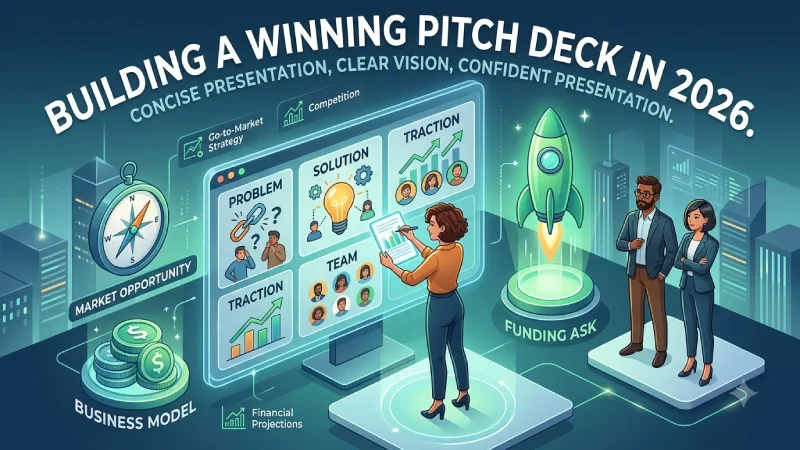
Pitch deck is a concise presentation which presents the investor with the general concept of your business, including its problem to be solved, the proposed solution, target market, business model and potential for growth. While instead of a lengthy business plan investors will prefer to see concise information presented via a presentation.
The creation of pitch deck involves no necessity of adding many slides and fancy graphics, rather it implies creating a well-thought story that will make it easier for investors to understand the essence of your business. Each of your slides should have its meaning.
In this guide, we will walk you through the steps of creating a pitch deck, structuring the presentation and providing all required information to investors.
What Is a Pitch Deck?
A pitch deck is a small presentation that explains an idea for the business to potential investors, business partners, accelerators or even customers.
You can consider a pitch deck to be a visual representation of your start-up company. It allows you to present the essence of your business to people in just a few slides.
Unlike a business plan, a pitch deck is not made up of long pieces of text or reports.
A typical number of slides in the presentation deck is from 10 to 15. The presentation of such a deck takes 10 to 20 minutes.
sent.
A good pitch deck answers questions like:
- What problem does your startup solve?
- How does your product solve that problem?
- Who are your customers?
- How will your company make money?
- How large is the market?
- Why is your team qualified?
- How much investment are you looking for?
The goal is not to answer every possible question. No, your objective should be creating sufficient interest so that the discussion continues.
Why Is a Pitch Deck Important?
A well-prepared pitch deck offers several benefits.
Creates a Strong First Impression
For many investors, your pitch deck is the first introduction to your business. A clear and professional presentation can immediately build trust.
Explains Your Business Clearly
This functions as an organizational mechanism that helps to organize your thoughts and give a clear idea about your business.
Helps During Fundraising
Regardless of whether your discussions are with angel investors, venture capitalists, or accelerators, a pitch deck may be considered one of the most crucial fundraising tools.
Supports Business Growth
Many founders continue to make revisions to their deck as the business progresses. This is because it acts as a handy guide for business partnerships and planning.
Pitch Deck vs. Business Plan
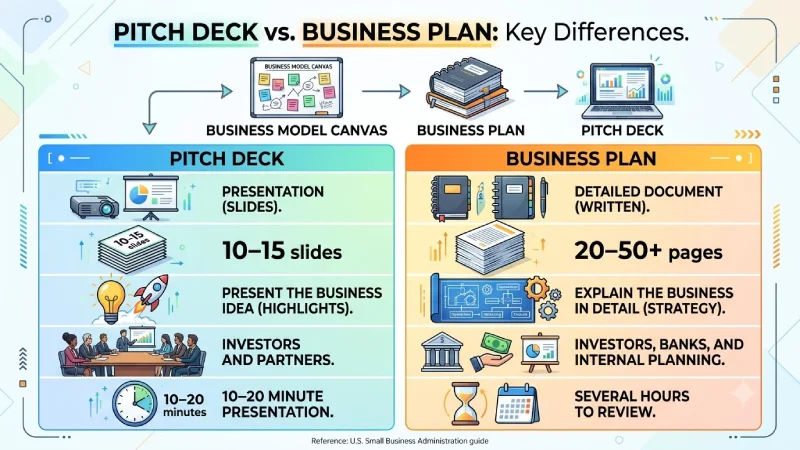
Although both documents describe your business, they serve different purposes.
It involves an elaborate description of every aspect of the business which includes operations, marketing, financial planning and strategizing for the future.
A pitch deck is much shorter. It focuses on the highlights and is designed to quickly communicate your business idea.
If you plan to prepare a detailed business plan before your investor presentation, the Write a business plan guide from the U.S. Small Business Administration explains the essential sections and planning process.
| Feature | Pitch Deck | Business Plan |
| Format | Presentation | Detailed document |
| Length | 10–15 slides | 20–50+ pages |
| Purpose | Present the business idea | Explain the business in detail |
| Audience | Investors and partners | Investors, banks, and internal planning |
| Presentation Time | 10–20 minutes | Several hours to review |
The majority of entrepreneurs begin the process using a business model canvas and then move on to create their business plan and pitch deck based on both.
When Should You Create a Pitch Deck?
You don’t have to wait until you start fundraising.
A pitch deck can help at different stages of your business journey.
You should create one if you are:
- Starting a new business
- Looking for investors
- Applying to startup accelerators
- Joining business competitions
- Meeting potential business partners
- Presenting your startup to customers
You should constantly update your pitch deck even when you have made the first investment.
Pitch Deck Structure for Seed-Stage Startups
One of the main problems that founders have is adding slides without using a structure.
Investors want to see a logical presentation of your business.
A simple structure makes your presentation easier to follow.
| Slide | Purpose |
| Cover | Introduce your company |
| Problem | Explain the customer’s challenge |
| Solution | Show how you solve the problem |
| Market Opportunity | Explain your target market |
| Product | Demonstrate your solution |
| Business Model | Explain how you earn revenue |
| Traction | Show business progress |
| Competition | Compare your business with competitors |
| Go-to-Market Strategy | Explain customer acquisition |
| Financial Projections | Show future growth |
| Funding Ask | Explain investment requirements |
| Team | Introduce your founders |
Let’s look at the first few slides in more detail.
Cover Slide
The cover slide introduces your startup.
It should immediately tell investors who you are.
Include:
- Company name
- Company logo
- Short tagline
- Founder name
- Contact information
Example
TaskFlow
“Simple project management for growing businesses.”
Avoid adding unnecessary text or complicated graphics.
Keep the design clean and professional.
Problem Slide
Every successful startup begins by solving a problem.
Your problem slide should explain:
- What challenge exists?
- Who experiences the problem?
- Why is the problem important?
For example:
These kinds of companies use several spreadsheets and messaging systems for managing projects which results in chaos and miscommunication.
Keep your explanation simple.
Rather than talking about product features, think about your customers’ problems.
A good problem statement will make investors realize why your business is important.
Tips for Writing the Problem Slide
- Focus on one main problem.
- Use simple language.
- Include real examples if possible.
- Explain the impact of the problem.
- Avoid making unrealistic claims.
Solution Slide
Now it’s time to explain your solution.
Show how your product or service solves the customer’s problem.
Instead of listing every feature, explain the biggest benefit.
Example:
TaskFlow solution combines the aspects of projects, tasks, due dates, and teamwork on a single user-friendly interface and helps companies improve their efficiency and productivity.
Your solution should answer questions like:
- What do you offer?
- How does it solve the problem?
- Why is it better than existing options?
Try to explain your solution in one or two simple sentences.
Solution Slide Checklist
✔ Explain the product clearly
✔ Focus on customer benefits
✔ Keep the message short
✔ Avoid technical language
✔ Support your claims with screenshots or product images if available
Market Opportunity Slide
Even if your product is excellent, investors want to know whether enough people will buy it.
The market opportunity slide explains:
- Who your customers are
- How large the market is
- Why demand is increasing
Instead of filling the slide with statistics, focus on the most relevant numbers.
Example
| Market Factor | Example |
| Target Customers | Small businesses with 5–100 employees |
| Industry | Project management software |
| Market Trend | Growing demand for remote collaboration tools |
| Growth Opportunity | Millions of businesses worldwide |
You can also explain why now is the right time to enter the market.
For example:
- Digital transformation is increasing.
- Remote work continues to grow.
- Businesses are adopting cloud software faster than before.
This helps investors understand why your startup has long-term potential.
Product Slide
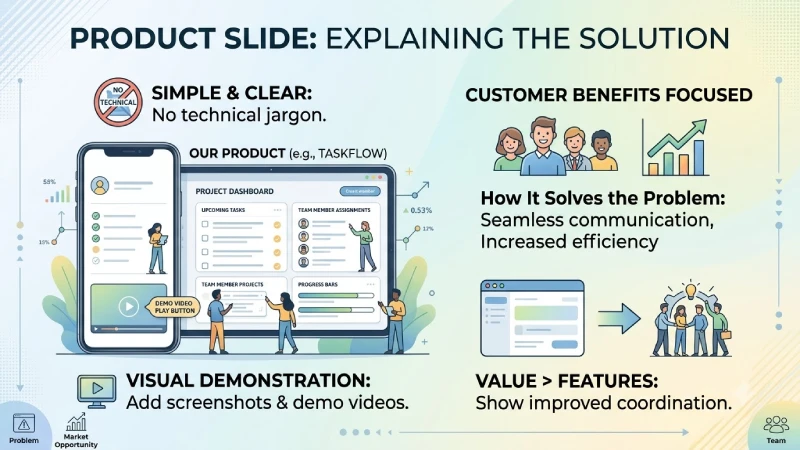
- The product slide makes it easy for the investor to understand what you are working on. It needs to provide enough details on the operation of the product or service, and the issues it will address for the consumer.
- Keep the slide short; do not include so many technical terms which will make it confusing for the audience. In case you have developed your product, ensure that you have screenshots and demo videos.
- Instead of going into the technical details of the features of your product, go for the values of your product.
For instance, if you are giving a presentation about project management software, give an insight on how it will enhance coordination and communication within the team.
Product Slide Tips
- Explain the product in simple language.
- Highlight the main customer benefit.
- Add screenshots or product images.
- Avoid long paragraphs.
- Focus on solving the customer’s problem.
Business Model Slide
The investors would be interested to find out how you intend to make money. You should have a slide explaining your business model. This should contain information about your pricing strategy and revenue streams.
You may have several revenue streams, which you should briefly outline.
Example Revenue Models
| Revenue Source | Example |
| Subscription | Monthly software plan |
| One-Time Sales | Product purchase |
| Commission | Marketplace transaction fees |
| Advertising | Sponsored content |
| Premium Services | Paid upgrades |
Keep your explanation realistic and easy to understand.
Traction Slide
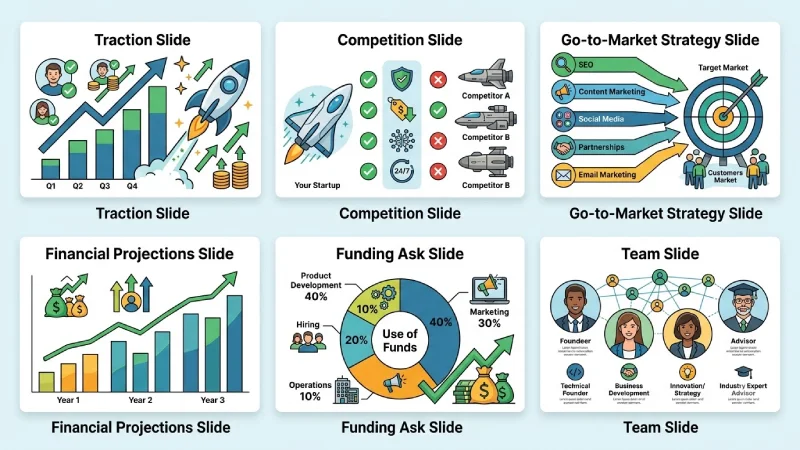
Traction demonstrates that your startup is making progress. Investors will appreciate seeing some signs of people’s enthusiasm for your product.
Even if your startup is new, share any positive results you have achieved.
Examples include:
- Number of users
- Revenue growth
- Customer feedback
- Product downloads
- Website traffic
- Business partnerships
- Waiting list sign-ups
Example Traction Table
| Metric | Current Result |
| Active Users | 5,000+ |
| Monthly Revenue | $12,000 |
| Customer Growth | 20% per month |
| Business Partners | 15 Companies |
But, in case you are only at the beginning of your business journey, you should focus on accomplishing goals such as creating your MVP, building your website, and obtaining your first customers.
Competition Slide
Every company has competition. The investors want the entrepreneurs to know the marketplace and differentiate their venture from other similar businesses.
Do not say you have no competitors. Instead, compare your business with existing solutions.
Example Comparison
| Feature | Your Startup | Competitor A | Competitor B |
| Easy to Use | ✔ | ✔ | ✘ |
| Affordable Pricing | ✔ | ✘ | ✔ |
| AI Features | ✔ | ✘ | ✘ |
| 24/7 Support | ✔ | ✘ | ✔ |
After making the comparison, give the reason for why your business is better than others. It could be due to any one of the following reasons – prices, speed, usability, or customer service.
Go-to-Market Strategy Slide
An excellent product will mean nothing if the customer cannot find it. The GTM Strategy outlines how you intend to go to market.
Identify the primary channels through which you intend to reach your audience.
Common customer acquisition channels include:
- Search Engine Optimization (SEO)
- Content marketing
- Social media
- Paid advertising
- Email marketing
- Referral programs
- Partnerships
- Direct sales
Investors are always looking for how you intend to get customers and keep them.
Financial Projections Slide
Financial forecasts will allow the investors to see how your business will develop during the coming years.
Your forecasts must be realistic and backed by research.
Include information such as:
- Revenue forecasts
- Expected expenses
- Profit estimates
- Customer growth
- Cash flow
Example Financial Forecast
| Year | Revenue | Expenses | Profit |
| Year 1 | $100,000 | $80,000 | $20,000 |
| Year 2 | $300,000 | $180,000 | $120,000 |
| Year 3 | $700,000 | $350,000 | $350,000 |
Explain the assumptions behind your numbers if investors ask for more details.
Funding Ask Slide
This slide explains how much investment you need and how you plan to use it.
Be specific. Investors appreciate founders who know exactly what they need.
Example:
Funding Required: $500,000
Use of Funds:
- Product development – 40%
- Marketing – 30%
- Hiring – 20%
- Operations – 10%
You should also discuss what milestones you intend to accomplish using this investment, such as launching a new product or gaining new customers.
Team Slide
Investors are as invested in people as they are in ideas. A good team slide will help you gain investor confidence.
Give an introduction about the founding team and the core team members of the business. Highlight their respective roles, expertise, and skills.
Include:
- Founder names
- Job titles
- Industry experience
- Technical or business expertise
- Major achievements
In case your advisers/mentors are equally knowledgeable and well experienced, then they could be included too.
How to Write a Compelling Investor Narrative
- The pitch deck must not only contain several slides but must convey a coherent story which will keep the investor’s interest.
- In the first place, it is necessary to introduce a real problem which faces the customers. The importance of the problem and the influence on customers should be mentioned. In addition, the possibility of solving this problem and what makes your solution better than others should be stated.
Then, you should give details about the market opportunity, your business model, and achievements made by your startup up to date. At last, you should share your vision of future and show how the investment will help you to move forward.
It is necessary to tell your story clearly and logically without any jargon and exaggeration regarding the importance of the solution. Whenever it is possible, your story should be proved by customer feedbacks or market research data or even by business achievements.
Pitch Deck Design Best Practices
Your presentation must be developed in such a way as to make it easier for you to get your point across without any hindrance. Well-designed layouts mean clear presentations and professional-looking designs.
Here are some best practices:
- Stick to one main point per slide.
Keep the sentences short and concise.
Use readable font types.
Be consistent in using colors in your slides.
Use diagrams, icons, or photos only if needed to explain something.
Keep sufficient white space for clean slides.
Highlight the figures instead of overcrowding slides with text.
Go through every slide once again before the presentation.
Professional Design shows that you have a sharp eye for detail and understand the importance of the preciousness of the time of your audience. An ordinary presentation can be made extremely efficient just through proper organization.
Pitch Deck Slides That Investors Expect
However, most of the investors need to go through many pitches every week, and thus, you must be in a position to organize yourself and explain your business clearly. It will help them understand your business easily.
The following slides are commonly included in a successful investor pitch deck.
| Slide | Purpose |
| Cover | Introduce your startup and brand |
| Problem | Explain the customer problem |
| Solution | Show how your product solves it |
| Market Opportunity | Describe your target market and growth potential |
| Product | Demonstrate your product or service |
| Business Model | Explain how you generate revenue |
| Traction | Share customer growth or business milestones |
| Competition | Show what makes your startup different |
| Go-to-Market Strategy | Explain how you will acquire customers |
| Financial Projections | Present expected business growth |
| Funding Ask | State the investment required |
| Team | Introduce the founders and key members |
Keep your slides simple and focus on the information investors need most.
Sample Pitch Deck for a Startup
Imagine you have created an online platform that helps small businesses manage projects.
Company: TaskFlow
Problem: Small businesses struggle with project management using spreadsheets and emails.
Solution: A cloud-based platform that manages projects, tasks, deadlines, and team communication in one place.
Target Market: Small and medium-sized businesses.
Business Model: Monthly subscription plans.
Traction: 3,000 active users and growing revenue.
Funding Ask: $500,000 to expand product development and marketing.
This simple structure gives investors a clear picture of the business without unnecessary details.
Common Pitch Deck Mistakes to Avoid
Even a strong business idea can lose investor interest if the presentation is poorly prepared.
Some common mistakes include:
- Adding too much text on each slide.
- Using unrealistic financial projections.
- Ignoring competitors.
- Failing to explain the customer problem.
- Using inconsistent slide design.
- Asking for funding without explaining how it will be used.
- Presenting too many slides.
- Reading directly from the presentation instead of speaking naturally.
A clear, honest, and well-organized pitch deck creates a much stronger impression.
Pitch Deck Presentation Tips
Creating a good pitch deck is only part of the process. How you present it is just as important.
Before your meeting, practice your presentation several times so you can explain each slide with confidence. Speak clearly, maintain eye contact, and avoid rushing through the slides.
Focus on telling a simple story instead of reading every word from the presentation. Investors are interested in understanding your vision, your business opportunity, and why your team is the right one to build the company.
Be prepared to answer questions about your market, competitors, financial projections, and future plans. If you don’t know an answer, be honest rather than guessing.
A confident presentation, supported by a well-structured pitch deck, can leave a positive impression and increase your chances of moving to the next stage of investor discussions.
Conclusion
A strong pitch deck helps you explain your business clearly and confidently. Keep your slides simple, focus on the problem, solution, market, and growth plan, and support your ideas with realistic data. With a clear story and a professional presentation, you can leave a positive impression and improve your chances of attracting investors.