


Introduction
Financial forecasts have a great significance for startups. They allow founders to estimate revenues, expenses, cash flows, and investments necessary for the accomplishment of business goals.
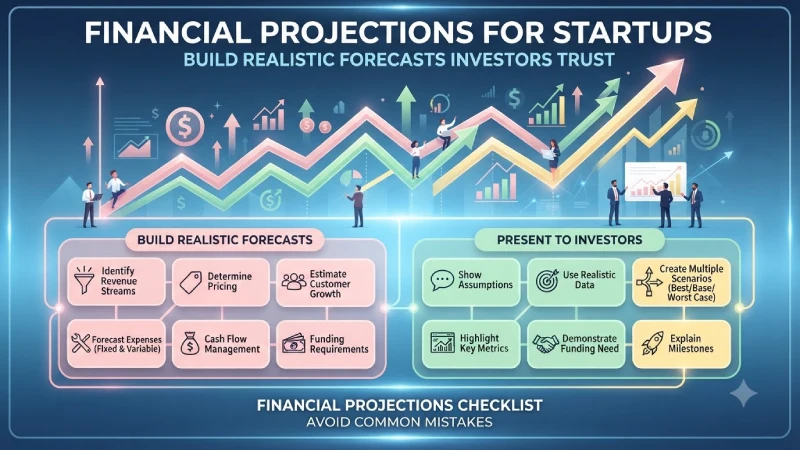
A financial forecast is an example for investors of how founders anticipate the development and management of the finances of their companies. Good financial forecasts are realistic and based on sound research.
This article will show you how to estimate revenues and expenses of your startup, how to find break-even points, cash flow management, and financial forecasting for investors.
For the overarching strategy, read our complete guide on Business Planning.
What Are Financial Projections for Startups?
Financial projections are estimates of a startup’s future financial performance.
They typically cover:
- Revenue
- Cost of goods sold
- Operating expenses
- Gross profit
- Net profit or loss
- Cash inflows and outflows
- Funding requirements
- Break-even point
Startups usually make plans for what they think will happen for the three years. They have a lot of details for the year but not as many for the years, after that. The startups have to think about what they want to do for the three years so they make these plans.
Why Financial Projections Matter for Startups
Financial projections can help founders in several ways.
Understand Funding Requirements
A forecast can help estimate how much money the startup needs before reaching important milestones.
Plan Spending
Founders can identify major expenses and prioritize where to allocate limited resources.
Establish Revenue Objectives
Projections about revenue give definite objectives that sales and customer acquisition should achieve.
Pinpoint Cash Problems
A projection about the company’s cash flow could point out when the firm is likely to have a shortage of cash.
Compare Actual Results with Projections
Comparisons can show discrepancies between actual results and projected results.
Communicate With Investors
A clear financial model helps investors understand the startup’s growth strategy and capital requirements.
The Main Parts of a Startup Financial Projection
A complete startup financial forecast typically includes several components.
| Financial Component | What It Shows | Key Question |
| Revenue Forecast | Expected sales | How much could the startup earn? |
| Cost of Goods Sold | Direct costs of delivering products or services | What does it cost to generate sales? |
| Gross Profit | Revenue after direct costs | How profitable is the core offering? |
| Operating Expenses | Ongoing business costs | How much does it cost to run the company? |
| Profit and Loss | Overall financial performance | Is the business profitable or losing money? |
| Cash Flow Forecast | Cash entering and leaving the business | Will the startup have enough cash? |
| Break-Even Analysis | Point where revenue covers costs | When can the business cover its costs? |
| Funding Requirements | Capital needed | How much money does the startup need? |
These components, working in unison, provide better insight into the financial state of the startup.
How to Create Revenue Projections for a Startup

Revenue projections are the calculations of the amount of revenue that your startup will be able to earn.
The best approach is to build your forecast from realistic business assumptions rather than simply choosing a large growth percentage.
Step 1: Identify Your Revenue Streams
Start by identifying how your business will make money.
Examples include:
- Product sales
- Subscription fees
- Service fees
- Advertising
- Licensing
- Transaction fees
- Consulting
- Memberships
An entrepreneur with various sources of income must individually project each one.
Step 2: Determine Your Pricing
Determine how much your customers are willing to spend on your goods or services.
Consider:
- Competitor pricing
- Customer willingness to pay
- Production costs
- Value provided
- Discounts
- Subscription tiers
Avoid setting a price simply because it produces an attractive revenue forecast.
Your pricing assumptions should be supported by research and testing.
Learn more about startup pricing strategy to understand different pricing models and choose a pricing approach that matches your market and business goals.
Step 3: Estimate Customer or Unit Growth
You need to think about how many customers you will have or how many units of something you will sell. This is a step because it helps you plan for the future. You have to make a guess, about the number of customers or units you expect to sell.
For example, a subscription startup might forecast:
- 100 customers in Month 1
- 150 customers in Month 2
- 220 customers in Month 3
The assumptions should reflect realistic customer acquisition capacity.
Step 4: Calculate Expected Revenue
A simple revenue forecast can be based on:
Number of customers × Average revenue per customer = Estimated revenue
For product businesses, you may instead use:
Units sold × Average selling price = Estimated revenue
The important thing is to record your reasoning process for each assumption.
Step 5: Account for Customer Churn
Subscription businesses should consider customer churn.
If customers cancel subscriptions, the total customer base may grow more slowly than new customer acquisition suggests.
For recurring revenue businesses, track:
- New customers
- Existing customers
- Customer churn
- Average revenue per customer
- Monthly recurring revenue
This creates a more realistic projection.
Revenue Projection Example
Imagine a SaaS startup charging $50 per month.
If the company expects an average of 100 paying customers during a month:
100 customers × $50 = $5,000 monthly recurring revenue
If the customer base grows over time, revenue may increase.
However, the forecast should also account for:
- Customer churn
- Discounts
- Failed payments
- Changes in pricing
- Seasonal demand
This prevents the forecast from assuming that every new customer remains active indefinitely.
Startup Cost and Expense Forecasting
Revenue is only one part of the financial picture.
Startups have to make an estimate of the costs associated with starting up and operating the business.
Costs can be classified as startup costs and operating expenses.
Startup Costs
Startup costs are expenses incurred before or around the launch of a business.
Examples include:
- Business registration
- Legal fees
- Website development
- Product development
- Equipment
- Initial inventory
- Branding
- Market research
- Software setup
- Initial marketing
The cost of such activities is incurred before the company starts making any significant revenue.
Ongoing Operating Expenses
Operating expenses refer to the recurring cost of doing business.
Examples include:
- Salaries
- Rent
- Software subscriptions
- Marketing
- Insurance
- Accounting
- Customer support
- Utilities
- Professional services
Some expenses are fixed, while others change with business activity.
Fixed vs. Variable Costs
Understanding the difference between fixed and variable costs is important for forecasting.
Fixed Costs
These costs generally remain stable regardless of sales volume.
Examples:
- Office rent
- Salaries
- Software subscriptions
- Insurance
Variable Costs
These costs change as sales or production increase.
Examples:
- Raw materials
- Packaging
- Shipping
- Payment processing fees
- Sales commissions
Understanding these costs lets you figure out margins and break-even points in a more accurate way. It helps you see how money you make after paying for the basics. This knowledge is important because it shows when you start making a profit.
Startup Cost Forecasting Table
| Cost Category | Example Expenses | Cost Type |
| Product Development | Design, development, testing | Mostly one-time |
| Legal | Registration, contracts, legal advice | One-time or occasional |
| Technology | Hosting, software, tools | Recurring |
| Marketing | Advertising, content, campaigns | Variable |
| Staffing | Salaries and contractors | Recurring |
| Office | Rent, utilities, equipment | Recurring |
| Inventory | Products and materials | Variable |
| Insurance | Business insurance | Recurring |
| Professional Services | Accounting, consulting | Recurring or occasional |
Review your expenses regularly and update your forecast when actual costs become available.
How to Forecast Expenses
Start by listing every expected expense.
Then divide expenses into:
- One-time startup costs
- Fixed monthly expenses
- Variable costs
- Unexpected or contingency costs
Estimate costs using:
- Supplier quotes
- Market prices
- Salary benchmarks
- Historical business data
- Competitor information
- Actual invoices
Do not underestimate the expenses just to make your financial plans look better.
You should have an extra money set aside for things that you do not expect to happen. This extra money is like a safety net, for plans and it can help with unexpected expenses.
Break-Even Analysis for New Businesses
Break-even analysis aids in identifying the point where a business breaks even.
The break-even point occurs when total revenue equals total costs.
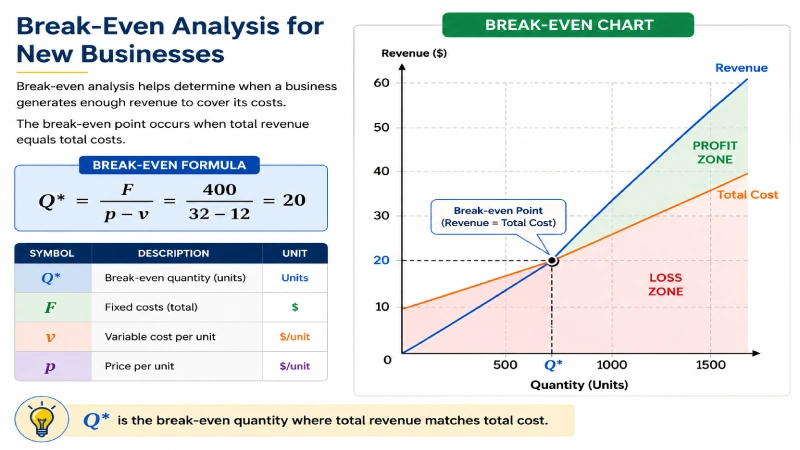
For example, when the fixed cost is relatively higher in a firm, then in order to break-even, the firm would have to sell many more goods.
Break-even analysis helps founders understand:
How many units must be sold
How much revenue is required
Whether pricing is sustainable
How fixed costs affect profitability
How changes in pricing influence profitability
Example of Break-Even Analysis
Imagine a startup selling a product for $100.
The variable cost per product is $40, and monthly fixed costs are $6,000.
The startup must generate enough contribution from each sale to cover its fixed costs.
The contribution per unit is:
$100 − $40 = $60
The startup would need to sell:
$6,000 ÷ $60 = 100 units
The break-even point is therefore 100 units per month under these assumptions.
This calculation can help founders evaluate whether their sales targets are realistic.
Why Break-Even Analysis Matters
Break-even analysis can help answer questions such as:
- How many customers do we need?
- Should we increase our price?
- Can we reduce fixed costs?
- Is our gross margin high enough?
- How much sales volume is required to become profitable?
It is particularly useful when evaluating different pricing and cost scenarios.
Cash Flow Forecasting Best Practices
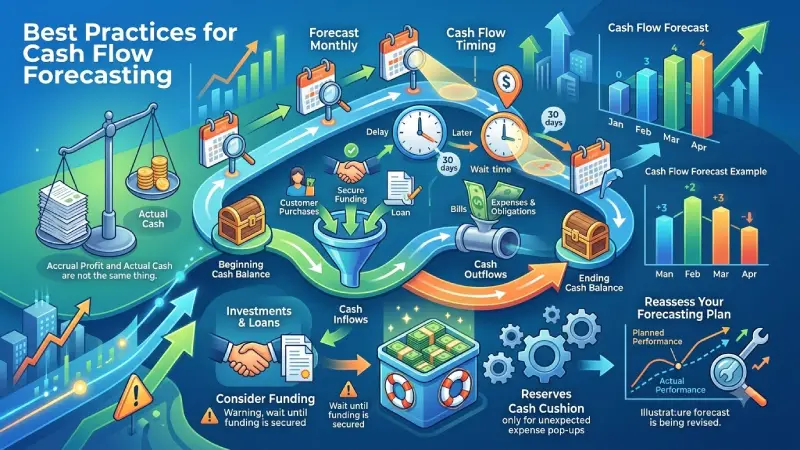
Profit and cash are not the same thing.
A company may appear to be profitable on paper, but it may still go out of cash when its debtors do not settle their accounts or when the business needs to meet its obligations before it receives any cash. This is an issue because for the business to survive, it needs cash to meet its obligations.
A cash flow forecast tracks:
- Beginning cash balance
- Cash received
- Cash paid
- Ending cash balance
Best Practice 1: Forecast Monthly
Startups in early stages should forecast their cash flows on a monthly basis.
Monthly forecasting will help you spot potential upcoming cash deficits.
Best Practice 2: Cash Flow Timing
Think about how much time it will take to get paid and pay for something.
For instance, customers might buy from you today and will have 30 days to pay.
The cash flow projection will need to reflect the actual date of cash receipt.
Best Practice 3: Consider Funding
If you plan to receive funding from investments or loans, put them into your cash flow forecast.
Never assume that the funding is going to be available to you until you secure it.
Best Practice 4: Always Have a Cash Cushion
There could always be unexpected expenses that pop up.
Having an adequate cash cushion can decrease the likelihood of being without money.
Best Practice 5: Reassess Your Forecasting Plan
Compare your current performance with your projections.
If your income is less and expenses are higher than expected, then adjust your cash flow projection.
A cash flow forecast is always a living document that needs to be adjusted regularly.
Cash Flow Forecast Example
| Month | Starting Cash | Cash Inflows | Cash Outflows | Ending Cash |
| January | $50,000 | $10,000 | $20,000 | $40,000 |
| February | $40,000 | $15,000 | $22,000 | $33,000 |
| March | $33,000 | $20,000 | $25,000 | $28,000 |
| April | $28,000 | $25,000 | $27,000 | $26,000 |
This simple prediction enables business persons to know how the cash balance evolves over time.
Create Best Case, Base Case, and Worst Case Scenarios
Startup forecasts are uncertain, therefore it is good practice to develop more than one scenario.
Best Case Scenario
Is based on optimistic expectations regarding customer growth and better-than-anticipated performance.
Base Case Scenario
Includes realistic assumptions based on present information.
Worst Case Scenario
Is based on slower growth, higher costs, or problems.
How to Present Financial Projections to Investors
Investors do not simply want to see large revenue numbers.
They want to understand the assumptions behind those numbers.
When presenting financial projections, explain:
- How revenue is generated
- How customers are acquired
- How pricing is determined
- What drives costs
- When the company expects to reach break-even
- How much funding is required
- How the funding will be used
- What milestones the funding will help achieve
Keep Your Financial Model Simple and Clear
Do not give people a hard to understand spreadsheet with no explanation.
Your financial model should be easy to get.
Investors need to understand what makes your business work.
They should be able to see the things that make Your Financial Model work.
For example:
Customer acquisition → Number of customers → Revenue → Gross profit → Operating expenses → Cash flow
This creates a clear connection between business activity and financial performance.
Use Realistic Assumptions
Another issue that startups do when making forecasts is that they end up making forecasts that appear to be too good to be true. Such forecasts are likely to cause a lot of damage to startups since they end up making very optimistic forecasts. This is something that startups should try to avoid.
Avoid assumptions such as:
- Customers will grow instantly
- Every customer will remain forever
- Marketing will always be successful
- Costs will never increase
- Competitors will not respond
Instead, support your assumptions with:
- Market research
- Customer interviews
- Early sales data
- Pilot programs
- Industry benchmarks
- Competitor pricing
- Historical performance
Investors believe in a forecast that appears realistic and not a forecast that appears too unrealistic and promises extremely rapid growth. An investor likes a forecast that appears possible. Investors like forecasts that appear real. Growth forecast appears too unrealistic.
Show Your Key Financial Metrics
Depending on your business model, investors may want to see metrics such as:
Revenue Growth
Shows how quickly revenue is increasing.
Gross Margin
Shows how much revenue remains after direct costs.
Customer Acquisition Cost
Estimates how much it costs to acquire a customer.
Customer Lifetime Value
This is what a business uses to figure out how money a customer will spend with them over time. It is, like trying to guess how much a customer will buy from the business during the time they’re a customer of the business. The business wants to know the value of a customer to the business.
Monthly Recurring Revenue
Important for subscription-based businesses.
Churn Rate
Shows how quickly customers are leaving a subscription business.
Burn Rate
Shows how quickly a startup is spending cash.
Runway
Estimates how long the startup can operate before needing additional funding.
Choose metrics that are relevant to your business model rather than including every possible metric.
How Much Funding Does a Startup Need?
Your financial projections can help determine your funding requirements.
Consider:
- Startup costs
- Monthly operating expenses
- Expected revenue
- Cash flow
- Hiring plans
- Product development
- Marketing investment
- Contingency reserves
The funding amount should be connected to specific milestones.
For example, funding might be used to:
- Launch a minimum viable product
- Hire a development team
- Acquire the first 1,000 customers
- Expand into a new market
- Reach a specific revenue target
This gives investors a clearer understanding of how their capital will support growth.
Common Financial Projection Mistakes Startups Should Avoid
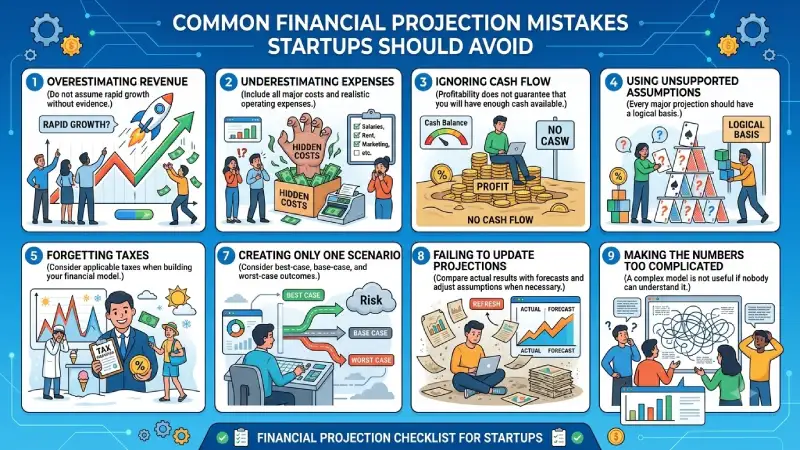
- Overestimating Revenue
Do not assume rapid growth without evidence.
- Underestimating Expenses
Include all major costs and realistic operating expenses.
- Ignoring Cash Flow
Profitability does not guarantee that you will have enough cash available.
- Using Unsupported Assumptions
Every major projection should have a logical basis.
- Forgetting Taxes
Consider applicable taxes when building your financial model.
- Ignoring Seasonality
Some businesses experience significant changes in demand throughout the year.
- Creating Only One Scenario
Consider best-case, base-case, and worst-case outcomes.
- Failing to Update Projections
Compare actual results with forecasts and adjust assumptions when necessary.
- Making the Numbers Too Complicated
A complex model is not useful if nobody can understand it.
Financial Projection Checklist for Startups
Before presenting your financial projections, check that you have:
- Revenue projections
- Pricing assumptions
- Customer growth assumptions
- Startup cost estimates
- Fixed and variable expenses
- Profit and loss forecast
- Cash flow forecast
- Break-even analysis
- Funding requirements
- Best-case scenario
- Base-case scenario
- Worst-case scenario
- Key financial metrics
- Clear assumptions
- Realistic growth expectations
Frequently Asked Questions
How do I make financial projections for a new company?
I need to estimate the income, pricing, number of clients, initial expenses, operational costs, and cash flow. Make monthly projections for the first year and annual projections for future years.
For how many years should financial projections of a startup be made?
Most startups develop detailed monthly projections for the first 12 months and annual projections for the next 2 to 4 years.
What information is included in financial projections?
Financial projections typically include income projections, expenses, profit and loss projections, cash flow projections, break-even projections, and financing needs.
How does one judge startup financial projections?
Startups’ financial projections are analyzed by looking at the underlying assumptions, market opportunities, growth prospects, margins, cash needs, and whether the projection is realistic.
Why is cash flow important for startups?
Cash flow tells whether a startup has enough cash available to meet its obligations. A business may be making profits on the books, but not necessarily generating enough cash.
Conclusion
A projection helps the company gauge its performance, as well as how much capital will be needed in order to hit major milestones. A good projection links revenues, expenses, cash flow, profitability and funding needs.
First of all, the projection should be realistic. Develop a forecast based on market research, customer data, pricing and realistic growth figures. Avoid overinflated figures which will be hard to justify.
Another element of a good financial projection is its evolution as the startup generates actual data. Compare actual performance against the forecast, analyze discrepancies, and adjust assumptions.
Properly done, realistic projections can assist in decision-making for founders and provide investors with an insight into the company’s performance and capital requirements.
To take the next step, see our detailed guide on Business Model Canvas.