


Introduction
Market Research for Startups Starting a business without prior information on the market is very dangerous. In some instances, the startup might fail owing to low demand, poor understanding of the market or because of competition offering better products.
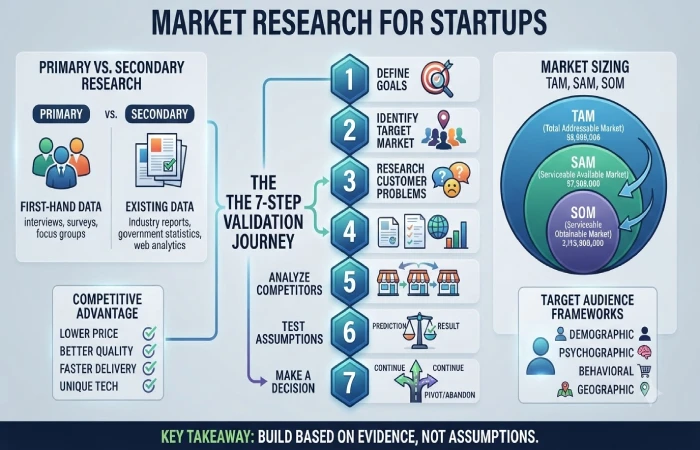
That is why market research plays an important role in planning a business, particularly for startups. Through market research, the entrepreneur can get knowledge about the potential customers, identify opportunities in the market, study the competitor and finally determine the viability of his/her business venture.
In other words, market research is not about confirming something. It is about learning what you do not know yet. Through the proper market research, one can get the idea of customer demands, price expectations, market trends and obstacles.
The following manual will provide the guidelines on how to conduct the market research for a startup, analyze the tools of target audience research, perform a competitive analysis for a new business, differentiate between primary and secondary market research techniques and calculate TAM, SAM, and SOM.
What Is Market Research for Startups?
Market research for startups is when you collect and look at information about the market. You want to know about the industry the customers, the competition and the business environment. The main idea is to use facts of just guessing.
For example the person who started a startup might think people will pay fifty dollars for a product.. Market research for startups can show that people will actually pay thirty dollars for the same product. This is why market research, for startups is so important. It gives you an insight into what is happening in the market.
Why Is Market Research Important for Startups?
Startups often operate with limited resources. Making major decisions based on incorrect assumptions can be expensive.
Market research can help you:
Test Your Business Concept
Market research is useful in finding out if there is an actual need among consumers for the solution you aim to provide.
Discover Customer Needs
You will discover what consumers appreciate, their complaints and what drives them to buy things.
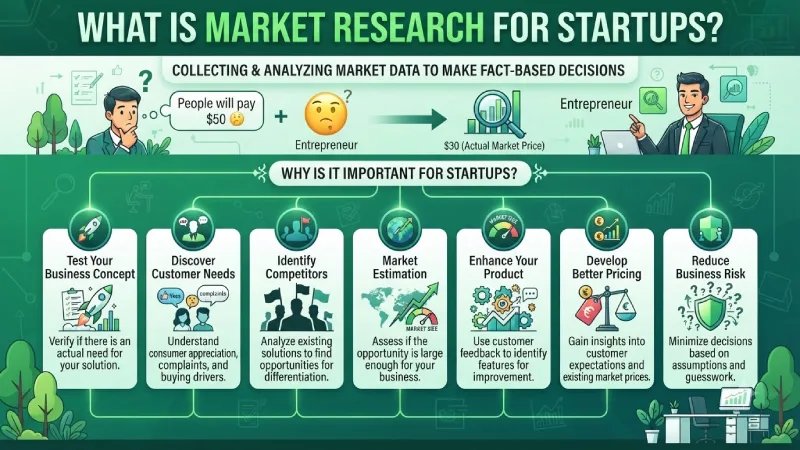
Identify Competitors
Understanding existing solutions helps you find opportunities to differentiate your business.
Market Estimation
Market size analysis can assist you in identifying whether the opportunity is sufficiently large for you.
Enhance Your Product
Customer feedback will allow you to identify which features to improve on.
Develop Better Pricing
Research can provide insights into customer expectations and existing market prices.
Reduce Business Risk
The more you understand your market, the fewer decisions you need to make based entirely on assumptions.
How to Conduct Market Research for a Startup
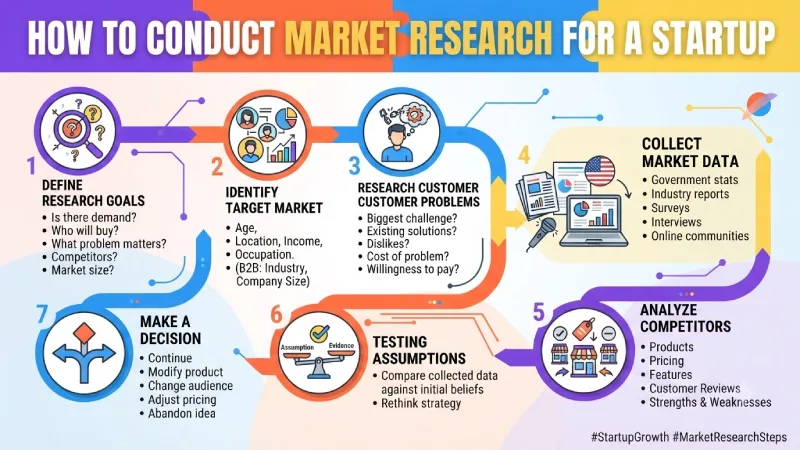
Market research need not be a complex undertaking. A logical process can be applied to obtain valuable information.
Step 1: Define Your Research Goals
Before gathering data, know what you would like to know.
Your research questions might include:
- Is there demand for my product?
- Who is most likely to buy it?
- What problem matters most to customers?
- What alternatives are customers using?
- How much are customers willing to pay?
- Who are the main competitors?
- How large is the potential market?
Good question framing will make sure you don’t end up with irrelevant information.
Step 2: Identify Your Target Market
Identify the population that would likely use your product. Identify the companies that would likely use your product.
Consider factors such as:
- Age
- Location
- Income
- Occupation
- Education
- Lifestyle
- Interests
- Buying behavior
For B2B startups, consider:
- Industry
- Company size
- Annual revenue
- Location
- Decision-makers
- Purchasing process
Do not try to target everyone.
The existence of an audience helps narrow your research and enhances the efficiency of your marketing process.
Step 3: Research Customer Problems
Find out what problems your target audience is experiencing.
Ask:
- What is the biggest challenge they face?
- How often does the problem occur?
- How serious is the problem?
- What solutions do they currently use?
- What do they dislike about existing solutions?
- How much does the problem cost them?
- Would they pay for a better solution?
The objective is to view the problem through the eyes of the customer.
Step 4: Collect Market Data
Use multiple sources to gather information about your industry and customers.
Government statistics are available from the U.S. Census Bureau business data, which provides demographic and economic information that can support market analysis.
Possible sources include:
- Government statistics
- Industry reports
- Trade associations
- Competitor websites
- Customer reviews
- Search trends
- Surveys
- Interviews
- Social media discussions
- Online communities
- Existing company reports
The use of multiple sources will enable you to establish patterns without depending on one information source only.
Step 5: Analyze Competitors
Recognize existing companies that cater to your target customers.
Study:
- Products
- Services
- Pricing
- Features
- Customer reviews
- Marketing
- Distribution
- Strengths
- Weaknesses
Check out possible opportunities that your business venture can exploit.
Step 6: Testing Your Assumptions
When you collect the required information, analyze it against your assumptions.
Assumption Example
The customers need a cost-effective solution.
Result:
The customers are prepared to pay more so as to get fast deliveries and customer service.
It will become imperative to reassess the positioning and pricing strategy that you have been following.
Step 7: Make a Decision
After completing your research, decide whether to:
- Continue with the idea
- Modify the product
- Change the target audience
- Adjust pricing
- Change the business model
- Test the idea further
- Abandon the idea
Changing direction based on evidence is not failure. It can save your startup from investing heavily in an idea that does not have enough potential.
Target Audience Analysis Frameworks
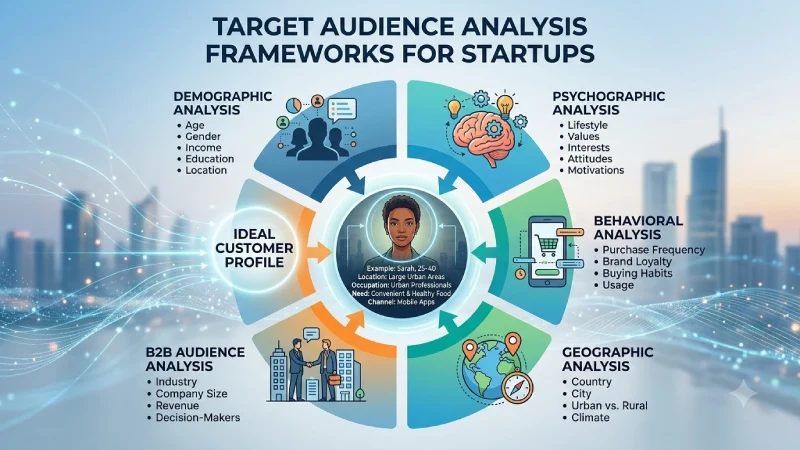
Audience analysis forms part of startup market research and is perhaps the most crucial aspect of it.
You can use several frameworks to organize your analysis.
Demographic Analysis
For consumer businesses, consider:
- Age
- Gender
- Income
- Education
- Occupation
- Family status
- Location
For instance, an upscale fitness business can be aimed at urban professionals who have more disposable income.
Psychographic Analysis
Psychographics explore how customers think and what they value.
Consider:
- Lifestyle
- Interests
- Values
- Attitudes
- Motivations
- Personality
Nevertheless, regardless of their having the same age and earnings, their areas of interest would completely differ since they live different lives.
Behavioral Analysis
Study how customers behave.
Look at:
- Purchase frequency
- Brand loyalty
- Buying habits
- Product usage
- Preferred channels
- Response to promotions
Behavioral information can help you determine when and how customers are most likely to buy.
Geographic Analysis
Geographic segmentation considers:
- Country
- State
- City
- Urban vs. rural location
- Climate
- Local market conditions
Location can significantly affect customer demand.
B2B Target Audience Analysis
For business customers, consider:
- Industry
- Company size
- Revenue
- Number of employees
- Location
- Decision-makers
- Budget
- Buying process
For instance, a startup offering enterprise software could find itself having to identify more than one decision-maker rather than just the single customer.
Create an Ideal Customer Profile
After collecting audience information, create an ideal customer profile.
For example:
| Customer Attribute | Example |
| Age | 25–40 |
| Location | Large urban areas |
| Occupation | Full-time professionals |
| Income | $60,000+ annually |
| Problem | Limited time for healthy meal preparation |
| Current Solution | Restaurants and meal delivery |
| Main Need | Convenient and healthy food |
| Buying Motivation | Convenience and quality |
| Preferred Channel | Mobile apps and online ordering |
An ideal customer profile will assist you in narrowing down your marketing and sales efforts.
Competitive Analysis for Startups
Competitive analysis allows you to see where your startup stands relative to other existing players.
You need to recognize two kinds of competitors.
Direct Competitors
Direct competition refers to competitors that offer similar products or services targeting the same target market.
Where there are two meal delivery companies within one city, they are direct competitors.
Indirect Competitors
Indirect competitors address the same customer’s problem but through a different route.
If a meal delivery service is competing with:
- Restaurants
- Grocery stores
- Meal preparation at home
It is essential to understand indirect competition because there may be other options which consumers can choose from and not think of yours.
How to Analyze Your Competitors
Create a competitor comparison table.
| Factor | Your Startup | Competitor A | Competitor B | Competitor C |
| Price | Medium | Low | High | Medium |
| Product Quality | High | Medium | High | Medium |
| Customer Service | High | Medium | High | Low |
| Delivery Speed | Fast | Medium | Slow | Fast |
| Product Variety | High | Low | High | Medium |
| Target Customer | Professionals | Families | Premium Buyers | Students |
| Main Advantage | Convenience | Low Price | Premium Quality | Variety |
Use this analysis to identify opportunities.
The objective is not to assert that your company outperforms all others across all areas. The task is to know where you can compete effectively.
Find Your Competitive Advantage
Your startup may differentiate itself through:
- Lower prices
- Better quality
- Faster delivery
- Superior customer service
- Specialized expertise
- Unique technology
- Better convenience
- Stronger branding
- Niche specialization
Competitive advantage must be something that matters to the consumer and hard enough for the competitor to copy.
Primary vs. Secondary Approaches to Conducting Market Research

There are two basic types in market research – primary and secondary.
Primary Market Research
Primary research involves the collection of information for the first time from the actual or potential customers.
Examples include:
- Surveys
- Customer interviews
- Focus groups
- Product testing
- Observations
- User testing
Advantages
- Provides information specific to your business
- Allows you to ask targeted questions
- Helps you understand customer opinions directly
Disadvantages
- Can take time
- May require money
- Small samples may not represent the entire market
Secondary Market Research
Secondary research uses information that already exists.
Sources may include:
- Government data
- Industry reports
- Academic research
- News publications
- Competitor websites
- Market studies
- Public company reports
Advantages
- Often faster
- Can be less expensive
- Provides broad market information
Disadvantages
- Information may be outdated
- Data may not perfectly match your target market
- Some reports may have limited access
Primary vs. Secondary Market Research: Which Should You Use?
The best approach is usually to combine both methods.
| Research Method | Best For | Examples |
| Primary Research | Understanding specific customers | Surveys, interviews, focus groups |
| Secondary Research | Understanding broader markets | Industry reports, government data |
| Primary + Secondary | Comprehensive validation | Combine customer feedback with market data |
Market Sizing: TAM, SAM, and SOM Explained
Market sizing is used to determine how big the potential market is for your business.
Three common concepts are:
- TAM
- SAM
- SOM
TAM: Total Addressable Market
TAM refers to the complete potential market demand that could be realized by your business entity serving all customers.
For instance, if all your potential customers from your industry bought your product, then the total sales opportunity will be considered your TAM.
TAM answers:
“How large could this market be in total?”
SAM: Serviceable Available Market
SAM is the portion of the TAM that your business can realistically target based on factors such as:
- Geography
- Product type
- Customer segment
- Distribution
- Business capabilities
SAM answers:
“Which part of the total market can our business actually serve?”
SOM: Serviceable Obtainable Market
SOM is the portion of the SAM that your business can realistically capture within a specific period.
It considers:
- Competition
- Marketing resources
- Sales capacity
- Pricing
- Distribution
- Brand awareness
SOM answers:
“How much of the market can we realistically capture?”
TAM vs. SAM vs. SOM
| Market Size | Meaning | Example Question |
| TAM | Total Addressable Market | How large is the entire opportunity? |
| SAM | Serviceable Available Market | Which part can our business serve? |
| SOM | Serviceable Obtainable Market | How much can we realistically capture? |
The three levels can be visualized as:
TAM → SAM → SOM
The market will be increasingly narrower the closer you get to the part that your startup could possibly exploit.
How to Calculate TAM, SAM, and SOM
There are several ways to estimate market size.
Top-Down Approach
Start with broad industry data and narrow the numbers.
For example:
Total industry market → Target segment → Geographic market → Realistic market share
This process is fast but relies greatly on the availability and accuracy of the market information.
Bottom-Up Approach
Start with your own business assumptions.
For example:
Potential customers × Average annual revenue per customer = Estimated market opportunity
Then you can refine the estimate taking into consideration your geographic scope and realistic ability to acquire customers.
The bottom-up approach is quite common for startups due to the possibility to base it on the real situation.
Example of TAM, SAM, and SOM
Imagine a startup selling business software.
- TAM: All companies around the world which could make use of the software
- SAM: Small and medium-sized companies within the markets that the startup wants to operate in
- SOM: The number of customers that the startup could reasonably expect to acquire within the first couple of years
The key is to make your estimates realistic.
Remember not to give a very big TAM number without showing how you will be able to access those specific customers.
How to Validate Your Business Idea Before Launch
Market research is only useful when you turn insights into action.
Use the following validation process:
- Identify the Problem
Find a real problem that customers experience.
- Talk to Potential Customers
Conduct interviews and surveys.
- Research the Market
Analyze industry data and trends.
- Study Competitors
Understand existing solutions and market gaps.
- Test Your Solution
Create a prototype, minimum viable product, or simple offer.
- Collect Feedback
Measure how potential customers respond.
- Test Willingness to Pay
Assess the willingness of consumers to pay for the product, not just their interest in it.
- Refine Your Idea
Use what you learn to improve your product, pricing, or target market.
- Reassess the Opportunity
Review whether the market opportunity still supports your business goals.
Signs That Your Business Idea Needs More Validation
Be cautious if:
- Customers show little interest.
- People like the idea but will not pay for it.
- The problem is not urgent.
- Competitors already dominate the market.
- Your target audience is too small.
- Customer acquisition costs appear too high.
- Your pricing does not cover your costs.
- You cannot clearly explain your competitive advantage.
This is not always an indication that the concept must be dropped altogether. It can signify that the product, target market, price point, or even business strategy needs some tweaking.
Common Market Research Mistakes Startups Should Avoid

Asking Only Friends and Family
Friends and family may be supportive but may not represent your actual target customers.
Asking Leading Questions
Questions should encourage honest feedback rather than confirmation of your assumptions.
Focusing Only on Positive Feedback
Pay attention to criticism and objections. They may reveal important problems.
Ignoring Competitors
Competition is not necessarily bad. It often proves that demand exists. The important question is how your business will compete.
Using Outdated Data
Markets change quickly. Check the date and reliability of your sources.
Overestimating Market Size
A large TAM does not mean your startup can capture a large share of it.
Confusing Interest With Demand
Someone saying they like your idea does not necessarily mean they will pay for it.
Skipping Real-World Testing
Whenever possible, test your idea with real customers before investing heavily in development.
Market Research Checklist for Startups
Use this checklist before launching your business.
Customer Research
- Have I clearly defined my target customer?
- Do I understand the customer’s main problem?
- Have I spoken with potential customers?
- Do I know how they currently solve the problem?
- Do I understand their willingness to pay?
Market Research
- Have I researched the industry?
- Do I understand market trends?
- Have I estimated TAM, SAM, and SOM?
- Is the market large enough for my goals?
Competitor Research
- Have I identified direct competitors?
- Have I identified indirect competitors?
- Do I understand competitor pricing?
- Do I know their strengths and weaknesses?
- Can I explain my competitive advantage?
Validation
- Have I tested my assumptions?
- Have I collected real customer feedback?
- Have I tested willingness to pay?
- Have I adjusted my idea based on research?
Frequently Asked Questions
What is market research for startups?
Market research for startups is the process of studying customers, competitors, industry trends, and market opportunities to determine whether a business idea has realistic potential.
How do I conduct market research for a startup?
Start by defining your research questions and target audience. Then collect primary and secondary data, analyze competitors, estimate market size, and test your assumptions with potential customers.
What is the difference between primary and secondary market research?
Primary research involves collecting new information directly from customers through methods such as surveys and interviews. Secondary research uses existing information from sources such as industry reports, government data, and public research.
What are TAM, SAM, and SOM?
TAM represents the total potential market, SAM represents the portion your business can serve, and SOM represents the realistic share your startup can capture.
How important is competitor research for a startup?
Competitor research helps you understand existing solutions, identify market gaps, learn how competitors operate, and find ways to differentiate your business.
How can I validate my startup idea?
Talk to potential customers, research the market, analyze competitors, test your product or service, and measure whether customers are willing to pay for your solution.
Conclusion
The market research process for start-ups assists entrepreneurs in making the right decisions prior to spending much time and resources. The research allows one to know the target audience, analyze the competition, understand the industry trends, and assess the size of the market to decide whether there is a viable business concept.
One should have specific research questions, conduct primary and secondary research, and base the decisions on data, not opinions. Most importantly, one should test the concept on the actual potential clients and be ready to change the strategy based on the results.
It is not important that a start-up knows all the answers at the initial stage. What is crucial is the readiness to raise the right questions and learn something new.
To take the next step, see our detailed guide on Financial Projections for Startups.