

Introduction
Financial modeling tools are really important for people who start businesses on their own without getting money from others. These people, known as bootstrappers use the money they get from their sales to help their businesses grow. They have to make decisions about money from the very beginning. There are tools that can help them like special software and spreadsheets that help them guess how much money they will make, figure out how much things will cost, keep track of the money coming in and out and plan for the future. All these tools help bootstrappers be careful, with their money and use their resources wisely. Financial modeling tools are essential for bootstrappers to make financial decisions and manage their resources properly.
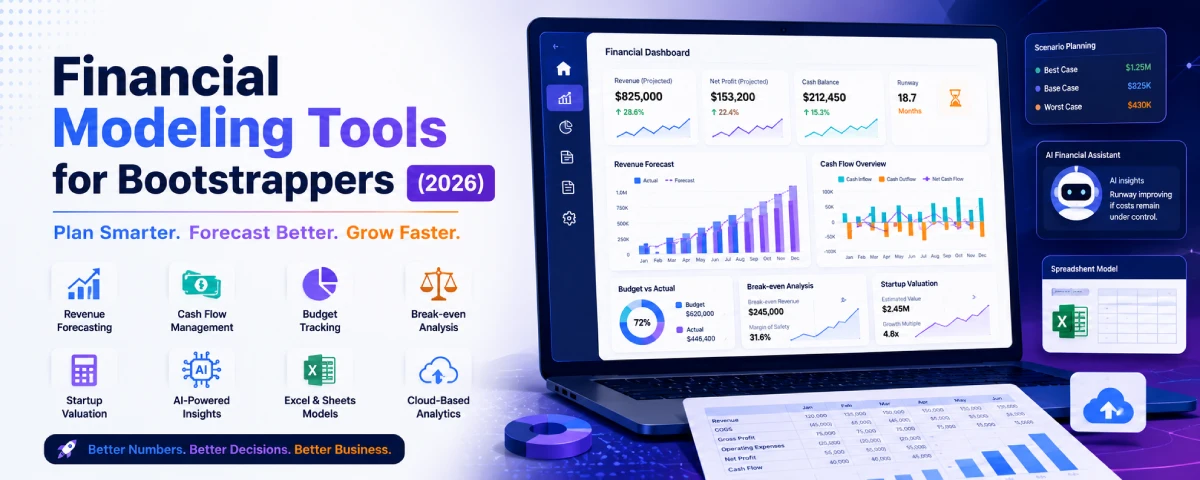
Tool roundup from our bootstrapped financial modeling guide.
As businesses get bigger founders usually move from using spreadsheets to manage finances to using tools, for financial planning.
- These tools are really useful for keeping track of everything and avoiding mistakes.
- They help you watch things like sales and expenses and cash flow and budgets and forecasts.
- Using these tools helps business owners see how their business is doing. That is a big help to them.
- Business owners can use these tools to understand their business and make good decisions, about their business.
One of the problems for startups that do not have a lot of money is that it is hard to know what will happen. The founders of these startups often ask questions such, as:
- How much cash do we have left?
- Can we afford to hire another employee?
- How quickly are expenses growing?
- When will the business become profitable?
- What happens if revenue slows down?
These tools help answer these questions using real data and realistic projections.
Financial planning tools are really helpful, for founders because they do things like forecasting and reporting automatically. This means founders have time to talk to customers and help their business grow. Financial planning tools give founders a picture of how their money is doing so they can see problems coming and fix them before they get bad. That is why financial planning tools are so important for founders to make decisions and run their business well.
Modern financial tools offer features such as:
- Revenue forecasting
- Expense tracking
- Cash flow monitoring
- Budget management
- Scenario planning
- Break-even analysis
- Startup valuation support
- Team collaboration
Some tools cost nothing and are perfect for beginners. The other tools are designed with advanced options suitable for growth-stage startups that require more comprehensive financial analysis.
What’s even more positive is that entrepreneurs will not need expensive applications to begin. Plenty of bootstrapping startups started off with basic spreadsheet analysis and later upgraded to more sophisticated tools.
Whether you run a SaaS startup, ecommerce business, agency, consulting firm, or freelance business, a startup agency, or freelance your skills, choosing effective financial models will definitely work to your advantage.
Why Financial Modeling Tools Matter for Bootstrapped Startups
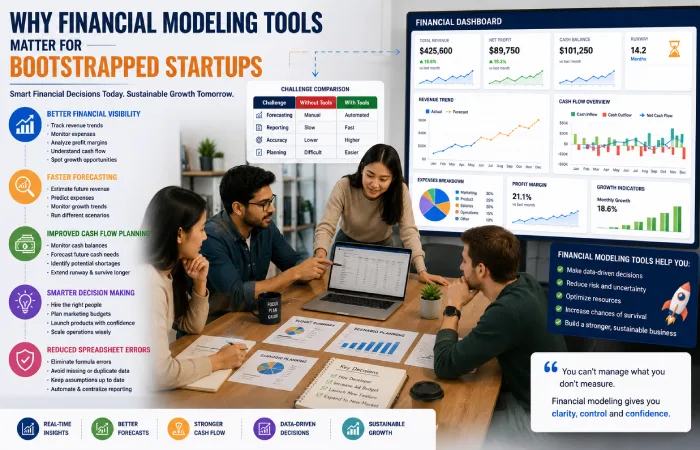
Bootstrapping is associated with startups that do not have much money. Each expense is crucial in such startups since each bad decision can impact their growth. Hence, there is no doubt why today financial modeling software is vital for any startup.
Although venture-backed startups have access to generous financing, bootstrapped firms should make wise decisions when it comes to money management. The understanding of income, expenditure, profit, and cash flows can prevent any unpleasant scenarios.
Better Financial Visibility
One of the biggest benefits of financial modeling tools is visibility.
Instead of guessing where money is going, founders can see:
- Revenue trends
- Monthly expenses
- Profit margins
- Cash flow movement
- Growth opportunities
This visibility makes planning easier and reduces uncertainty.
Faster Forecasting
Creating forecasts manually can take hours.
Financial tools simplify forecasting by allowing founders to:
- Estimate future revenue
- Predict expenses
- Monitor growth trends
- Create financial scenarios
This helps businesses plan ahead more confidently.
Improved Cash Flow Planning
It’s not the profits that matter but the cash flow in bootstrap businesses.
One can be highly profitable in business but still unable to settle accounts.
Financial modeling tools help founders:
- Monitor cash balances
- Forecast future cash needs
- Identify potential shortages
- Protect business runway
Proper planning of cash flow enhances chances of survival among startup companies.
Smarter Decision Making
Founders make important decisions every day.
Examples include:
- Hiring employees
- Increasing marketing budgets
- Launching new products
- Expanding operations
Financial tools provide data that supports these decisions and reduces guesswork.
Reduced Spreadsheet Errors
Manual spreadsheets are useful but prone to mistakes.
Common issues include:
- Formula errors
- Missing data
- Duplicate entries
- Outdated assumptions
Financial software helps with these problems by doing things and putting all the information in one place. This way financial software reduces these risks. It is really good at automation. It also does a great job, with centralized reporting.
| Challenge | Without Tools | With Tools |
| Forecasting | Manual | Automated |
| Reporting | Slow | Fast |
| Accuracy | Lower | Higher |
| Planning | Difficult | Easier |
What Features Should Founders Look For?
Not every financial modeling tool offers the same features. Before choosing software, founders should understand which capabilities matter most.
Revenue Forecasting
Revenue forecasting helps estimate future sales and growth.
Good forecasting features allow founders to:
- Predict future income
- Set growth targets
- Test different pricing strategies
- Build realistic financial plans
Expense Tracking
Tracking expenses is essential for controlling costs.
A strong expense management system should help founders:
- Categorize spending
- Monitor recurring expenses
- Identify unnecessary costs
- Improve budgeting
Cash Flow Monitoring
Cash flow monitoring helps founders understand how money moves through the business.
Important cash flow features include:
- Cash balance tracking
- Monthly projections
- Runway calculations
- Burn rate monitoring
Scenario Planning
Business conditions can change quickly.
Scenario planning allows founders to test different situations such as:
- Faster growth
- Slower sales
- Higher expenses
- New hiring plans
This helps reduce financial risk.
Budget Management
Budgets provide spending limits and financial discipline.
Good budgeting tools help founders:
- Set targets
- Monitor actual performance
- Compare forecasts with results
- Control spending
Startup Valuation Support
As businesses grow, founders may eventually need valuation estimates.
Some financial tools include features that help calculate:
- Revenue multiples
- Growth metrics
- Business value estimates
These can be useful when seeking partnerships, loans, or future investment opportunities.
Team Collaboration
Many startups have multiple team members involved in financial planning.
Collaboration features allow:
- Shared access
- Real-time updates
- Role permissions
- Centralized reporting
This improves communication and keeps financial information organized.
The best financial modeling tool is not always the one that costs a lot of money. What works for you depends on how big your businesss how complicated it is, how much money you have and what you need to plan for. A lot of people who start their businesses with little money begin with simple financial modeling tools and then move to more advanced ones as their businesses get bigger. Financial modeling tools are important, for businesses so it is good that people can choose financial modeling tools that fit their needs.
Best Free Financial Modeling Tools for Bootstrappers

Choosing the financial tool can make planning easier for founders with limited funds. The good news is that many helpful tools offer plans, which are perfect for startups on a tight budget.
Google Sheets
Google Sheets is an option. It lets teams work together in time and access spreadsheets from anywhere.. It’s free and easy to share with team members. According to Google Workspace Google Sheets offers cloud-based access and spreadsheet management for teams.
I use Google Sheets for things, like predicting revenue tracking cash flow creating a budget and making reports.
Pros
- Free to use
- Easy collaboration
- Accessible from anywhere
Cons
- Limited automation
- Can become complex as data grows
Best For: Beginners and small startups
Microsoft Excel
Excel continues to be a favorite among founders because of its flexibility and powerful formulas. Many startup financial models are still built using Excel.
Pros
- Advanced calculations
- Highly customizable
- Large template library
Cons
- Paid software
- Learning curve for beginners
Best For: Advanced financial models
Notion
Notion combines planning, documentation, and project management in one platform. Many founders use it to organize financial plans alongside business operations.
Pros
- Easy to use
- Good for planning
- Flexible workspace
Cons
- Limited financial calculations
- Not designed specifically for modeling
Best For: Startup planning
Airtable
The Airtable offers an integrated suite of functions of a spreadsheet and database at once. It allows founders to manage financial information and performance.
Pros
- Strong data organization
- Custom workflows
- Team collaboration
Cons
- More complex than spreadsheets
- Limited advanced modeling features
Best For: Data tracking
Wave
The Wave is a free accounting tool made specifically for small organizations and freelancers. It allows founders to manage financial operations.
Pros
- Free accounting tools
- Expense tracking
- Financial reports
Cons
- Limited forecasting features
- Not built for advanced financial models
Best For: Accounting and bookkeeping
Comparison Table
| Tool | Free Plan | Best For | Difficulty |
| Google Sheets | Yes | Beginners | Easy |
| Excel | Limited | Advanced Models | Medium |
| Notion | Yes | Planning | Easy |
| Airtable | Yes | Data Tracking | Medium |
| Wave | Yes | Accounting | Easy |
Excel Templates for Startup Financial Models
Even with newer software available, many founders continue to use Excel Templates for Startup Financial Models because they provide flexibility and complete control.
Why Founders Still Use Excel
Founders can create unique financial models in Excel that fit their business requirements. Excel is suitable for companies that need to conduct thorough analysis but do not wish to buy costly software..
Common Excel templates include:
Revenue Forecast Templates
These templates help founders estimate future sales and growth. They work particularly well when combined with Revenue Projections for Bootstrapped Startups.
Cash Flow Templates
Cash flow templates help startups track money entering and leaving the business. They are useful alongside Cash Flow Modeling for Bootstrapped Startups.
Startup Budget Templates
Budget templates organize monthly expenses and help founders manage spending.
Break-Even Templates
The break-even templates help you calculate the sales volume required to meet your break-even point. Break-even templates cater to break-even analysis for bootstrapped startups.
Valuation Templates
Valuation templates help estimate business value using common startup valuation methods.
| Template Type | Purpose |
| Revenue Model | Forecast Sales |
| Expense Model | Track Costs |
| Cash Flow Model | Manage Cash |
| Break-Even Model | Calculate Profitability |
| Valuation Model | Estimate Business Value |
AI Tools for Bootstrapped Financial Planning
Financial Planning with Bootstrapped AI Tools is gaining popularity since it enables founders to process information faster and make better decisions.
How AI Is Changing Financial Planning
AI technology enables quick processing of financial data by founders and recognition of patterns that could be hard to recognize manually.
Benefits of AI Forecasting
AI tools can assist with:
- Revenue forecasting
- Expense planning
- Financial analysis
- Business reporting
Faster Scenario Analysis
Founders can test multiple business situations quickly. This supports Scenario Planning for Bootstrapped Startups and helps prepare for uncertainty.
Better Expense Predictions
AI can help identify spending patterns and forecast future expenses more accurately.
Automated Reporting
Many AI-powered tools generate summaries and reports automatically, saving valuable time.
| Tool | Main Use |
| ChatGPT | Financial Planning Ideas |
| Claude | Data Analysis |
| Gemini | Forecast Assistance |
| Notion AI | Planning Support |
| Copilot | Spreadsheet Assistance |
Benefits and Disadvantages of AI
AI may help to boost effectiveness, however, AI-based forecasts cannot serve as an exclusive source for founders, because human intuition and experience play significant roles too.
Cloud-Based Financial Modeling Software
Cloud-Based Financial Modeling Software helps founders to view financial statistics on the Internet independently of any particular devices.
What Does Cloud-Based Tools Mean?
It means that cloud-based software collects data in the Internet and users can have access to such data instantly at different locations.
Advantages Over Offline Spreadsheets
Compared to offline spreadsheets, online spreadsheets are more collaborative and accessible.
Real-Time Collaboration
Many people can collaborate while working on financial planning in real time.
Access From Anywhere
Founders can review financial reports from any location with internet access.
Auto-Saved Changes
In most cases, cloud storage saves changes without any manual effort by users.
| Feature | Spreadsheet | Cloud Software |
| Collaboration | Limited | Strong |
| Backup | Manual | Automatic |
| Access | Device Based | Anywhere |
| Updates | Manual | Automatic |
DIY vs Professional Financial Modeling Tools
Many founders eventually face the decision between building financial models themselves or using professional software.
What Is DIY Financial Modeling?
DIY financial modeling involves creating forecasts and financial plans using spreadsheets or free tools.
Advantages of DIY Models
- Lower cost
- Full control
- Flexible structure
- Suitable for early-stage startups
Disadvantages of DIY Models
- More manual work
- Higher risk of errors
- Time-consuming updates
When Professional Tools Make Sense
As businesses grow, professional software can improve efficiency through automation and advanced reporting.
Which Option Is Better for Bootstrappers?
For most early-stage startups, DIY financial modeling is usually sufficient. As the company grows, professional tools may provide additional value.
| Factor | DIY Tools | Professional Software |
| Cost | Low | Higher |
| Setup | Manual | Easier |
| Flexibility | High | Medium |
| Support | Limited | Available |
| Automation | Lower | Higher |
How to Choose the Right Financial Modeling Tool
Choosing the a suitable financial modeling tool varies depending on your company type, budget, and requirements for financial planning. While some founders may only require simple forecasting and budgeting tools, others may need complex ones to forecast cash flows, conduct scenarios, and estimate valuations.
The highest priced software doesn’t necessarily have all the capabilities you need. Sometimes, simple software provides everything needed by a bootstrapped founder.
Before selecting a tool, consider:
- Business size
- Revenue model
- Team size
- Budget
- Forecasting complexity
- Reporting requirements
As your startup grows, your financial modeling needs may also change.
For Freelancers
Freelancers often have simple revenue streams and lower operating expenses. Most freelancers do not need advanced financial software during the early stages.
Google Sheets is usually enough for:
- Income tracking
- Expense management
- Cash flow monitoring
- Monthly budgeting
Its simplicity and free access make it a practical choice for solo professionals.
For SaaS Startups
SaaS businesses need to plan their finances. They need to track how money they make from subscriptions how much it costs to get new customers how many customers leave and how fast they grow.
Many SaaS founders combine:
- Excel for financial modeling
- Notion for planning and documentation
This combination helps with predicting revenue analyzing cash flow and planning long-term growth.
If you are working on Revenue Projections for Bootstrapped Startups then Excel is really useful, for making forecasts of recurring revenue.
For Ecommerce Businesses
To run an ecommerce startup well you need to keep an eye on the products you have in stock how much it costs to ship them what you spend on marketing and how money you make from each product. It is better to use accounting programs instead of just using spreadsheets. These programs give you an understanding of where your money is going and how it affects the profit you make from each product.
For example with ecommerce startup you can see how much money you are spending and how it is affecting the profit you make from each product, which is very important, for ecommerce startup.
.Many founders use:
- Zoho Books
- Google Sheets
- Inventory management software
These tools help track expenses and maintain better visibility into profitability.
Ecommerce founders should also monitor inventory costs while working on Expense Forecasting for Lean Startups.
For Agencies
The agencies will be dealing with several clients, projects, invoices, and contractors payments.
Airtable is usually very helpful because it integrates database management with finance management.
Agency founders can use it for:
- Client revenue tracking
- Project profitability
- Team resource planning
- Expense monitoring
As agencies grow, stronger reporting systems become increasingly important.
For Growing Startups
As startups expand, spreadsheets can become harder to manage.
Growing companies often benefit from cloud-based financial tools that offer:
- Collaboration features
- Automated reporting
- Real-time updates
- Better data security
The cloud application makes it easier for the founders to make decisions than wasting time managing spreadsheets.
Recommended Tools by Business Type
| Business Type | Recommended Tool |
| Freelancer | Google Sheets |
| SaaS Startup | Excel + Notion |
| Ecommerce Business | Zoho Books |
| Agency | Airtable |
| Growing Startup | Cloud-Based Software |
There is no universal solution. The best financial modeling tool is the one that fits your current stage while remaining flexible enough to support future growth.
Financial Modeling Workflow for Bootstrapped Founders
Financial tools gain their true value when applied through a well-defined workflow process.
Founders gather information regarding finances but do not use it to form business insights.
A simple workflow can help transform numbers into better decisions.
If you’re new to startup finance, begin with our financial modeling basics guide before building forecasts and financial plans
Step 1: Track Revenue
The first step is understanding where money comes from.
Track:
- Product sales
- Service income
- Subscription revenue
- Affiliate earnings
- Consulting fees
Revenue tracking creates the foundation for every financial model.
This step connects directly with your Revenue Projections for Bootstrapped Startups article.
Step 2: Forecast Expenses
Once revenue is tracked, estimate future expenses.
Include:
- Software subscriptions
- Marketing costs
- Team expenses
- Operational costs
- Taxes and fees
This is useful for the founder to plan their expenses in the coming years and prevent any shocks to the system.
Further reading on the subject may be found in Expense Forecasting for Lean Startups.
Step 3: Build Cash Flow Model
Cash flow planning shows how money moves through the business.
A basic cash flow model should track:
- Cash inflows
- Cash outflows
- Net cash position
It ensures better financial discipline and increases chances of survival even in times of slow growth.
Step 4: Calculate Break-Even Point
All startup owners must understand the concept of break-even point since a comprehensive analysis on the same helps to know the period when the company starts making profits instead of losses.
A break-even analysis will help us answer questions like:
- How many products must be sold?
- How much revenue is needed?
- When will losses stop?
This information is critical for pricing and growth planning.
Step 5: Review Monthly
Financial models should not remain untouched for months.
Review:
- Revenue performance
- Expense changes
- Cash flow trends
- Business assumptions
Month-end analysis helps improve forecasting skills and allows founders to spot problems before they become serious.
Step 6: Create Growth Scenarios
The final step is scenario planning.
Most founders should create:
- Best-case scenario
- Expected scenario
- Worst-case scenario
Scenario planning helps a firm deal with uncertainties and facilitates good decision-making.
Common Mistakes When Using Financial Modeling Tools
Although financial software can help in better planning, it does not compensate for lack of wisdom.
There are some common errors committed by founders in creating financial models.
Excessive Complexity of Financial Models
It is quite common to find complex spreadsheets that are difficult to manage.
The best is a simpler financial model that can be easily updated.
Ignoring Cash Flow
Many startups focus only on revenue and profit.
However, cash flow often determines whether a business survives.
Always track:
- Available cash
- Monthly expenses
Cash runway
Not Updating Forecasts
Financial assumptions change over time.
If forecasts are not updated, they quickly become inaccurate.
Review projections at least once every month.
Depending Only on AI
The use of advanced AI systems could assist in forecasting and analysis, but they must not be involved in making decisions for the founders
AI is more effective when it serves as an advisor rather than an alternative to decision-making.
Tracking Too Many Metrics
There are some founders who seek to track many financial metrics at once.
This creates confusion.
Focus on the metrics that matter most:
- Revenue
- Expenses
- Cash Flow
- Burn Rate
- Runway
- Profit Margin
Using Wrong Assumptions
A financial model is only as accurate as its assumptions.
Common mistakes include:
- Overestimating growth
- Underestimating expenses
- Ignoring seasonality
- Assuming perfect customer retention
Realistic assumptions lead to more useful forecasts.
For founders just getting started, the best approach is to build a simple model first and improve it gradually. This aligns with the principles explained in Bootstrapped Financial Modeling Basics and supports the broader goal of startup bootstrapped financial modeling.
Financial Modeling Tools Comparison (2026)
The choice of a particular software product for your business model will depend on the number of people working in the company, its objectives, and budget. For some entrepreneurs, Excel is sufficient, while others may have more complex requirements.
The table below compares some of the most popular financial modeling tools used by bootstrapped founders in 2026.
| Tool | Free Version | Forecasting | Cash Flow | AI Features | Best For |
| Google Sheets | Yes | Good | Good | No | Beginners |
| Microsoft Excel | Limited | Excellent | Excellent | Basic | Advanced Models |
| Notion | Yes | Basic | Basic | Yes | Planning & Documentation |
| Airtable | Yes | Good | Good | Limited | Data Tracking |
| Zoho Books | Trial | Good | Excellent | Some | Small Businesses |
| Wave | Yes | Basic | Good | No | Freelancers |
No single tool is perfect for every founder.
Many bootstrapped companies begin using Google Sheets or Excel as they are inexpensive and highly customizable. With growth, many founders integrate spreadsheets with cloud software or AI software for better projections and analysis.
It is not the software that makes the most difference, but rather its consistency. No matter how effective any tool is, its effect will be minimal if you are working with outdated information.
Frequently Asked Questions (FAQ)
What are financial modeling tools?
Financial Modeling Software refers to the use of software applications, spreadsheet tools, or any kind of platform designed to help startup entrepreneurs make financial projections.
What is the best financial modeling tool for startups?
There is no definite answer, but Google Sheets works great for beginners, whereas Excel is suitable for more advanced models. Cloud-based financial software can be useful for startups at various stages.
Are free financial modeling tools enough?
Many bootstrapped companies find that their needs can be met through free products at the beginning.
Can Excel be used by a startup to model finances?
Yes. Excel is among the best tools used for forecasting, budgeting, breakevens, and valuations.
What are some AI products used in bootstrapped financial planning?
AI helps entrepreneurs with forecasting, analysis, expense management, accounting, and spreadsheets.
Cloud-based financial modeling software
Cloud-based software will enable founders to review financial data on the internet, collaborate with other team members, and make updates to their financial models from any location.
How often should financial models be revised?
Startups should ideally revise their financial models on a monthly basis. However, startups at an early stage might do better with weekly revisions.
What differentiates budgeting and financial modeling?
Budgeting deals with spending and incomes, but financial modeling is based on forecasting future business performance under many different conditions.
Should financial consultants be hired by founders?
Most bootstrapping founders begin with Do-It-Yourself financial modeling. The value of financial consultants is greater if companies expand or need more sophisticated forecast and valuation capabilities.
Which tool is ideal for SaaS businesses?
Founders choose Excel and Notion since SaaS companies require recurring revenue metrics, customer metrics, and forecast ability.
Which mistakes do they make?
They make such mistakes as unrealistic assumptions, lack of focus on cash flow management, lack of updates to the model, and dependence solely on AI.
Is there any software for small businesses?
Sure. Financial modeling software can be applied by any businesses, ranging from freelancers to agencies, e-commerce platforms, and startups.
What does cash flow prediction mean for founders?
Cash flow prediction allows founders to determine whether they will have enough funds to pay for future expenses.
Conclusion
Financial Modeling Tools for Bootstrappers will aid the entrepreneur in making better decisions, enhance their forecasting abilities, and assist with managing their businesses’ finances.
The ideal way would be to start small. For businesses that were able to bootstrap themselves into success, most started off with spreadsheets before moving on to complicated financial models.
While picking out the right tool for you, pay attention to the most important aspects:
- Revenue forecasting
- Expense tracking
- Cash flow management
- Scenario planning
- Financial reporting
Modern AI tools can also support financial planning, but they should be treated as assistants rather than replacements for business judgment.
Apply these tools to our scenario planning guide to explore how different business scenarios can impact revenue, expenses, and cash flow.