


Introduction
Bootstrapped financial modeling is becoming one of the most important skills for modern startup founders. Today, many entrepreneurs are building businesses without investor funding and relying on personal savings, freelance income, or early business revenue to grow slowly and sustainably.
This approach is called a bootstrapped startup. According to Investopedia, bootstrapping refers to building a company using personal savings and business-generated revenue rather than external funding.
Since bootstrapped businesses operate with limited money, financial planning becomes extremely important from the beginning.
Founders need to know what the company will earn, what it will spend, and how long it will be able to operate during its low-growth phases.
This is where startup bootstrapping financial modeling helps, by helping the founders to make better financial choices early on.
A financial model helps founders:
- Track startup expenses
- Estimate future revenue
- Manage business cash flow
- Avoid unnecessary spending
- Predict profitability
- Plan sustainable growth
- Reduce financial risks
These basics are part of our bootstrapped financial modeling guide.
The assumption that only big organizations and venture-backed businesses require financial models is widespread. That is far from being true.
Even a small startup can benefit from simple financial planning.
Bootstrapped founders really need models. They need them more than startups that have money from investors. This is because bootstrapped founders do not have money to fix financial mistakes.
This guide is helpful, for people who are just starting out. It explains things in a way that is easy to understand.
This article is designed for:
- Startup founders
- Small business owners
- Freelancers
- Solo entrepreneurs
- SaaS startups
- Ecommerce businesses
- Agencies
- Digital creators
- Online service businesses
The goal is simple.
To help founders understand business finances clearly before financial problems happen.
What is Startup Bootstrapped Financial Modeling?
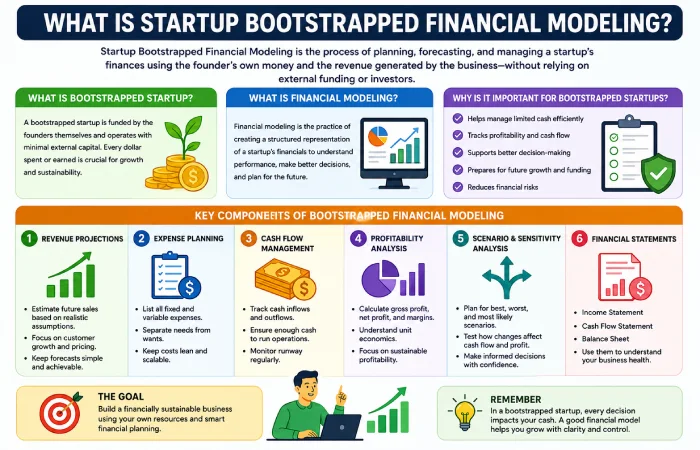
Financial modeling for a bootstrapped startup is a process where you create a plan that helps the founders of a bootstrapped startup figure out how their business will do in the future. The founders of a bootstrapped startup do not use money from investors. They use the money the business makes and the resources they have so they need to plan their finances carefully.
A financial model helps the people who start the business understand what will happen to the money they make what they will spend how cash they will have and if they will make a profit. Most of the time the people who start the business make these models using spreadsheets. They use these spreadsheets to organize their ideas about money and to guess what will happen in the future.
The key things that are usually part of a model for a bootstrapped startup are:
- Financial Component: this is a part of the financial model
- Revenue Forecasting: this is when you try to guess how money you will make
- Expense Planning: this is when you keep track of how much money you are spending
- Profit Analysis: this is when you see if you are making money
- Cash Flow Management: this is when you watch the money that is coming into the business and the money that is leaving the business
- Growth Projections: this is when you plan for the business to get
- Break-Even Analysis: this is when you find out when the business will make enough money to cover the costs
By using financial modeling for a bootstrapped startup the founders can make good decisions based on what they think will really happen. This helps them make a budget spend their money wisely and grow the business in a way that’s good for the business. The founders also get to keep control of the business.
Even a simple financial model for a bootstrapped startup can give the founders some useful ideas and help them keep the business financially healthy when it is just starting out. Financial modeling for a bootstrapped startup is very important for the founders of a bootstrapped startup because it helps them plan for the future and make decisions about the business. Financial modeling, for a bootstrapped startup is something that the founders of a bootstrapped startup should definitely consider..
Why Bootstrapped Start-ups Require Financial Modeling More than Others
Bootstrapped start-ups tend to run their operations with financial constraints.
Unlike other start-ups, entrepreneurs cannot make expensive investments since every penny needs to be earned.
This makes financial planning much more important.
A financial model helps founders avoid common startup problems such as:
- Running out of cash
- Overspending on marketing
- Hiring too early
- Poor pricing decisions
- Uncontrolled software expenses
- Unrealistic revenue expectations
Many startups don’t succeed not because of their poor ideas, but because of inadequate financial plans.
Some startups are capable of making sales, but still face difficulties due to ineffective cash flow management.
Financial modeling assists startupers to learn about such threats beforehand.
Financial modeling helps founders understand these risks before they become serious problems.
Main Benefits of Bootstrapped Financial Modeling
| Benefit | Explanation |
| Better Planning | Helps founders prepare for future growth |
| Expense Control | Reduces unnecessary spending |
| Revenue Forecasting | Improves sales planning |
| Cash Flow Visibility | Helps monitor business survival |
| Risk Reduction | Identifies financial problems early |
| Decision Making | Supports smarter business decisions |
| Growth Management | Helps scale more sustainably |
Because bootstrapped founders usually have limited financial backup, these benefits become extremely valuable.
What Makes Bootstrapped Financial Models Different?
Boostrapped financial models tend to be more conservative than those of venture-backed startups.
Venture-financed businesses focus on fast growth while boostrapped businesses emphasize sustainability as their main goal.
| Area | Bootstrapped Startup | VC-Funded Startup |
| Funding Source | revenue or Personal funds | Investor funding |
| Spending Style | Careful and controlled | Aggressive growth spending |
| Growth Speed | Sustainable growth | Rapid scaling |
| Profitability Focus | Important early | Sometimes delayed |
| Hiring Strategy | Lean teams | Fast expansion |
| Financial Risk | Founder carries more risk | Shared investor risk |
| Budget Flexibility | Limited | Larger budgets |
This difference affects how financial models are created.
Bootstrapped startups usually prioritize:
- Cost control
- Positive cash flow
- Lean operations
- Gradual growth
- Financial stability
Founder’s Guide to Financial Modeling Basics
Financial modeling does not need to be complicated.
Many founders think they need advanced accounting knowledge before creating financial projections.
That is not true.
Most early-stage startups can begin with very simple financial systems.
The goal is clarity.
Not complexity.
A beginner financial model usually contains:
- Revenue estimates
- Expense tracking
- Cash flow calculations
- Profit forecasting
- Growth assumptions
Over time, founders can improve the model as the business grows.
Simple systems are often easier to maintain consistently.
The purpose of startup bootstrapped financial modeling is not to create perfect forecasts but to help founders make informed business decisions.
Basic Parts of a Startup Financial Model
A financial model is made up of several important parts that help the people who started the company understand how their business is doing financially. Each part of the model has a job and helps with planning and making good decisions.
Revenue Forecasting
When we do revenue forecasting for a startup we are trying to figure out how money the company will make over a certain period of time. The people who started the company usually make these predictions based on things like how much they will charge for their products how customers they want to get how many people will actually buy their products and how much people want their products.
If we can predict revenue accurately startups can set goals that they can really achieve and measure how well their business is doing over time.
Next, build out our revenue projections framework.
Expense Forecasting
Expense forecasting is about figuring out all the costs that are related to the business. You can learn more about this in Expense Forecasting for Lean Startups. These costs can include things like software subscriptions, marketing campaigns paying employees and other costs that happen all the time.
If the people who started the company can predict expenses ahead of time they can make a budget that’s realistic and avoid spending money that they do not need to spend, which can affect how much cash they have.
Cash Flow Management
Cash flow management is about keeping track of the money that is coming into and going out of the business. For startups that are paying for themselves it is often more important to have a cash flow than to grow really quickly because the business is relying on the money it makes itself.
If the people who started the company check the cash flow regularly they can find out if they are going to have any problems and keep their business stable.
Profitability Analysis
Profitability analysis is about figuring out if the business is making money than it is spending. This part of the model calculates things like profit, operating profit and net profit to see how well the business is doing financially.
If the people who started the company keep an eye on profitability they can understand if their business model is going to work in the term.
Growth and Scenario Planning
Growth planning is about estimating how much the startup will grow in the future including things like hiring people developing new products and expanding into new markets. Many people who start companies also make plans for different situations like if things go really well if they go as expected or if they do not go well to prepare for things that might change.
Break-Even Analysis
Break-even analysis is about finding the point where the total revenue equals the total expenses. You can learn more about this in Break-Even Analysis for Bootstrapped Startups. Understanding this point helps the people who started the company know how revenue they need to make before their business starts making a profit.
For startups that are paying for themselves getting to the break- point is often a big sign that the business is financially sustainable.
All these parts of a financial model work together to create a framework that helps the people who started the company use their resources efficiently reduce financial risk and make decisions based on data.
How to Build a Financial Model Without Funding
Many founders believe financial modeling requires expensive software or financial consultants.
That is not necessary.
Most bootstrapped startups begin with simple tools.
Examples include:
- Google Sheets
- Microsoft Excel
- Notion
- Airtable
- Free budgeting templates
Just tracking can make a huge difference in business decision making.
Step-by-Step Guide to Create Your First Model
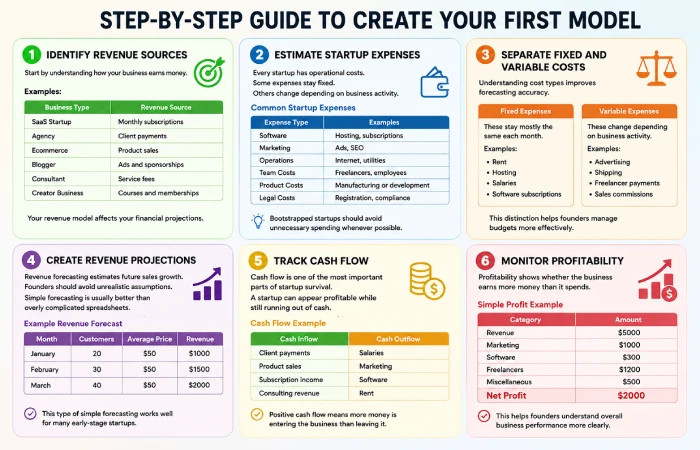
Step 1: Identify Revenue Sources
It is important to start with knowing how your business makes money.
Examples:
| Business Type | Revenue Source |
| SaaS Startup | Monthly subscriptions |
| Agency | Client payments |
| Ecommerce | Product sales |
| Blogger | Ads and sponsorships |
| Consultant | Service fees |
| Creator Business | Courses and memberships |
This will affect your financial forecast.
Step 2: Estimate Startup Expenses
Every startup has operational costs.
Some expenses stay fixed.
Others change depending on business activity.
Common Startup Expenses
| Expense Type | Examples |
| Software | Hosting, subscriptions |
| Marketing | Ads, SEO |
| Operations | Internet, utilities |
| Team Costs | Freelancers, employees |
| Product Costs | Manufacturing or development |
| Legal Costs | Registration, compliance |
If you are bootstrapping, do not spend anything you don’t need.
Step 3: Separate Fixed and Variable Costs
Knowing what the cost is will enhance your forecast.
Fixed Expenses
These stay mostly the same each month.
Examples:
- Rent
- Hosting
- Salaries
- Software subscriptions
Variable Expenses
These change depending on business activity.
Examples:
- Advertising
- Shipping
- Freelancer payments
- Sales commissions
This distinction helps founders manage budgets more effectively.
Step 4: Create Revenue Projections
Sales forecast involves predicting sales growth.
Founders should avoid unrealistic assumptions.
Simple forecasting is usually better than overly complicated spreadsheets.
Example Revenue Forecast
| Month | Customers | Average Price | Revenue |
| January | 20 | $50 | $1000 |
| February | 30 | $50 | $1500 |
| March | 40 | $50 | $2000 |
This type of simple forecasting works well for many early-stage startups.
Step 5: Track Cash Flow
Cash flow is one of the most important parts of startup survival.
A startup can appear profitable while still running out of cash.
Cash Flow Example
| Cash Inflow | Cash Outflow |
| Client payments | Salaries |
| Product sales | Marketing |
| Subscription income | Software |
| Consulting revenue | Rent |
Positive cash flow implies that the amount of cash inflow into the business is higher than cash outflow.
Step 6: Monitor Profitability
Profitability reveals whether the firm earns more than it spends.
Simple Profit Example
| Category | Amount |
| Revenue | $5000 |
| Marketing | $1000 |
| Software | $300 |
| Freelancers | $1200 |
| Miscellaneous | $500 |
| Net Profit | $2000 |
This helps founders understand overall business performance more clearly.
Essential Assumptions Every Founder Should Make
Every financial model depends on assumptions.
Assumptions are estimated numbers used to predict future business performance.
Good assumptions improve forecasting accuracy.
Bad assumptions create unrealistic financial plans.
Important startup assumptions include:
- Expected customer growth
- Product pricing
- Monthly expenses
- Marketing costs
- Employee costs
- Conversion rates
- Retention rates
- Seasonal demand
Founders should keep assumptions realistic and conservative.
One of the most frequent errors committed by startups is overestimation of revenue.
Common Financial Metrics Every Bootstrapper Should Track
Tracking financial metrics helps founders understand overall business health.
Burn Rate
Burn rate measures how quickly a startup spends money.
High burn rates increase financial risk.
Cash Runway
“Runway” is a term that measures how long the company can survive without funds.
Profit Margin
Profit margin measures how much profit remains after expenses.
Customer Acquisition Cost
The cost incurred in generating new business is measured here.
Monthly Recurring Revenue (MRR)
Recurring income on a month-to-month basis.
MRR is especially important for SaaS startups.
Financial Metrics Table
| Metric | Why It Matters |
| Burn Rate | Measures spending speed |
| Cash Runway | Predicts survival time |
| Profit Margin | Shows business health |
| CAC | Tracks marketing efficiency |
| MRR | Measures recurring growth |
Consistent metric monitoring enhances decision-making.
Bootstrapped Startup Budget Template (Download for Free)
A startup budget assists entrepreneurs in managing their expenditure per month.
Simple budgeting avoids overspending.
Simple Startup Budget Example
| Category | January | February | March |
| Revenue | $1000 | $1500 | $2000 |
| Marketing | $200 | $250 | $300 |
| Software | $100 | $100 | $100 |
| Team Costs | $300 | $400 | $500 |
| Net Profit | $400 | $750 | $1100 |
This simple structure helps founders:
- Monitor monthly performance
- Predict future expenses
- Understand profitability
- Reduce unnecessary spending
- Improve cash flow planning
Early stage businesses have little problem with keeping track of their finances using simple spreadsheets.
Common Financial Mistakes Founders Should Avoid
A lot of self-funded founders end up making mistakes when dealing with finances in the early stages of business growth.
| Mistake | Problem |
| Overestimating sales | Creates unrealistic expectations |
| Ignoring cash flow | Causes financial pressure |
| Hiring too early | Increases operating costs |
| Overspending on software | Wastes startup capital |
| No emergency savings | Creates survival risk |
| Poor budgeting | Reduces financial control |
Simple financial discipline often matters more than complicated spreadsheets.
Why Startup Revenue Projections Often Fail
Making guesses about how money a startup will make is helpful but a lot of startups make mistakes when they do this. They think they will make money than they really will.
There are some reasons why this happens.
- They think they will get customers than they really do
- They do not pay attention to what other companiesre doing
- They do not have a plan for selling their product
- They charge the price for what they are selling
- They do not think about how their business might change at times of the year
If startups are careful when they make these guesses they can make better plans for how they will use their money.
Why Startup Cash Flow Becomes Negative
A lot of startups have problems with money coming in and going out.
Even companies that are making money can still have trouble paying their bills.
Some things that can cause this to happen include:
- Customers taking a time to pay what they owe
- Having a lot of expenses every month
- Spending much money on advertising
- Not making a good budget
- Hiring many people too quickly
- Charging little money for what they are selling
Being able to manage money is something that startup founders really need to be good, at if they want their company to survive.
Financial Modeling Tools for Beginners
Different startups use different tools depending on budget and business complexity.
Free Financial Tools
| Tool | Best For |
| Google Sheets | Beginners |
| Notion | Simple planning |
| Excel | Detailed financial models |
| Airtable | Workflow tracking |
Paid Financial Tools
| Tool | Best For |
| QuickBooks | Accounting |
| Xero | Financial management |
| FreshBooks | Freelancers |
| LivePlan | Startup planning |
Most early-stage startups can begin with free spreadsheet tools.
Real-Life Examples of Bootstrapped Startup Financial Discipline
Many successful companies started without heavy investor funding.
Examples include:
| Startup | Industry |
| Mailchimp | Email Marketing |
| Basecamp | Project Management |
| Zoho | Business Software |
| TechSmith | Software |
| Spanx | Apparel |
These businesses focused heavily on:
- Controlled spending
- Sustainable growth
- Profitability
- Lean operations
- Strong cash management
This shows that startups do not always need massive funding to become successful.
Signs Your Financial Model Needs Updating
Financial models should evolve as the business grows.
Ignoring updates may create inaccurate forecasts.
Common signs include:
- Revenue changes
- Team expansion
- Rising expenses
- Product launches
- Market slowdowns
- Pricing changes
Most startups should review financial projections monthly.
Scenario Planning for Bootstrapped Startups
When you are starting a business you have to think about what might happen. Scenario planning is a way for founders to get ready for things that’re not certain.
For example what happens if people stop buying from you? What if it costs more to market your business? What if you do not get many new customers as you want? What if you launch a product and it does not work out?
Thinking about all these things that could happen helps your business be more stable.
Scenario planning helps founders prepare for uncertainty. For a detailed framework, see Scenario Planning for Bootstrapped Startups.
Internal Growth Strategy for Bootstrapped Founders
If you want your business to grow you need to have a plan for money. Bootstrapped founders should make sure their financial plans will work for a time.
Founders should focus on things like scaling. They should also think about controlled hiring and smart marketing. It is important to have operations and to keep your customers. You want to have cash flow.
It is better to grow your business and be careful with your money than to try to grow too fast without a plan. Slow growth with financial discipline is often safer than rapid expansion without planning. Scenario planning and internal growth strategy are important, for bootstrapped startups..
FAQ Section
What is bootstrapped modeling?
Bootstrapped financial modeling is when you plan the money that your startup will make the money it will spend the money that comes in and out and the profits all without getting money from investors.
Why do startups need models?
Startups need models so that the people who started the company can see how the business is doing control the money they spend and avoid problems with money.
Can beginners create models?
Yes beginners can make models. A lot of startups start with spreadsheets and basic ways to predict what will happen.
What is the free financial modeling tool?
Google Sheets and Excel are tools for beginners to use because they are free and easy to use.
What is the important startup financial metric?
Cash flow is very important, for startups because it determines if the business will survive. Startups need to have money coming in to pay for everything.
How often should startups update models?
Most startups should update what they think they will make and spend every month. This helps them stay on track and make sure they have money.
As a startup grows, its financial needs become more complex. A well-structured startup bootstrapped financial modeling system helps founders stay prepared, reduce uncertainty, and make confident decisions based on real numbers.
Conclusion
Bootstrapped financial modeling is really helpful for founders who want to build a business. It helps them be more careful with money and make plans. This way they can avoid risks.
A financial model does not have to be super complicated.
Even a simple spreadsheet can be very useful, for founders. It helps them see how much money is coming in how much is going out if they are making a profit and if they have cash.
Bootstrapped startups often do well because they focus on being sustainable. They do not spend much money.
If founders keep track of their money all the time and make decisions they can make their business more stable in the long run. Their business can also grow.
The main goal of modeling is not to make the perfect spreadsheet.
Then map your cash flow model.