

Introduction
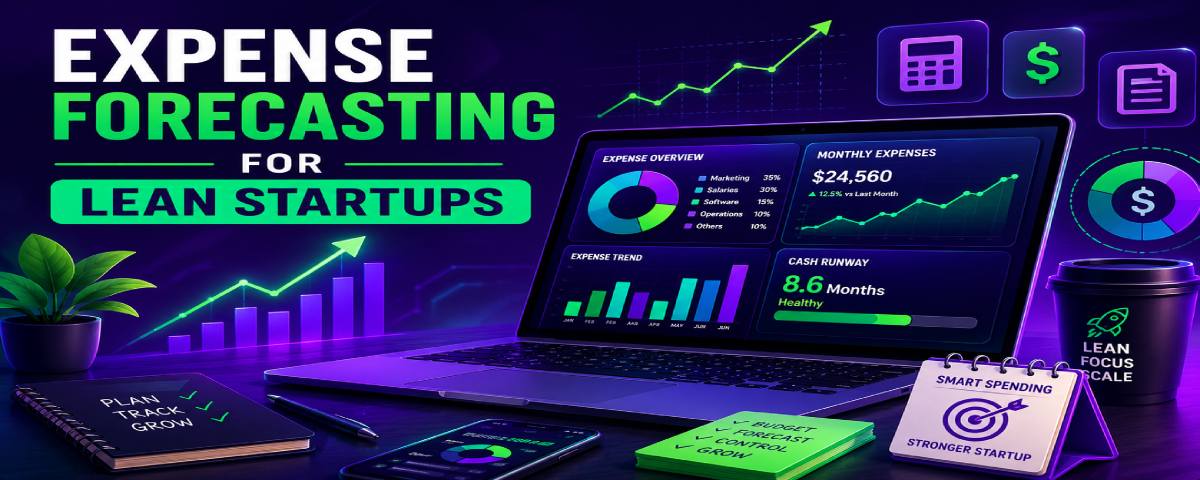
Expense forecasting is super crucial for lean startups. Here’s the thing some entrepreneurs focus on ramping up sales and snagging more customers, managing costs well matters a ton for lasting success.
You know bootstrapped startups, each dollar matters since there are no investors to help out during cost spikes.
Let me tell you founders must keep track of their spending, forecast expenses, and look for ways to handle costs without stopping growth.
Here’s the thing predicting future expenses through looking at present spending, growth targets, and business strategies allows for better planning. This way, they can avoid financial troubles before they hit.
When done correctly, expense forecasting can help startups:
- Improve profitability
- Extend cash runway
- Reduce financial stress
- Avoid unnecessary spending
- Prepare for growth
- Improve financial planning
In this guide, you will learn how to manage Bootstrapped Startup Expense Categories, understand Fixed vs Variable Costs for Startups, use a Lean Operating Expense Template, discover practical ways on How to Cut Costs in a Bootstrapped Startup, and explore the best Expense Tracking Tools for Founders.
Expense forecasting from our Bootstrapped Financial Modeling guide
Why Expense Forecasting Matters
Here’s the thing many startup founders believe revenue is the most important financial metric.
Basically revenue is important, but expenses determine how much of that revenue remains available for good growth and best profitability.
Basically a startup that makes $10,000 every month but spends $11,000 is actually losing money.
That does not make sense.
A startup that brings in $6,000 and only spends $4,000 is doing better.
- It has room to grow.
- The first one needs to cut costs.
- The second one can use its money to invest in growth..
Forecasting expenses lets founders know what they’ll spend before it actually happens, which is super. Reference: According to U.S. Small Business Administration (SBA), financial forecasting helps businesses plan cash flow, manage expenses, and support long-term growth
Benefits of Expense Forecasting
| Benefit | Why It Matters |
| Better Budget Control | Prevents overspending |
| Improved Cash Flow | Supports healthy finances |
| Longer Runway | Extends startup survival |
| Smarter Hiring | Avoids unnecessary payroll growth |
| Better Planning | Supports future expansion |
| Risk Reduction | Identifies potential financial issues |
Forecasting expenses is especially important during the early stages of business growth because resources are usually limited.
Bootstrapped Startup Expense Categories You Must Track
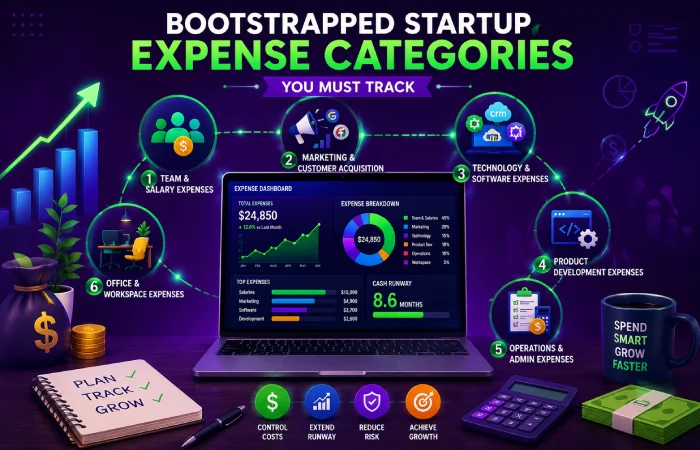
Understanding here’s the thing where money goes is the first step toward controlling expenses.
Most startup costs fall into several major categories.
Team and Salary Expenses
People-related costs are often the largest expense category for growing startups.
Examples include:
- Founder salaries
- Employee wages
- Freelancers
- Contractors
- Virtual assistants
- Consultants
Example
| Team Expense | Monthly Cost |
| Founder Salary | $1,500 |
| Freelancer | $600 |
| Virtual Assistant | $300 |
| Consultant | $400 |
When a startup gets bigger the money it spends on payroll goes up a lot. Figuring out how people the startup will need to hire helps prevent problems, with cash flow though.
Marketing and Customer Acquisition Expenses
A lot of startups put a lot of money into getting new customers.
Common things that startups spend money on for marketing include:
- Google Ads
- Facebook Ads
- SEO services
- Content writing
- Email marketing software
- Influencer partnerships
Marketing Budget Example
| Marketing Activity | Monthly Cost |
| Google Ads | $400 |
| SEO Content | $300 |
| Email Software | $50 |
| Social Ads | $250 |
Staying on top of marketing spending shows founders how much it costs to acquire customers and the return on investment
Technology and Software Expenses
You will have to pay for technology when you have a business.
Technology expenses are something that most digital businesses have to deal with.
The thing is, technology expenses are a part of doing business online.
Examples include:
- Website hosting
- CRM software
- Design tools
- Analytics tools
- Project management software
- Communication platforms
Technology expenses, like these are a thing for digital businesses.
Digital businesses have to pay for technology expenses, such, as technology and software expenses in order to operate.
Technology and software expenses are a part of digital businesses.
Technology Cost Example
| Tool | Monthly Cost |
| Hosting | $25 |
| CRM | $30 |
| Design Software | $20 |
| Project Management Tool | $15 |
Many startups accumulate software subscriptions over time, making this category important to review regularly.
Product Development Expenses
Product development costs are especially important for SaaS startups and technology businesses.
Examples include:
- Software development
- App maintenance
- Testing tools
- Cloud infrastructure
- Security services
These expenses often increase as products become more advanced.
Operations and Administrative Expenses
Operational costs support daily business activities.
Examples include:
- Internet service
- Phone service
- Accounting
- Legal services
- Banking fees
- Business licenses
Even if costs appear tiny individually, they pile up big time over months.
Office and Workspace Expenses
Some startups operate remotely while others require office space.
Possible expenses include:
- Office rent
- Utilities
- Equipment
- Furniture
- Coworking memberships
Remote-first businesses often reduce these expenses substantially.
Fixed vs Variable Costs for Startups
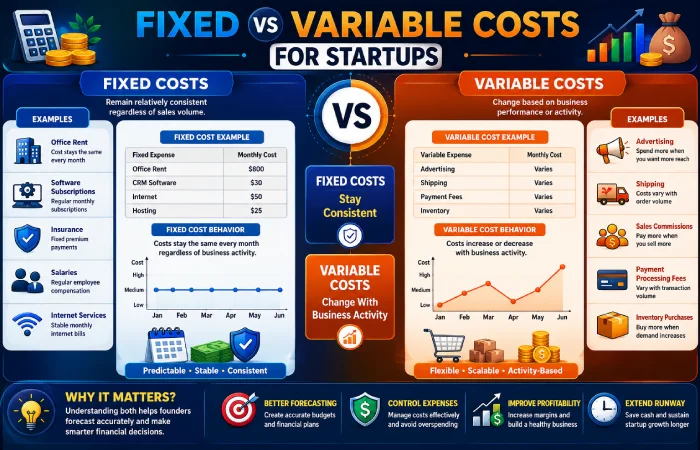
Understanding Fixed vs Variable Costs for Startups is one of the most important parts of expense forecasting. These cost estimates become even more accurate when combined with Cash Flow Modeling for Bootstrapped Startups.
Project cash flows in our cash flow modeling guide.
Not all expenses behave the same way.
Cash Flow Modeling for Bootstrapped Startups.
Not all expenses behave the same way.
Some costs stay stable each month.
Others change depending on business activity.
Understanding the difference helps founders create more accurate forecasts.
What Are Fixed Costs?
Fixed costs remain relatively consistent regardless of sales volume.
Examples include:
- Office rent
- Software subscriptions
- Insurance
- Salaries
- Internet services
Fixed Cost Example
| Fixed Expense | Monthly Cost |
| Office Rent | $800 |
| CRM Software | $30 |
| Internet | $50 |
| Hosting | $25 |
These expenses typically remain stable over short periods.
What Are Variable Costs?
Variable costs change based on business performance or activity.
Examples include:
- Advertising
- Shipping
- Sales commissions
- Payment processing fees
- Inventory purchases
Variable Cost Example
| Variable Expense | Monthly Cost |
| Advertising | Varies |
| Shipping | Varies |
| Payment Fees | Varies |
| Inventory | Varies |
When sales increase, variable costs often increase as well.
Why Founders Must Understand Both
Knowing the difference helps founders make best smarter financial decisions.
During difficult periods:
- Variable expenses can often be reduced quickly.
-
Actually fixed expenses are usually harder to change.
You now lean startups often focus on keeping fixed costs as low as possible.
This creates flexibility and reduces financial pressure.
Fixed vs Variable Costs Comparison
| Area | Fixed Costs | Variable Costs |
| Changes Monthly | Rarely | Frequently |
| Easier to Predict | Yes | No |
| Can Be Reduced Quickly | Difficult | Easier |
| Impact on Cash Flow | Consistent | Flexible |
| Examples | Rent, Salaries | Ads, Shipping |
How to Forecast Expenses Accurately
Many founders believe expense forecasting requires advanced financial knowledge.
In reality, simple forecasting methods work well for most startups.
The goal is not perfection.
The goal is preparation.
Step 1: RevieStepw Historical Spending
You need to look at your spending.
- What did you buy with your money before?
- When you do this you have to think about some things.
- Did you ever purchase something that was totally unplanned by you?
You must be able to distinguish what necessities you will require in spending money on.
Looking at Historical Spending can really help you with your money.
It can help you figure out what you will spend your money on later.
Historical Spending is, like a guide to help you with your money in the future.
Step 2: Identify Upcoming Expenses
What you plan to do with your business will affect what you spend money on.
For example you might spend money on:
- Hiring employees
- Launching products
- Running marketing campaigns
- Upgrading your software
- Buying equipment
When you try to figure out what you will spend money on you should think about the things you want to do to grow your business like hiring employees and launching products and running marketing campaigns and upgrading your software and buying new equipment.
Step 3: Create Monthly Forecasts
Forecast expenses month by month.
Example Expense Forecast
| Month | Forecasted Expenses |
| January | $2,000 |
| February | $2,200 |
| March | $2,400 |
| April | $2,600 |
This simple approach helps founders prepare for upcoming costs.
Step 4: Separate Optional Spending
You have to think about what you really need to spend money on. Not all expenses are equally important. Some things you have to pay for, no matter what.
Essential Expenses are the things you cannot do without. Examples of these are:
- Hosting
- Payroll
- Utilities
- Core software
Then there are Optional Expenses. These are the things that’re nice to have but you can live without them. Examples of these are:
- Additional software
- Premium subscriptions
- -essential equipment
It is truly very useful for you to understand the difference between Essentials and Discretionary Items during a slowdown period.
Step 5: Adjust for Inflation and Price Increases
A lot of things cost more over time. For example:
- Software subscription prices go up
- Advertising costs increase
- Salaries get
- Service fees rise
If you add a little extra to your budget to account for these increases you will be better, at predicting what you will spend. This helps you plan better.
Step 6: Develop Multiple Forecast Scenarios
The smart entrepreneurs are always prepared for different scenarios. Most entrepreneurs use Scenario Planning for Bootstrapped Startups when developing the financial forecast for their startup companies
Scenario Planning Example
| Scenario | Monthly Expenses |
| Best Case | $2,000 |
| Expected Case | $2,500 |
| Worst Case | $3,200 |
This approach helps startups stay prepared for uncertainty.
Before finalizing your forecast, ask:
- Have all recurring expenses been included?
- Have future hiring costs been considered?
- Are software subscriptions accounted for?
- Have marketing costs been forecasted?
- Is there room for unexpected expenses?
- Have multiple scenarios been created?
A simple checklist can improve forecasting accuracy and reduce surprises.
Expense forecasting is not about building complex spreadsheets. It’s about knowing where your money goes and preparing for upcoming costs beforehand.
By keeping track of Bootstrapped Startup Expense Categories and knowing the difference between Fixed and Variable Costs, along with figuring out how to forecast expenses right, founders can make smarter financial choices and cut down risks.
This way, the founders will be able to make better decisions regarding finances. The greatest startups may not necessarily be those that spend much money. Rather, they are those that manage money well.
Common Expense Forecasting Mistakes
Even careful business owners trip up when forecasting. Mostly due to overly sunny growth views or overlooking future costs.
Grasping these typical blunders can boost financial planning and shield new ventures from avoidable headaches.
Underestimating Expenses
Many startups focus only on major costs and forget smaller recurring expenses.
Examples include:
- Software subscriptions
- Payment processing fees
- Banking charges
- Cloud storage
- Domain renewals
Individually, these costs may look minimal, but collectively, they may greatly influence the bottom line.
Example
| Expense | Monthly Cost |
| Hosting | $25 |
| Email Tool | $20 |
| CRM | $30 |
| Design Tool | $15 |
| Storage | $10 |
| Total | $100 |
Over one year, this becomes $1,200.
Making Money Mistakes
Lots of people who start businesses think they will make money than they really will.
This means they make budgets that’re not realistic and they spend too much money.
It is better to be safe and not expect much money to come in.
For example if you think you might get 100 customers just plan for 50.
If you get customers than you thought that is great for your business.
Not Paying Attention To The Time Of Year
Some businesses make money at certain times of the year.
Here are a few examples:
- Online stores usually do well during holidays.
- Schools and things like that often have times of the year when more people sign up.
- Tourism businesses have times when they’re busy and times when they are not.
If you do not pay attention to what time of year it’s you might not have a good idea of how much money you will make.
Forgetting About The Costs Of Hiring New People
When you hire people it usually costs you money before you start making more money.
There are a lot of costs that come with hiring people, such, as:
- Salaries
- Benefits
- Equipment
- Training
People who start businesses should think about these costs before they hire someone.
Not Updating Forecasts
Expense forecasts are not one-time activities.
Business conditions change regularly.
Most startups should review forecasts monthly.
Growing businesses may need weekly reviews.
Mixing Personal and Business Expenses
It leads to inaccurate accounting and difficult forecasting.
Best practice:
- Separate bank accounts
- Separate credit cards
- Separate bookkeeping systems
Well-kept records aid in accurate forecasting.
Ignoring Inflation and Price Increases
Costs rarely remain constant forever.
Examples:
- Advertising costs increase
- Software providers raise prices
- Service providers adjust rates
Forecasts should include reasonable cost increases.
Expense Forecasting Examples for Different Startup Types
ach company will incur its own unique expenses.
Recognizing such differences helps entrepreneurs forecast better.
SaaS Startup Example
SaaS companies tend to incur relatively lower inventories and higher technology-related costs.
Common SaaS Expenses
- Developers
- Cloud hosting
- Customer support
- Security services
- Software subscriptions
Sample SaaS Monthly Budget
| Category | Monthly Cost |
| Hosting | $300 |
| Development | $2,000 |
| Customer Support | $500 |
| Marketing | $700 |
| Software Tools | $200 |
| Total | $3,700 |
SaaS entrepreneurs must be careful about their costs related to hosting and development, as they will tend to rise as the number of customers increases.
Ecommerce Startup Example
Ecommerce businesses typically face inventory and best shipping expenses.
Common Ecommerce Expenses
- Inventory
- Packaging
- Shipping
- Advertising
- Website maintenance
Sample Ecommerce Budget
| Category | Monthly Cost |
| Inventory | $2,500 |
| Shipping | $600 |
| Marketing | $800 |
| Website | $100 |
| Packaging | $300 |
| Total | $4,300 |
Agency Business Example
Agencies often depend heavily on labor costs.
Common Agency Expenses
- Freelancers
- Contractors
- Marketing
- Software
- Client management tools
Sample Agency Budget
| Category | Monthly Cost |
| Freelancers | $1,500 |
| Software | $150 |
| Marketing | $300 |
| Operations | $200 |
| Total | $2,150 |
Freelance Business Example
Freelance businesses typically have lower operating costs.
Common Freelancer Expenses
- Website
- Marketing
- Software
- Education
- Professional memberships
Sample Freelancer Budget
| Category | Monthly Cost |
| Website | $25 |
| Software | $40 |
| Marketing | $100 |
| Training | $50 |
| Miscellaneous | $35 |
| Total | $250 |
Freelancers often benefit from lean operations and flexible expenses.
Startup Expense Comparison Table
| Startup Type | Largest Expense |
| SaaS | Product Development |
| Ecommerce | Inventory |
| Agency | Labor |
| Freelancer | Software & Marketing |
This will allow for creating better estimates.
Troubleshooting Expense Forecasting Problems
However prepared, even the best estimates can turn out to be wrong.
Here are some possible solutions founders can use to solve their problems.
Expenses Keep Increasing
Possible Causes
- Growing team
- More software subscriptions
- Increased advertising
- Rising service costs
Solutions
- Review recurring subscriptions
- Audit monthly spending
- Negotiate vendor pricing
- Remove unused tools
Budget Is Always Exceeded
Possible Causes
- Unrealistic assumptions
- Missing expense categories
- Poor spending controls
Solutions
- Compare forecast vs actual expenses monthly
- Improve budgeting accuracy
- Add contingency funds
Revenue Is Growing but Profit Is Not
Possible Causes
- Expenses increasing faster than sales
- Rising customer acquisition costs
- Low pricing
Solutions
- Analyze profit margins
- Review marketing efficiency
- Optimize operating expenses
Cash Flow Is Tight
Possible Causes
- High operating expenses
- Slow customer payments
- Aggressive expansion
Solutions
- Reduce unnecessary spending
- Improve collections
- Delay non-essential purchases
Forecasts Are Frequently Wrong
Possible Causes
- Limited historical data
- Poor assumptions
- Rapid business changes
Solutions
- Forecast monthly
- Review historical spending
- Update assumptions regularly
Related Financial Modeling Guides: To build a complete financial planning system, founders should also study the following topics.
Bootstrapped Financial Modeling Basics
You know learn how revenue, expenses, cash flow, and profitability work together in a startup financial model.
Revenue Projections for Bootstrapped Startups
The best part is understand realistic sales forecasting and growth planning.
Cash Flow Modeling for Bootstrapped Startups
Understand your company’s finances and cash flow management, which is more important than profits.
Break-Even Analysis for Bootstrapped Startups
You know discover the point where your startup begins generating profit.
Financial Modeling Tools for Bootstrappers
Believe me Compare spreadsheets, forecasting software, and budgeting tools.
Scenario Planning for Bootstrapped Startups
You know prepare for best-case, expected, and worst-case business situations.
Bootstrapped Startup Valuation Methods
Understand how to value the value of self-financed firms using various methods based on revenue, profit, and growth.
Frequently Asked Questions (FAQ)
What is expense forecasting?
Basically expense forecasting is the process of estimating future best business costs based on current you know spending patterns and growth plans.
Why is expense forecasting important for startups?
This is actually a way for founders to control cash flow, not to spend more than necessary, and possibly enhance financial planning.
What are bootstrapped startup expense categories?
Take the case of common categories include salaries, software, marketing, operations, and administrative expenses.
What is the difference between fixed and variable costs?
Actually fixed costs remain stable, while variable costs change based on best business activity.
How often should startups update expense forecasts?
Take the case of Most startups should review forecasts monthly.
What is a lean operating expense template?
An easy example is a budgeting tool where both planned and actual spending can be monitored.
Conclusion
Predicting expenses is key for startup founders. While many focus on growing revenue, managing costs actually speeds up and stabilizes profitability gains.
Learning about different bootstrapped startup costs, figuring out fixed versus variable costs, making solid forecasts, and using good expense tracking tools can really help. Entrepreneurs end up making smarter financial choices and cut down risks too.
The thing is, successful bootstrapped companies aren’t always the cheapest around. This doesn’t mean having to estimate each cost to the last cent, but rather understanding your costs, working intelligently, and planning properly. What you really need to do is to matter more.
Reach profit using our break-even analysis guide.