

Induction
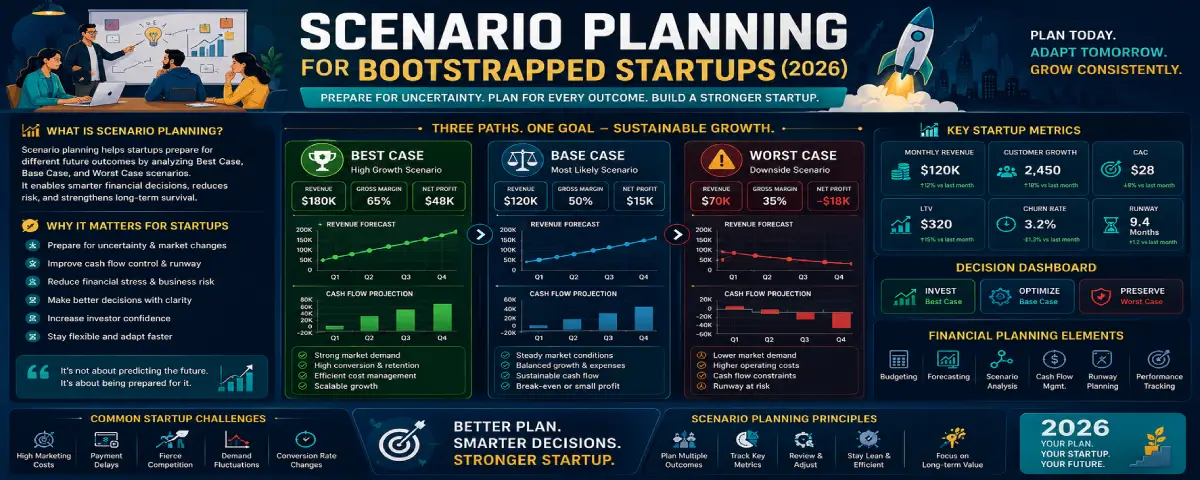
Scenario planning is one of the most practical tools for bootstrapped startups and an important part of Bootstrapped Financial Modeling Basics because it helps founders prepare for uncertainty before it happens. Instead of depending on a single financial prediction, startups build different possible outcomes to understand how the business may perform in real situations.
For founders who are bootstrapping this is really important because every single decision they make affects Cash Flow Modeling for Bootstrapped Startups and how their business grows and stays alive.
When they do not have a lot of money to work with tiny mistakes can cause big problems.
Scenario planning is a help because it shows them what could go well what could go badly and what is most likely to happen to their Cash Flow Modeling, for Bootstrapped Startups.
In simple terms, it helps founders stay prepared instead of surprised. According to Corporate Finance Institute (CFI), scenario analysis helps businesses evaluate multiple possible outcomes and improve decision-making under uncertainty.
Scenario planning from our bootstrapped financial modeling guide.
Why Scenario Planning is Important for Startups
Running a startup is never really stable. One month your sales can go up fast and the next month everything can slow down. This can happen because of competition. Because you have to spend a lot on marketing or because customers start wanting different things. This is where a lot of startups have problems. They only plan for one thing to happen.
Scenario planning allows the entrepreneur to overcome this challenge through planning for several possible outcomes, instead of relying on one set of Revenue Projections for Bootstrapped Startups. Scenario planning is a much more practical approach in early or bootstrapped stage companies, where each rupee counts.
Understanding the Real Problem Startups Face
Start-ups don’t fail because of a flawed business idea; rather, the failures result from poor preparation for uncertainty.
Common real-world situations include:
- Marketing costs suddenly increase
- Customer demand drops after initial growth
- A competitor enters the market with lower pricing
- Payment delays affect cash flow
- Conversion rates fluctuate without warning
Without scenario planning, founders often react too late. With it, they prepare in advance.
How Scenario Planning Actually Helps Founders
Scenario planning isn’t just financial planning; it’s a means of decision-making that forces entrepreneurs to plan for any eventuality in their minds before it occurs
Instead of asking:
“How much will I earn this month?”
Founders start asking:
“What happens if I earn less than expected?”
“What if my costs go up suddenly?”
“How long can my startup survive without new customers?”
This change in attitude is highly crucial for survival.
Key Benefits of Scenario Planning
1. Reduces Business Risk in Real Time
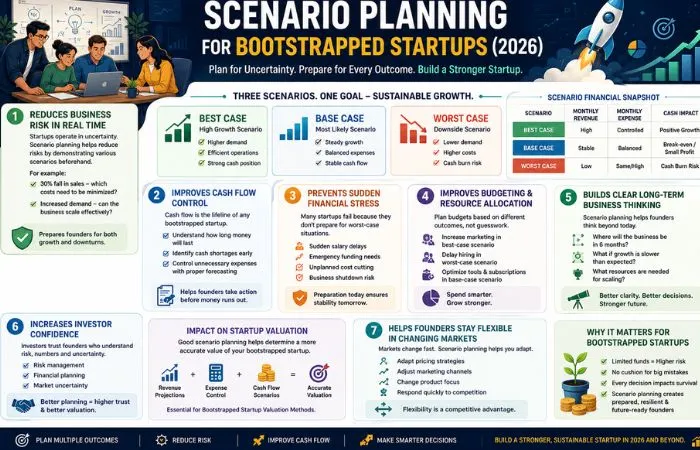
Startups operate in uncertainty. Scenario planning helps reduce risks by demonstrating various scenarios beforehand.
For example:
- In case of a 30% fall in sales, which costs need to be minimized?
- In case of increased demand, will the firm cope with scaling up operations?
This prepares founders for both growth and downturns.
2. Improves Cash Flow Control (Most Important for Bootstrapped Startups)
Cash flow is the lifeline of any bootstrapped startup.
Scenario planning helps founders:
- Understand how long money will last
- Identify when cash shortage may happen
- Control unnecessary expenses early through proper Expense Forecasting for Lean Startups.
Simple Example:
| Scenario | Monthly Revenue | Monthly Expense | Cash Impact |
| Best Case | High | Controlled | Positive growth |
| Base Case | Stable | Balanced | Break-even / small profit |
| Worst Case | Low | Same/high | Cash burn risk |
This helps founders take action before money runs out.
Understanding when a startup reaches profitability becomes easier when founders conduct a Break-Even Analysis for Bootstrapped Startups alongside scenario planning. This helps determine the revenue required to cover expenses and achieve sustainable growth.
3. Prevents Sudden Financial Stress
Many startups fail because they don’t prepare for worst-case situations.
Scenario planning helps avoid:
- Sudden salary delays
- Emergency funding situations
- Unplanned cost cutting
- Business shutdown risk
Through proper preparation, founders maintain stability even when there are lean times.
4. Improves Budgeting and Resource Allocation
Instead of spending randomly, founders can plan budgets based on different outcomes.
For example:
- Marketing budget can be increased only in best-case scenario
- Hiring decisions can be delayed in worst-case scenario
- Tools and subscriptions can be optimized in base-case scenario
This makes spending smarter and more controlled.
5. Builds Clear Long-Term Business Thinking
Startups often focus only on short-term survival.
Scenario planning helps founders think long term:
- Where will the business be in 6 months?
- What if growth is slower than expected?
- What resources will be needed for scaling?
This creates better clarity in decision-making.
6. Increases Investor Confidence
Even though most startups might be bootstrapping at inception, many ultimately look for funding in different ways.
Investors prefer founders who understand:
- Risk management
- Financial planning
- Market uncertainty
When you do good scenario planning it also helps you figure out a more accurate value of your Bootstrapped Startup. This is because the founders can see how different things like revenue and expenses, and cash flow will affect the value of the business. They can look at all these outcomes and get a better idea of what the business is worth. This is really important, for Bootstrapped Startup Valuation Methods.
7. Helps Founders Stay Flexible in Changing Markets
Markets change quickly—especially in tech, ecommerce, and digital services.
Scenario planning helps founders:
- Adapt pricing strategies
- Adjust marketing channels
- Change product focus if needed
- Respond quickly to competition
Flexibility becomes a strong advantage.
Why It Matters More for Bootstrapped Startups
Bootstrapped startups don’t have external funding support, so they cannot afford long mistakes.
That is why scenario planning acts like a financial safety system.
It helps founders:
- Survive longer with limited cash
- Avoid unnecessary spending
- Make safer decisions during uncertainty
- Focus on profitability instead of only growth
Simple Summary Table
| Benefit Area | What It Helps With |
| Risk Management | Prepares for uncertainty |
| Cash Flow Control | Avoids money shortages |
| Financial Stability | Reduces sudden crises |
| Budget Planning | Smarter spending decisions |
| Strategic Thinking | Long-term clarity |
| Investor Readiness | Better fundraising confidence |
| Market Adaptability | Quick response to changes |
Best Insight
The thing about planning for the future is that it is not about getting everything right. It is about making sure the startup is ready for whatever happens.
For people who start companies those who do it on their own without a lot of money planning for different things that can happen is a really useful thing to do. It helps them make decisions it helps them not worry so much about money and it helps them build a strong company that will last.
Startups that think about all the things that can happen are always more ready for what’s going to happen than startups that just think one thing will happen. Planning for scenarios is just a good idea, for startups.
Best Case vs Worst Case Financial Scenarios
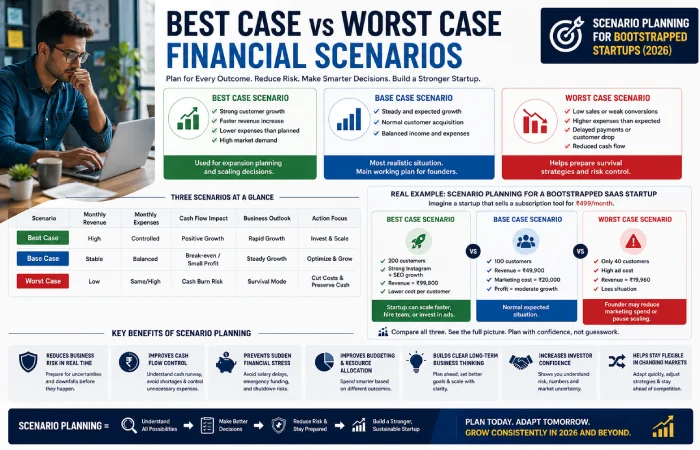
One of the simplest ways to understand scenario planning is by building three financial situations: best case, base case, and worst case.
1. Best Case Scenario
This is when everything goes better than expected.
- Strong customer growth
- Faster revenue increase
- Lower expenses than planned
- High market demand
This scenario is usually used for expansion planning and scaling decisions.
2. Base Case Scenario
This is the most realistic version of the business.
- Steady and expected growth
- Normal customer acquisition
- Balanced income and expenses
This is usually the main working plan for founders.
3. Worst Case Scenario
This is when business performance slows down.
- Low sales or weak conversions
- Higher expenses than expected
- Delayed payments or customer drop
- Reduced cash flow
This scenario helps founders prepare survival strategies.
By comparing all three, founders get a clear picture of financial possibilities instead of depending on guesswork.
Real Example of Scenario Planning for a Bootstrapped Startup
Let’s understand scenario planning with a simple example of a small SaaS startup.
Imagine a startup that sells a subscription tool for ₹499/month.
Base Case Scenario
- 100 customers in Month 1
- Revenue = ₹49,900
- Marketing cost = ₹20,000
- Profit = moderate growth
This is the normal expected situation.
Best Case Scenario
- 200 customers
- Strong Instagram + SEO growth
- Revenue = ₹99,800
- Lower cost per customer
Startup can scale faster, hire team, or invest in ads.
Worst Case Scenario
- Only 40 customers
- High ad cost
- Revenue = ₹19,960
- Loss situation
Founder may reduce marketing spend or pause scaling.
Stress Testing a Bootstrapped Business
Stress test is a process that tests the robustness of a startup under stress. This gives entrepreneurs an idea about what would break their company and its weaknesses.
Some simple stress questions include:
- What if revenue drops by 40% suddenly?
- Can the business survive for 2–3 months without new customers?
- What happens if advertising costs double?
- What if a major client stops working with the company?
These questions help founders prepare backup plans before problems actually happen.
Practical Tips for Better Scenario Planning
Here are some simple but powerful tips founders can follow:
- Always Start Simple
Don’t build complex models in the beginning. Even a basic Excel sheet is enough to start.
- Focus on Cash Flow First
For bootstrapped startups, cash flow matters more than profit. Always track how long money will last.
- Update Scenarios Monthly
Markets change quickly. Update your best, base, and worst case every month.
- Use Real Data, Not Guessing
Base your numbers on real customer behavior, not assumptions.
- Prepare for Worst Case First
Most founders plan for growth, but smart founders first ensure survival.
Sensitivity Analysis for Startup Models
The sensitivity analysis refers to knowing what variables influence your business. Every little change in something can affect the entire performance.
Important variables include:
- Customer acquisition cost
- Conversion rate
- Pricing changes
- Monthly churn rate
- Operating expenses
For example, what is the decline in percentage terms of profits when marketing costs increase by 20 percent?
It helps entrepreneurs focus only on relevant figures, rather than keeping an eye on everything..
Scenario Planning Templates for Founders
Most startups do not need complex tools to start scenario planning. A simple structure in Excel or Google Sheets is enough.
A basic model usually includes:
Revenue side:
- Number of customers
- Average revenue per customer
- Conversion rate
Cost side:
- Fixed costs like tools, salaries, rent
- Variable costs like ads and commissions
Output:
- Monthly revenue
- Profit or loss
- Cash runway
Many entrepreneurs begin with basic spreadsheets, but refine them as their companies develop.
Three-Statement Scenario Modeling Basics
With the development of startups, a three statement model may be used.
1. Income Statement
This shows whether the business is making profit or loss.
- Revenue
- Expenses
- Net profit
2. Cash Flow Statement
This tracks how money moves in and out of the business.
- Cash received
- Cash spent
- Burn rate
- Remaining runway
3. Balance Sheet
This shows the financial position of the startup.
- Assets
- Liabilities
- Owner equity
Together, these three reports give a complete financial picture under different scenarios.
Future Advice for Scenario Planning in Startups
Scenario planning will become even more important from 2026 onwards as changes in the market occur more rapidly than ever.
Some tips for the future are:
- Use Simple AI Tools (Optional but Helpful)
Many startups now use AI-based tools, spreadsheets, and other Financial Modeling Tools for Bootstrappers to predict different business outcomes faster and more accurately.
- More Attention to Cash, Not Revenue Alone
In the coming period, survival is going to depend less on your revenues but more on how long you can keep cash going.
- Monthly Scenario Planning
Rather than making one-time plans, future startups will revise their plans based on actual results on a monthly basis..
- Prepare for Fast Market Changes
Changes may happen rapidly in markets, which means flexibility is going to matter more than planning ahead of time.
- Integrate Scenario Planning with Real-Time Data Analysis
Startups will increasingly mix planning + live data tracking to make faster decisions.
FAQs on Scenario Planning for Bootstrapped Startups
- What is scenario planning in simple words?
Scenario planning is an approach for businesses to plan for diverse scenarios such as best, base, and worst cases in order to make better decisions amid uncertainties.
- Why should scenario planning be used by startups?
Scenario planning is significant due to the presence of uncertainties such as sales, expenses, and demands of markets, whereby it helps owners to minimize risks.
- Is scenario planning only useful for big companies?
That’s not it; rather, it becomes all the more valuable for small and cash-strapped startups that cannot afford to make any financial errors.
- What are some of the different kinds of scenarios employed by startups?
The main types are:
- Best Case Scenario
- Base Case Scenario
- Worst Case Scenario
These help founders understand different financial outcomes.
- How does scenario planning help in cash flow management?
It helps founders predict how long their money will last in different situations and plan expenses accordingly so they don’t run out of cash suddenly.
- What is stress testing in scenario planning?
This term means assessing the performance of the startup when it faces critical situations with little income, excessive costs, or loss of an important customer.
- Do startups need tools for scenario planning?
Not at all. For most startups, Excel or Google Sheets would suffice for keeping track of revenues and costs.
- How often should scenario planning be updated?
It should be updated regularly, preferably every month, because startup conditions and market trends change quickly.
- Can scenario planning help in getting investors?
Yes. Investors prefer founders who understand risks and have clear financial planning for different situations.
- What is the biggest benefit of scenario planning?
Decision-making becomes easier. They help founders prevent surprises and be prepared for any future success or problems.
Final Insight
For bootstrapped startups, scenario planning is not just a financial exercise—it is a core part of Startup Bootstrapped Financial Modeling and a survival habit.
It helps founders:
- Think ahead instead of reacting late
- Use money more carefully
- Reduce unnecessary risk
- Make better long-term decisions
Startups that prepare themselves for different outcomes will always be more prepared than those that assume a single outcome in uncertain markets.