


Introduction
Valuation methods for bootstrapped startups are really important for entrepreneurs because they figure out how much their companies are worth. This helps entrepreneurs see how they are doing make plans for what’s coming next and make big decisions like who to partner with or if they should sell. Figuring out the value of a bootstrapped startup is hard because there is not a lot of information, about investments and the market.. It is necessary if entrepreneurs want to set good goals and manage their money well. This guide is going to talk about why it’s so important for entrepreneurs to understand valuation methods that are made for bootstrapped startups. Bootstrapped startup valuation methods can really help entrepreneurs make business choices about their bootstrapped startups.
Valuation methods from our bootstrapped financial modeling guide
What Is Startup Valuation?
Startup valuation is the estimated monetary value of a business. The variable t represents the worth of the company, depending on different parameters such as revenue, profitability, assets, customers, growth opportunities, and market conditions.
According to Investopedia, startup valuation estimates the current worth of a business based on financial performance, growth prospects, market conditions, and future potential.
Valuation is not an exact science. Two people may value the same startup differently depending on the method used and the assumptions made. This explains why founders prefer to use several types of valuations to get a more accurate perspective of their company’s value.
Why Valuation Matters for Founders

Many founders think valuation only matters when raising investment. In reality, valuation plays a role in several important business decisions.
A proper valuation can help founders:
- Measure business growth over time
- Understand company performance
- Set realistic financial goals
- Prepare for future funding opportunities
- Evaluate acquisition offers
- Make strategic planning decisions
The valuation process will also allow the founder to determine if the business he/she started is actually adding value or just making money.
When Bootstrapped Startups Need Valuation
Even without outside investors, there are situations where startup valuation becomes important.
Selling Part of the Business
If a founder wants to sell shares in the company, valuation helps determine a fair price.
Bringing in Partners
A valuation can help establish ownership percentages when adding business partners.
Applying for Loans
Some lenders may review business value when evaluating loan applications.
Strategic Planning
The valuation process helps founders assess how well their company is doing in terms of increasing its value.
Business Acquisitions
In case an acquiring company wants to buy the business, the valuation will provide the basis for discussions.
Factors That Affect Startup Value
Several factors influence how much a startup may be worth.
| Factor | Impact on Valuation |
| Revenue Growth | High |
| Profitability | High |
| Customer Base | High |
| Market Size | Medium |
| Brand Strength | Medium |
| Assets | Medium |
Out of all these variables, income growth and profitability tend to make the biggest difference to valuation. This means that startups which manage to achieve consistent income growth together with good profitability can expect higher valuations than those startups with poor performance.
How to Valuate a Bootstrapped Startup
Valuation methods vary from company to company since no single method is appropriate for all types of organizations.
Revenue-Based Valuation
When we talk about Revenue-Based Valuation we are looking at how money a startup makes each year. This way of valuing a startup is really useful for businesses that are growing and have sales even if they are not making a lot of money yet.
Profit-Based Valuation
Profit-Based Valuation is different because it looks at how profit a startup makes, not just the money it brings in. This method works well for startups that have been around for a while and have an idea of how much profit they can make consistently.
Valuation Based on Assets
In asset-based valuation, business valuation is done based on assets such as inventory, machinery, equipment, patents, and cash reserves held by the business firm.
Valuation Based on the Market
The market valuation approach works by comparing the startup with other firms in its industry.
Valuation Based on Growth Potential
The growth potential approach values businesses based on their growth and future potentials.
Which Valuation Method Should Founders Use?
| Method | Best For |
| Revenue Multiple | Growing Startups |
| Profit Multiple | Profitable Startups |
| Asset-Based | Asset-Heavy Businesses |
| DCF | Predictable Revenue |
| Comparable Companies | Most Startups |
Accurate valuations depend heavily on reliable financial forecasts. Founders should first build realistic Revenue Projections for Bootstrapped Startups and cash flow forecasts before applying any valuation method. Strong financial planning creates a more reliable foundation for estimating business value.
Why Startup Valuation Is Different for Bootstrapped Companies
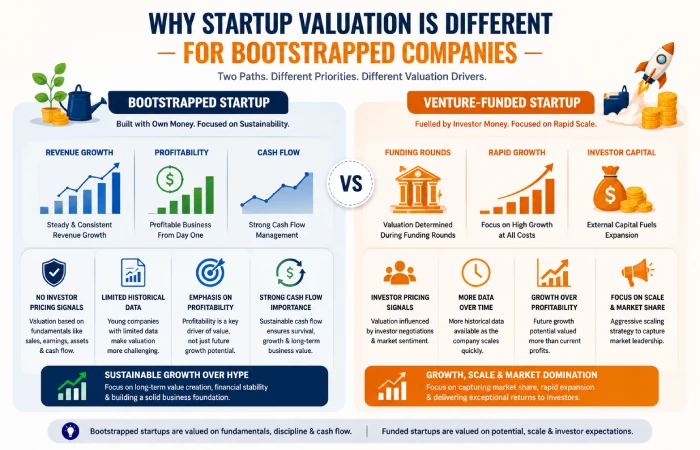
The valuation of a bootstrapped company may be quite different from that of a venture-financed company. The reason for this is that bootstrapped companies earn income and expand without getting financing from any external source. Therefore, valuation of such companies depends upon their fundamental finances.
No Investor Pricing Signals
Valuation is common for funded startups. It is established during the rounds of funding where negotiations are held regarding the ownership stakes and the investment required.
In the case of bootstrapped startups, there are no signals about valuation. Since such startups are not funded by external sources, they use sales, earnings, asset bases, and cash flow to determine their worth.
Insufficient Historical Data
Most bootstrapped ventures are relatively young enterprises. It is likely that they have been in operation for just a couple of months or years.
Lack of sufficient data makes valuation difficult because less information is available to predict the company’s future success.
Emphasis on Profitability
Sometimes investors value funded ventures on their future growth even if they are unprofitable.
This is not the case with bootstrapped ventures because the entrepreneur depends on the income from the venture to make ends meet. Profitability thus becomes one of the crucial valuation parameters.
Ventures that have proven to be profitably profitable get better valuations than others that are only focused on growth.
Strong Cash Flow Importance
Cash flow plays a major role in bootstrapped startup valuation.
Nevertheless, there might be situations when despite making profits, the business faces difficulties because of ineffective management of its cash flows, which are needed for paying expenses, growing the company, and handling unexpected situations.
This explains why many evaluation tools depend on the forecasted Cash Flow Modeling for Bootstrapped Startups. A lot of founders who keep track of their cash flow do well in terms of evaluations..
Sustainable Growth Over Hype
Many ventures backed by investors seek fast growth, while bootstrapping entrepreneurs are inclined towards slow growth.
Slow growth is less risky financially and helps to build a more solid base for the future. Many buyers, bankers, and other stakeholders appreciate slow growth over anything else
Why Bootstrapped Startups Often Receive Different Valuations
| Area | Bootstrapped Startup | Funded Startup |
| Funding | Self-Funded | Investor Funded |
| Growth Focus | Sustainable | Aggressive |
| Profitability | Important | Sometimes Secondary |
| Valuation Basis | Fundamentals | Growth Expectations |
Pre-Revenue Startup Valuation Methods
Some startups do not have revenue yet. They still need a valuation, for planning, partnerships or future fundraising talks.
These businesses are called -revenue startups.
What Is a Pre-Revenue Startup?
A pre-revenue startup refers to an organization which has not commenced sales
The firm may still be developing its products or carrying out other preliminary work before going into operation.
The pre-revenue startup may still be figuring out its -revenue startup valuation.
Challenges of Valuing a Startup Before Revenue
It is hard to value startups that have yet to generate revenues since valuation techniques normally take financial performance into account.
Common challenges include:
- No sales history
- Limited financial data
- Uncertain market demand
- Higher business risk
- Difficult future forecasting
Because of these challenges, founders often use alternative valuation methods.
Cost-to-Build Method
This method estimates startup value based on the amount spent creating the business.
Costs may include:
- Product development
- Software development
- Research costs
- Equipment purchases
- Marketing expenses
The logic is simple: the business should be worth at least what it cost to build.
Scorecard Valuation Method
The scorecard method compares a startup with similar businesses in the same industry.
Factors commonly evaluated include:
- Team quality
- Product strength
- Market opportunity
- Competitive advantage
- Growth potential
This method is often used for early-stage startups.
Market Opportunity Method
This approach focuses on the size of the potential market.
Founders estimate:
- Total market size
- Expected market share
- Future growth opportunities
Startups targeting large and growing markets may receive higher valuations using this method.
Risk Factor Summation Method
This method evaluates business risks and adjusts valuation accordingly.
Factors may include:
- Market risk
- Technology risk
- Competition risk
- Financial risk
- Management risk
Lower-risk startups generally receive higher valuations.
| Method | Suitable For |
| Cost-to-Build | Idea Stage |
| Scorecard | Early Stage |
| Market Opportunity | High Growth Markets |
| Risk Factor | Pre-Revenue Founders |
Which Pre-Revenue Method Is Most Practical?
For most bootstrapped founders, the Cost-to-Build and Scorecard methods are often the easiest to apply.
They require fewer assumptions and provide a practical starting point when revenue data is unavailable.
DCF Valuation for Bootstrapped Founders
What Is DCF Valuation?
DCF stands for Discounted Cash Flow valuation.
It values businesses using the present value of expected future cash flows generated by the business.
DCF is among the most popular valuation methods, as it concentrates more on the earning capacity of the business in the future and not its performance in the past.
How Discounted Cash Flow Works
The basic idea behind DCF is that money received in the future is worth less than money received today.
DCF adjusts future cash flows using a discount rate to estimate their current value.
Understanding Future Cash Flow Forecasts
DCF relies heavily on financial forecasting and the use of Financial Modeling Tools for Bootstrappers.
Founders must estimate:
- Future revenue
- Future expenses
- Expected profits
- Cash flow growth
This is why accurate forecasting is essential before applying DCF valuation.
Benefits of DCF
Benefits include:
- Focuses on future business performance
- Useful for long-term planning
- Considers cash flow generation
- Provides detailed valuation estimates
Limitations of DCF for Startups
It may be hard for early-stage companies to use DCF since future projections are not certain.
A slight change in estimates would make a big impact on the valuation results.
Simple DCF Valuation Example
| Year | Projected Cash Flow |
| Year 1 | $10,000 |
| Year 2 | $15,000 |
| Year 3 | $25,000 |
These projected cash flows are then valued using an adequate discount rate.
When Should Bootstrapped Founders Use DCF?
DCF works best for startups with:
- Predictable revenue
- Stable customer demand
- Reliable cash flow forecasts
- Established operating history
Because the DCF analysis relies greatly on future assumptions, the entrepreneur is advised to use the Scenario Planning for Bootstrapped Startups approach alongside DCF.
Bootstrapped Startup Multiples for Valuation
What Are Valuation Multiples?
Multiples are ratios that indicate the estimated value of a business using income or earnings.
They provide a faster alternative to complex valuation calculations.
Revenue Multiples
Revenue multiples determine the value by taking into account the multiple of annual revenue.
It is widely used in fast-growing startups.
EBITDA Multiples
EBITDA multiples are based on earnings before interest, taxes, depreciation, and amortization.
It is used when evaluating established companies with stable financial performance.
Profit Multiples
Profit multiples focus directly on net profit.
Higher profits typically result in higher valuations.
Industry Multiples
Different industries use different valuation ranges.
A SaaS firm can generally receive higher valuation multiples compared to that of a regular services firm due to the recurring revenues generated.
Choosing the Right Multiple
| Business Type | Common Multiple |
| SaaS | 3x–10x Revenue |
| Ecommerce | 1x–3x Revenue |
| Agency | 2x–5x Profit |
| Freelance Business | 1x–3x Profit |
Comparable Company Valuation for Startups
What Is Comparable Company Analysis?
The comparable company analysis technique assesses the firm’s worth using its peers operating in the same industry.
This technique is widely used since it considers real-life scenarios.
How to Find Similar Businesses
Look for companies with similar:
- Industry
- Revenue size
- Customer base
- Growth rate
- Business model
The closer the match, the more accurate the valuation comparison.
Metrics to Compare
Founders typically compare:
- Revenue
- Profitability
- Customer growth
- Market share
- Valuation multiples
Revenue Growth Comparisons
Companies experiencing higher rates of revenue growth usually have higher valuation multiples.
Profit Margin Comparisons
Businesses with good profit margins are usually seen as less risky investments.
Advantages and Disadvantages
Advantages:
- Easy to understand
- Uses real market data
- Useful for most startups
Disadvantages:
- Difficult to find truly comparable companies
- Market conditions can change quickly
- Valuations may vary across industries
| Metric | Startup A | Startup B |
| Revenue | $100K | $120K |
| Growth Rate | 20% | 25% |
| Valuation Multiple | 3x | 4x |
Common Mistakes When Using Comparable Companies
Common mistakes include:
- Comparing businesses from different industries
- Ignoring growth rates
- Using outdated valuation data
- Focusing only on revenue
- Overlooking profitability
Startup Valuation Examples
SaaS Startup Example
Let us take a SaaS firm that makes $100,000 in annual recurring revenue with a revenue multiple of 5x.
Estimated valuation: $500,000.
Ecommerce Startup Example
An e-commerce company, with $200,000 in annual sales, can be valued by comparing itself with other companies selling their onlin
Agency Example
A marketing agency earns $50,000 in annual profit and applies a profit multiple to estimate business value.
Freelance Business Example
A freelancer with stable earnings may use an earnings multiple to estimate business worth.
| Startup Type | Revenue | Method Used |
| SaaS | $100K ARR | Revenue Multiple |
| Ecommerce | $200K Sales | Comparable Companies |
| Agency | $50K Profit | Profit Multiple |
| Freelancer | $20K Profit | Earnings Multiple |
How to Increase Startup Valuation
Valuation at the point of start-up provides more chances for funding, increased confidence from the investors, and enhances positioning of the venture. Whether you are raising capital or planning an exit, valuation should be improved through consistent business performance—not artificial numbers.
The following is the list of most effective methods of boosting the valuation of a new venture:
Key Drivers That Increase Startup Valuation
Instead of scattered points, here is the core valuation improvement framework:
Valuation Growth Factors
| Factor | Why It Matters |
| Revenue Growth | Shows business demand & scalability |
| Profit Margins | Indicates efficiency & sustainability |
| Customer Retention | Improves predictable revenue |
| Recurring Revenue | Increases valuation multiples |
| Cash Flow Management | Reduces financial risk |
| Competitive Advantage | Improves long-term survival |
| Financial Reporting | Builds investor trust |
How to Increase Startup Valuation (Action Plan)
Improve Revenue Growth
Perhaps the single strongest contributing factor to valuations is revenue growth. People like companies whose revenue keeps on growing.
Focus on:
- Expanding customer base
- Upselling existing customers
- Improving sales funnels
Build forecasts using our revenue projections guide to create more accurate sales and growth estimates.
Increase Profit Margins
Profit is more crucial than revenue.
Improve margins by:
- Reducing operational waste
- Increasing pricing strategically
- Elimination of underperforming products/services
- Efficiency improvements
Use insights from Expense Forecasting for Lean Startups
Strengthen Customer Retention
High retention = stable business = higher valuation.
Benefits:
- Lower acquisition cost
- Higher lifetime value
- Predictable income
Build Recurring Revenue (VERY IMPORTANT)
Recurring revenue is highly valued by investors.
Examples:
- Subscriptions
- Membership models
- Retainers
- Long-term contracts
This often increases valuation multiples significantly.
Improve Financial Reporting
Clean financial data builds investor trust.
Maintain:
- Income statements
- Cash flow reports
- Expense breakdowns
- Revenue tracking
Reduce Unnecessary Expenses
Cutting waste improves profitability immediately.
Common leaks:
- Unused tools/software
- Inefficient ads
- Overstaffing
- Untracked subscriptions
Improve Cash Flow Management
Cash flow determines survival.
Strong cash flow means:
- Lower risk
- Better stability
- Higher valuation confidence
Use Cash Flow Modeling for Bootstrapped Startups
Strengthen Competitive Advantage
Investors pay more for hard-to-replicate businesses.
Examples:
- Strong brand
- Proprietary tech
- Loyal user base
- Niche dominance
Common Valuation Mistakes (Must Avoid)
These mistakes LOWER valuation or create unrealistic expectations:
| Mistake | Problem |
| Overestimating Revenue | Creates unrealistic valuation |
| Ignoring Expenses | Misrepresents profitability |
| Using Wrong Multiples | Inflates valuation incorrectly |
| Wrong Comparisons | Invalid benchmarking |
| Ignoring Market Conditions | Misleading valuation timing |
| Focusing Only on Valuation | Weak business fundamentals |
| Not Updating Financial Models | Outdated projections |
This section is critical for SEO long-tail searches like:
“startup valuation mistakes founders make”
Valuation Checklist for Bootstrapped Founders
Before calculating valuation, ensure readiness:
Checklist
- Revenue documented
- Expenses tracked
- Cash flow forecast updated
- Break-even analysis completed
- Growth projections created
- Comparable companies researched
- Valuation method selected
- Financial reports organized
This should ideally be completed after:
Break-Even Analysis for Bootstrapped Startups
Startup Valuation Examples (Very Important Section)
Real examples improve readability and SEO engagement.
SaaS Startup Example
- Revenue: $100K ARR
- Method: Revenue Multiple
- High scalability = higher valuation multiple
E-commerce Startup Example
- Revenue: $200K Sales
- Method: Comparable Company Valuation
Agency Business Example
- Profit: $50K
- Method: Profit Multiple
Freelance Business Example
- Profit: $20K
- Method: Earnings Multiple
Summary
| Business Type | Revenue/Profit | Valuation Method |
| SaaS | $100K ARR | Revenue Multiple |
| E-commerce | $200K Sales | Comparable Companies |
| Agency | $50K Profit | Profit Multiple |
| Freelancer | $20K Profit | Earnings Multiple |
Conclusion
Startup valuation enables the founders to know the actual value of their venture. Whether your business is an early-stage startup, growing software-as-a-service firm, or an ecommerce or services-oriented business, knowledge about valuation will give you important information.
Different valuation methods work best at different stages of growth. Revenue multiples, profit-based methods, DCF analysis, and comparable company valuations all have strengths and limitations.
Rather than relying on a single calculation, founders should use multiple valuation approaches to gain a more balanced view of business value.
Most importantly, keep revenue records, expense reports, and cash flow forecasts updated. trong financial planning based on Bootstrapped Financial Modeling Basics leads to more accurate valuations and better long-term business decisions.
Run cases with our scenario planning guide to evaluate how different business conditions can affect startup valuation.