

Introduction
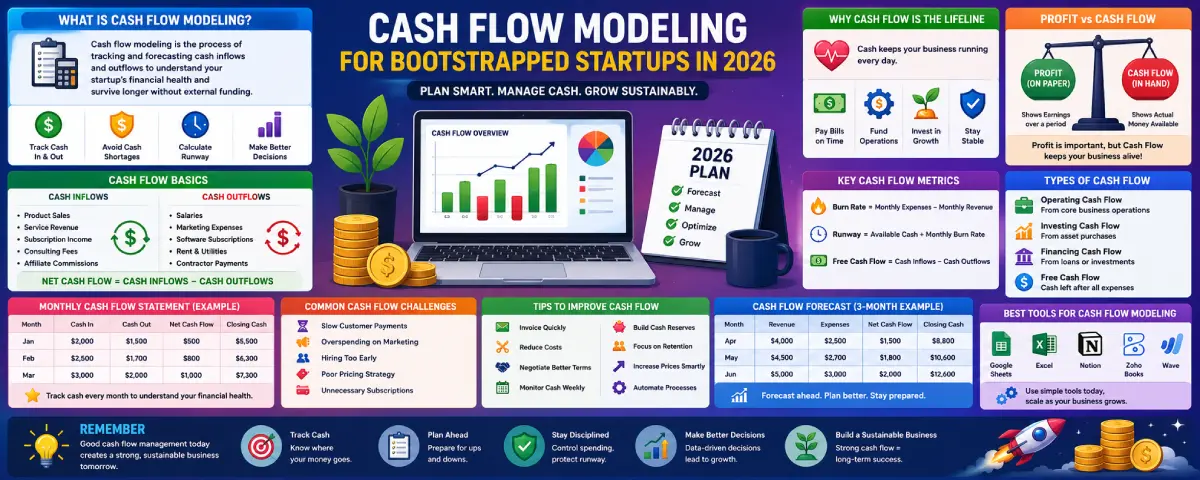
Cash flow modeling for bootstrapped startups should be one of the essential financial abilities that an entrepreneur learns. While many entrepreneurs are concerned with sales, marketing, and product development, they often neglect cash flows within their company. Regrettably, a startup may be profitable and experience severe financial difficulties due to inadequate cash flow management.
Unlike venture-backed startups, bootstrapped startups require little investment since there is no additional capital provided by investors. As such, they may rely on their founders’ savings, revenue from the first customers, income from freelancing, or profits from their businesses. Consequently, they need to manage cash flows as a matter of routine.
Startup founders usually devote weeks or even months of effort to building their products, acquiring customers, and earning more revenue. If cash outflows outweigh cash inflows, the firm will have no choice but to curtail its expenditures on growth. This is the reason why cash flow management becomes more important than profit management in young startup.
Before building cash flow forecasts, founders should understand the basics of Startup Bootstrapped Financial Modeling.
Cash flow guide from our bootstrapped financial modeling pillar.
A strong cash flow model helps founders:
- Understand where money comes from
- Track business spending
- Plan future expenses
- Avoid cash shortages
- Calculate startup runway
- Forecast future growth
- Reduce financial risks
- Make better business decisions
This guide explains cash flow modeling in simple language. It does not require you to have a degree in accounting or any background knowledge in finances to comprehend all of these terms. The aim is for founders to be able to develop a working system that will sustain business development.
What Is Cash Flow Modeling for Bootstrapped Startups?
The best and good concept of cash flow modeling involves tracing and forecasting cash inflows and outflows in an organization.
A cash flow model helps founders estimate…”Corporate Finance Institute – Cash Flow Guide:
| Financial Area | Purpose |
| Cash Inflows | Money entering the business |
| Cash Outflows | Money leaving the business |
| Net Cash Flow | Difference between inflows and outflows |
| Burn Rate | Monthly cash usage |
| Runway | Survival time before cash runs out |
| Future Cash Position | Expected financial health |
Unlike the calculation of profits, the modeling of cash flow involves just the actual movement of cash.
This is particularly true for bootstrapped startups, which thrive on the availability of cash rather than profits.
Understanding Cash Flow in Simple Words
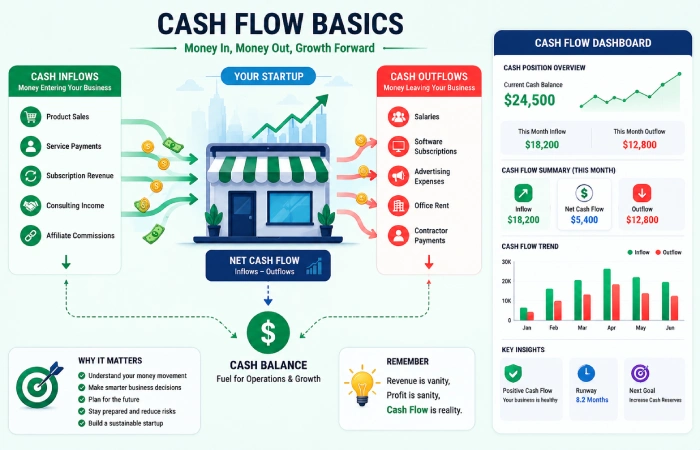
Cash flow simply means the movement of money.
Whenever money enters your business, it creates positive cash flow.
Examples include:
- Product sales
- Service payments
- Subscription revenue
- Consulting income
- Affiliate commissions
Whenever money leaves your business, it creates negative cash flow.
Examples include:
- Salaries
- Software subscriptions
- Advertising expenses
- Office rent
- Contractor payments
The difference between money entering and leaving the business determines your net cash flow.
Why Cash Flow Is the Lifeline of a Startup
Cash is what keeps a business operating every day.
A startup may have:
- Good products
- Growing customers
- Strong revenue
But if cash becomes unavailable, the business can struggle to pay expenses.
This is why many founders say:
Revenue creates opportunities, but cash flow creates survival.
Cash flow affects:
- Hiring decisions
- Marketing budgets
- Product development
- Vendor payments
- Business stability
Without healthy cash flow, growth becomes difficult.
Cash Flow Modeling vs Financial Modeling
Many founders confuse these two concepts.
Although related, they are different.
| Area | Cash Flow Modeling | Financial Modeling |
| Focus | Cash movement | Entire business finances |
| Purpose | Survival planning | Business forecasting |
| Main Metric | Cash balance | Revenue, profit, cash |
| Time Horizon | Short and medium term | Short and long term |
| Importance | Critical for survival | Critical for planning |
Cash flow modeling is usually one part of a larger startup financial model.
Why Bootstrapped Startups Rely on Cash Flow More Than Funded Startups
Funded startups generally have external funding, which can offset losses in times of difficulty.
Bootstrapped startups normally don’t have this advantage.
This is one reason why Startup Bootstrapped Financial Modeling focuses heavily on cash management rather than aggressive growth projections.
| Area | Bootstrapped Startup | Funded Startup |
| Cash Reserve | Limited | Higher |
| Risk | Higher | Lower |
| Funding Support | None | Investors |
| Cash Discipline | Critical | Important |
This is why founders who bootstrap their companies must pay close attention to cash flow from the very beginning.
Understanding Cash Flow vs Profit in Bootstrapped Startups
Many founders believe profit and cash flow are the same thing.
They are not.
Understanding the difference can prevent major financial mistakes.
What Is Profit?
Profit is simply and easy what is left behind after deducting expenses from revenue.
Simple formula:
Profit = Revenue − Expenses
For example:
Revenue = $10,000
Expenses = $7,000
Profit = $3,000
This looks positive.
However, profit does not always represent the actual cash available in the bank account.
What Is Cash Flow?
Cash flow measures the actual movement of money.
It focuses on:
- Money received
- Money spent
- Current cash position
Cash flow shows whether the business has enough cash available right now.
Why Startups Can Be Profitable and Still Fail
Startups may generate profit but fail for want of adequate cash flow.
Imagine this situation:
A company invoices customers for $20,000.
The invoices are due in 90 days.
The company records revenue immediately.
However:
- Salaries must be paid today
- Software bills must be paid today
- Rent must be paid today
This is why cash flow matters so much.
Real Example of Profit vs Cash Flow
| Metric | Amount |
| Revenue Recorded | $20,000 |
| Expenses | $15,000 |
| Profit | $5,000 |
| Cash Received | $3,000 |
| Cash Available | Low |
In this example, profit looks healthy but actual cash remains limited.
Profit vs Cash Flow Comparison
| Metric | Profit | Cash Flow |
| Measures | Earnings | Actual Cash |
| Affected By | Accounting | Real Money |
| Survival Impact | Medium | Very High |
| Shows Business Health | Yes | Yes |
| Shows Available Cash | No | Yes |
Why Founders Should Track Both
Profit helps measure business performance.
Cash flow helps measure business survival.
Successful founders monitor both regularly because each provides different information about the business.
Types of Cash Flow Every Startup Founder Should Know
Knowledge about various forms of cash flows enables the entrepreneur to understand sources and destinations of funds. Most startups focus only on sales revenue, but cash flow includes many other activities.
Operating Cash Flow
Operating cash flow refers to money generated from normal business activities.
Examples include:
- Product sales
- Service income
- Subscription payments
- Consulting revenue
- Affiliate commissions
A positive cash flow from operations usually implies that the business is running efficiently.
Investing Cash Flow
Investing cash flow involves money spent on assets that support future growth.
Examples include:
- Purchasing equipment
- Buying computers
- Investing in software development
- Purchasing office furniture
These costs might be a drain on resources in the immediate future but will contribute to growth of the business in the long run.
Financing Cash Flow
Financing cash flow comes from funding-related activities.
Examples include:
- Business loans
- Founder contributions
- Investor funding
- Loan repayments
Free Cash Flow
The free cash flow is defined as the surplus that remains when all necessary expenditures are taken into account.
This money can be used for:
- Expansion
- Emergency savings
- New product development
- Hiring employees
Positive free cash flow provides founders with greater flexibility and stability.
Cash Flow Types
| Cash Flow Type | Example | Purpose |
| Operating Cash Flow | Product sales | Daily operations |
| Investing Cash Flow | Equipment purchase | Future growth |
| Financing Cash Flow | Founder investment | Business funding |
| Free Cash Flow | Remaining cash | Expansion and reserves |
Why Cash Flow Problems Happen in Bootstrapped Startups
Many startup failures are connected to cash flow problems rather than a lack of customers.
Slow Customer Payments
Customers might pay invoices within 30 days, 60 days, or even 90 days later.
Though there may be adequate revenue, late payment can lead to dire cash shortages.
Overspending on Marketing
Marketing is capable of producing growth; however, excessive spending can exhaust available cash very rapidly.
Returns need to be measured before increasing marketing expenditures.
Hiring Too Early
Adding staff before the revenue is established leads to increased monthly expenditure.
Successful bootstrapped companies are usually lean when starting out.
Poor Pricing
Setting prices too low leads to sales that don’t earn adequate profit.
Prices should account for the cost of goods sold and leave some margin for growth.
Inventory Issues
Ecommerce businesses often tie up large amounts of money in inventory.
Unsold inventory reduces available cash and creates additional risk.
Subscription Tool Overload
Many startups subscribe to numerous software tools.
Even small fees paid monthly can turn out to be substantial in the long run.
Software auditing can save a lot of money.
Seasonal Revenue Fluctuations
Some companies have peak and off-peak seasons each year.
Inadequate planning may lead to financial difficulties during the off-peak season.
How to Create Cash Flow Statement for Startups
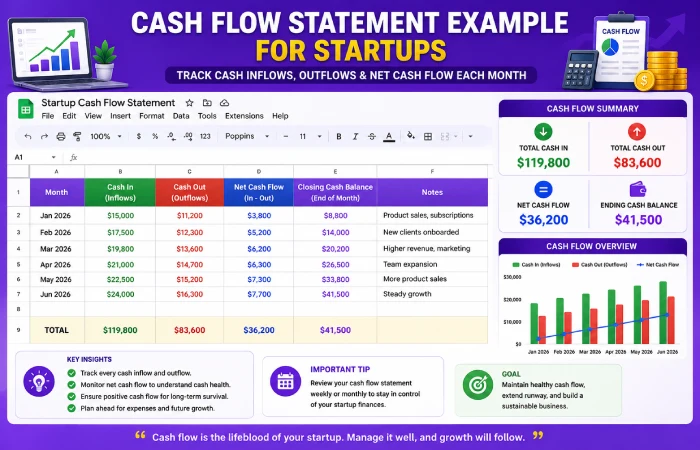
A cash flow statement is a document showing how cash flows in and out of a company.
This report is among the key documents for startup owners.
Step 1 – List All Cash Inflows
Cash inflows include every source of incoming money.
Examples:
- Product sales
- Service revenue
- Subscription revenue
- Affiliate income
- Consulting income
Step 2 – List All Cash Outflows
Cash outflows include all business expenses.
Examples:
- Salaries
- Marketing expenses
- Software subscriptions
- Rent
- Utilities
- Contractor payments
Step 3 – Calculate Net Cash Flow Bootstrapped Financial Modeling Basics
Net Cash Flow = Cash Inflow − Cash Outflow
A positive result means more money is entering the business than leaving it.
Step 4 – Calculate Ending Cash Balance
Ending Cash Balance = Starting Cash + Net Cash Flow
This shows how much money remains available.
Sample Cash Flow Statement for Startups
| Month | Cash In | Cash Out | Net Cash |
| Jan | $2,000 | $1,500 | $500 |
| Feb | $2,500 | $1,700 | $800 |
| Mar | $3,000 | $2,000 | $1,000 |
Monthly Cash Flow Projection for Startups
Cash flow forecasting helps founders prepare for future best business conditions.
Why Monthly Forecasting Matters
Monthly forecasting helps businesses: Accurate forecasting becomes easier when founders create realistic Revenue Projections for Bootstrapped Startups.
- Plan expenses
- Prepare for slow periods
- Manage growth
- Avoid cash shortages
How to Forecast 3 Months Ahead
The short-term forecast is more accurate since founders know what to expect regarding sales and costs.
How to Forecast 6 Months Ahead
A six-month forecast helps with:
- Hiring decisions
- Product launches
- Marketing campaigns
How to Forecast 12 Months Ahead
The annual forecast is a guide which has to be sufficiently adaptable to accommodate changes.
Business conditions can change quickly.
Sample Monthly Cash Flow Projection
| Month | Expected Revenue | Expected Expenses | Forecast Cash Flow |
| April | $4,000 | $2,500 | $1,500 |
| May | $4,500 | $2,700 | $1,800 |
| June | $5,000 | $3,000 | $2,000 |
Bootstrapped Cash Burn Rate Calculation (With Examples)
What Is Burn Rate?
Burn rate measures how a startup spends money.
It is one of the most important quickly and easy metrics for bootstrapped cashflow businesses.
Why Burn Rate Matters
Burn rate helps founders understand:
- Financial risk
- Cash runway
- Sustainability
- Growth capacity
Burn Rate Formula
Burn Rate Example
Suppose:
- Monthly Revenue = $4,000
- Monthly Expenses = $6,000
Burn Rate = $2,000
The business loses $2,000 each month.
Good vs Bad Burn Rate
| Burn Rate | Risk Level |
| Low | Healthy |
| Medium | Watch Closely |
| High | Dangerous |
A lower burn rate usually gives founders more flexibility.
Understanding Startup Runway
What Is Runway?
Runway measures how long a startup can survive before running out of money. Runway calculations work best when combined with regular Break-Even Analysis for Bootstrapped Startups.
Runway Formula
Runway Example
Available Cash = $24,000
Monthly Burn Rate = $2,000
Runway = 12 Months
This means the startup can operate for approximately one year without additional revenue growth.
Recommended Runway for Bootstrapped Startups
Many founders try to maintain:
| Runway | Risk Level |
| Less than 3 Months | High Risk |
| 3–6 Months | Moderate Risk |
| 6–12 Months | Healthy |
| 12+ Months | Strong Position |
This provides protection during unexpected challenges.
To understand how investors and buyers may evaluate a self-funded business, read our guide on Bootstrapped Startup Valuation Methods.
Managing Cash Flow Without Investors – Practical Tips
Because there are no other people besides the entrepreneurs involved to seek help from for funding problems, cash flow management becomes one of the crucial skills that need to be developed by the business. Even small improvements in cash flow might change everything.
Focus on Revenue First
Unfortunately, many entrepreneurs focus on planning for growth but forget about generating revenue from today’s operations.
First and foremost, revenue must be created
Ways to increase revenue include:
- Selling existing products more effectively
- Improving customer retention
- Offering additional services
- Creating recurring revenue streams
Revenue solves many cash flow problems.
Invoice Customers Quickly
Late invoicing often leads to delayed payments.
The bills must be sent out right away when the services have been provided or the goods delivered.
Best practices include:
- Using automated invoicing software
- Clearly stating payment terms
- Following up before due dates
- Offering online payment options
Faster invoicing often leads to faster cash collection.
Reduce Unnecessary Expenses
A lot of new ventures incur costs whose benefit is negligible.
Review business spending regularly.
Examples include:
- Unused software subscriptions
- Expensive office space
- Duplicate tools
- Low-performing advertising campaigns
Small savings add up over time.
Development of an expense forecast for lean startups could make it easier to detect wasteful expenses. Tighten costs with our expense forecasting guide.
Negotiate Better Payment Terms
Founders should negotiate whenever possible.
Examples include:
- Longer payment terms with suppliers
- Annual software discounts
- Flexible contractor agreements
- Bulk purchasing discounts
Keep Emergency Cash Reserves
It is inevitable to incur unforeseen costs in any business venture.
Examples include:
- Equipment failures
- Slow sales periods
- Economic downturns
- Customer payment delays
Many founders aim to maintain several months of operating expenses as a cash reserve.
Monitor Cash Weekly
Monthly reviews are useful, but weekly monitoring helps founders spot problems sooner.
Weekly reviews should include:
- Cash balance
- Revenue received
- Upcoming expenses
- Outstanding invoices
Smaller problems will be easier to address once identified.
Avoid Over-Hiring
Hiring creates ongoing expenses.
Before adding employees, founders should ask:
- Is workload consistently increasing?
- Can automation solve the problem?
- Are freelancers able to do the job temporarily?
Delay Non-Essential Purchases
All business expenditures are not equally urgent.
Founders should separate:
| Essential Purchases | Non-Essential Purchases |
| Hosting | Office upgrades |
| Customer support tools | Premium gadgets |
| Security software | Fancy furniture |
| Core business systems | Unnecessary software |
Delaying unnecessary purchases improves cash availability.
Improve Customer Retention
Keeping existing usefull customers is often cheaper than finding new ones.
Ways to improve retention:
- Better customer support
- Regular communication
- Product improvements
- Loyalty programs
Repeat customers generate more reliable income streams.
Build Recurring Revenue
Recurring revenue creates stability.
Examples include:
- Memberships
- SaaS subscriptions
- Maintenance plans
- Retainer services
Consistent income makes forecasting easier and helps make sense of cash flow.
How to Improve Cash Flow in a Bootstrapped Startup
Improving our cash flow does not always require increasing sales dramatically. Sometimes small operational changes can make a good and best significant difference.
Increase Prices Strategically
Many startups underprice their products.
If customers see strong value, moderate price increases may improve cash flow without reducing demand.
Review pricing regularly.
Offer Annual Plans
Annual subscriptions bring cash into the business faster.
Example:
| Plan Type | Monthly Revenue |
| Monthly Plan | $20 per month |
| Annual Plan | $200 upfront |
Annual plans help boost cash flow and minimize customer churn.
Reduce Refund Rates
Refunds reduce available cash.
Ways to lower refund requests include:
- Clear product descriptions
- Better onboarding
- Improved customer support
- Transparent expectations
Happy customers will not demand refunds often.
Improve Collections
Some customers pay late.
Improve collections by:
- Sending reminders
- Offering multiple payment methods
- Following up consistently
- Creating clear payment terms
Faster collections improve liquidity.
Optimize Marketing ROI
Not all marketing activities produce results.
Track:
- Customer acquisition cost
- Conversion rates
- Revenue generated
Direct your resources where you can measure success.
Cut Low-Value Expenses
Every expense should support business growth.
Ask:
- Does this expense generate revenue?
- Does it improve efficiency?
- Is there a lower-cost alternative?
Regular expense reviews improve profitability.
Improve Inventory Management
Inventory ties up cash.
Good inventory management includes:
- Ordering based on demand
- Reducing excess stock
- Monitoring turnover rates
Efficient inventory systems improve cash flow.
Automate Repetitive Tasks
Automation conserves time and minimizes costs.
Examples include:
- Invoice automation
- Email marketing automation
- Customer support workflows
- Appointment scheduling
Efficiency improvements often strengthen cash flow.
Cash Flow Management Tips for First-Time Founders
The process of managing cash flow is made simpler as the founders form good financial habits.
Review Financial Reports Weekly
Weekly reviews provide better visibility than waiting until month-end.
Key reports include:
- Cash flow statement
- Revenue reports
- Expense summaries
- Outstanding invoices
Separate Business and Personal Money
Mixing personal and business finances creates bad confusion.
Use separate:
- Bank accounts
- Credit cards
- Accounting systems
This improves financial accuracy.
Keep Accurate Records
Accurate records help founders:
- Track spending
- Prepare taxes
- Create forecasts
- Make better decisions
Consistent bookkeeping is essential.
Forecast Conservatively
Optimistic forecasts often create problems.
Conservative projections best help founders prepare for uncertainty.
Realistic forecasts prove to be much more helpful than optimistic forecasts.
Build Cash Reserves
Cash reserves provide protection during difficult periods.
Benefits include:
- Reduced stress
- Greater flexibility
- Better decision-making
- Improved stability
Avoid Emotional Spending
Many startup purchases are driven by excitement rather than necessity.
Before spending money, ask:
- Is this essential?
- Will it generate value?
- Can it wait?
Disciplined spending improves long-term sustainability.
Free Cash Flow Forecast Template for Bootstrappers
Forecasting helps entrepreneurs estimate their cash position in the future and avoid any surprises. It will be enough to have a simple cash flow projection format.
What Should a Cash Flow Template Include?
A useful cash flow forecast should include:
- Opening cash balance
- Expected revenue
- Operating expenses
- Marketing expenses
- Software costs
- Team expenses
- Other business costs
- Net cash flow
- Closing cash balance
The goal is to understand how much cash the business may have available in future months.
Monthly Template Example
| Month | Opening Cash | Revenue | Expenses | Net Cash Flow | Closing Cash |
| January | $5,000 | $2,000 | $1,500 | $500 | $5,500 |
| February | $5,500 | $2,500 | $1,700 | $800 | $6,300 |
| March | $6,300 | $3,000 | $2,000 | $1,000 | $7,300 |
This simple template gives founders a clear picture of business cash movement.
How Often to Update It
Cash flow forecasts should not be created once and forgotten.
Recommended update schedule:
| Startup Stage | Update Frequency |
| Early Stage Startup | Weekly |
| Growing Startup | Monthly |
| Established Business | Monthly or Quarterly |
Regular updates improve forecast accuracy.
Common Forecasting Mistakes
Many founders make avoidable forecasting errors.
Common mistakes include:
- Overestimating future sales
- Ignoring seasonal changes
- Forgetting annual expenses
- Underestimating marketing costs
- Not updating forecasts regularly
Best Tools for Cash Flow Modeling in 2026
Founders do not need expensive software to manage cash flow effectively.
Many startups begin with simple spreadsheet tools.
| Tool | Best For | Cost |
| Google Sheets | Beginners | Free |
| Excel | Advanced Models | Paid |
| Notion | Planning | Freemium |
| Zoho Books | Accounting | Affordable |
| Wave | Small Businesses | Free |
Free vs Paid Tools Comparison
| Feature | Free Tools | Paid Tools |
| Cost | No cost | Monthly fee |
| Ease of Use | Beginner friendly | More advanced |
| Reporting | Basic | Detailed |
| Automation | Limited | Strong |
| Scalability | Moderate | Higher |
Most bootstrapped founders can begin with free tools and upgrade later and trendy if necessary.
Common Cash Flow Mistakes That Hurt Startups
Cash flow some problems and mistakes often result from small mistakes that build over time.
Ignoring Forecasts
Some founders sometime make decisions without looking at future cash needs.
Without forecasting, surprises become more likely.
Depending on One Customer
Relying heavily on a single customer creates risk.
If that customer leaves, revenue can drop suddenly.
Diversification improves stability.
Tracking Revenue Instead of Cash
Profit and cash flows are different things.
Companies could earn money but face difficulties due to delays in payment receipts.
Always monitor actual cash balances.
Expanding Too Quickly
Rapid growth often increases expenses faster than revenue.
Examples include:
- Hiring too many employees
- Increasing office space
- Launching expensive marketing campaigns
Controlled growth is usually safer for bootstrapped businesses.
Not Monitoring Burn Rate
Burn rate provides an early warning sign of financial pressure.
Ignoring it can shorten runway without founders realizing it.
Cash Flow Modeling Examples for Different Startup Types
Various companies have different ways of managing cash flow.
SaaS Startup Example
Revenue usually comes from recurring subscriptions.
Typical cash flow characteristics:
- Predictable monthly income
- Lower inventory costs
- High software development expenses
Ecommerce Startup Example
Cash flow often depends on inventory management.
Challenges include:
- Inventory purchases
- Shipping costs
- Seasonal demand changes
Agency Example
Agencies generate revenue through client projects.
Cash flow depends heavily on:
- Client retention
- Invoice collection
- Project management
Freelance Business Example
Income changes are quite typical for freelancers.
Having ample cash will help deal with slower periods.
Startup Comparison
| Startup Type | Main Revenue Source | Main Cash Flow Challenge |
| SaaS | Subscriptions | Customer churn |
| Ecommerce | Product sales | Inventory costs |
| Agency | Client projects | Late payments |
| Freelance | Service fees | Revenue fluctuations |
Troubleshooting Cash Flow Problems
Businesses that have been properly run still encounter problems with cash flow.
Revenue Is Growing but Cash Is Low
Possible causes:
- Customers paying late
- Large operating expenses
- High marketing costs
Review accounts receivable and spending levels.
Customers Pay Late
Possible solutions:
- Shorter payment terms
- Automated reminders
- Upfront deposits
- Online payment systems
Expenses Are Increasing
Review all expense categories and identify:
- Unused subscriptions
- Marketing campaigns that underperform
- Non-essential spending
Cash Flow Forecast Is Inaccurate
Common causes include:
- Unrealistic assumptions
- Missing expenses
- Revenue overestimation
Update forecasts regularly using actual business data.
Burn Rate Is Too High
Possible solutions:
- Increase revenue
- Reduce unnecessary costs
- Delay hiring
- Improve pricing
Lower burn rates usually increase business stability.
To build stronger startup financial skills, explore these related guides:
- Bootstrapped Financial Modeling Basics
- Revenue Projections for Bootstrapped Startups
- Expense Forecasting for Lean Startups
- Break-Even Analysis for Bootstrapped Startups
- Financial Modeling Tools for Bootstrappers
- Scenario Planning for Self-Funded Ventures
Stress-test with our scenario planning guide.
Frequently Asked Questions (FAQ)
What is cash flow modeling?
Cash flow bootstrapped modeling refers to the prediction of cash flows into and out of a good business in the future.
Why does a startup need cash flow?
This is needed to cover its costs and remain operational.
What is a cash flow statement?
The cash flow statement is a record of cash flows in and out during a particular period.
How to calculate burn rate?
Burn rate is found by deducting the company’s monthly revenue from its monthly expenditure.
What is startup runway?
Startup runway means the period of time that a startup can stay alive until it exhausts its cash resources.
Why would there be negative cash flow?
Some factors that might cause negative and bad cash flow are low revenues, customer paid late payments, high expenses, and bad budget management.
What is meant by operating cash flow?
Operating cash flow means the cash that is generated from operations of the business.
What does free cash flow mean?
Free cash flow means the cash left after paying business and startup expenses.
Conclusion
Cash flow modeling for bootstrapped startups is not about making fancy financial reports. It is about comprehending where the money flows in your company and making good decisions before there are any issues.
Startup owners who practice proper management of cash flow on a consistent basis would be able to exercise more control over their expenses and plan better. Proper cash flow management enables the firm to survive difficult times and also adapt to changes in the market environment.
The main takeaway here is rather straightforward – revenue is important, but you need cash flow to run your business. Even when a bootstrapped business is profitable, its cash flow situation can remain poor.
Forecasting cash flow, burn rate management, runway assessment, and analysis of financial performance are just some of the actions that a bootstrapped firm can undertake in order to succeed.