Introduction
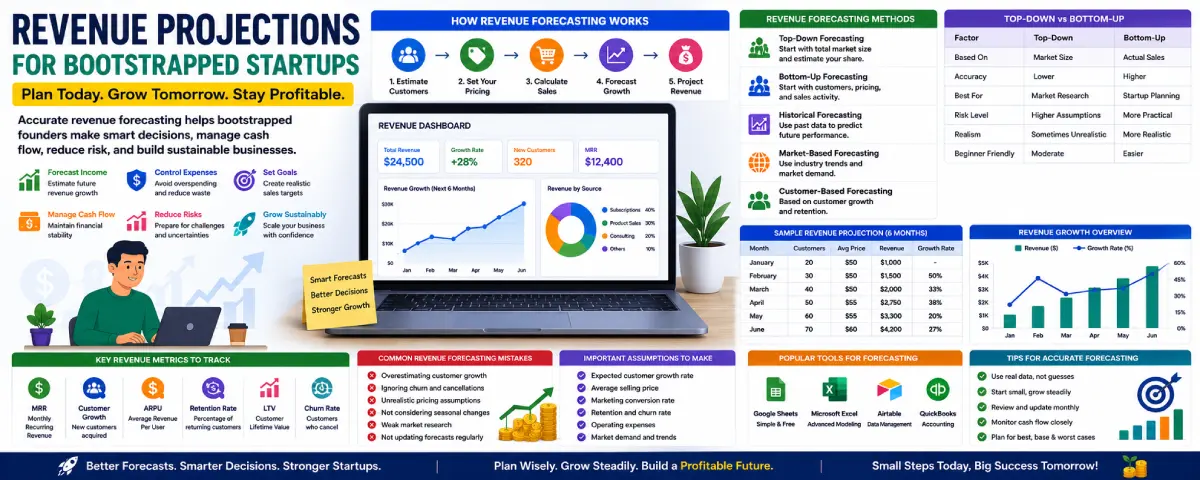
Revenue projections for bootstrapped startups Revenue forecasts for bootstrapped companies have become very relevant now that many entrepreneurs are starting companies without venture capital investment. As opposed to venture-backed companies, most bootstrapped companies rely on personal funds, freelancing work, revenues from early customers, and budgeting in order to succeed.
Due to scarcity of resources, an assessment of future earnings must be made by the founder rather than arbitrary decisions.
A revenue projection helps startups understand:
- Expected monthly income
- Future customer growth
- Pricing strategy performance
- Sales targets
- Cash flow stability
- Growth opportunities
- Financial risks
However, many startup founders think that revenue forecasting is something only applicable to big firms. On the contrary, even an individual founder relying on spreadsheet software can take advantage of proper revenue forecasts.
Proper revenue forecasting allows entrepreneurs to prevent such mistakes as overspending, unreasonable growth plans, and lack of cash.
Revenue projections from our bootstrapped financial modeling guide.
The following tutorial is focused on explaining the concept of startup revenue forecasts for beginners through examples, templates, comparisons, and troubleshooting tips.
This article is designed for:
- Bootstrapped founders
- SaaS startups
- Freelancers
- Agencies
- Ecommerce brands
- Digital creators
- Service businesses
- Solo entrepreneurs
- Small business owners
The goal is simple.
In order to assist entrepreneurs in making realistic forecasts of their revenues to enable sustainable growth.
Why Revenue Forecasting Matters for Bootstrapped Startups
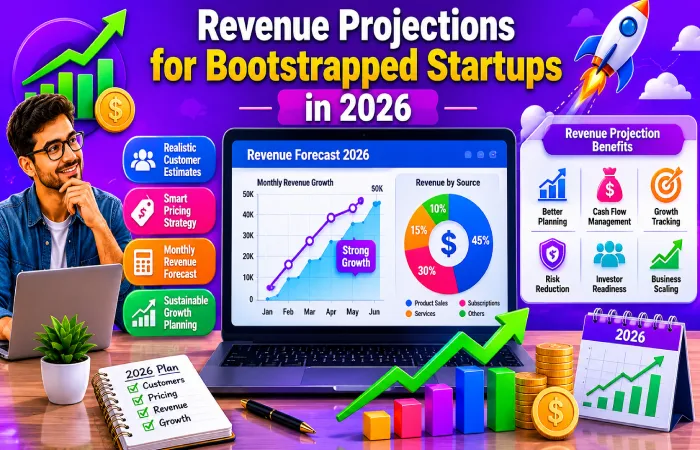
Bootstrapped startups have restricted access to funds. In contrast to venture-funded companies, they cannot withstand large losses.
For this reason, revenue forecasting is crucial.
Revenue projections help founders:
| Benefit | Why It Matters |
| Financial planning | Helps estimate future income |
| Cost control | Prevents overspending |
| Goal setting | Creates realistic targets |
| Cash flow stability | Reduces financial pressure |
| Growth planning | Supports sustainable scaling |
| Risk reduction | Helps prepare for slow periods |
Startups fail for many reasons, but one of them is the best expectation that they will generate revenues quickly and easy.
By having realistic forecasts, founders can rely on data rather than assumptions when making useful decisions.
Revenue forecasting also connects closely with startup cash flow modeling, expense forecasting, and break
-even analysis. Brush up via our financial modeling basics.
What Are Revenue Projections for Startups?
Best revenue forecasts can be described as predictions about how much revenue the startup will generate in the future.
The Corporate Finance Institute, also known as the CFI has a Revenue Forecasting Guide that says revenue forecasting is a way for businesses to guess how money they will make in the future. This is done by looking at what happened in the past what is going on in the market now and what people think will happen as the business grows. The Corporate Finance Institute says that revenue forecasting is important for businesses to figure out their income and it is based on things, like historical data and market conditions and what people assume about growth. Revenue forecasting is a part of what the Corporate Finance Institute teaches in their Revenue Forecasting Guide.
These estimates are based on:
- customer growth
- product pricing
- market demand
- sales performance
- marketing efforts
- business trends
Revenue forecasting does not guarantee future income.
Instead, it helps founders create realistic expectations.
For example:
| Month | Customers | Avg Price | Revenue |
| January | 20 | $50 | $1000 |
| February | 30 | $50 | $1500 |
| March | 40 | $50 | $2000 |
This simple structure helps founders understand possible business growth.
Even basic forecasting systems can improve financial decision-making significantly.
Difference Between Revenue Forecasting and Profit Forecasting
Many founders confuse revenue with profit.
However, they are different.
| Area | Revenue | Profit |
| Meaning | Total income | Income after expenses |
| Includes costs? | No | Yes |
| Main purpose | Sales estimation | Business sustainability |
| Example | $5000 sales | $2000 remaining profit |
An entrepreneur can be earning lots of money but still incur losses due to good high costs.
Revenue forecasts become more effective when combined with Cash Flow Modeling for Bootstrapped Startups, helping founders understand both expected income and available cash.
Startup Revenue Forecasting Methods
When it comes to startup revenue forecasting methods there are a lot of ways that startups try to figure out how money they will make in the future. Startups estimate revenue in different ways.
The method that a startup uses to forecast revenue depends on a things, including the business model of the startup the data that is available to the startup, the size of the market that the startup is in and the stage that the startup is at. For example startup revenue forecasting methods can depend on:
- Business model
- Data
- Market size
- Startup stage
-
Top-Down Revenue Forecasting
One way that startups forecast revenue is by using the top-down method. The top-down method starts with the size of the market.
For instance let us say the market size is ten million dollars and the startup thinks it can get one percent of the market. The estimated revenue for the startup would be one hundred thousand dollars. Startup revenue forecasting methods like this one are useful for things like investor presentations and market analysis and industry research.
However when early stage startups use this method they often make assumptions that’re not realistic.
-
Bottom-Up Revenue Forecasting
Another way that startups forecast revenue’s by using the bottom-up method. The bottom-up method starts with the activities of the business.
For example let us say a startup has twenty customers and each customer pays fifty dollars. The monthly revenue for the startup would be one thousand dollars. Startup revenue forecasting methods like this one are usually more realistic for startups that are just starting out.
This method uses numbers like the price of what the startup is selling and how many customers the startup thinks it can get and how many of those customers will actually buy something and what the sales team is doing.
Because of this a lot of entrepreneurs, like the up method better because it is based on what is really happening in the business.
Top-Down vs Bottom-Up Revenue Projections
| Area | Top-Down | Bottom-Up |
| Based On | Market size | Actual sales estimates |
| Accuracy | Lower | Higher |
| Best For | Market research | Startup planning |
| Risk Level | Higher assumptions | More practical |
| Beginner Friendly | Moderate | Easier |
| Realism | Sometimes unrealistic | Usually more realistic |
For bootstrapped startups, bottom-up forecasting is usually safer because it reduces unrealistic growth expectations.
-
Historical Revenue Forecasting
This way of guessing what will happen with money uses what has happened before.
Revenue forecasting is really important.
Historical revenue forecasting looks at what has happened
For example if a company has seen its revenue go up by ten percent every month the people who started the company may think that this will keep happening.
This method works well for new companies that have been around for a bit and have some history.
These are the kinds of companies that historical revenue forecasting works for:
- They have sold things before
- They have customers who keep coming
- They get money from subscriptions every month
The a new company has been around the better historical revenue forecasting gets at guessing what will happen.
Historical revenue forecasting is a way to guess what will happen with revenue.
-
Market-Based Revenue Forecasting
This way of guessing what will happen with money looks at what’s going on in the market.
It uses things like what people want what other companies are charging, what customers are doing and how big the market is.
Market-based revenue forecasting is another way to guess what will happen with revenue.
For example if more people in a city want marketing services, a company that does that may think that it will sell more in the future.
This method is really useful for kinds of companies.
These are the kinds of companies that market-based revenue forecasting works for:
- companies that sell things online
- companies that sell software
- companies that do marketing for other companies
- companies that are in a specific city or area
Market-based revenue forecasting is a good way to guess what will happen with revenue.
Revenue forecasting is really important, for all companies.
Revenue forecasting and market-based revenue forecasting are two ways to do it.
- Customer-Based Revenue Forecasting
Customer-based forecasting estimates revenue using expected customer growth.
Example:
| Month | Customers | Avg Revenue Per Customer | Total Revenue |
| January | 50 | $20 | $1000 |
| February | 70 | $20 | $1400 |
| March | 100 | $20 | $2000 |
This method is common for:
- SaaS startups
- subscription businesses
- coaching businesses
- agencies
How to Project Revenue for a New Startup
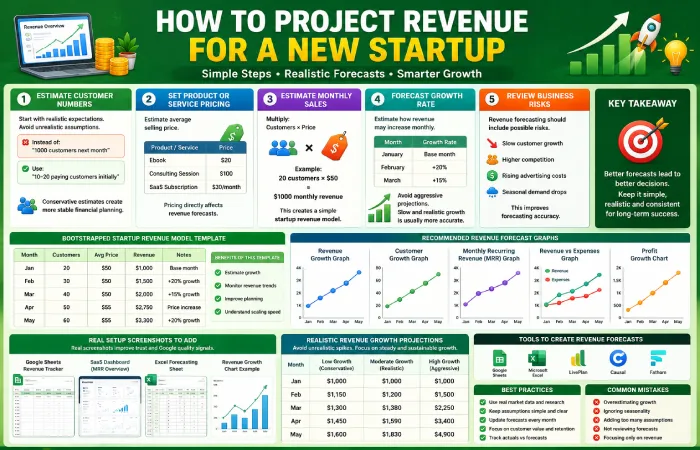
Many startup founders find forecasting difficult since they lack business history.
However, simple forecasting is still possible.
Step 1: Estimate Customer Numbers
Start with realistic customer expectations.
Avoid unrealistic assumptions.
Instead of:
“1000 customers next month”
Use:
“10–20 paying customers initially”
Conservative estimates usually create more stable financial planning.
Step 2: Set Product or Service Pricing
Estimate average selling price.
Example:
| Product | Price |
| Ebook | $20 |
| Consulting Session | $100 |
| SaaS Subscription | $30/month |
Pricing directly affects revenue forecasts.
Step 3: Estimate Monthly Sales
Multiply:
Customers × Price
Example:
20 customers × $50 = $1000 monthly revenue
This creates a simple startup revenue model.
Step 4: Forecast Growth Rate
Estimate how revenue may increase monthly.
Example:
| Month | Growth Rate |
| January | Base month |
| February | +20% |
| March | +15% |
Avoid aggressive projections.
Slow and realistic growth is usually more accurate.
Step 5: Review Business Risks
Revenue forecasting should include possible risks.
Examples:
- slow customer growth
- higher competition
- rising advertising costs
- seasonal demand drops
This improves forecasting accuracy. Revenue planning should always be balanced with Expense Forecasting for Lean Startups to maintain healthy profitability and cash reserves.
Bootstrapped Startup Revenue Model Template
Below is a beginner-friendly startup revenue projection template.
| Month | Customers | Avg Price | Revenue |
| Jan | 20 | $50 | $1000 |
| Feb | 30 | $50 | $1500 |
| Mar | 40 | $50 | $2000 |
| Apr | 50 | $55 | $2750 |
| May | 60 | $55 | $3300 |
This simple template helps founders:
- estimate growth
- monitor revenue trends
- improve planning
- understand scaling speed
Most early-stage startups can manage projections successfully using simple spreadsheets.
Once revenue projections are created, founders can use Break-Even Analysis for Bootstrapped Startups to determine when the business may become profitable.
Realistic Revenue Growth Projections
Many founders create unrealistic projections during early business stages.
This creates financial pressure later.
Why Founders Overestimate Revenue
Common reasons include:
- Excitement
- Social media hype
- Unrealistic expectations
- Copying competitors
- Ignoring customer acquisition difficulty
Real business growth usually takes time. Consistent revenue growth can significantly impact business value. Learn more in our guide to Bootstrapped Startup Valuation Methods.
Conservative vs Aggressive Forecasting
| Forecast Type | Characteristics |
| Conservative | Safer assumptions |
| Aggressive | Faster growth expectations |
Bootstrapped startups tend to benefit greatly from conservative forecasts.
Realistic Startup Growth Benchmarks
| Startup Stage | Expected Monthly Growth |
| Early stage | 5%–15% |
| Growing startup | 10%–25% |
| Fast-growing SaaS | 20%–40% |
Growth rates vary by industry and business model.
Revenue Projection Examples by Startup Type
Different startup types use different revenue models.
SaaS Startup Revenue Forecast Example
| Month | Subscribers | Monthly Price | MRR |
| Jan | 20 | $20 | $400 |
| Feb | 35 | $20 | $700 |
| Mar | 50 | $20 | $1000 |
SaaS companies focus on revenue growth in their projections.
Ecommerce Revenue Forecast Example
| Month | Orders | Avg Order Value | Revenue |
| Jan | 40 | $30 | $1200 |
| Feb | 60 | $30 | $1800 |
| Mar | 80 | $35 | $2800 |
Ecommerce forecasting also includes:
- inventory planning
- seasonal demand
- advertising costs
Agency Revenue Forecast Example
| Month | Clients | Avg Contract | Revenue |
| Jan | 5 | $300 | $1500 |
| Feb | 7 | $300 | $2100 |
| Mar | 10 | $350 | $3500 |
Revenue for agency companies largely relies on:
- client retention
- referrals
- recurring contracts
Content Creator Revenue Forecast Example
| Revenue Source | Monthly Estimate |
| Sponsorships | $500 |
| Ads | $300 |
| Affiliate Marketing | $400 |
| Digital Products | $600 |
The revenue model of content companies generally includes many sources of income.
Monthly Recurring Revenue (MRR) Forecasting
MRR is one of the key SaaS metrics.
What Is MRR?
MRR means:
Monthly Recurring Revenue.
It measures predictable subscription income.
Why MRR Matters
MRR helps founders:
- predict future revenue
- monitor growth
- improve retention
- estimate business stability
MRR Growth Formula
Example:
50 subscribers × $20 = $1000 MRR
Common MRR Forecasting Mistakes
| Mistake | Problem |
| Ignoring churn | Inflated projections |
| Unrealistic subscriber growth | Inaccurate forecasts |
| Weak retention strategy | Revenue instability |
Revenue Projection Assumptions Every Founder Should Make
Every forecast depends on assumptions.
Strong assumptions improve forecast quality.
Customer Growth Assumptions
Estimate realistic monthly customer growth.
Pricing Assumptions
Forecast future pricing stability or increases.
Marketing Conversion Assumptions
Estimate:
- click rates
- lead conversions
- customer acquisition
Retention Rate Assumptions
Returning customers improve revenue stability.
Retention forecasting is extremely important for SaaS startups.
Common Revenue Projection Mistakes Bootstrapped Founders Make
| Mistake | Problem |
| Unrealistic revenue goals | Poor planning |
| Ignoring seasonality | Revenue fluctuations |
| Weak pricing strategy | Lower profits |
| No marketing budget | Slower growth |
| Copying competitors | Inaccurate assumptions |
Avoiding these mistakes improves financial stability.
Troubleshooting Revenue Projection Problems
Troubleshooting sections help content rank for real user problems.
Why Revenue Projections Fail
Common reasons include:
- unrealistic assumptions
- poor market research
- incorrect pricing
- weak customer acquisition
Why Startup Revenue Stagnates
Revenue growth may slow because of:
- high competition
- weak product positioning
- low customer retention
- ineffective marketing
Why Forecasted Sales Never Happen
Sometimes projections fail because:
- marketing underperforms
- product demand is weak
- pricing is incorrect
- sales process is unclear
Why Pricing Models Fail
Pricing issues may include:
- pricing too high
- pricing too low
- poor perceived value
- wrong customer targeting
Regular pricing reviews improve revenue forecasting accuracy. Revenue forecasts are never perfect, which is why founders should also use Scenario Planning for Bootstrapped Startups to prepare for different growth outcomes.
Revenue Forecasting Tools for Startups
Different startups use different tools depending on complexity and budget.
| Tool | Free Version | Best For |
| Google Sheets | Yes | Beginners |
| Excel | No | Advanced modeling |
| Notion | Yes | Simple tracking |
| Airtable | Partial | Workflow automation |
| QuickBooks | No | Accounting |
Simple spreadsheet systems are usually enough for early-stage startups.
Real Startup Revenue Forecast Case Study
Imagine a small SaaS startup.
Business:
AI writing tool
Monthly subscription:
$25
Forecast:
| Month | Customers | Revenue |
| Jan | 20 | $500 |
| Feb | 40 | $1000 |
| Mar | 70 | $1750 |
| Apr | 100 | $2500 |
The founder tracks:
- churn
- customer acquisition
- marketing costs
- recurring revenue
This helps improve long-term planning.
For additional planning resources, explore our guide to Financial Modeling Tools for Bootstrappers.
FAQ Section
What is the best type of forecast for startups?
Bottom up forecasts would work better for bootstrapped startups.
Will the forecasts of the startup always be correct?
Forecasting can never be completely accurate as it is a predictive method of doing things.
Why do forecasted startup revenues fall apart?
Some typical reasons are unrealistic forecasts, improper pricing, and weak demand in the market.
How often should startups update revenue forecasts?
Most startups should review projections monthly.
What does MRR mean in SaaS forecasting?
MRR stands for Monthly Recurring Revenue.
Schema Markup Opportunities
Recommended schema types:
| Schema Type | Purpose |
| FAQ Schema | FAQ rich results |
| Article Schema | Better indexing |
| How-To Schema | Step-by-step sections |
Best placement:
Near the end of the article before conclusion.
Conclusion
Revenue projections for bootstrapped startups are really important for founders because they help them make financial decisions using real business data instead of just guessing.
Revenue projections for bootstrapped startups help founders in a lot of ways.
They support things like
- Growth
- Better budgeting
- Smarter pricing
- Improved cash flow
- Long-term business stability.
The main thing is not to try to predict the future
Revenue projections for bootstrapped startups are about understanding how revenue for bootstrapped startups may grow under business conditions.
Even simple systems for revenue projections for bootstrapped startups can be really helpful for founders.
They can help reduce risks and improve planning and build businesses over time.
When you combine revenue projections for bootstrapped startups with important things like cash flow modeling for startups and expense forecasting and break-even analysis systems it becomes even more powerful, for bootstrapped startups.
Calculate your break-even point using our break-even analysis guide.