

Introduction
Startup bootstrapped financial modeling is becoming more and more important as more entrepreneurs launch enterprises without investor funding. Many founders seek complete independence in their choices, revenues, and business direction.
Startup companies that use their money are finding that making financial plans is really important. This is because a lot of people are starting businesses without getting money from investors. Many of these business owners want to be in charge of their decisions the money they make and where their business is going. They like the idea of having control, over their startup companies and the freedom to make choices about their startup companies
Bootstrapping involves raising the necessary capital by using personal savings, earned profits, freelancing income, and even revenue from a small business.
This is where startup bootstrapped financial modeling becomes useful.
A financial model helps startup founders understand:
- How much money is coming in
- How much money is going out
- Whether the startup is profitable
- When the business may break even
- How long the cash can survive
- What risks may affect growth
Many people think financial modeling is only for big companies or investors. That is not true. Even a small startup can benefit from simple financial planning.
In fact, bootstrapped startups need financial modeling even more because they do not have large investor funding to cover mistakes.
This guide explains everything in simple words.
You will learn:
- What financial modeling means
- Why bootstrapped startups need it
- How to create a simple startup financial model
- Revenue projections
- Expense forecasting
- Cash flow management
- Break-even analysis
- Financial tools
- Common mistakes
- Practical startup examples
This article is written for:
- New founders
- Small business owners
- Freelancers building startups
- Solo entrepreneurs
- Digital creators
- Service businesses
- SaaS startups
- Online businesses
The goal is simple.
To help founders understand money clearly before problems happen.
Startup & Bootstrapped Financial Modeling Resource Center
Explore our complete collection of guides covering financial modeling fundamentals, revenue projections, cash flow management, expense forecasting, break-even analysis, valuation methods, tools, and scenario planning for startups and bootstrapped businesses.
The 8 Key Pillars of Bootstrapped Financial Modeling
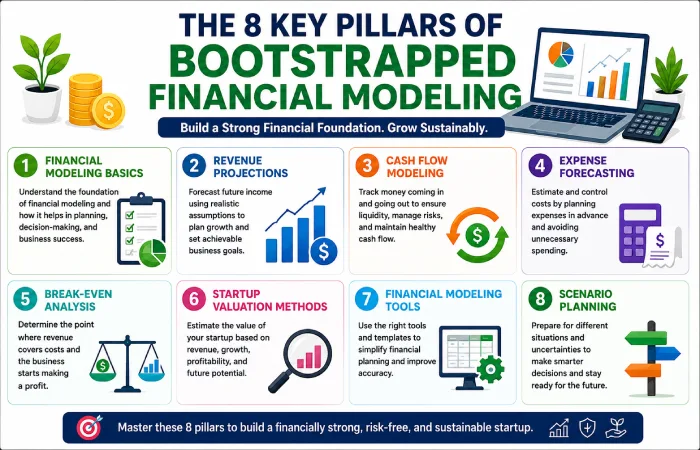
Startup bootstrapped financial modeling is not only about spreadsheets or revenue calculations. In order to help founders manage development, costs, risks, and long-term sustainability, a robust financial system is constructed employing several interconnected areas.
Before scaling a firm, every bootstrapped entrepreneur should comprehend the eight key pillars that make up this guidance.
1. Bootstrapped Financial Modeling Basics
This section teaches the fundamentals of startup financial planning, such as how financial models function, why they’re important, and how founders can build simple systems without sophisticated finance skills.
2. Revenue Projections for Bootstrapped Startups
Revenue forecasting enables enterprises to figure out future income based on realistic assumptions rather than guesswork. Proper forecast procedures improve planning and reduce financial uncertainty.
3. Cash Flow Modeling for Bootstrapped Startups
Cash flow management enables startups to understand how money flows in and out of the company. Positive cash flow is critical to long-term survival.
4. Expense Forecasting for Lean Startups
Expense prediction helps lean startups approximation future business costs while keeping spending controlled, practical, and focused on important growth activities.
5. Break-Even Analysis for Bootstrapped Startups.
Break-even analysis helps businesspeople to forecast when their business will begin to make profits. It recovers decision-making and financial security.
To learn more about how to calculate your startup’s break-even point, read Break-Even Analysis for Bootstrapped Startups.
6. Bootstrapped Startup Valuation Methods
The process of valuing startups helps entrepreneurs evaluate how much their company is likely worth according to their growth and profitability potential. Learn more in Bootstrapped Startup Valuation Methods.
7. Financial Modeling Tools for Bootstrappers
Financial modeling tools can help companies keep track of their finances through spreadsheets, forecasting templates, and budgeting software. Learn more in Financial Modeling Tools for Bootstrappers.
8. Scenario Planning for Bootstrapped Startups
Scenario planning gives room for both favorable and unfavorable contingencies, for instance, slow-moving sales, changes in the market environment, increasing prices, or rapid growth of the business.
These eight pillars give bootstrapped startups a base to build on so they can grow slowly and stay in control of their money.
Scenario planning prepares founders for both positive and negative business outcomes. Learn more in Scenario Planning for Bootstrapped Startups.
What Is a Startup?
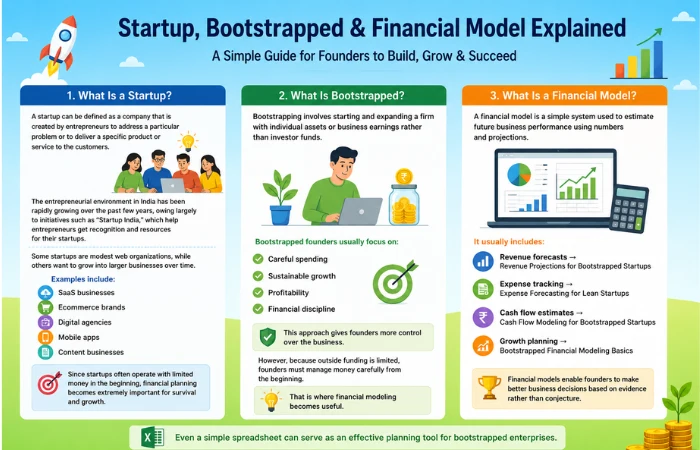
A startup can be defined as a company that is created by entrepreneurs to address a particular problem or to deliver a specific product or service to the customers.
The entrepreneurial environment in India has been rapidly growing over the past few years, owing largely to initiatives such as “Startup India,” which help entrepreneurs get recognition and resources for their startups.
Some startups are modest web organizations, while others want to grow into larger businesses over time.
Examples include:
- SaaS businesses
- Ecommerce brands
- Digital agencies
- Mobile apps
- Content businesses
Since startups often operate with limited money in the beginning, financial planning becomes extremely important for survival and growth.
What Is Bootstrapped?
Bootstrapping involves starting and expanding a firm with individual assets or business earnings rather than investor funds.
Bootstrapped founders usually focus on:
- Careful spending
- Sustainable growth
- Profitability
- Financial discipline
This approach gives founders more control over the business.
However, because outside funding is limited, founders must manage money carefully from the beginning.
That is where financial modeling becomes useful.
What Is a Financial Model?
A financial model is something that people use to figure out how their business will do in the future. It is a system that uses numbers to make guesses about what will happen. This helps the people who started the business understand how they will do with money and make choices.
It usually has an important parts:
- The company needs to make revenue forecasts. This is when they try to figure out how money the company will make from sales.
- They also have to do expense tracking. Expense tracking is when they keep an eye on how money the company is spending.
- The company has to make cash flow estimates. Cash flow estimates are when they try to predict how money will come into the company and how money will go out of the company.
- The company also does growth planning. Growth planning is when the founders get ready, for when the company gets bigger. They do growth planning to help the company when it makes money from sales and gets bigger..
Financial models help the founders make choices based on facts rather than just guessing.
Even a simple spreadsheet can be a tool, for planning when a business is just starting out. As the business gets bigger financial models can help the founders deal with problems control how much they spend and plan for growth that will last.
What Is Startup Bootstrapped Financial Modeling?
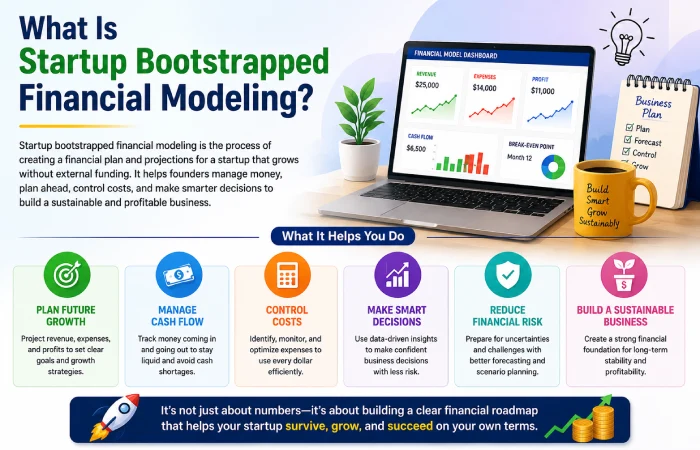
Startup bootstrapped financial modeling means creating a simple financial plan for a startup that grows without investor funding.
A financial model is usually a spreadsheet or document that predicts future business performance.
It estimates:
| Financial Area | Purpose |
| Revenue | Expected income |
| Expenses | Business costs |
| Profit | Money left after costs |
| Cash Flow | Movement of money |
| Break-Even Point | When losses stop |
| Growth Forecast | Future expansion |
A financial model helps founders make smarter decisions.
Instead of guessing, founders can plan using numbers.
What Is a Bootstrapped Startup?
A bootstrapped startup is a business built using personal funds or business profits instead of venture capital.
Examples include:
- Freelancers starting agencies
- Small SaaS businesses
- Online stores
- Bloggers
- YouTubers
- Digital marketing agencies
- Consulting firms
- Software tools
Bootstrapped founders often focus on:
- Low costs
- Sustainable growth
- Profitability
- Careful spending
- Long-term stability
Unlike lavishly backed startups, bootstrapped enterprises cannot afford huge financial errors.
That is why financial modeling matters.
Common Challenges Faced by Bootstrapped Startups
Although bootstrapped startups offer more independence, they also current financial and operational problems.
- Limited Budget
Most founders begin with limited savings. This makes spending decisions extremely important.
- Slow Growth
Growth without investor funds may occur over a longer period than with investor-backed companies.
- Hiring Difficulty
Many bootstrapped founders cannot hire large teams in the early stages.
- Marketing Limitations
Advertising budgets are typically smaller, affecting consumer acquisition speed.
- Cash Flow Pressure
The impact that unforeseen expenditure or overdue payments may have on a person’s financial situation should not be underestimated.
In order to meet these requirements, startup owners need to prepare for their finances beforehand.
Benefits of Building a Bootstrapped Startup
Regardless of all of the above issues, most entrepreneurs prefer bootstrapping startups because of its advantages.
Full Ownership
- Founders keep control over business decisions.
- Improved Financial Responsibility
- Financial constraints make one learn how to spend money wisely.
Sustainable Growth
Companies that bootstrap their businesses focus on growing over time of just developing their business.
Flexibility
Founders can change direction more easily without investor pressure.
Long-Term Stability
A major advantage of bootstrapping is that such ventures can be more profitable at an earlier stage than others.
This is what makes entrepreneurs today lean towards sustainable business development as compared to fundraising practices.
Why Financial Modeling Matters for Bootstrapped Startups
Money mismanagement causes many startups to fail.
Some businesses make sales but still run out of cash.
Others spend too much on:
- Marketing
- Hiring
- Software
- Office space
- Product development
Understanding basic concepts using the resource Bootstrapped Financial Modeling Basics can assist entrepreneurs in building a better financial base.
Main Benefits
| Benefit | Explanation |
| Better planning | Helps founders plan future growth |
| Cost control | Tracks unnecessary spending |
| Revenue forecasting | Predicts expected income |
| Risk reduction | Identifies financial problems early |
| Decision making | Helps founders make smarter choices |
| Cash management | Prevents cash shortages |
Since bootstrapping entrepreneurs depend heavily on self-funding or early income from the business, financial discipline is one of the most critical survival traits.
Difference Between Bootstrapping and Venture Capital Funding Financial Structures
Bootstrapping ventures and ventures that have been venture funded often have totally distinct approaches to managing their money. Their financial structures can be significantly different because of various reasons.
Generally, bootstrapped businesses pay more attention to profitability and prudent budgeting. This is so because the capital invested comes from their pocket or profits earned through the business.
Venture capitalists’ investments enable startups to grow their customer base and expand to new markets, hence spending more freely due to having access to capital.
The knowledge will help founders make realistic plans based on their business model.
| Area | Bootstrapped Startup | VC-Funded Startup |
| Funding Source | Personal savings or revenue | Investor capital |
| Spending Style | Controlled and careful | Aggressive growth spending |
| Growth Strategy | Sustainable growth | Fast scaling |
| Profitability Focus | Important early | Sometimes delayed |
| Hiring Approach | Small and lean teams | Rapid team expansion |
| Risk Level | Founder carries more risk | Risk shared with investors |
| Marketing Budget | Usually limited | Often larger budgets |
| Financial Planning Style | Conservative | Growth-focused |
It is recommended that a company adopt a lean finance model during the bootstrapping stage to be able to manage expenses and not incur any unneeded financial burden.
Successful Examples of Bootstrapped Startups
There are quite a number of popular firms which started out as bootstrapped organizations before becoming successful firms.
| Startup | Industry | Known For |
| Mailchimp | Email Marketing | Grew for years without major VC funding |
| Basecamp | Project Management | Focused on profitability and simple growth |
| Shutterstock | Stock Media | Started small and expanded gradually |
| Zoho | Business Software | Built global software products using bootstrapped growth |
| Craigslist | Online Classifieds | Operated with a lean business model |
| GitHub | Developer Platform | Initially grew with limited outside funding |
| Spanx | Apparel | Started using personal savings |
| TechSmith | Software | Built long-term sustainable software business |
This is how you can make your business successful without spending much money.
A business that starts small and grows slowly focuses on making a profit and making customers happy.
Components of a Bootstrapping Company Financial System
A financial model usually has several parts.
- Revenue Projections
Revenue Projections help you figure out how you will make money. You can learn more about Revenue Projections in our guide on Revenue Projections for Bootstrapped Startups.
Components of a Bootstrapping Company Financial System
A financial model usually has several parts.
- Revenue Projections
Revenue Projections help you figure out how you will make money. You can learn more about Revenue Projections in our guide on Revenue Projections for Bootstrapped Startups.
- Expense Forecasting
Proper budgeting techniques are covered in Expense Forecasting for Lean Startups.
- Cash Flow Modeling
Read Cash Flow Modeling for Bootstrapped Startups to understand how cash affects startup survival.
- Profit and Loss Statement
A Profit and Loss Statement calculates your business profit. It helps you understand if you are making money.
- Break-Even Analysis
To learn more about how to do this you can look at Break-Even Analysis, for Bootstrapped Startups. It has ways to calculate and examples.
- Scenario Planning
Scenario Planning prepares you for risks. It helps you plan for situations.
All these areas help founders understand their company’s health. They are important, for making financial decisions. A good financial model uses Revenue Projections, Expense Forecasting, Cash Flow Modeling, Profit and Loss Statement, Break-Even Analysis and Scenario Planning to give a clear picture.
Simple Example of a Bootstrapped Startup Financial Model
Imagine a small online design agency.
Monthly Revenue Estimate
| Service | Clients | Price | Monthly Revenue |
| Logo Design | 10 | $100 | $1000 |
| Social Media Design | 5 | $200 | $1000 |
| Website Design | 2 | $500 | $1000 |
| Total | – | – | $3000 |
Monthly Expenses
| Expense | Cost |
| Internet | $50 |
| Design Software | $100 |
| Marketing | $200 |
| Freelancers | $500 |
| Miscellaneous | $150 |
| Total | $1000 |
Monthly Profit
- Revenue: $3000
- Expenses: $1000
- Profit: $2000
It is a basic and lightweight startup finance model.
Such an elementary analysis of your finances will help you gain more insight into the sustainability of your business.
Steps to Create a Bootstrap Financial Model
Creating your initial business financial model does not have to be hard. Many successful bootstrapped founders begin with simple spreadsheets and improve them over time.
The goal is not perfection.
The objective should be a clear understanding of the business’s financial affairs.
Step 1: Define how your company makes money
Think about what brings in revenue for your startup.
Step 2: Estimate what you spend each month
List what you pay every month like rent and what you pay that changes, like supplies.
Step 3: Forecast your income
Try to figure out how money your company will make.
Step 4: Keep track of your company money
See how company money you get and how much company money you spend.
Step 5: Check how you’re doing each month
Look at your income and expenses every month to see how your company is doing.
Tools You Can Use (Free vs Paid)
Various financial techniques are used by startups depending upon their budget, complexity, and size.
While some startup owners utilize free spreadsheet software, others use commercial financial software that offers full automation and reporting features.
| Tool Type | Examples | Best For |
| Free Tools | Google Sheets, Notion | Beginners |
| Paid Tools | QuickBooks, Xero | Growing startups |
| Spreadsheet Software | Excel | Detailed modeling |
| Automation Tools | Airtable | Workflow management |
Most early-stage bootstrapped startups can manage finances successfully using simple free tools.
Common Startup Expenses
Every startup has operational costs.
Tracking expenses properly helps founders avoid overspending.
| Expense Type | Examples |
| Tools | Hosting, software |
| Marketing | Ads, SEO |
| Operations | Internet, electricity |
| Team | Freelancers, employees |
| Product | Manufacturing or development |
| Legal | Registration, compliance |
Bootstrapped startups should avoid unnecessary spending whenever possible.
Fixed vs Variable Expenses
Business Expenses and Financial Forecasting
Fixed Expenses
These stay mostly the same.
Examples:
- Rent
- Hosting
- Software subscriptions
- Salaries
Variable Expenses
These change depending on business activity.
Examples:
- Advertising
- Shipping
- Freelancer costs
- Commissions
The knowledge of this distinction will help to make budgeting and financial forecasts more effective.
Create Revenue Projections
Forecasts for revenues give an indication of expected sales revenue.
It is essential that such estimates not be exaggerated.
Use practical assumptions.
Example Revenue Forecast
| Month | Expected Customers | Average Price | Revenue |
| January | 20 | $50 | $1000 |
| February | 30 | $50 | $1500 |
| March | 40 | $50 | $2000 |
Simpler forecasting techniques prove to be more useful than complicated spreadsheets.
Common Revenue Projection Methods
- Historical Growth Method
Use past growth data.
- Market-Based Method
Estimate based on market demand.
- Customer-Based Method
Its estimate using expected customer growth.
- Pricing-Based Method
Estimate using product pricing and sales volume.
Common Mistakes Bootstrapped Founders Make in Financial Modeling
Founders tend to make their forecasts overly optimistic.
The avoidance of common errors is highly impactful for business planning.
| Mistake | Problem |
| Overestimating sales | Creates unrealistic plans |
| Ignoring seasonality | Causes inaccurate predictions |
| No marketing budget | Reduces growth accuracy |
| Copying competitors | May not match your business |
Realistic forecasting improves long-term decision making.
Understand Cash Flow Modeling
Cash flow is an important aspect of financial modeling for bootstrapped enterprises.
Profit may not always imply available cash.
A startup may be lucrative on paper, but it still has cash constraints.
Cash Flow Basics
| Cash Inflow | Cash Outflow |
| Client payments | Salaries |
| Product sales | Marketing |
| Subscriptions | Software |
| Consulting income | Rent |
Positive cash flow refers to the situation where there is more cash inflow than cash outflow.
Why Cash Flow Problems Happen
Common reasons include:
- Late customer payments
- High expenses
- Aggressive hiring
- Poor planning
- Seasonal business slowdown
Startups bootstrapping themselves need to safeguard cash.
Cash Flow Forecast Example
| Month | Cash Inflow | Cash Outflow | Net Cash |
| January | $3000 | $2500 | $500 |
| February | $4000 | $3000 | $1000 |
| March | $4500 | $3500 | $1000 |
This will allow entrepreneurs to gain better visibility of future cash flows.
Build a Profit and Loss Statement
A Profit and Loss statement shows:
- Revenue
- Expenses
- Profit
- Losses
Simple P&L Example
| Category | Amount |
| Revenue | $5000 |
| Marketing | $1000 |
| Software | $300 |
| Freelancers | $1200 |
| Miscellaneous | $500 |
| Net Profit | $2000 |
This helps founders understand overall business performance.
Break-Even Analysis
Break-even analysis helps find the level of profitability attained by a new venture.
This is extremely important for bootstrapped businesses.
Break-Even Formula
Example
| Monthly Costs | Revenue Needed |
| $1000 | $1000 |
| $3000 | $3000 |
| $5000 | $5000 |
If revenue grows above expenses, profit begins.
Why Break-Even Matters
| Benefit | Explanation |
| Reduces uncertainty | Founders understand survival timeline |
| Helps planning | Improves goal setting |
| Controls spending | Prevents unnecessary costs |
| Measures sustainability | Shows business stability |
Understanding break-even points helps founders make safer financial decisions.
Lean Startup Financial Model Approach
A lean startup financial model focuses on simplicity and efficiency.
Instead of building complicated spreadsheets, founders focus on:
- Essential costs
- Realistic projections
- Monthly tracking
- Quick adjustments
- Sustainable growth
This approach works well for:
- Solo founders
- Freelancers
- Agencies
- SaaS startups
- Content businesses
Simple systems are often easier to maintain and improve over time.
Monthly Startup Financial Projection Template
Below is a simple startup financial projection template.
| Category | Jan | Feb | Mar |
| Revenue | $1000 | $1500 | $2000 |
| Marketing | $200 | $250 | $300 |
| Software | $100 | $100 | $100 |
| Team Costs | $300 | $400 | $500 |
| Net Profit | $400 | $750 | $1100 |
It is evident from the above discussion that a company can gradually build up its success.
In the beginning, revenue may be small because customer growth takes time. As sales increase, founders usually spend more on marketing and team support to manage business operations.
The important point is not just increasing revenue. Founders should also monitor whether expenses are growing too fast. A healthy startup keeps a balance between growth and spending.
Simple financial projection templates help founders:
- Understand monthly performance
- Predict future expenses
- Plan business decisions
- Avoid cash shortages
- Track profitability trends
Many bootstrapped startups use basic spreadsheets instead of complicated financial systems. Simple tracking is often easier to manage consistently.
Signs Your Startup Financial Model Needs Updating
As startups grow, financial models also need updates.
Ignoring changes may create inaccurate projections.
Common signs include:
- Revenue changes
- Team expansion
- Rising expenses
- Market slowdown
- Product launches
Regular updates enable founders to keep correct financial planning.
Startup Financial Metrics Every Founder Should Track
Monitoring best key financial metrics will help you assess the financial state of your organization.
| Metric | Why It Matters |
| Burn Rate | Spending speed |
| Cash Runway | Survival time |
| Profit Margin | Business health |
| Customer Acquisition Cost | Marketing efficiency |
| Monthly Recurring Revenue | Growth tracking |
Regular checking of these figures may be useful to achieve more financial stability in your business operations.
Scenario Planning for Bootstrapped Startups
Scenario planning helps founders prepare for different business situations before problems happen.
For example:
- What happens if sales drop?
- What if marketing costs increase?
- What if customer growth becomes faster than expected?
Conducting such research assists startups in maintaining financial stability amidst uncertainty.
Troubleshooting Common Financial Problems in Bootstrapped Startups
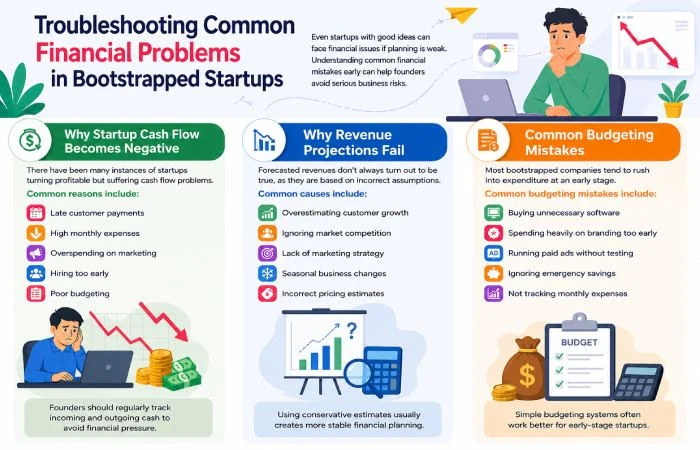
Startups with innovative ideas may run into financial problems due to poor planning. It is therefore wise to learn some common mistakes with regards to finances.
Why Startup Cash Flow Becomes Negative
There have been many instances of startups turning profitable but suffering cash flow problems.
Common reasons include:
- Late customer payments
- High monthly expenses
- Overspending on marketing
- Hiring too early
- Poor budgeting
Founders should regularly track incoming and outgoing cash to avoid financial pressure.
Why Revenue Projections Fail
Forecasted revenues don’t always turn out to be true, as they are based on incorrect assumptions.
Common causes include:
- Overestimating customer growth
- Ignoring market competition
- Lack of marketing strategy
- Seasonal business changes
- Incorrect pricing estimates
Using conservative estimates usually creates more stable financial planning.
Common Budgeting Mistakes
Most bootstrapped companies tend to rush into expenditure at an early stage.
Common budgeting mistakes include:
- Buying unnecessary software
- Spending heavily on branding too early
- Running paid ads without testing
- Ignoring emergency savings
- Not tracking monthly expenses
Simple budgeting systems often work better for early-stage startups.
FAQ Section
What is startup bootstrapped financial modeling?
The process of bootstrapping involves creating models of the income, expenses, cash flow, and profitability of startups without making any investments.
Why is financial modeling important for startup companies?
Financial modeling will aid the entrepreneur in making the right decisions and avoiding cost and cash flow challenges.
Can small startups use simple financial models?
Yes. Many startups begin with simple spreadsheets and basic forecasting systems.
What tools are best for beginner founders?
Google Sheets, Excel, and Notion are popular beginner-friendly tools.
What is the biggest financial mistake startups make?
Many startups overspend before building stable revenue.
How often should startups update financial models?
Most startups should review and update financial projections monthly.
Conclusion
When people start a company they can use something called startup bootstrapped financial modeling to help them build and grow their business without needing money from investors. This means they have to think about how money they will make what things will cost and how they will manage their cash. They also have to think about when they will break and make a plan for their money. When they do all this they can make decisions about their business and feel more sure of themselves.
Companies that do not take money from investors often have a time because they do not have a lot of money to spend. They may also grow slowly and have trouble with cash flow.. If they make a good financial plan they can control their costs avoid problems and plan for growth that will last.
The point of startup bootstrapped modeling is not to make complicated spreadsheets. It is to understand how money works in the business and make decisions based on realistic ideas, about what will happen.
Whether you are starting a company that sells software online an internet business, a agency or a small company planning your money carefully can help you stay stable make a profit and do well in the run.