

Introduction
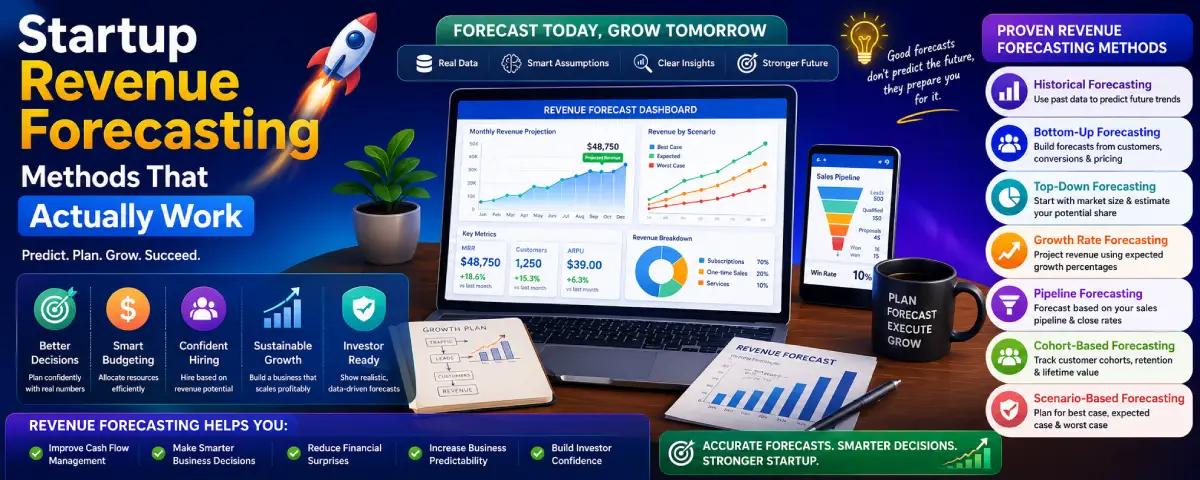
Startup revenue forecasting estimates future earnings, crucial for bootstrapped startups reliant on early customer revenue due to limited resources. The forecasts of the entrepreneurs could also turn out to be too idealistic. This creates the need for proper financial planning that entails forecast making to help with hiring and other processes. Although perfection cannot be achieved, it is important because it allows for making decisions based on market research and pricing.
What matters is not the creation of perfect projections but rather realistic forecasts that ensure survival and proper business decision making.
What Is Startup Revenue Forecasting Methods?
Definition of Revenue Forecasting
Forecasting revenue implies determining the anticipated future earnings for a business during a specified period of time. The process of revenue forecasting helps businesses predict future sales and prepare their budgets.
Start-ups forecast their revenues in order to predict their future sales and plan for growth.
A startup revenue forecast may include:
- Monthly revenue projections
- Yearly growth estimates
- Customer acquisition assumptions
- Pricing expectations
- Subscription revenue estimates
- Sales conversion projections
For example, a SaaS startup may forecast:
- 100 customers in Month 1
- 10% monthly growth
- $50 monthly subscription pricing
This would help estimate expected monthly recurring revenue.
One of the key concepts of Bootstrapped Financial Modeling Basics is revenue forecasting since it impacts every decision within the firm.
Why Revenue Forecasting Matters for Startups
Revenue prediction will assist entrepreneurs in becoming more strategic when they use predictions instead of making guesses.
Without forecasting, startups may:
- Overspend too early
- Hire too quickly
- Underestimate expenses
- Run out of cash unexpectedly
- Create unrealistic growth plans
Forecasting supports:
Expense Planning
Founders can estimate how much the business can realistically afford to spend.
Revenue forecasts should be combined with Expense Forecasting for Lean Startups to understand overall financial health.
Hiring Decisions
Forecasts help determine whether the company can support additional salaries.
Marketing Budgets
Revenue estimates help founders decide how much to spend on customer acquisition.
Runway Planning
Bootstrapped startups must carefully monitor how long available cash can support operations.
Investor Preparation
In spite of the fact that founders may be not looking for financing at the time, investors will always require realistic revenue projections.
Founders who want stronger startup planning foundations should also understand Bootstrapped Financial Modeling Basics because forecasting works closely with overall financial planning.
Revenue Forecasting vs Sales Goals
Many founders confuse sales goals with revenue forecasts.
They are not the same thing.
Sales Goals
Sales goals are targets the business hopes to achieve.
Example:
“We want to reach $1 million in revenue next year.”
Goals are aspirational.
Revenue Forecasts
Revenue predictions involve being realistic and making reasonable assumptions about the company, customers, pricing, conversions, and operations.
Forecasts should answer:
- What is realistically achievable?
- What growth rate makes sense?
- How many customers can we actually acquire?
Aggressive business targets do not necessarily mean that startups maintain aggressive financial projections.
The distinction is extremely vital to bootstrapped entrepreneurs since making overly optimistic forecasts could lead to significant financial issues.
Common Revenue Forecasting Challenges
Revenue forecasting is difficult for early-stage startups because uncertainty is very high.
No Historical Data
New startups often have no previous sales data available.
Market Uncertainty
Customer demand may change quickly.
Seasonal Demand
Some businesses experience large seasonal sales changes.
Unrealistic Assumptions
Founders sometimes assume growth will happen faster than reality.
Historical Forecasting Method
Historical forecasting uses past sales data to estimate future revenue.
This method works best for startups that already have:
- Existing customers
- Monthly sales history
- Recurring revenue
- Historical growth trends
Founders analyze previous performance and apply growth assumptions to future periods.
Example
| Month | Revenue |
| January | $5,000 |
| February | $5,500 |
| March | $6,200 |
Consistent income growth may prompt entrepreneurs to make future business growth forecasts.
Advantages
- Uses real business data
- Easier to calculate
- More accurate for existing businesses
Disadvantages
- Not useful for brand-new startups
- Past performance may not predict future conditions
Historical forecasting also helps identify:
- Seasonal trends
- Slow months
- Growth patterns
- Customer behavior changes
Bottom-Up Forecasting Method
Bottom-up forecasting is one of the most realistic methods for bootstrapped startups.
Instead of starting with market size, founders estimate revenue based on operational assumptions.
This usually includes:
- Website traffic
- Leads
- Conversion rates
- Customer numbers
- Pricing
Example
| Metric | Value |
| Website Visitors | 5000 |
| Conversion Rate | 2% |
| Customers | 100 |
| Product Price | $50 |
| Monthly Revenue | $5000 |
This method works well because it focuses on realistic business capacity.
Why Bootstrapped Startups Prefer Bottom-Up Forecasting
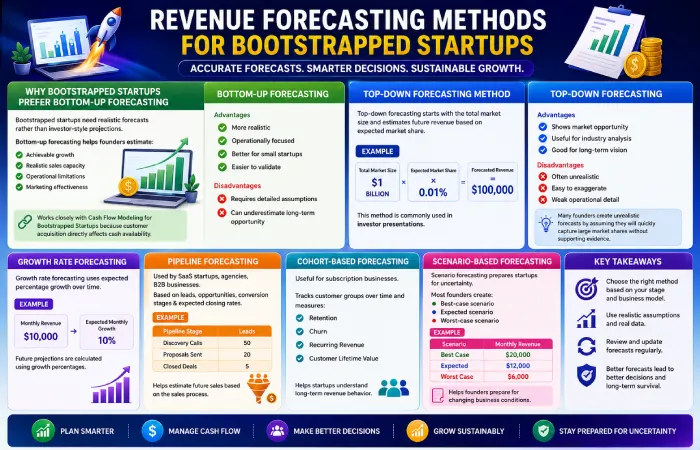
Bootstrapped startups usually need realistic forecasts rather than investor-style projections.
Bottom-up forecasting helps founders estimate:
- achievable growth
- realistic sales capacity
- operational limitations
- marketing effectiveness
This method also works closely with Cash Flow Modeling for Bootstrapped Startups because customer acquisition directly affects cash availability.
Advantages
- More realistic
- Operationally focused
- Better for small startups
- Easier to validate
Disadvantages
- Requires detailed assumptions
- Can underestimate long-term opportunity
Top-Down Forecasting Method
Top-down forecasting starts with the total market size and estimates future revenue based on expected market share.
Example
If the total market size is:
$1 billion
And the startup expects:
0.01% market share
Forecasted revenue becomes:
$100,000
This method is commonly used in investor presentations.
Advantages
- Shows market opportunity
- Useful for industry analysis
- Good for long-term vision
Disadvantages
- Often unrealistic
- Easy to exaggerate
- Weak operational detail
Many founders create unrealistic forecasts by assuming they will quickly capture large market shares without supporting evidence.
Growth Rate Forecasting
Growth rate forecasting uses expected percentage growth over time.
Example
If monthly revenue is:
$10,000
And expected monthly growth is:
10%
Future projections are calculated using growth percentages.
This method is simple but depends heavily on realistic assumptions.
Pipeline Forecasting
Pipeline forecasting is commonly used by:
- SaaS startups
- Agencies
- B2B businesses
Revenue forecasts are based on:
- leads
- sales opportunities
- conversion stages
- expected closing rates
Example
| Pipeline Stage | Leads |
| Discovery Calls | 50 |
| Proposals Sent | 20 |
| Closed Deals | 5 |
This helps estimate future sales based on the sales process.
Cohort-Based Forecasting
Cohort forecasting is useful for subscription businesses.
This method tracks customer groups over time and measures:
- retention
- churn
- recurring revenue
- customer lifetime value
It helps startups understand long-term revenue behavior.
Scenario-Based Forecasting
Scenario forecasting prepares startups for uncertainty.
Most founders create:
- Best-case scenario
- Expected scenario
- Worst-case scenario
Example
| Scenario | Monthly Revenue |
| Best Case | $20,000 |
| Expected | $12,000 |
| Worst Case | $6,000 |
This method helps founders prepare for changing business conditions.
Founders wanting deeper forecasting flexibility should also explore Scenario Planning for Bootstrapped Startups.
How to Project Revenue for a New Startup
Start With Customer Research
Revenue forecasting begins with understanding customers.
Founders should research:
- target audience size
- customer problems
- competitor pricing
- buying behavior
- market demand
Without customer research, revenue forecasts become guesses rather than informed estimates.
Estimate Initial Sales
New startups should begin with conservative expectations.
Many founders assume customers will arrive quickly after launch.
In reality, growth often takes longer.
Instead of forecasting explosive growth immediately, founders should estimate:
- initial customer acquisition
- launch traffic
- conversion rates
- realistic sales volume
Choose Pricing Strategy
Pricing directly affects revenue forecasts.
Different startups use different pricing models.
Subscription Pricing
Monthly recurring revenue model.
One-Time Pricing
Single payment products.
Service Pricing
Consulting or agency billing structures.
Founders should test pricing assumptions carefully before building long-term projections.
Calculate Conversion Rates
Conversion rates help estimate how many visitors become customers.
Example
| Stage | Number |
| Website Visitors | 1000 |
| Leads | 50 |
| Customers | 10 |
This creates a 1% visitor-to-customer conversion rate.
Accurate conversion estimates improve forecasting reliability.
Forecast Monthly Revenue
| Month | Estimated Customers | Estimated Revenue |
| January | 10 | $500 |
| February | 18 | $900 |
| March | 30 | $1,500 |
You can also make it slightly more realistic like this:
| Month | New Customers | Total Customers | Estimated Revenue |
| January | 10 | 10 | $500 |
| February | 8 | 18 | $900 |
| March | 12 | 30 | $1,500 |
Second table looks more natural for startup forecasting articles because it shows growth progression clearly.
Those founders looking to gain further insight into how to generate more comprehensive sales forecasts, growth assumptions, and future financial projections may refer to our Revenue Projections for Bootstrapped Startups guide.
Review and Adjust Forecasts Regularly
Forecasts should never remain unchanged for long periods.
As new data becomes available, founders should update:
- pricing assumptions
- conversion rates
- growth expectations
- customer acquisition costs
Revenue forecasting is an ongoing process rather than a one-time exercise.
Bottom-Up vs Top-Down Approaches
What Is Bottom-Up Forecasting?
Bottom-up forecasting estimates revenue using operational data.
This includes:
- customers
- pricing
- traffic
- conversion rates
- sales capacity
It focuses on realistic execution.
What Is Top-Down Forecasting?
Top-down forecasting starts with market size and estimates future market share.
This approach focuses more on industry opportunity than operational reality.
Advantages of Bottom-Up Forecasting
- More realistic
- Easier to validate
- Better for bootstrapped startups
- Uses actual business assumptions
Advantages of Top-Down Forecasting
- Shows market opportunity
- Useful for investors
- Supports strategic planning
Which Method Is Better for Startups?
In most cases, bootstrapped startup companies need to focus on bottom-up financial forecasting because it uses practical operating assumptions rather than market estimations.
Comparison Table
| Factor | Bottom-Up | Top-Down |
| Accuracy | Higher | Lower |
| Data Source | Customers | Market Size |
| Risk | Lower | Higher |
| Best For | Bootstrapped Startups | Investor Pitches |
How to Validate Revenue Assumptions
Founders can validate assumptions using:
- customer interviews
- competitor research
- beta testing
- early sales data
- industry benchmarks
Using Conservative Assumptions
Conservative forecasting becomes important for bootstrapped entrepreneurs, considering that staying alive becomes more important than making bold forecasts.
Conservative forecasts reduce financial surprises.
Updating Assumptions Over Time
Forecast assumptions should evolve as the business grows.
Real data gradually replaces estimated assumptions.
Avoiding Hockey-Stick Forecasting Mistakes
What Is Hockey-Stick Forecasting?
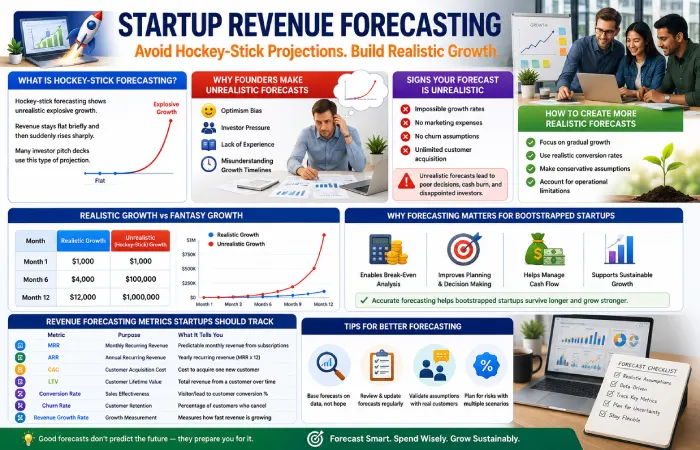
Hockey-stick forecasting shows unrealistic explosive growth.
Revenue stays flat briefly and then suddenly rises sharply.
Many investor pitch decks use this type of projection.
Why Founders Make Unrealistic Forecasts
Common reasons include:
- optimism bias
- investor pressure
- lack of experience
- misunderstanding growth timelines
Signs Your Forecast Is Unrealistic
Examples include:
- impossible growth rates
- no marketing expenses
- no churn assumptions
- unlimited customer acquisition
How to Create More Realistic Forecasts
Focus on:
- gradual growth
- realistic conversion rates
- conservative assumptions
- operational limitations
Realistic Growth vs Fantasy Growth
| Month | Realistic | Unrealistic |
| Month 1 | $1000 | $1000 |
| Month 6 | $4000 | $100,000 |
| Month 12 | $12,000 | $1M |
Another reason why forecasting becomes important for bootstrapped entrepreneurs is that it enables the Break-Even Analysis for Bootstrapped Startups.
Revenue Forecasting Metrics Startups Should Track
| Metric | Purpose |
| MRR | Monthly recurring revenue |
| ARR | Annual recurring revenue |
| CAC | Customer acquisition cost |
| LTV | Customer lifetime value |
| Conversion Rate | Sales effectiveness |
| Churn Rate | Customer retention |
| Revenue Growth Rate | Growth measurement |
Tracking these metrics improves forecasting accuracy over time.
Common Revenue Forecasting Mistakes
Common mistakes include:
- overestimating sales
- ignoring seasonality
- unrealistic market share assumptions
- failing to update forecasts
- ignoring churn
- assuming unlimited growth
The safest forecasts are usually conservative, realistic, and regularly updated.
FAQ
What is startup revenue forecasting?
Reveneu forecasting entails the prediction of the future revenues based on certain assumptions, customers’ information, pricing, and growth.
How often should forecasts be updated?
Monthly forecast reviews are ideal for most startups.
What is an appropriate startup growth rate?
Each sector has different growth rates; however, conservative forecasts will always be more accurate when it comes to startups.
Is it possible to leverage AI in forecasting?
AI can be used in forecasting calculations but assumptions need to be manually validated.
Why is forecasting important?
Forecasting assists with decision-making, budgeting, and staffing.
Conclusion
Financial forecasting by startups will assist the entrepreneurs in making sound judgment using real financial forecasts instead of speculation.
The conservative approach to forecasting is usually preferred by bootstrapped companies since liquidity and staying alive is more important than wild optimism.
The best forecasts are:
- realistic
- regularly updated
- based on actual customer behavior
- supported by clear assumptions
Improvements should be made gradually instead of expecting the perfect forecast to begin with. Revenue forecasting will become more accurate as more information about customers and sales is gathered.
More important, new firms should never assume unrealistic hockey-stick proje