

Being a startup founder in 2026 has become more difficult yet more feasible than ever before. The entry barriers into the world of product development have never been lower due to no-code development, assistance from artificial intelligence and faster feedback mechanisms. Still, the failure rate stays high. What differentiates startups that stay afloat from those that run out of money is simple – the ability to develop an MVP effectively.
An MVP is no longer considered to be the basic prototype of your solution. In 2026, an MVP is the ultimate tool for validated learning, efficient use of capital and quick launch into the market. Here, in our ultimate guide to MVP development, you can read about everything there is to learn about developing an MVP including the fundamental principles, processes, tools, testing strategies and no-code development.
Founders new to business, as well as those with experience, can benefit from this discussion. As you go through the article, you have to be sure that you pay attention to the hyperlinks on cluster articles for every topic.
MVP Development Resource Center
Explore our complete collection of guides covering minimum viable product fundamentals, real-world MVP examples, testing strategies, development tools, no-code MVP creation, and the lean startup approach.
Minimum Viable Product Guide: What an MVP Really Means in 2026
The classic definition of a Minimum Viable Product still holds true. As Eric Ries popularized it:
Minimum viable product is that version of a new product which helps a team get maximum validated learning about customers with the least possible effort.”
The term was invented back in 2001 by Frank Robinson, who defined MVP as the product that provides maximum return on risk – big enough for adoption and sales but not so big that it becomes bulky and risky. Ries later put a different spin on it by focusing on validated learning.
The concept remains the same in 2026, but the standard of “viable” has increased. With the help of artificial intelligence and no-code technology, building something has never been easier, but it is not just about that anymore. Users now expect even early versions to deliver real value quickly. The focus has shifted from “the smallest thing we can ship” to “the smallest amount of proof we can earn.”
What a Strong MVP Looks Like in 2026
A well-designed MVP today is:
- Focused on solving one core problem extremely well
- Built specifically to test a high-risk assumption (not just to launch)
- Measurable — success metrics are defined before development begins
- Designed for rapid iteration and learning
- Often a hybrid of code, no-code, and manual processes (Concierge or Wizard of Oz approaches)
What an MVP Is Not
Despite how commonly the term is misused, an MVP is not:
- A half-finished or low-quality product
- A feature-complete beta version
- Something built in isolation for months before any user contact
- The cheapest possible version of your full vision
- An excuse for poor user experience
As per a latest study conducted by CB Insights research, 43% of the businesses had failed due to poor product market fit, which shows the importance of validating customer needs before doing anything. Startups that begin with the idea of MVP concept development will be more successful compared to other startups.
MVP vs Prototype vs Full Product
One of the most common sources of confusion is mixing up these three stages. Here’s a clear comparison:
| Aspect | Prototype | MVP (Minimum Viable Product) | Full Product |
| Primary Goal | Test design, usability & concept | Validate real market demand & learning | Scale, retain users & grow revenue |
| Functionality | Simulated or partial | Fully functional core features only | Complete feature set + polish |
| Users | Internal team / stakeholders | Early adopters / real customers | Broad market |
| Time to Build | Days to a few weeks | Weeks to a few months | Months to years |
| Cost | Low | Medium | High |
| Feedback Type | Design & usability feedback | Behavioral data + willingness to pay | Market growth & retention data |
| Risk Level | Very low | Medium | High (if unvalidated) |
| Typical Output | Clickable Figma / mockup | Live product with limited scope | Production-ready platform |
Key takeaway: A prototype answers “Does this feel right?” An MVP answers “Will real people use and pay for this?” A full product answers “Can this scale sustainably?”
The error that founders commit which proves to be very costly is to skip the MVP step and go directly to full-fledged production.
MVP vs Prototype vs Full Product
| Aspect | Prototype | MVP | Full Product |
| Main Goal | Check if the idea feels right | Check if real people will use & pay | Scale and grow the business |
| Functionality | Simulated or partial | Fully working core features only | Complete + polished |
| Who uses it | Team and a few stakeholders | Early real users | Broad market |
| Time needed | Few days to 2–3 weeks | 4–12 weeks | Several months to years |
| Typical cost | Low | Medium | High |
| Type of feedback | Design & usability comments | Actual behaviour + willingness to pay | Growth and retention data |
| Risk if wrong | Very low | Medium | Very high |
Core Principles That Still Matter
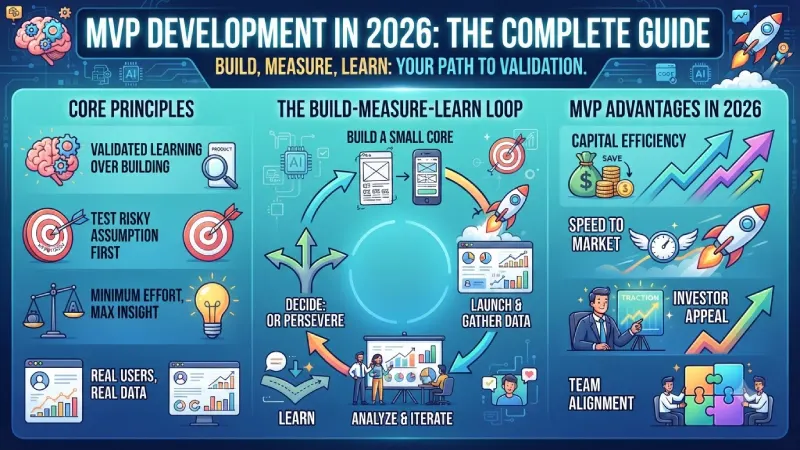
- Validated learning over building — The goal is not to launch a product; it is to reduce uncertainty.
- Test the riskiest assumption first — Every MVP should be designed around one critical hypothesis.
- Minimum effort, maximum insight — Cut everything that does not help answer the core question.
- Real users, real behavior — Opinions are weak signals. Actual usage and payment are strong signals.
- Pivot based on evidence – The Build-Measure-Learn cycle continues to be the operating system for creating successful MVPs.It is important that you have an idea about these fundamentals before you start coding or use no-code tools.
To learn more about the definition, its basic tenets, detailed comparisons, and most common misconceptions founders hold today, see the complete cluster article here: → What Is a Minimum Viable Product (MVP)? A Founder’s Guide
It is essential that you understand these basics even before you start coding or use any no code development tool.
How to Build an MVP: The Practical Roadmap
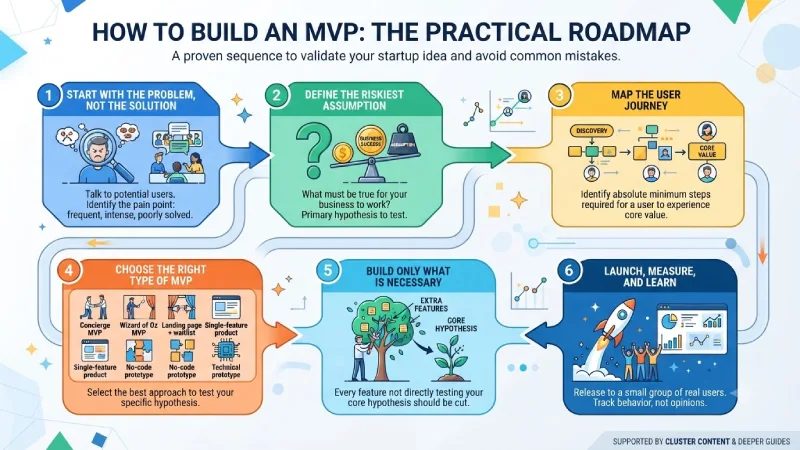
MVP creation process involves a set sequence of steps. The biggest mistake startup founders make is not following the steps.
- Start with the problem, not the solution
Talk to potential users. Identify the pain point that is frequent, intense, and currently poorly solved.
- Define the riskiest assumption
What must be true for your business to work? That becomes the primary hypothesis your MVP must test.
- Map the user journey
Identify the absolute minimum steps required for a user to experience the core value.
- Choose the right type of MVP
- Concierge MVP
- Wizard of Oz MVP
- Landing page + waitlist
- Single-feature product
- No-code prototype
- Technical prototype
- Build only what is necessary
Every feature that does not directly test your core hypothesis should be cut.
- Launch, measure, and learn
Release to a small group of real users and track behavior, not opinions.
The process is described in more detail in the following sections as well as in our supporting cluster content.
MVP Development Process: Step-by-Step Framework
Here is a proven, modern MVP development process used by successful startups in 2026:
Phase 1 – Discovery & Validation (1–3 weeks)
- Problem interviews
- Solution interviews
- Competitive analysis
- Define success metrics
Phase 2 – Design & Prioritization (1–2 weeks)
- User flow mapping
- Feature prioritization (MoSCoW or RICE)
- Low-fidelity wireframes or clickable prototypes
Phase 3 – Build (2–8 weeks depending on complexity)
- Choose tech stack or no-code platform
- Develop only the core loop
- Set up analytics from day one
Phase 4 – Launch & Test (Ongoing)
- Soft launch to early adopters
- Collect quantitative and qualitative data
- Run structured experiments
Phase 5 – Iterate or Pivot
- Analyze results against success metrics
- Decide: persevere, pivot, or kill
It is quite associated with the lean startup approach. More details on the Build-Measure-Learn cycle and validated learning can be found here: → Lean Startup MVP Methodology
MVP Examples: What Successful Startups Actually Launched
Theory is useful. Real examples are better.
Some of the most famous companies started with extremely limited MVPs:
- Dropbox began with a simple explainer video
- Airbnb launched with air mattresses and a basic website
- Zappos tested demand by photographing shoes in stores and buying them only after orders came in
- Buffer started as a two-page landing page
- Many modern SaaS companies launched with no-code tools or manual backends
We have documented detailed case studies, including SaaS, mobile, and marketplace examples, plus lessons from failed MVPs: → MVP Examples and Case Studies
Analysis of these cases enables you to determine what “minimum” really is.
MVP for Startups: Why It Matters More Than Ever in 2026
For startups, MVP development is no longer a nice-to-have strategy — it is a survival necessity. In an environment where building products has become dramatically cheaper and faster, the biggest risk is no longer technical feasibility. The biggest risk is building something nobody actually wants.
Based on CB Insight statistics, about 42% of startups fail due to creating products with no demand in the market. The startups that have their process of product development begin with the MVP methodology are more successful compared to others who do not begin with the same process.
Why MVP Development Is Critical for Startups in 2026
Here are the most important advantages:
1. Efficiency of Capital An MVP will enable you to test market demand for your product without investing huge sums of money or time into it. Rather than spending between 6 and 12 months and thousands of dollars on developing a product, most people can test their idea within 4 to 10 weeks.
2.Market Opportunities Are Time Sensitive As you are refining features, other companies or artificial intelligence-based solutions can move into the market. With an MVP, you are able to capture the user while they are still in pain and have an unsolved problem.
3. Speed of Learning The true benefit of an MVP is not the MVP itself, but rather the speed at which founders learn through shipping it out. What do people value about the product? How are they using it? What are their points of friction?
4. Investor Friendly In 2026, when seeking funding for your startup, many seed stage investors prefer seeing a live product with some usage data than hearing you talk about your vision through a beautifully designed pitch deck.
5. Feature Creep of Team Alignment kills more startups than the lack of funding does. The creation of an MVP ensures that all team members – founders, designers, engineers – work toward the same goal of proving their riskiest hypothesis.
MVP vs Building the Full Product First
| Factor | Building Full Product First | Starting with an MVP |
|---|---|---|
| Time to first users | 6–18 months | 4–12 weeks |
| Typical early cost | High ($50K–$250K+) | Medium to low ($5K–$60K) |
| Risk of building wrong | Very high | Significantly reduced |
| Learning speed | Slow (feedback comes late) | Fast (continuous feedback loop) |
| Investor appeal | Vision-heavy | Traction + evidence |
| Ability to pivot | Expensive and painful | Relatively easy and low-cost |
| Team focus | Scattered across many features | Locked on one core hypothesis |
The 2026 Reality Check
From AI-powered tools to no-code products and worldwide remote talent, it is easier now than ever to build. However, the difficult part isn’t development anymore; it is making decisions on what to build. In this context, the success of a startup isn’t measured by how many features you are able to deliver, but how quickly you can learn.
Minimum Viable Product is the best tool available for entrepreneurs to decrease uncertainty, protect their resources, and maximize chances of getting product-market fit.
If done right, an MVP will change the process of developing a product from a gamble into a set of experiments.
MVP Testing Strategies: How to Know If It’s Working
Building is only half the job. The real value of an MVP comes from systematic testing.
Effective testing approaches in 2026 include:
- User testing sessions (moderated and unmoderated)
- A/B testing of key flows and messaging
- Smoke tests and pre-launch landing pages
- Concierge and manual delivery to observe real behavior
- Tracking leading indicators (activation, retention, referral) rather than vanity metrics
Find out all the methodologies, techniques to collect feedback, and metrics that an entrepreneur must track here: → MVP Testing Strategies
Choosing the Right Tools for MVP Development
Your tech stack (or lack of one) can make or break your timeline.
Options range from:
- Traditional code (React, Next.js, Flutter, etc.)
- Low-code platforms
- No-code tools (Bubble, Glide, FlutterFlow, Softr, etc.)
- Hybrid approaches
We maintain an up-to-date comparison of the best tools and platforms for different types of MVPs: → MVP Development Tools and Platforms
No-Code MVP Development: When It Makes Sense
In 2026, most of the successful early-stage startups would have built their very first product using non-traditional programming. The no-code development platforms have evolved a lot and have expanded beyond just building simple websites.
When no-code is the right choice:
- You need to validate demand quickly
- Your product logic is relatively straightforward
- You want to keep burn rate extremely low
- You plan to rebuild later once product-market fit is clearer
When it is not:
- You have complex, performance-critical requirements
- You already have strong technical co-founders and a clear product vision
- Scalability and technical debt would become major issues too early
Full guide with platform recommendations and real examples: → No-Code MVP Development
Putting It All Together: Your MVP Development Checklist
- Clearly define the problem and the riskiest assumption
- Choose the right type of MVP
- Map the minimum user journey
- Select tools (code, no-code, or hybrid)
- Build only what is required to test the hypothesis
- Launch to real users quickly
- Measure against pre-defined success metrics
- Iterate, pivot, or stop based on data
F&Q
1. How would you describe MVP in easy words?
MVP or Minimum Viable Product is the most basic version of your product offering that offers any value to early adopters. It is created precisely to find out if there is any demand for such product without spending too much time and resources on developing it.
2. Why do you think that MVP differs from the prototype?
The prototype is mostly created to check its design and usability. On the other hand, MVP is the product which is already developed and ready to be used by real users.
3. How much time do you need to create your MVP in 2026?
It takes from 4 to 12 weeks to develop well-specified MVPs. The no-code MVPs require 2-6 weeks to be developed.
Final Thoughts
MVP development is not about building less — it is about learning faster. The founders who treat their first version as an experiment rather than a finished product consistently outperform those who try to launch the “perfect” product on day one.
Use this pillar page as your starting point. Dive into the linked cluster articles for deep dives on each topic. Then go build, measure, and learn.
The market will value rapid learning in 2026 over fast coding. Be good at developing MVPs, and you’ll greatly improve your chances of creating something desirable.