

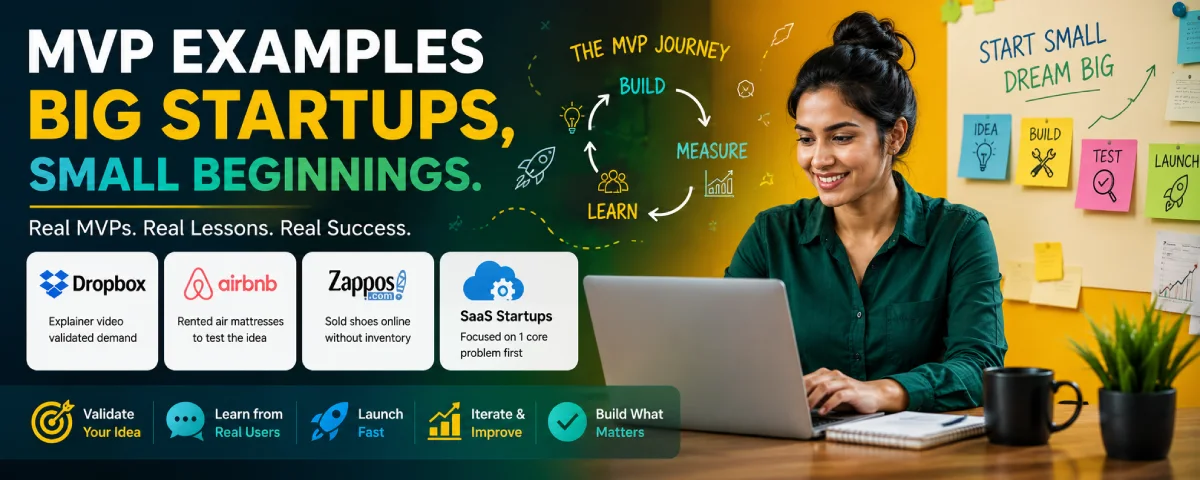
But most entrepreneurs fall for the same trap. They get a brilliant idea, spend months developing a perfect-looking product, release it—and nobody cares. It’s beautiful, but the problem solved by the solution isn’t really the problem of anyone’s life, or there is no one ready to pay for its solving.
That’s precisely why the MVP approach was developed. MVP isn’t just half-developed. It is the minimum amount of product which gives true value and lets see if people want it or not.
In this article, we will analyze some examples of MVP from the giants of today and understand what exactly made them successful or not. And then you’ll learn how to use it in 2026.
For the overarching strategy, read our complete guide on MVP Development.
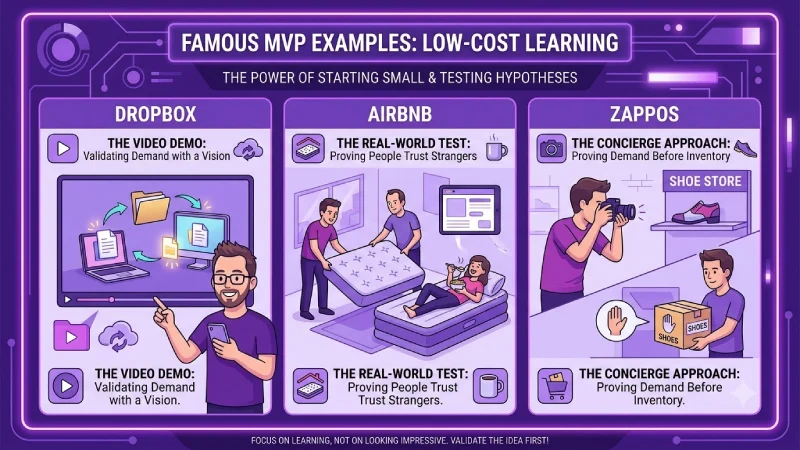
Famous MVP Examples Like Dropbox, Airbnb, and Zappos
These three stories get told a lot, but for good reason. Each one shows a different way of testing an idea with almost no money and very little code.
Dropbox
Drew Houston did not create an elaborate file-syncing app at first. He created a three-minute video demo of Dropbox. The video appeared quite realistic even though there was nothing yet to show. He then published the video on forums where early tech enthusiasts used to hang around.
In no time, the number of people in the waiting list grew from a few thousands to well over 75,000 people. It was quite obvious from the feedback that Drew Houston understood there was indeed an issue to be solved. Only then, the team started working on the actual product.
The moral of this story remains relevant today – sometimes the best MVP is not the software at all. It is a demonstration that makes people say: “I need this!”
Airbnb
Brian Chesky and Joe Gebbia had trouble paying their bills in San Francisco. A big design conference was coming and all the hotels were booked. So they purchased some air mattresses, set up a website and started offering their guests a place to sleep and breakfast.
This little experiment brought them some cash and, even more importantly, showed that people would agree to spend a night in a stranger’s apartment. And
Zappos
Nick Swinmurn wondered whether there was interest in buying shoes online. Rather than spending money on warehouses and inventory, he would simply go into local shoe shops and take pictures of the shoes. Once someone made an order, he would visit the shop again, buy the shoes for full price, and send them out himself.
This model was entirely unscaleable. However, it gave the answer to the one and only question that needed answering back then: do customers buy shoes online without actually trying them?
Once he saw that people would, he raised money and built the real operation.
These three examples show different styles of MVP:
- Dropbox used a demo video
- Airbnb used a real-world experiment with a basic website
- Zappos used a manual, concierge-style approach
All of them focused on learning, not on looking impressive.
| Company | Type of MVP | What They Launched First | Main Question They Answered | Result |
| Dropbox | Demo Video | 3-minute explainer video | Do people want easy file syncing? | 75,000+ joined the waitlist |
| Airbnb | Real-world experiment | Air mattresses + basic website | Will strangers pay to stay in homes? | Validated the idea + first guests |
| Zappos | Manual / Concierge | Photos of shoes + simple website | Will people buy shoes online? | Proved demand before inventor |
SaaS MVP Examples and Lessons Learned
One of the industries that have provided some of the best MVP stories is that of Software as a Service (SaaS).
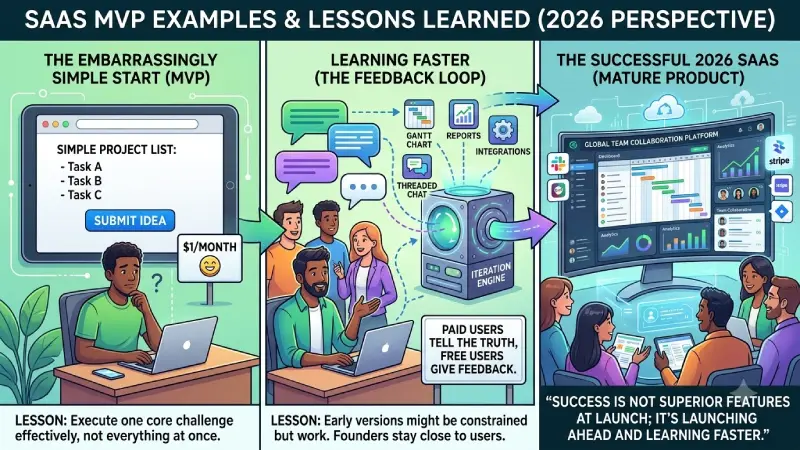
Many successful SaaS tools started with almost embarrassingly simple versions:
- Early project management apps usually started off with only lists and basic assignment capabilities. No Gantt charts, no time tracking, no reports.
- Initial communication tools came with just one purpose (group communication or simple communication) and subsequently added threading, integrations, videos, and search.
- Some popular CRMs and customer support apps were initially built internally or had very specific user groups to serve.
Common patterns from successful SaaS MVPs:
- They executed on one difficult challenge very effectively rather than trying to do too much at once.
- Early versions were often ugly or constrained but worked perfectly fine for the basic functionality.
- The founders remained very close to the initial users and let the feedback drive the features that came after.
- They started charging money early on even if it was just a small amount. Free users give you feedback. Paid users tell you the truth.
One major thing that has not changed by 2026: the firms that succeed do not do so based on their superior features at launch time; they succeed by virtue of launching ahead and learning faster.
The founders remained very close to the initial users and let the feedback drive the features that came after.
MVP Case Studies for Mobile App Startups
Mobile apps are expensive to build well, which makes the MVP approach even more important.
Many well-known apps started much simpler than people remember:
- The early ride-hailing applications only had the functionality of sending someone a car; there were no complex map options or reward systems or multiple options of vehicles.
- Physical fitness apps initially contained only tracking functionalities or even only a log-in of workouts without any social or other additional aspects added later on.
- The food delivery applications initially used only a few restaurants from a single location for delivering the orders manually or semi-manually.
The pattern is consistent. The first version does one job reliably. Everything else comes later, only if users actually want it.
Mobile founders especially need to be careful. App stores are crowded, development is costly, and users have very little patience. A bloated first version that tries to do too much often dies quietly.
What Makes a Great Startup MVP?
A great MVP is not defined by how little you build. It’s defined by how much you learn relative to the time and money you spend.
Strong MVPs usually share these traits:
- They focus on one clear problem
- They deliver real value, even if the solution is incomplete
- They make it easy to collect feedback (through usage data, conversations, or both)
- They can be improved quickly
- They feel reliable enough that early users don’t immediately abandon them
There’s a difference between a minimal product and a viable product. Something can be tiny and still useless. Something can also be simple and still genuinely helpful. The second one is what you’re aiming for.
Good questions to ask before building:
- What is the smallest thing I can give someone that still solves a meaningful part of their problem?
- How will I know if it’s working?
- What am I trying to learn with this version?
If you can’t answer those clearly, you’re probably not ready to build yet.
| Characteristic | Why It Matters | Good Example | Weak Example |
| Focuses on one clear problem | Keeps everything simple | File syncing (Dropbox) | All-in-one productivity platform |
| Delivers real value | Users must get something useful | Staying in a real home | Pretty design with no real benefit |
| Easy to collect feedback | Learning is the main goal | Usage data + conversations | No way to hear from users |
| Can be improved quickly | Fast learning beats perfect planning | Weekly updates | Long development cycles |
Lessons from Failed MVPs and How to Avoid Them
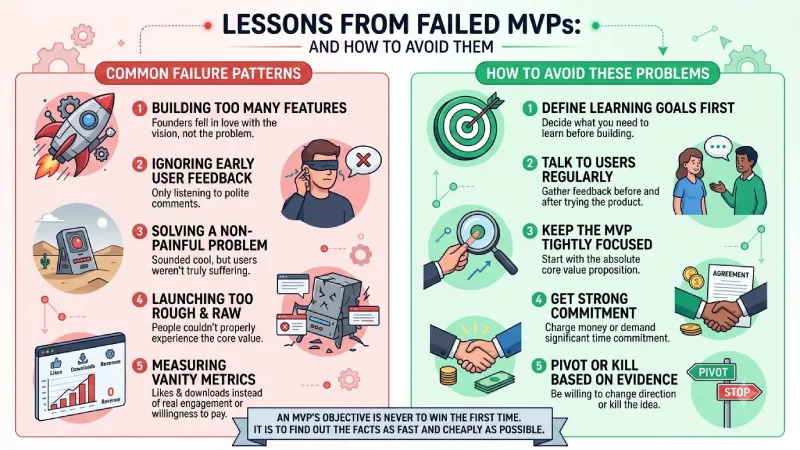
Not every MVP works. In fact, many fail. The reasons are usually predictable.
Common failure patterns:
- Building too many features because the founders fell in love with the vision
- Ignoring what early users actually said (or only listening to the polite comments)
- Solving a problem that sounded interesting but wasn’t painful enough
- Launching something so rough that people couldn’t properly experience the core value
- Measuring the wrong things (vanity metrics instead of real engagement or willingness to pay)
How to avoid these problems:
- Decide in advance what you need to learn
- Talk to users before and after they try the product
- Keep the first version tightly focused
- Charge money or get strong commitment when possible
- Be willing to change direction (or kill the idea) based on evidence
An MVP’s objective is never to win the first time out. It is always to find out the facts as fast and cheaply as possible.
Practical Takeaways for 2026
Tools are better than ever. You can build functional prototypes faster than founders could ten years ago. That is both good and dangerous. It makes it easier to overbuild.
The founders who do well still follow the old principles:
- Start with a real problem
- Test the riskiest assumption first
- Talk to users constantly
- Stay focused longer than feels comfortable
Whether you’re building software, a service business with a digital front end, or a marketplace, the same logic applies. Reduce the risk of building the wrong thing.
Final Thoughts
There would be no Dropbox, Airbnb, Zappos, and other successful businesses that came into existence through trial and error. They were successful because they looked at their initial stage not as an unveiling, but rather as a learning process.
It doesn’t matter whether your first version will amaze everyone; all that matters is whether it will provide you with some truth about the market.
Start small; start way smaller than you think you should. Talk to customers more often than you wish to. Learn from what they do, not just from what they say.
Such an approach guarantees you the best chance of success.
To take the next step, see our detailed guide on MVP Testing Strategies