

Most startups don’t fail because the founders are lazy. They fail because they spend too long building something nobody really wants. They fall in love with their idea, disappear for six or nine months, launch with a big bang… and then hear silence.
This is precisely where the Lean Startup concept came in to help prevent this situation from occurring. It is better to invest in creating a mini-version of the business and test it out with people, learning from the results.
This process is nothing new, but even in 2026 it beats most of the complex tips that you will get.
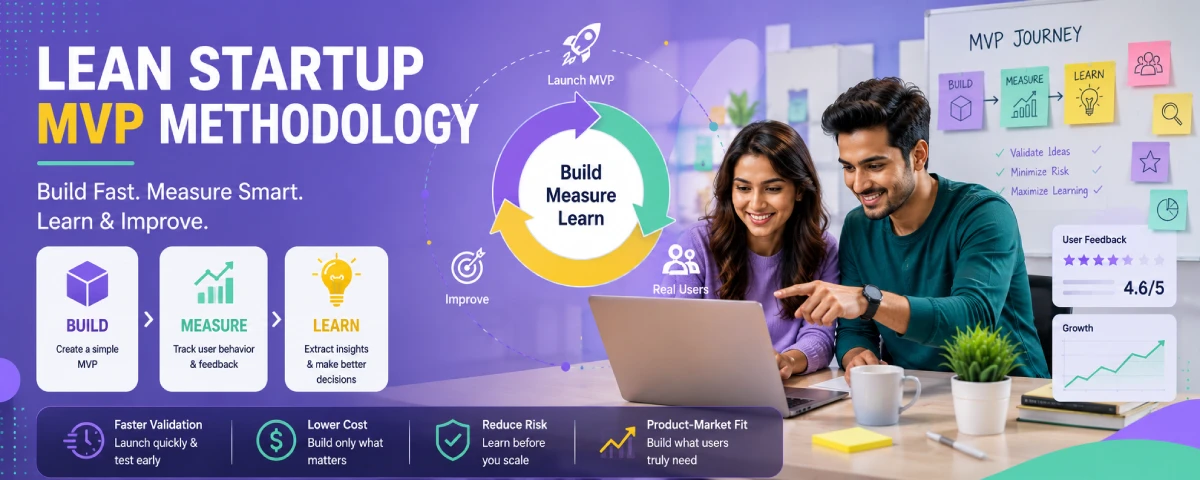
Lean Startup Principles and Build-Measure-Learn
The concept of the lean startup was developed by Eric Ries several years ago, and the basic cycle remains unchanged: Build-Measure-Learn.
Build
You create the smallest thing that can test your main assumption. This is usually called the Minimum Viable Product.It does not have to be nice or even finished. All it has to be is good enough to make people respond to it realistically.
Measure
You watch what users actually do. Not what they say in surveys when they’re being polite. Real behavior: do they come back? Do they use the main feature? Do they pay? Do they ignore half the product?
Learn
You look at the data and the conversations and decide what it means. Then you use that learning to decide the next step.
The loop never really ends. Even successful companies keep running smaller versions of this cycle.
Here’s a simple way to look at it:
| Stage | What You Do | Main Goal | Common Mistake |
| Build | Create the smallest useful version | Test the riskiest assumption | Building too many features |
| Measure | Track real user behavior + feedback | Get honest signals | Only looking at vanity metrics |
| Learn | Decide what the data actually means | Know whether to continue or change | Ignoring uncomfortable results |
| Repeat | Improve or change direction | Move closer to product-market fit | Stopping after one cycle |
Validated Learning Through MVPs
Validated learning is basically a more elegant way of saying: Stop guessing; start validating.
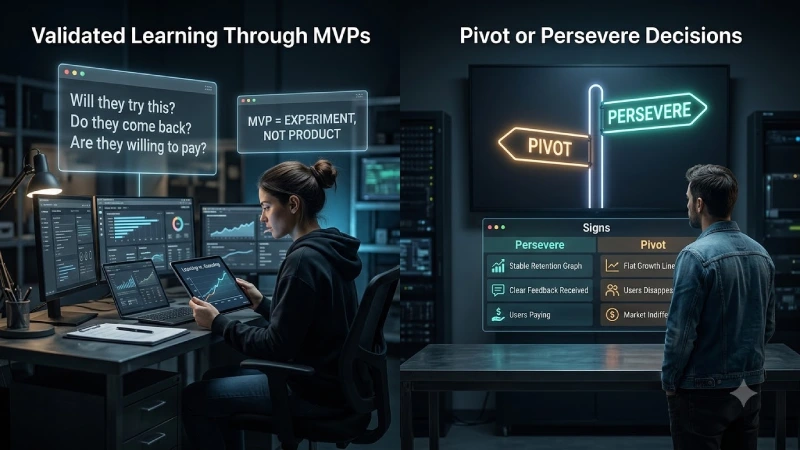
Each MVP must address at least one critical question such as:
- Will people even try this?
- Do they understand what it does?
- Do they come back after the first use?
- Are they willing to pay?
- Which part do they care about most?
If you’re not learning something clear from the MVP, then it wasn’t designed well. A lot of founders treat the MVP like a mini version of their final product. That’s usually a mistake. The MVP is closer to an experiment than a product.
From my experience, the startups that progress the most quickly are those that use each iteration as an opportunity to learn rather than an opportunity to make themselves look good.
Pivot or Persevere Decisions for Startups
This is the part most founders hate. After you gather data, you have to decide: keep going in the same direction, or change?
Signs you should persevere (keep going):
- People are using the product regularly
- Retention is stable or improving
- You’re getting clear feedback on how to make it better
- Some users are paying or asking when they can pay
- The core problem still feels real
Signs you should consider a pivot:
- Users try it once and disappear
- Feedback keeps pointing to a different problem
- Growth stays flat even after several improvements
- You have to keep explaining the product because people don’t get it
- The market simply doesn’t care as much as you thought
A pivot is not failure. A lot of well-known companies changed direction after their first version. The failure is staying stubborn when the evidence is clear.
Minimum Viable Product vs Minimum Viable Feature
People often mix these two up.
| Aspect | Minimum Viable Product (MVP) | Minimum Viable Feature (MVF) |
| Purpose | Test if the overall idea is worth pursuing | Test if one new feature is valuable |
| Scope | A full (but simple) product | One feature inside an existing product |
| Main Question | Does this product deserve to exist? | Does this feature improve the product? |
| Users | Early adopters / new customers | Existing users |
| Risk Level | Higher (whole idea is being tested) | Lower (product already exists) |
An MVP helps you decide if you should build the company at all. An MVF helps you decide what to add next once the product is already alive.
Lean MVP Case Studies and Frameworks
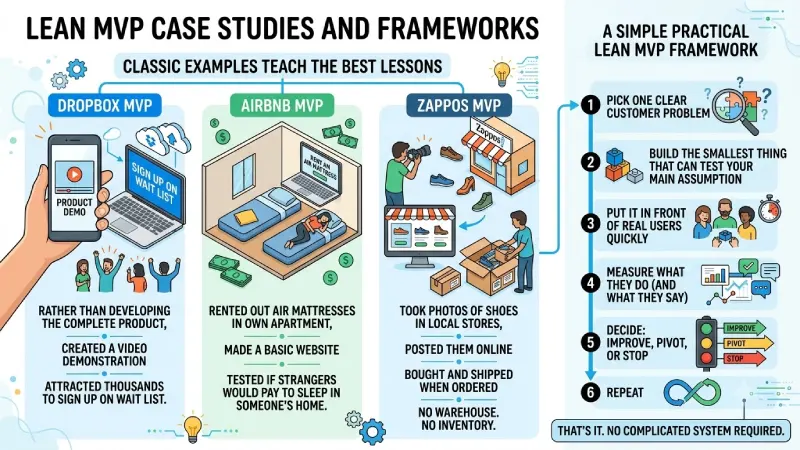
The classic examples still teach the best lessons.
Dropbox
Rather than developing the complete product, they simply created a video demonstration of how the product would work. This video attracted thousands of individuals who were willing to sign up on the wait list.
Airbnb
The founders rented out air mattresses in their own apartment and made a basic website. They didn’t build a complex platform first. They just tested whether strangers would pay to sleep in someone else’s home.
Zappos
The founder took photos of shoes in local stores and posted them online. When someone ordered, he bought the shoes and shipped them. No warehouse. No inventory. Just a test of demand.
A simple practical framework many founders still use:
- Pick one clear customer problem
- Build the smallest thing that can test your main assumption
- Put it in front of real users quickly
- Measure what they do (and what they say)
- Decide: improve, pivot, or stop
- Repeat
That’s it. No complicated system required.
FAQs
What is the Lean Startup MVP approach?
It is a product development methodology that involves experimentation, measuring user behavior, and learning before investing.
What is meant by “validated learning?”
This is making decisions based on user behavior rather than your assumptions about it.
When is a startup expected to pivot?
When it becomes apparent from data that the chosen direction isn’t working despite multiple attempts.
Does the concept of build-measure-learn make sense in 2026?
Yes. While the means may be different now, the principle of validating hypotheses before investing has not lost its relevance.
How small an MVP can be?
Not too small to launch but not too big to validate.
Conclusion
The Lean Startup is not all about speed, but rather the reduction of risk by making sure that the right product is being developed.
Most founders don’t need more features or a bigger vision. They need faster feedback and the humility to listen to it.
Build something small. Measure what really happens. Learn from it. Then decide what to do next.
Do that consistently, and you give yourself a much better chance of ending up with a product people actually want — instead of one that only looked good in your head.