

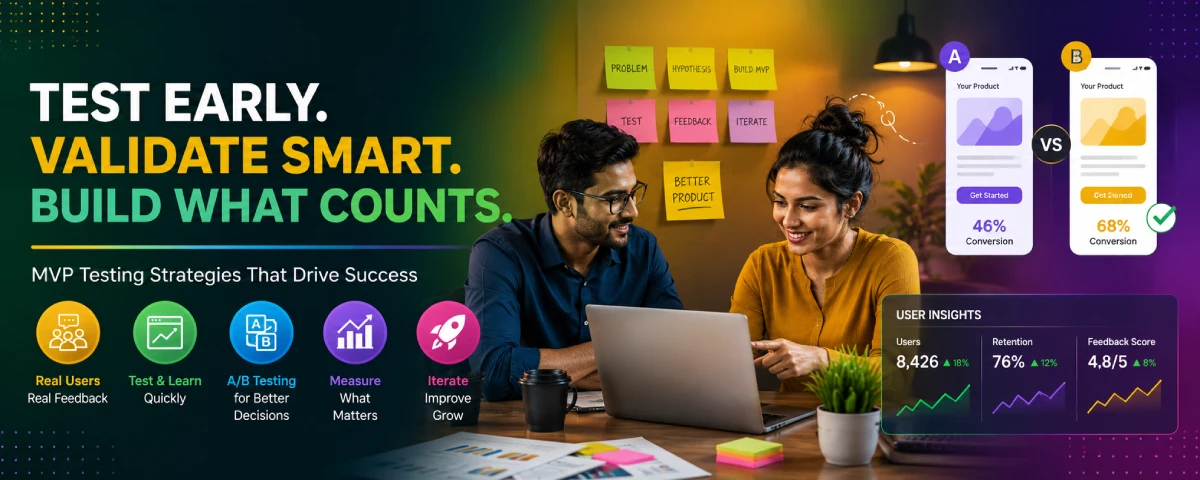
Creating the MVP is just one part of the process. What happens next really counts – showing your creation to the people who will use it and seeing what works and what doesn’t. But most entrepreneurs ignore or mismanage this step and end up asking why their users disappeared.

Proper MVP testing is how you remove the guesswork from the equation. It will tell you what your users are doing, what is frustrating them, and whether there is enough demand for your product that they stick with (and pay for) it long term. Entrepreneurs of 2026 are going to be those who tested early and tested often thanks to rapidly developing technology.
This guide describes different testing techniques, A/B testing on an early product, smoke testing, concierge approach, how to gather meaningful feedback and which metrics to focus on.
User Testing Methods for Early-Stage MVPs
Since your product is not polished yet, you will need techniques which send strong signals without involving thousands of users.
Here are some techniques which will help you the most at this stage:
One-on-one user interviews
Spend time with individuals representing the target audience while they use the product and ask them to narrate what they are doing. This is not an effort to persuade them to accept the product, but to find out their stumbling blocks and blind spots.
Usability testing
Give users specific tasks (“Sign up and create your first project” or “Find the pricing page and choose a plan”). Watch where they hesitate or fail. Even five to eight sessions can reveal major problems.
Closed beta testing
Invite a small group of ideal users and give them access before anyone else. Make it easy for them to report bugs and share opinions. The best beta users are people who already feel the problem your product tries to solve.
Short surveys
Once the user has used the product, send out a survey of three to six questions. Find out why they were almost about to go away, what was most helpful to them, and if they would recommend it.
Behavioral analytics
Tools that can illustrate click paths, drop-off points, and feature usage are effective even with low quantities. People tend to say one thing but do another. Analytics reveal the “do” part.
| Testing Method | Best For | Ideal Number of Users | Type of Insight | Cost Level |
| One-on-one interviews | Understanding deep motivations | 5–15 | Qualitative, rich | Low |
| Usability testing | Finding friction points | 5–10 | Task success & confusion | Low |
| Closed beta | Real-world usage & bugs | 20–100 | Mixed (bugs + opinions) | Low–Medium |
| Short surveys | Quick satisfaction signals | 30+ | Quantitative + directional | Very Low |
| Behavioral analytics | Seeing actual user behavior | 50+ | Quantitative, unbiased | Low |
In most cases, the best early-stage companies use several of these approaches instead of only focusing on one of them.
A/B Testing for Minimum Viable Products
What is A/B testing? It is a test conducted by showing two versions of the same thing to separate groups of users. You can conduct such tests even on MVP level.
Common things worth testing early:
- Landing page headline
- Call-to-action button text or color
- Sign-up form length
- Pricing presentation
- Onboarding flow
- Feature placement
Best practices that still matter in 2026:
- Test only one major change at a time
- Decide the success metric before you start (sign-ups, activation, clicks, etc.)
- Run the test long enough to get meaningful data
- Don’t declare a winner too early
AB testing becomes valuable once you have some users; having just 20 users, qualitative research techniques such as interviews and usability tests yield more insights.
Smoke Testing and Concierge MVPs
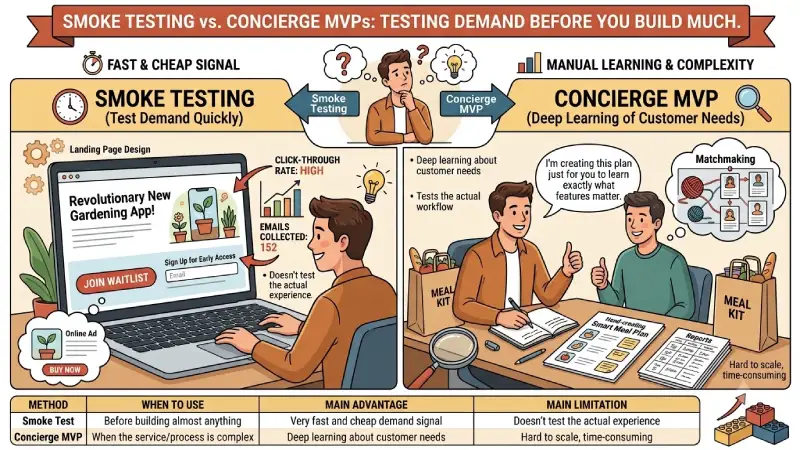
These two approaches help you test demand before you build much (or anything).
Smoke Testing
You create the appearance of a product and measure interest. Common versions include:
- A landing page with a clear offer and email signup
- Fake “Buy Now” or “Join Waitlist” buttons
- Simple ads that point to a page describing the product
If people sign up or click in decent numbers, demand may exist. If almost nobody acts, the idea probably needs work.
Concierge MVP
You deliver the result manually instead of through software. For example:
- A “smart” meal planning service where you personally create plans for the first customers
- A matching service where you manually connect people before building an algorithm
- A reporting tool where you create the reports by hand at the beginning
Concierge MVPs are excellent for learning the real workflow and discovering what customers actually value.
| Method | When to Use | Main Advantage | Main Limitation |
| Smoke Test | Before building almost anything | Very fast and cheap demand signal | Doesn’t test the actual experience |
| Concierge MVP | When the service/process is complex | Deep learning about customer needs | Hard to scale, time-consuming |
| Traditional MVP | When you need to test the product itself | Tests real usage | Costs more time and money to build |
Many successful products used one or both of these methods before writing serious code.
How to Collect Actionable Feedback from MVP Users
Not all feedback is useful. Some of it is polite, vague, or based on what users think they should say.
Ways to get better feedback:
- Ask about specific moments (“What were you trying to do when you got stuck?”)
- Watch people use the product instead of only listening to opinions
- Look for patterns across multiple users instead of reacting to one loud voice
- Separate feature requests from actual pain points
- Pay special attention to what users do, not just what they say
Good follow-up questions include:
- What almost made you stop using it?
- What would need to improve for you to recommend this?
- How were you solving this problem before?
The most useful feedback usually comes from a mix of conversation + watching behavior + simple data.
MVP Success Metrics Every Founder Should Track
Vanity metrics (total sign-ups, page views) can look good while the product is failing. Focus on metrics that show real progress toward product-market fit.
Key metrics worth tracking early:
| Metric | What It Measures | Why It Matters | Healthy Early Signal |
| Activation Rate | % of users who complete a key action | Shows if people get value quickly | Rising over time |
| Retention (D1/D7) | % of users who come back | Core indicator of value | Improving week over week |
| Engagement | How often / how deeply people use it | Reveals if the product is habit-forming | Core features used regularly |
| Conversion to Paid | % of users who pay | Ultimate proof of value | Even small numbers are meaningful |
| Qualitative Feedback | What users say in interviews/surveys | Explains the “why” behind the numbers | Clear patterns across users |
| Churn | % of users who stop | Shows problems that need fixing | Declining over time |
You don’t need perfect data. You need directional signals that help you decide what to improve next.
Frequently Asked Questions
How many users should be used for MVP testing?
It is possible to get valuable insights through interviews and observation of just 10–30 target users. Higher quantities are necessary for quantitative tests, but not always at the MVP stage.
Is A/B testing helpful at this stage?
Yes, but only after there is some amount of traffic. At the early stages, interviews and usability tests will provide much more useful insights.
What is the difference between smoke test and MVP?
The smoke test tells whether people want it or not. MVP, on the other hand, will tell whether people benefit from using the product.
Should I charge for users during MVP testing?
Wherever possible, yes. The willingness to pay is the most powerful signal that you can ever receive.
What is the most common mistake of founders regarding MVP testing?
Asking their opinion and then developing whatever was politely asked for.
Conclusion
The MVP test process is not a once-off activity. It is an ongoing process of learning before making any heavy investments.
The top founders of 2026 also do the following things in order to be successful: build something tangible for your users to see early, observe what is going on, formulate smart questions, measure a few relevant metrics, and use data rather than speculation for improvement purposes.
Be modest at first, choose the appropriate target audience for testing, concentrate on behavior rather than opinions, and keep your feedback loops fast.
This process will save you from wasting months on creating something that nobody wants.