

Introduction
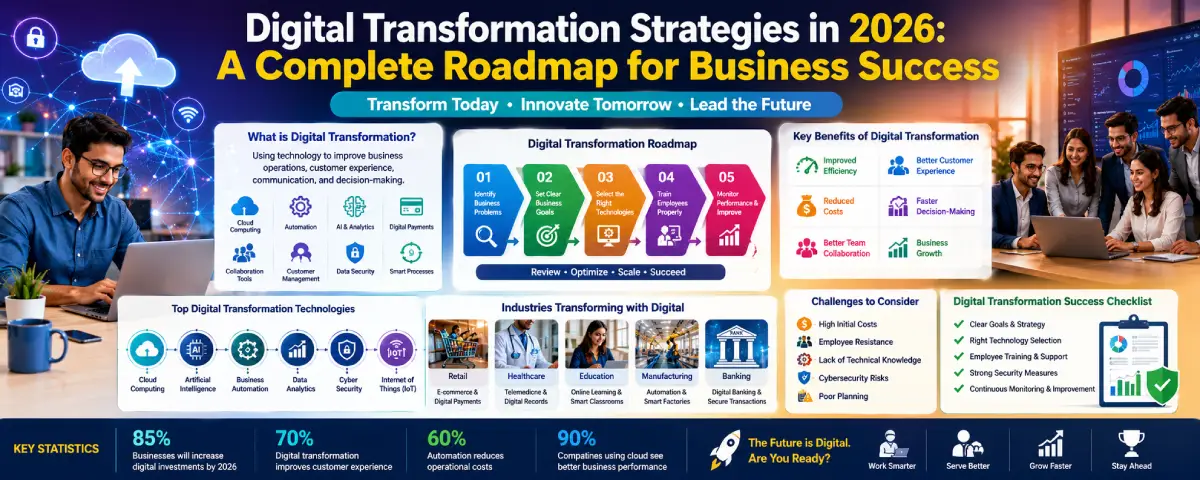
Digital transformation strategies are changing the way businesses work today. In the past companies used to do things by hand they used a lot of paperwork. They talked to each other in person or over the phone. Now businesses are using platforms to get things done faster and better.
The process through which the above occurs is termed digital transformation.
Digital transformation is not just the adoption of technology; rather, it involves applying technology to enhance business processes.
In 2026, digital transformation strategies are becoming important for:
- Small businesses
- Startups
- Retail stores
- Healthcare companies
- Educational institutions
- Manufacturing firms
- Service businesses
In fact, businesses can use cloud computing, e-payments, automation systems, communication devices, and data analysis to improve their operational processes and CRM systems.
However, digital transformation is an inevitable process for modern enterprises due to the requirements of customers who want rapid services, online support, convenient communication, and e-payments.
The following guide will explain digital transformation in clear terms. It discusses frameworks, roadmaps, advantages, challenges, examples, and best practices.
Digital Transformation Resource Center
Explore our complete collection of guides covering cloud computing, AI and business automation, data-driven decision-making, customer experience, cybersecurity, and change management in digital transformation.
What is Digital Transformation?
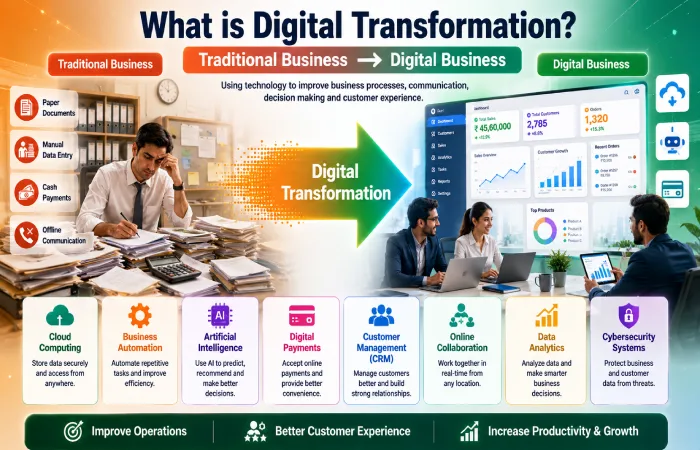
Digital transformation is the use of technology to enhance business processes, products, communication, and decision-making.
Consequently, the organizations will be streamlined, eliminate manual tasks, have enhanced customer experience, and also manage information.
Digital transformation can include:
- Cloud computing
- Business automation
- Artificial intelligence
- Digital payments
- Customer management software
- Online collaboration tools
- Data analytics
- Cybersecurity systems
It is not only about using the technology but about increasing the efficiency of your business from inside.
Why Businesses Are Moving Toward Digital Transformation
Businesses adapt themselves depending on the behavior of their customers.
Today’s customers expect:
- Fast response
- Online access
- Mobile-friendly services
- Easy payments
- Quick delivery
- Better communication
Traditional systems often create delays and confusion.
For example:
| Traditional Method | Digital Method |
| Paper invoices | Automated billing |
| Manual attendance | Biometric systems |
| Phone-only support | Chat and email support |
| Physical records | Cloud storage |
| Cash payments | UPI and online payments |
Digital systems reduce errors and improve efficiency.
Signs Your Business Needs Digital Transformation
Many businesses already face problems that digital transformation can solve.
Slow Operations
Manual processes often waste time. Employees spend hours doing repetitive work.
Too Much Paperwork
Managing files and records manually becomes difficult as the business grows.
Customer Complaints
Delayed responses and poor communication can reduce customer satisfaction.
Data Confusion
Companies have difficulties when their data is spread out into various spreadsheets and books.
Poor Team Coordination
Without digital tools, departments may not communicate properly.
Difficulty Tracking Performance
Companies require reporting and analysis for knowing about sales, expenses, and client behavior.
Digital Transformation Framework
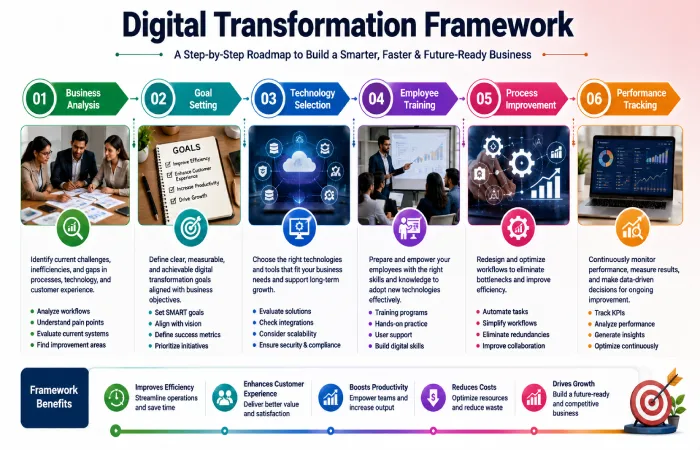
A digital transformation framework helps businesses plan their technology changes step by step.
Without a framework, businesses may spend money on unnecessary tools.
A simple framework includes:
| Step | Purpose |
| Business Analysis | Identify problems |
| Goal Setting | Define business objectives |
| Technology Selection | Choose useful tools |
| Employee Training | Help teams adapt |
| Process Improvement | Improve workflows |
| Performance Tracking | Measure results |
This approach reduces confusion and improves implementation.
Digital Transformation Roadmap
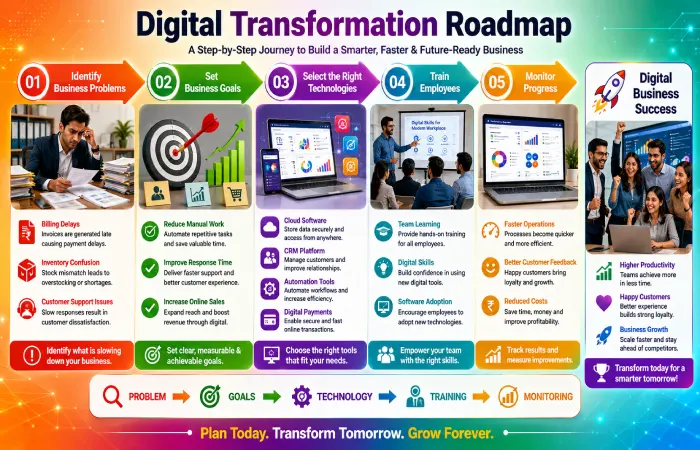
A roadmap helps businesses implement digital transformation gradually.
Step 1: Identify Business Problems
Find areas where operations are slow or inefficient.
Examples:
- Billing delays
- Inventory confusion
- Customer support issues
Step 2: Set Business Goals
Goals should be practical.
Examples:
- Reduce manual work
- Improve customer response time
- Increase online sales
Step 3: Select the Right Technologies
Choose tools based on business needs.
Do not buy expensive enterprise software unnecessarily.
Step 4: Train Employees
Technology will work effectively when the employees understand how to apply it.
Step 5: Monitor Progress
Track improvements regularly.
Examples:
- Faster operations
- Better customer feedback
- Reduced costs
Who Should Be Involved in a Digital Transformation Strategy?
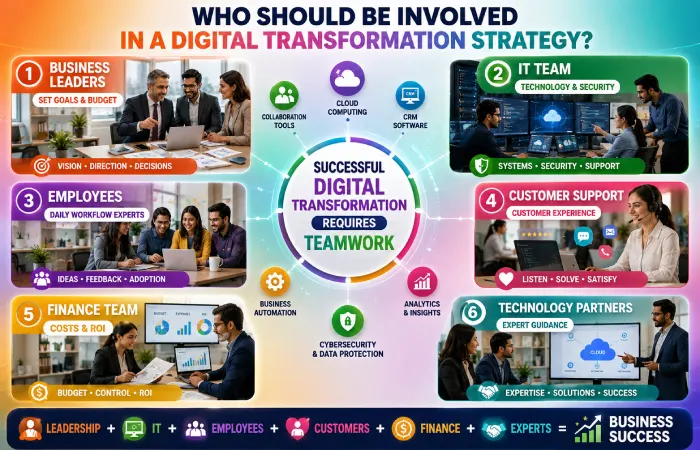
Digital transformation is not an IT initiative alone. An organization will not be able to transform its processes by having only one team responsible for change.
Departments should collaborate since they face their own challenges.
For instance, customer service departments understand customer dissatisfaction issues, while finance departments deal with budget constraints, and operations teams are aware of the points at which delays occur in routine operations.
Inclusion of multiple departments in digital transformation strategy always leads to a better outcome.
Business Owners and Company Leaders
The digital transformation goals can be set by business owners and top-level managers.
They decide:
- what problems need solving
- how much budget is available
- which areas need improvement first
Without leadership support, digital transformation projects often fail.
IT Teams
IT teams help businesses choose and manage digital tools.
They handle:
- software setup
- cloud systems
- cybersecurity
- technical support
They also help employees understand new systems.
Employees
Feedback from employees on business systems is invaluable because they work with these systems on a daily basis.
For example:
- sales teams know customer problems
- HR teams understand employee workflow
- warehouse staff know inventory issues
Including employees helps businesses find practical solutions instead of creating unnecessary systems.
Customer Support Teams
Customer service teams understand what customers expect from the business.
They can identify:
- common complaints
- slow support issues
- communication problems
This helps businesses improve customer experience during digital transformation.
Finance Teams
Finance departments help businesses control digital transformation costs.
They track:
- software expenses
- implementation costs
- return on investment
This prevents overspending on unnecessary technologies.
External Consultants and Technology Partners
Some businesses also work with external experts.
Technology consultants may help with:
- cloud migration
- cybersecurity
- automation planning
- software integration
Small businesses sometimes use outside experts because they may not have internal technical teams.
Why Team Collaboration Matters
Digital transformation works better when departments communicate properly.
If businesses only focus on technology and ignore employees, many systems may become difficult to use.
Successful digital transformation usually happens when:
- leadership supports the project
- employees receive training
- departments work together
- customer needs remain important
Technology alone cannot improve a business without proper teamwork.
Practical Steps Businesses Follow During Digital Transformation
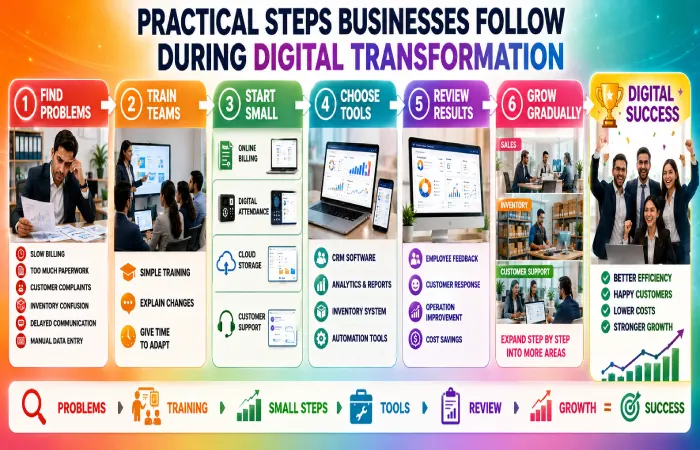
Businesses should not start digital transformation by immediately buying expensive software or changing everything at once. A better approach is to improve operations step by step based on real business needs.
The following practical steps can help businesses create a smoother and more useful digital transformation strategy.
1. Understand Business Problems First
Before choosing any technology, businesses should identify the main problems affecting daily operations.
Common business problems include:
- Slow billing process
- Too much paperwork
- Customer complaints
- Inventory confusion
- Delayed communication
- Manual data entry
When companies clearly understand these problems, it becomes easier to choose the right digital solutions.
2. Help Employees Adjust to Changes
The effects of digital transformation cut across all tiers of employees. It is a process that affects the employees and therefore is of concern to them.
There might be some employees who may fear using digital technology. This is particularly so for employees who have been using conventional practices.
Businesses should:
- provide simple training
- explain the purpose of changes
- give employees time to adapt
Employee support is important because even good technology can fail without proper usage.
3. Start With Small Improvements
Businesses do not need to transform everything immediately.
Starting with small improvements often gives better results.
Examples include:
- online billing systems
- digital attendance tracking
- cloud file storage
- customer support software
Small initiatives will help organizations minimize risks and learn how to do things right before making any bigger moves.
4. Choose Digital Tools Carefully
Not every business needs advanced AI systems or expensive enterprise software.
Businesses should select tools based on:
- company size
- budget
- business goals
- daily operational needs
For instance, instead of automating operations with complicated technologies, a small retail store would only require accounting and inventory control systems.
Selecting appropriate technologies is necessary to help organizations cut down extra costs.
5. Get Expert Help if Needed
Some businesses may require assistance from experts in information technologies.
External experts can help with:
- cloud setup
- cybersecurity
- software integration
- automation planning
Small businesses often use outside support because they may not have large technical teams internally.
6. Check What Is Working
Businesses should regularly review digital transformation progress.
This includes:
- employee feedback
- customer response
- operational improvements
- cost savings
Regular reviews help companies identify weak areas and improve systems over time.
7. Expand Slowly Over Time
After seeing positive results from smaller projects, businesses can gradually expand digital systems into other departments.
For example:
- a company may first digitize billing
- then move to inventory management
- later improve customer support systems
A slow and steady pace leads to fewer complications and greater success in the end.
Simple Digital Transformation Steps for Businesses
| Step | Purpose |
| Identify business problems | Understand what needs improvement |
| Train employees | Reduce confusion |
| Start with small projects | Lower risks |
| Choose useful tools | Avoid wasting money |
| Review progress regularly | Improve results |
| Expand gradually | Support long-term growth |
Many businesses fail because they try to change everything too quickly. Digital transformation works better when companies improve step by step instead of rushing into expensive technology systems.
Benefits of Digital Transformation
The concept of digital transformation is very helpful to businesses. It makes them communicate more efficiently, coordinate more effectively, manage their information better, and serve their customers better. Many organizations are implementing systems since they want to minimize manual activities and make their operations more efficient.
It does not only benefit businesses. Small businesses, startups, retail stores, schools, and service providers can also become more efficient through digital transformation.
Below are some of the benefits of businesses when they implement digital technology.
Improved Efficiency
Efficiency is perhaps one of the most significant benefits of digital transformation.
Traditional business operations often involve:
- paperwork
- manual approvals
- repetitive data entry
- physical record management
These activities consume time and may increase human errors.
Digital tools help automate many routine tasks.
For example:
- billing software can automatically generate invoices
- inventory systems can update stock levels instantly
- attendance software can reduce manual tracking
The digital transformation can help organizations increase the customer satisfaction level by providing better service efficiency.
Employees can concentrate on activities that produce better results rather than waste time performing repetitive tasks.
Example
A retail organization which uses the digital method for managing its inventory can know about the availability of products without counting each day.
Better Customer Experience
Customer expectations are changing quickly in 2026.
Most customers now expect:
- fast responses
- online communication
- smooth payment options
- mobile-friendly services
- faster support
When businesses use technology to make things better they can make their customers happier. This is because things are faster and easier.
Examples include:
- online booking systems
- customer support chat tools
- automated order updates
- digital payment systems
If organizations act quickly and offer a better experience, it is easier for the customer to trust the organization.
Faster Decision-Making
Organizations generate a huge volume of data every day.
Digital transformation is really helpful for companies. It helps them do a things.
Digital transformation helps companies:
- track sales
- monitor expenses
- analyze customer behavior
- identify business trends
Tools for business analytics offer reports and dashboards that assist the management to make decisions quickly and effectively.
Example
An owner of a restaurant is able to know the food items that do best on weekends and manage his inventory.
Reduced Operational Costs
While digital transformation needs investments in the beginning, it helps in saving operational costs in the future.
Businesses can save money by reducing:
- paper usage
- manual labor
- storage costs
- repetitive administrative work
The cloud computing process reduces the need for expensive physical infrastructure.
Through automation, more tasks are completed using less effort.
Example
Use of cloud accounting software could help minimize costs of printing, filing, and storing documents.
Better Team Collaboration
Many businesses now work across multiple departments and locations.
Digital communication tools improve teamwork by helping employees:
- share files quickly
- communicate in real time
- manage tasks more easily
- collaborate remotely
Cloud solutions and collaboration tools ensure that teams remain connected even when the employees are working from different places.
This was particularly relevant after remote and hybrid work arrangements became more popular.
Improved Data Security
The paper-based records may be lost, tampered with, or viewed by unauthorized persons.
A modern digital solution will usually offer better security options such as:
- password protection
- encrypted storage
- automatic backups
- multi-factor authentication
Businesses can also get back their data more easily via cloud-based backups.
Nonetheless, cybersecurity measures are required in order to prevent online attacks.
Improved Business Flexibility
The digital transformation will help businesses to become more flexible.
Companies can:
- launch online services faster
- respond to customer demands quickly
- adjust pricing and promotions easily
- manage operations remotely
Business organizations with digital technology tend to be more flexible when faced with unexpected scenarios like market shifts or any disruptions in the supply chain process.
Better Business Growth Opportunities
Digital systems help businesses reach more customers through:
- ecommerce platforms
- social media marketing
- digital advertising
- online customer support
Even small businesses can now sell products and services beyond their local areas using digital platforms.
This creates new opportunities for long-term business growth.
Benefits of Digital Transformation for Businesses
| Benefit | Business Impact |
| Automation | Reduces repetitive tasks |
| Faster communication | Improves customer support |
| Cloud systems | Easier data access |
| Business analytics | Better decision-making |
| Online services | Expands customer reach |
| Collaboration tools | Improves teamwork |
| Digital payments | Faster transactions |
Digital Transformation Challenges
Even though digitalization presents numerous advantages for business organizations, there are various challenges that these organizations might encounter while adopting digital transformation strategies.
High Initial Costs
Some digital technologies require significant investment.
Businesses may spend money on:
- software licenses
- cloud services
- hardware upgrades
- employee training
- cybersecurity systems
For small businesses, these costs can feel difficult initially.
However, many businesses adopt digital systems gradually to reduce financial pressure.
Employee Resistance
Employees may feel uncomfortable with new technology.
Some workers may worry about:
- learning new systems
- changes in daily workflow
- job security
- increased monitoring
Resistance usually happens when employees do not fully understand the purpose of digital transformation.
Businesses should provide:
- proper training
- clear communication
- gradual implementation
This helps employees adapt more comfortably.
Lack of Technical Knowledge
Many small businesses do not have dedicated IT departments.
Business owners may struggle with:
- choosing software
- managing cloud systems
- understanding cybersecurity
- integrating technologies
Without any proper guidance, companies can spend on the wrong kind of software or create unnecessary complexity.
It is for this reason that most businesses prefer to seek advice from experts on technology.
Cybersecurity Risks
With the advancement of businesses into cyberspace, cybersecurity threats emerge.
Common threats include:
- phishing attacks
- ransomware
- password theft
- data leaks
Ineffective security measures could lead to the compromise of confidential business and client data.
Businesses should:
- update software regularly
- use strong passwords
- train employees about cyber threats
- backup important data
For companies to build their digital strategies, it is very essential for them to consider cybersecurity.
Integration Problems
Many businesses already use older systems and software.
The new digital solutions might not be compatible with existing systems.
This can create:
- data transfer issues
- software conflicts
- operational delays
A proper assessment of compatibility should be made prior to technology adoption.
Poor Planning
Some companies rush into digital transformation without clear goals.
They may:
- buy unnecessary software
- implement too many systems at once
- ignore employee training
- fail to monitor results
If proper planning is not done, these changes can become costly and useless.
A step-by-step approach usually works better.
Dependence on Internet Connectivity
Many digital systems rely heavily on stable internet access.
Poor connectivity may affect:
- cloud access
- online communication
- remote work
- payment systems
This problem remains pertinent in some areas where internet infrastructure is not well-developed.
Difficulty Measuring Results
Many companies experience challenges in determining the efficiency of digital transformation projects.
Without proper measures, organizations will not know:
- what is improving
- what needs adjustment
- whether investments are delivering value
The setting up of achievable targets is useful for measuring success.
Common Digital Transformation Challenges
| Challenge | Possible Impact |
| High costs | Budget pressure |
| Employee resistance | Slower adoption |
| Cybersecurity threats | Data risks |
| Poor planning | Wasted investment |
| Integration problems | Workflow disruption |
| Limited technical knowledge | Wrong technology decisions |
It is possible for digital transformation to provide future benefits, but it must be approached with caution by the organizations. Organizations that emphasize planning, people, utilization of technology, and continual improvement have positive outcomes.
How to Measure Digital Transformation Success
It is crucial for businesses to find out whether the digital transformation helps to achieve some kind of improvements in their operations and enhances the experience of customers.
Otherwise, without measurement, companies might be unaware if their efforts yield any benefits.
Businesses can measure success using:
- Customer Satisfaction
- Faster Response Times
- Reduced Operational Costs
- Higher Online Sales
- Better Employee Productivity
- Fewer Manual Errors
For example, if a company introduces digital billing software, it can measure:
- How Much Time Is Saved
- Whether Billing Mistakes Reduced
- How Quickly Invoices Are Generated
Tracking performance regularly helps businesses improve digital strategies over time.
Digital Transformation for Small Businesses
Digital transformation is not only for large companies.
Examples include:
- Online billing systems
- QR code payments
- WhatsApp business communication
- Inventory software
- Online marketplaces
Small businesses gain from this since digital means help with organization.
Industries Changing Fast
Different industries are adopting technology rapidly.
| Industry | Digital Change |
| Retail | Online payments and ecommerce |
| Healthcare | Telemedicine and online appointments |
| Education | Learning apps and virtual classrooms |
| Banking | Mobile banking and digital wallets |
| Logistics | GPS tracking and automation |
| Hospitality | Online booking systems |
Industries Using Digital Transformation the Most
Some industries are adopting digital technologies faster because customer expectations and competition are increasing rapidly.
Retail Industry
Retail businesses use:
- ecommerce platforms
- online payments
- inventory systems
- digital marketing
Banking Sector
Banks now depend heavily on:
- mobile banking
- digital wallets
- online customer support
- fraud detection systems
Healthcare Industry
Healthcare companies use:
- telemedicine
- digital patient records
- appointment booking systems
- health monitoring apps
Education Sector
Educational institutions now use:
- online learning platforms
- virtual classrooms
- digital assignments
- learning management systems
Manufacturing Industry
Manufacturing companies use:
- automation systems
- smart sensors
- robotics
- supply chain software
The process of digital transformation is gaining momentum in almost all industries because businesses are seeking to operate more efficiently and offer superior customer experience.
How Different Businesses Use Digital Transformation
Digital transformation varies from one enterprise to another because various businesses implement digital technologies differently according to their size, financial situation, clientele, and internal processes.
While some enterprises may need relatively simple digital processes, other enterprises may need more sophisticated solutions.
Small Businesses
Small businesses often begin with affordable and practical tools.
Common examples include:
- QR code payment systems
- billing software
- WhatsApp Business
- inventory management apps
- online order systems
The following technologies help in saving time and effort without making any huge investments.
For example, a newly formed retail firm may use digital accounting software for keeping track of their sales and inventory.
Startups
Startups generally tend to opt for digital tools initially due to certain reasons.
Many startups use:
- cloud platforms
- online collaboration software
- digital marketing tools
- customer management systems
- automation tools
Digital solutions facilitate small companies in conducting business operations with less staff.
Medium-Sized Businesses
Medium-sized companies usually concentrate their efforts on communication, reporting, and customers’ management.
They may use:
- CRM software
- cloud storage
- employee management systems
- business analytics tools
- ecommerce platforms
These businesses usually begin connecting multiple departments through digital systems.
Large Enterprises
Large companies often implement digital transformation across several departments and locations.
They may use:
- AI-based automation
- enterprise cloud systems
- cybersecurity platforms
- advanced analytics software
- supply chain automation
Large organizations also invest more in employee training and long-term digital planning.
Comparison of Digital Transformation by Business Size
| Business Type | Common Digital Tools |
| Small businesses | Billing software, QR payments |
| Startups | Cloud platforms, automation tools |
| Medium businesses | CRM systems, analytics tools |
| Large enterprises | AI systems, enterprise software |
However, digital transformation does not have to be executed in the same pace by all companies. Firms tend to succeed better if they utilize technology according to their business requirements and not just because of any trend.
Digital Transformation Examples
Retail Businesses
Retail stores now use:
- POS systems
- Inventory software
- Online payment systems
Healthcare Sector
Hospitals use:
- Digital patient records
- Online consultations
- Appointment management systems
Education Sector
Schools and colleges use:
- Online learning platforms
- Virtual classrooms
- Digital assignments
Manufacturing Industry
Factories use:
- Automation systems
- Smart sensors
- Supply chain software
Common Mistakes Companies Make
Many businesses fail because they implement digital transformation incorrectly.
Buying Complex Software Too Early
Businesses sometimes purchase expensive tools they do not actually need.
Ignoring Employee Training
Employees must understand how to use digital systems.
Focusing Only on Technology
Technology alone cannot solve poor business processes.
Poor Planning
Without a roadmap, businesses often waste money and time.
Ignoring Cybersecurity
Weak security can create serious problems.
How Cloud Computing Supports Digital Transformation
Cloud computing helps businesses store and access data online.
Benefits include:
- Remote access
- Lower hardware costs
- Easier collaboration
- Better scalabilityImproved Data Security
Most startups use cloud-based applications as this helps save on costs associated with infrastructure.
Cloud computing holds significance in digital transformation as it assists in increasing the scalability, collaboration, security, and flexibility of companies. How cloud computing enables companies to transform digitally is discussed by Microsoft.
Role of AI and Automation in Business
Businesses now automate repetitive tasks.
Examples include:
- Chatbots
- Invoice generation
- Customer support
- Email automation
AI helps businesses save time and improve productivity.
However, businesses should use AI carefully and avoid over-automation.
Data-Driven Decision Making
Businesses collect data to improve decisions.
Examples:
- Customer behavior analysis
- Sales performance tracking
- Inventory forecasting
Good data helps companies plan better strategies.
Digital Customer Experience
Customer experience is becoming more important.
Customers expect:
- Fast websites
- Mobile-friendly services
- Quick support
- Easy payment methods
Poor digital experience may reduce customer trust.
Cybersecurity in Digital Transformation
As businesses move online, cybersecurity becomes important.
Common risks include:
- Data theft
- Ransomware
- Phishing attacks
Businesses should:
- Use strong passwords
- Update software regularly
- Train employees about security
Change Management for Digital Transformation
Technology changes can affect employees and business culture.
Businesses should:
- Communicate clearly
- Provide training
- Introduce changes gradually
Successful transformation depends on people as much as technology.
Comparison: Traditional Business vs Digitally Transformed Business
| Feature | Traditional Business | Digitally Transformed Business |
| Communication | Manual | Digital platforms |
| Record Management | Paper files | Cloud systems |
| Payments | Cash | Online payments |
| Customer Support | Offline only | Multi-channel support |
| Reporting | Manual reports | Real-time analytics |
Future of Digital Transformation
India’s digital economy is growing rapidly.
Future trends may include:
- AI-driven automation
- Smart business analytics
- Advanced cybersecurity
- More cloud adoption
- Improved digital customer experiences
Small businesses are also expected to adopt more affordable digital tools.
Growth of Digital Transformation in Recent Years
Digital transformation has experienced rapid growth within the past few years.
Organizations would use conventional ways to carry out their operations in the past. Nevertheless, currently, more investments have been made for digitalization owing to high customer expectations and rivalry amongst organizations.
Several factors helped accelerate digital transformation growth
- growth of ecommerce
- increased internet access
- smartphone usage
- digital payment adoption
- remote work trends
- cloud computing services
In recent years, businesses have shown stronger interest in:
- automation tools
- cloud platforms
- online collaboration systems
- AI-based business solutions
- cybersecurity technologies
The digital transformation process will definitely become even more popular since there is a need for greater efficiency, usability, and web presence.
Digital Transformation Trends Across Different Countries
Various countries pursue different speeds of their digital transformation due to the technological environment, Internet availability, corporate expenditures, and governmental support.
Some countries prefer AI and automation, whereas other countries pay more attention to ecommerce, cloud technologies, and digital payments.
Country-Wise Digital Transformation Focus
| Country | Major Digital Transformation Focus |
| India | Digital payments, cloud adoption, ecommerce |
| United States | AI automation, cloud platforms, data analytics |
| China | Smart manufacturing, AI systems, digital commerce |
| Japan | Robotics and industrial automation |
| Germany | Industry 4.0 and manufacturing technology |
| United Kingdom | Digital banking and online services |
| Singapore | Smart city technology and cloud infrastructure |
India is growing rapidly because of:
- affordable internet access
- UPI payment systems
- startup growth
- increasing smartphone usage
- government digital initiatives
Small businesses are also adopting digital tools faster than before.
Frequently Asked Questions (FAQs)
What are digital transformation strategies?
Digital transformation strategies are business plans that use technology to improve operations, customer service, and efficiency.
Why is digital transformation important ?
Companies have started using digital solutions to gain speed, cut down on expenses, and satisfy new customer requirements.
What is meant by a digital transformation roadmap?
A roadmap is the systematic way in which businesses follow technological changes and improvements in their operations.
Why should companies undergo digital transformation?
Benefits include:
- Faster operations
- Better customer experience
- Improved communication
- Reduced manual work
Conclusion
There are digital transformation strategies being implemented by firms for increased efficiency, good customer service, and sustainable growth.
For the year 2026, there are changes in how businesses are running. These are through the use of technologies such as cloud computing, automation technologies, digital communications, and data analytics.
It should be noted that digital transformation is not only based on technology. Moreover, it includes planning, training for employees, security, and customers’ experience.
Companies adopting practical and planned digital transformation strategies will increase efficiency, reduce difficulties, and have good relationships with customers in the future.