

Introduction
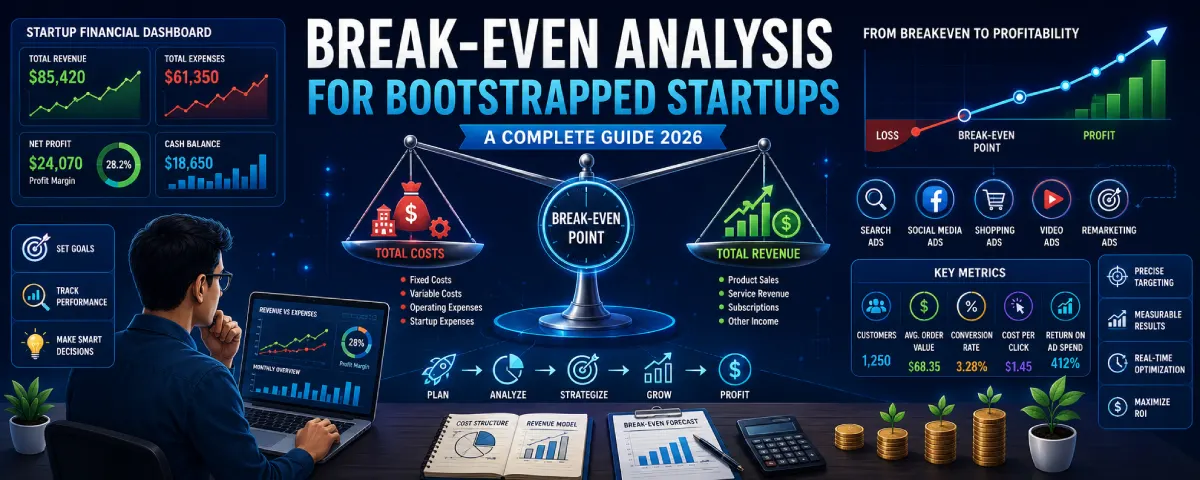
A Break-Even Analysis for Bootstrapped Businesses is the most critical financial skill that any entrepreneur needs to learn. In bootstrapping, there is no money from outside investors, and therefore, you have to do everything by yourself. This means that the business will not grow unless it can make enough money to cover its cost.
That moment is called the break-even point.
Many entrepreneurs concentrate their attention solely on revenue growth, while forgetting about the fact that they must estimate the amount of revenue needed for covering all expenses. The company may have sales every month, yet still lose money as a result of the fact that expenses exceed income.
This break-even guide is part of our bootstrapped financial modeling pillar.
This is why break-even analysis is so valuable.
It helps founders understand:
- When the business can become profitable
- How many customers are required to cover costs
- Whether pricing is sustainable
- How expenses affect profitability
- How long it may take to recover startup investments
- Whether growth plans are realistic
Break-even calculations become even more useful when combined with a strong understanding of Startup Bootstrapped Financial Modeling Basics, which connects revenue, expenses, cash flow, and profitability into one financial framework.
In this guide, you will learn:
- What break-even analysis means
- Why it matters for bootstrapped startups
- Break-Even Point Formula for Startups
- Variable Cost Break-Even Calculation
- How to Calculate Break-Even in Excel
- Break-Even Analysis Example for Bootstrapped Founders
- Free break-even forecast templates
- Common mistakes founders should avoid
That is the easy part: to enable you to determine the specific objectives that should be achieved by your firm in order to become profitable.
What Is Break-Even Analysis?
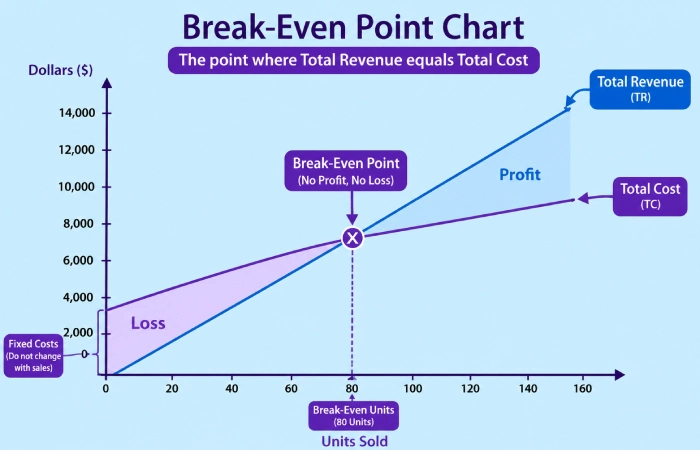
- Break-even analysis is one method used to determine when an organization earns sufficient revenues to offset all the expenses incurred by the organization.
It is the point whereby the total earnings of the organization equal the total costs incurred. - At this point the business does not make any money. It does not lose any money either.
- All the costs of running the business are paid for.
- When the business makes money than this point it starts to make a profit.
- The extra money the business makes after this point is its profit.Simple Example
Imagine:
- Product price = $100
- Variable cost per sale = $40
- Monthly fixed expenses = $3,000
The business must sell enough units to cover the $3,000 fixed cost.
Break-even analysis helps calculate that number.
Types of Break-Even Analysis
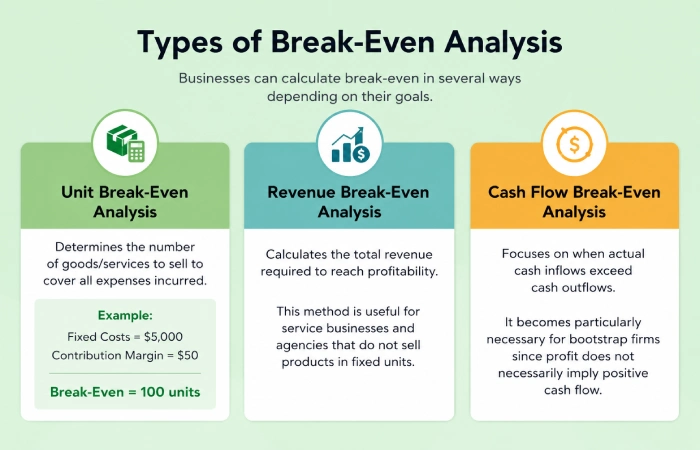
Businesses can calculate break-even in several ways depending on their goals.
Unit Break-Even Analysis
Determines the number of goods/services to sell to cover all expenses incurred.
Example:
- Fixed Costs = $5,000
- Contribution Margin = $50
Break-Even = 100 units
Revenue Break-Even Analysis
Calculates the total revenue required to reach profitability.
This method is useful for service businesses and agencies that do not sell products in fixed units.
Cash Flow Break-Even Analysis
Focuses on when actual cash inflows exceed cash outflows.
It becomes particularly necessary for bootstrap firms since profit does not necessarily imply positive cash flow.
Why Break-Even Analysis Matters for Bootstrapped Startups
Bootstrapped startups operate with limited resources.
Unlike funded startups, there is usually no investor capital available to absorb losses for long periods.
Understanding the break-even point helps founders:
| Benefit | Why It Matters |
| Better planning | Understand revenue targets |
| Cash management | Avoid financial surprises |
| Pricing decisions | Set sustainable prices |
| Growth forecasting | Create realistic goals |
| Risk reduction | Identify problems earlier |
| Profitability tracking | Monitor business health |
Many founders focus only on revenue.
This is the most relevant and natural location because the paragraph is already discussing revenue projections and profitability planning.
Benefits of Break-Even Analysis
Additional Benefits
In addition to profit planning, break-even analysis aids in providing support for founders:
- Set realistic sales targets
- Evaluate new products
- Plan marketing budgets
- Measure business risk
- Secure loans and financing
- Improve investor confidence
- Test pricing strategies
Entrepreneurs who consistently track their breakeven figures tend to detect financial red flags at an early stage.
Understanding Fixed Costs and Variable Costs
Before calculating break-even, founders must understand business costs.
According to U.S. Small Business Administration Financial Basics, understanding fixed and variable expenses is essential for financial planning and profitability analysis.
What Are Fixed Costs?
Fixed costs remain relatively stable regardless of sales volume.
Examples:
- Rent
- Salaries
- Software subscriptions
- Insurance
- Internet expenses
Fixed Cost Examples
| Expense | Fixed Cost? |
| Office Rent | Yes |
| Hosting Subscription | Yes |
| Employee Salary | Yes |
| Accounting Software | Yes |
These expenses occur even if sales drop.
What Are Variable Costs?
Variable costs increase when sales increase.
Examples include:
- Shipping costs
- Manufacturing costs
- Transaction fees
- Sales commissions
- Packaging expenses
Variable Cost Examples
| Expense | Variable Cost? |
| Shipping | Yes |
| Payment Processing Fees | Yes |
| Packaging | Yes |
| Production Materials | Yes |
What Are Semi-Variable Costs?
Some business expenses contain both fixed and variable components.
Examples include:
| Expense | Fixed Portion | Variable Portion |
| Utility Bills | Base Charge | Usage Charge |
| Sales Salaries | Base Salary | Commission |
| Cloud Hosting | Monthly Fee | Usage Costs |
Understanding semi-variable costs improves break-even accuracy.
Break-Even Point Formula for Startups
The standard formula is:
This equation determines how many units must be sold to meet all expenses
The visual below illustrates how total revenue and total costs interact to determine the break-even point where a startup begins generating profit.
Break-Even Formula Explained
| Component | Meaning |
| Fixed Costs | Monthly operating expenses |
| Selling Price | Revenue per unit sold |
| Variable Cost | Cost of producing one unit |
| Contribution Margin | Profit remaining after variable costs |
Contribution margin is:
Selling Price − Variable Cost
The amount of money they get from sales helps to pay for the expenses that do not change.
Break-Even Point in Revenue Terms
Formula
Breakeven Sales = Fixed Costs ÷ Contribution Margin Ratio
Contribution Margin Ratio Formula
Contribution Margin Ratio = (Revenue − Variable Costs) ÷ Revenue
The following equation will help entrepreneurs determine the level of revenue required instead of the number of units to be sold.
Break-Even Analysis Example for Bootstrapped Founders
Let’s take an example of a company offering an online course.
Business Information
| Item | Amount |
| Course Price | $100 |
| Variable Cost | $20 |
| Monthly Fixed Costs | $4,000 |
Step 1: Calculate Contribution Margin
$100 − $20 = $80
Step 2: Calculate Break-Even
4,000 ÷ 80 = 50
The business needs to sell 50 courses every month to achieve its breakeven point.
Sales above 50 generate profit.
Sales below 50 generate losses.
Variable Cost Break-Even Calculation
Variable costs directly affect profitability.
Many founders underestimate this impact.
Example
Scenario A:
| Metric | Amount |
| Price | $100 |
| Variable Cost | $20 |
| Contribution Margin | $80 |
Break-even:
4,000 ÷ 80 = 50 units
Scenario B:
| Metric | Amount |
| Price | $100 |
| Variable Cost | $50 |
| Contribution Margin | $50 |
Break-even:
4,000 ÷ 50 = 80 units
The startup now needs 80 sales instead of 50.
This demonstrates why controlling variable costs is important.
How Pricing Changes the Break-Even Point
This is a very valuable SEO section.
Example
| Price | Variable Cost | Contribution Margin | Break-Even |
| $100 | $40 | $60 | 67 Units |
| $120 | $40 | $80 | 50 Units |
| $150 | $40 | $110 | 37 Units |
With increased prices, sales could be fewer than required in order to break even.
Still, an entrepreneur needs to ensure that his or her pricing strategy does not decrease the demand.
Understanding Contribution Margin
Contribution margin shows how much money remains after covering variable costs.
Formula
Example
| Item | Amount |
| Product Price | $120 |
| Variable Cost | $45 |
| Contribution Margin | $75 |
Higher contribution margins generally lower break-even requirements.
How to Calculate Break-Even in Excel
Excel remains one of the most user-friendly instruments in order to perform break-even analysis.
Step 1: Enter Data
| Cell | Value |
| B1 | Fixed Costs |
| B2 | Selling Price |
| B3 | Variable Cost |
Example:
| Cell | Amount |
| B1 | 5000 |
| B2 | 100 |
| B3 | 40 |
Step 2: Enter Formula
=B1/(B2-B3)
Excel instantly calculates break-even units.
Step 3: Build Forecast Scenarios
Create different assumptions:
| Scenario | Fixed Cost | Price | Variable Cost |
| Best Case | 4000 | 120 | 30 |
| Base Case | 5000 | 100 | 40 |
| Worst Case | 6000 | 90 | 50 |
This helps founders prepare for uncertainty.
Forecast sales with our revenue projections guide.
Break-Even Revenue Formula
Some founders prefer revenue targets instead of unit targets.
Formula:
This calculates total revenue required before profitability begins.
Why Break-Even Analysis Is Important Before Hiring
When you are starting a business hiring people is usually the biggest expense you will have.
Before you hire someone you need to think about a things.
You should ask yourself these questions:
- What other things will I sell to make up for the pay of the new hire?
- Is the revenue that I earn from the sales enough to cover the cost of my paying salaries to my employees
- How is it going to influence my break-even analysis?
For example let us look at what happens and after you hire someone.
Before Hiring and After Hiring are two things.
- Before Hiring your fixed costs are $3,000.
- After Hiring your fixed costs are $6,000.
This means that before you hire someone you need to make 50 sales to break even which is the break- point.
After you hire someone you need to make 100 sales to break even which is the new break-even point.
This shows how the people you hire can affect how money you make, which is the break-even analysis.
Example
| Before Hiring | After Hiring |
| Fixed Costs = $3,000 | Fixed Costs = $6,000 |
| Break-Even = 50 Sales | Break-Even = 100 Sales |
This is an example of how staff choices influence the bottom line.
Break-Even Analysis for Different Startup Types
SaaS Startup Example
Monthly subscription:
- Price = $30
- Variable Cost = $5
- Fixed Costs = $2,500
Break-even:
2,500 ÷ 25 = 100 customers
Ecommerce Startup Example
Product Price = $50
Variable Cost = $25
Fixed Costs = $5,000
Break-even:
5,000 ÷ 25 = 200 orders
Agency Example
Average Project Value = $1,000
Variable Cost = $200
Fixed Costs = $4,000
Break-even:
4,000 ÷ 800 = 5 clients
Freelance Business Example
Project Fee = $500
Variable Cost = $50
Fixed Costs = $1,800
Break-even:
1,800 ÷ 450 = 4 projects
Common Break-Even Analysis Mistakes
Ignoring Variable Costs
Many founders only consider fixed expenses.
This produces inaccurate calculations.
Using Unrealistic Pricing
Break-even calculations become meaningless when pricing assumptions are unrealistic.
Forgetting Taxes
Taxes influence profitability and need to be taken into account when planning.
Not Updating Forecasts
Business conditions change.
Analysis of the breakeven point needs to be conducted often.
Assuming Every Sale Produces Profit
Sales will be covering up expenses before break-even occurs.
Free Break-Even Forecast Templates
A simple template should include:
| Category | Amount |
| Fixed Costs | |
| Variable Costs | |
| Product Price | |
| Contribution Margin | |
| Break-Even Units | |
| Break-Even Revenue |
The accuracy of break-even forecasting increases with Cash Flow Modeling for Bootstrapped Startups because the owners can know not only about their profits but also about their cash available.
Best Tools for Break-Even Analysis
Founders looking for more advanced forecasting solutions can explore Financial Modeling Tools for Bootstrappers to compare spreadsheets, budgeting software, and startup planning tools.
| Tool | Best For | Cost |
| Google Sheets | Beginners | Free |
| Excel | Advanced Models | Paid |
| Notion | Planning | Freemium |
| Zoho Books | Accounting | Affordable |
| Wave | Small Businesses | Free |
Troubleshooting Break-Even Problems
Revenue Is Growing but Profit Is Not
Review:
- Variable costs
- Marketing expenses
- Discounts
Break-Even Seems Too High
Investigate:
- Fixed costs
- Pricing strategy
- Product margins
Costs Keep Rising
Evaluate vendor agreements and costs.
Sales Targets Feel Unrealistic
Consider:
- Price increases
- Cost reductions
- Product improvements
Frequently Asked Questions
What is break-even analysis?
Calculations to determine at what point expenses equal revenues.
How does break-even help startups?
It helps founders understand profitability targets.
What is the Break-Even Point Formula for Startups?
Fixed Costs ÷ (Selling Price − Variable Cost).
What are fixed costs?
Costs that stay relatively stable regardless of sales volume.
What are variable costs?
Costs that increase as sales increase.
How do I calculate break-even in Excel?
Use:
=Fixed Costs/(Price-Variable Cost)
What is the contribution margin?
The contribution margin is the amount of money that is left over after you subtract the expenses, from the sales.
How often should you do break- calculations?
You should do break- calculations every month that is what most people recommend.
Can service businesses use break- analysis to help them?
Yes service businesses can use break- analysis. Service businesses can figure out their break- point by using the revenue and costs from each project.
What happens to a business after it reaches the break- point?
After a business reaches the break- point any additional revenue that comes in will generally contribute toward the profit of the business. The contribution margin is very important here because it helps the business to make a profit.
Does the break- point guarantee that a company will be successful?
No. The break- point is just a financial milestone. It does not mean a company will be successful in the run.
How does the price of something affect the break- point?
The break- point is affected by pricing. If a company has margins on what they sell they need to make fewer sales to break even.
Can startup companies make it easier to reach the break- point?
Yes startup companies can make it easier to reach the break- point. They can do this by spending money or by making more money on each sale.
Why should the people who start a company with their money keep track of the break-even point all the time?
The people who start a company with their money should keep track of the break-even point all the time. This is because they do not have a lot of cash to throw around. They need to make a profit soon as possible. The break- point is important, for these companies.
Conclusion
A break-even analysis is a helpful financial tool for founders who are bootstrapping their business. It shows how much money you need to make to cover your costs and it helps you plan your business with more certainty.
When you know your fixed costs, variable costs and how much you make from each sale you can make decisions, about things like setting prices hiring people spending money on marketing and growing your business.
The bootstrapped startups don’t just make things up as they go. They understand their finances keep an eye on their spending and regularly check to see if they’re making a profit.
As profitability improves, understanding Bootstrapped Startup Valuation Methods can help founders measure business value and make better long-term financial decisions.
Estimate costs via our expense forecasting guide to improve financial planning and profitability analysis.
In the article we will look at Scenario Planning for startups that are bootstrapped. This will assist you in learning how to prepare for the worst possible scenarios for your business, and how to protect yourself from future growth. Scenario Planning is extremely useful for bootstrapped companies.
It helps you prepare for business outcomes. You can think about the case, worst-case and realistic situations. This way you can protect your growth over time. Bootstrapped startups can really benefit from this.
They can make plans, for scenarios. This helps them stay on track. They can achieve their goals.