

Introduction
PPC and paid advertising are likely to expand even further because organizations need digital marketing more than ever before in order to reach their target audience and achieve concrete results in a timely fashion. PPC advertising is a form of online advertising known as pay-per-click, which means that an organization can promote their product/service using the internet for free until the user clicks on the advertisement.
These days, companies have recognized the power of paid advertising, as it provides faster results than most conventional advertising methods. Irrespective of whether you are looking for sales, leads, product promotion, or even building your brand, PPC can help.
With the rise in internet use, the mobile revolution, e-commerce trends, and online competition, the digital advertising sector has grown significantly.
Companies are spending money on Pay Per Click because people are getting more involved in online spaces.
Pay Per Click is still important in 2026. This is because Pay Per Click allows companies to show their ads to the people and see how well they are doing. Companies can control how money they spend and get noticed quickly with Pay Per Click.
This tutorial talks about Pay Per Click advertising. It covers what Pay Per Click is, why it is important, for marketing how it helps businesses and what the future holds for paid ads. Pay Per Click is one of the growing parts of online marketing. To really understand Pay Per Click you need to know about the picture of online marketing.
PPC advertising is one of the fastest-growing platforms in digital marketing. Understanding where PPC advertising falls within digital marketing requires knowledge of the Scope of Digital Marketing.
PPC from our scope of digital marketing guide.
What is PPC and Paid Advertising?
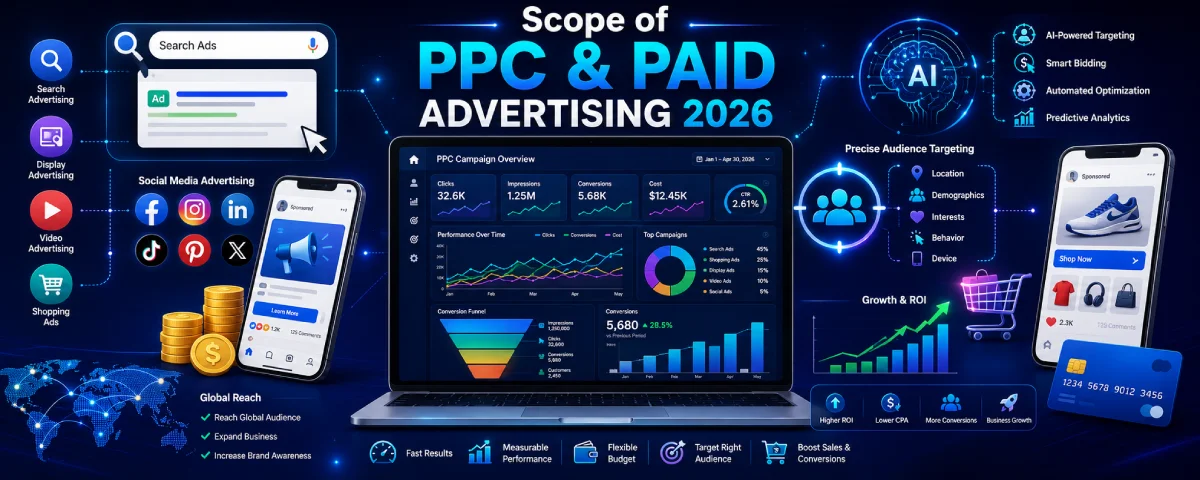
PPC is Pay Per Click. It is an internet-based method of advertising where companies pay each time their online advertisement is clicked by consumers. PPC Advertising Overview . According to the guidelines of advertisement from Google, the use of PPC makes it possible for companies to communicate with their clients through online advertisements that can be quantified. PPC ads can show up on search engines, websites, social media, and mobile applications.
This form of advertising differs from other types of advertising in that businesses can do advertising to specific individuals based on similarities in location, demographics, and interests.
How PPC Advertising Works
The process is simple:
- Businesses create advertisements.
- They choose target keywords or audiences.
- Ads are displayed to potential customers.
- Businesses pay only when users click the ad.
- Campaign performance is measured and optimized.
Why Businesses Use Paid Advertising
Businesses use PPC because it helps them:
- Reach customers quickly
- Generate leads
- Increase sales
- Build brand awareness
- Promote products and services
- Track marketing performance
Traditional Advertising vs PPC Advertising
| Traditional Advertising | PPC Advertising |
| Broad targeting | Precise targeting |
| Hard to measure | Easy tracking |
| Fixed campaigns | Flexible campaigns |
| Slower optimization | Real-time optimization |
| Higher waste | Better budget control |
Why PPC is Important in Digital Marketing
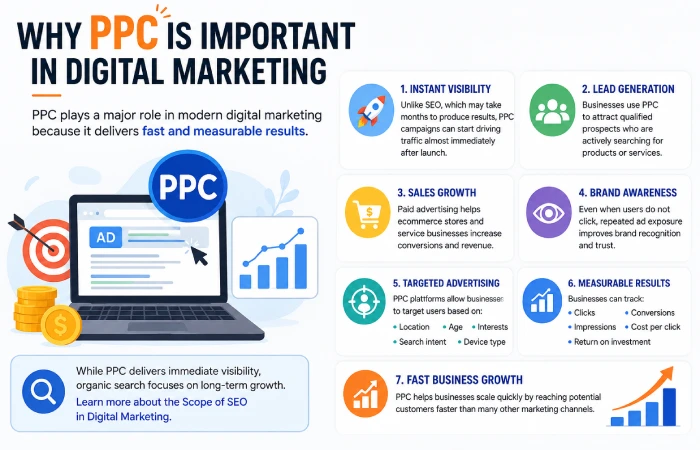
PPC has been a big part of digital marketing nowadays because of its quick and measurable results.
Instant Visibility
Contrary to SEO that takes months to yield fruit, PPC campaigns begin bringing in traffic within no time.
Whereas PPC is all about getting immediate visibility, SEO takes time and is based on growth. Read about the Scope of SEO in Digital Marketing.
While PPC delivers immediate traffic, SEO focuses on long-term organic visibility. Compare the two approaches in our scope of SEO
Guide.
Lead Generation
PPC is employed by companies to target potential clients who actively search for their offerings.
Sales Growth
With the help of paid advertisement, ecommerce businesses and service-based firms can make more sales.
Brand Awareness
Brand awareness and trust are created even when one does not click on any ad.
Targeted Advertising
PPC platforms allow businesses to target users based on:
- Location
- Age
- Interests
- Search intent
- Device type
Measurable Results
Businesses can track:
- Clicks
- Impressions
- Conversions
- Cost per click
- Return on investment
Fast Business Growth
With PPC, companies can develop fast since they get an opportunity to connect with their prospective clients fast as compared to other marketing techniques.
How PPC Ads Fit Into a Digital Marketing Strategy
PPC works best when combined with other marketing channels.
-
- Supports SEO by increasing search visibility.
- Supports content marketing by promoting valuable content.
- In addition to this, PPC is very effective when used together with email campaigns because it drives traffic to landing pages and builds mailing lists.
- Content promotion is one of the most effective uses of paid advertising. Read about the Scope of Content Marketing to understand how quality content supports PPC campaigns
- Supports social media campaigns through paid reach.
- Social platforms are also major advertising channels. Explore the Scope of Social Media Marketing for additional growth opportunities
- Supports ecommerce growth with product-focused advertising.
- Helps test new products and offers before larger investments.
PPC is an effective method of bringing more traffic and sales when it is used alongside SEO, content marketing, and social media marketing.
Current Scope of PPC and Paid Advertising in 2026
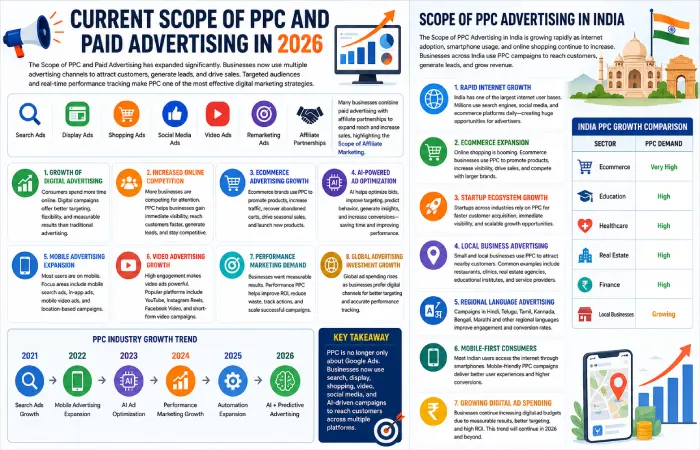
However, The Scope of PPC and Paid Advertising has greatly evolved in recent years. Today, businesses operate in a highly competitive online environment where organic exposure may not be sufficient for attracting customers, generating leads and making sales. Therefore, many firms are spending more money on paid advertising aimed at attracting customers, generating leads, and making sales.
By 2026, PPC has moved beyond the scope of search engine advertising. Currently, businesses are using several advertising channels such as search advertisements, display advertisements, shopping advertisements, social media advertisements, video advertisements, and even remarketing campaigns. Besides, some businesses incorporate paid advertisements with affiliate programs as a way of reaching out to potential customers and increasing sales. Thus, there is a significant expansion of The Scope of Affiliate Marketing as a performance based marketing channel.
Growth of Digital Advertising
The growth of digital advertisements is expected due to the increasing amount of time people spend using the Internet. People regularly use search engines, social media sites, video sharing sites, and e-commerce markets. Companies try to adapt to such a trend by spending an increasing part of their budget on digital advertisements.
Digital advertising provides better targeting capabilities, flexibility, and results compared to traditional advertising.
Increased Online Competition
The number of businesses running online is increasing every year. It includes startups, local businesses, ecommerce, and global corporations that are competing for customers’ attention.
Because competition is growing, businesses use PPC to:
- Gain immediate visibility
- Reach potential customers faster
- Promote products and services
- Generate qualified leads
- Stay competitive in crowded markets
By using PPC, companies can reach out to their customers even if they do not have any ranking in search engines.
Ecommerce Advertising Growth
One of the important reasons for PPC success is ecommerce. Consumers tend to search for the products’ details or check the prices before buying anything online.
Ecommerce businesses use paid advertising to:
- Promote products
- Increase store traffic
- Recover abandoned carts
- Drive seasonal sales
- Launch new products
Shopping advertising and marketplace advertising have become an integral part of ecommerce marketing campaigns.
AI-Powered Ad Optimization
Artificial intelligence is transforming PPC advertising.
Modern advertising platforms use AI to:
- Optimize bids automatically
- Improve audience targeting
- Predict customer behavior
- Generate campaign insights
- Increase conversion rates
AI allows advertisers to boost performance and cut down on manual labor. Nevertheless, human skill is still essential in order to get the maximum effect from the campaign.
Mobile Advertising Expansion
Nowadays, most people use their smartphones in order to gain access to online services. It makes mobile advertising one of the most rapidly developing spheres of PPC.
Businesses increasingly focus on:
- Mobile search ads
- In-app advertising
- Mobile video ads
- Location-based campaigns
Mobile-first advertising strategies are expected to dominate throughout 2026 and beyond.
Video Advertising Growth
Video content continues to attract higher engagement than many other content formats.
Businesses invest heavily in:
- YouTube Ads
- Instagram Reels Ads
- Facebook Video Ads
- Short-form video campaigns
Video Advertising can help brands show their products, communicate stories and connect better with the target audience. Brands often use the concept of video advertising in conjunction with creator collaboration to increase engagement and establish trust. This is an indication of the increasing Scope of Influencer Marketing within modern digital advertising.
Performance Marketing Demand
Companies want to see tangible results out of their marketing efforts. That is why there is rising demand for performance marketing.
Performance-focused PPC campaigns help businesses:
- Improve ROI
- Reduce wasted spending
- Track customer actions
- Scale successful campaigns
Global Advertising Investment Growth
Global advertising expenditure trend has continued to increase as more companies opt for digital marketing. This is because digital advertising can do a better job of targeting audiences and tracking their performance as compared to other forms of advertising.
With improved technologies, companies will spend more on paid advertising platforms.
PPC Industry Growth Trend
| Year | Growth Trend |
| 2021 | Search Ads Growth |
| 2022 | Mobile Advertising Expansion |
| 2023 | AI Ad Optimization |
| 2024 | Performance Marketing Growth |
| 2025 | Automation Expansion |
| 2026 | AI + Predictive Advertising |
Key Takeaway
PPC is not only about Google AdWords. Companies have started utilizing search advertising, display advertising, shopping advertising, video advertising, social media advertising, and AI-based advertising methods to reach customers through several channels. With rising competition on the internet, there is a continuous rise in the need for PPC advertising.
Scope of PPC Advertising in India
The Scope of PPC Advertising in India has risen significantly with the increasing number of people browsing the internet, using smartphones, and shopping online.
Rapid Internet Growth
India boasts one of the biggest user bases on the internet. The daily activity of millions of people consists of using search engines, social networking sites, and e-commerce websites.
This large online audience presents many advertising opportunities.
Ecommerce Expansion
Online shopping has become a major part of consumer behavior.
Indian ecommerce businesses use PPC advertising to:
- Promote products
- Increase visibility
- Drive sales
- Compete with larger brands
Advertising platforms enable ecommerce businesses to target consumers who are actively looking for products.
Startup Ecosystem Growth
The startup ecosystem of India keeps expanding in various fields like technology, education, healthcare, finance, and ecommerce.
Startups depend on PPC advertising owing to its ability to offer:
- Faster customer acquisition
- Immediate visibility
- Scalable growth opportunities
Local Business Advertising
Small and local businesses have increasingly been using paid ads in order to bring in local customers.
Common examples include:
- Restaurants
- Clinics
- Real estate agencies
- Educational institutes
- Service providers
The use of PPC for local campaigns helps businesses in generating leads and bringing more customers into the business.
Regional Language Advertising
Regional language marketing is becoming more important in India.
Businesses now create campaigns in:
- Hindi
- Telugu
- Tamil
- Kannada
- Bengali
- Marathi
Localized advertising often improves engagement and conversion rates.
Mobile-First Consumers
Most Indian users access the internet through smartphones. This shows that mobile advertising is an important component of PPC strategy.
Advertisers have been making efforts towards developing campaigns which are mobile optimized and deliver good experiences and quick conversions.
Growing Digital Ad Spending
Companies keep investing more in digital advertising as it brings measurable results and precise audience targeting.
This trend is expected to continue throughout 2026 and beyond.
India PPC Growth Comparison
| Sector | PPC Demand |
| Ecommerce | Very High |
| Education | High |
| Healthcare | High |
| Real Estate | High |
| Finance | High |
| Local Businesses | Growing |
Major PPC Advertising Platforms
Different advertising platforms serve different business goals.
Google Ads
Google Ads remains the largest PPC platform.
Businesses use it for:
- Search Ads
- Display Ads
- Shopping Ads
- YouTube Ads
It is particularly effective for reaching users with strong purchase intent.
Meta Ads
Meta’s advertising platform includes:
- Facebook Ads
- Instagram Ads
These platforms offer advanced audience targeting and strong brand awareness opportunities.
LinkedIn Ads
LinkedIn Ads are widely used for B2B marketing.
Businesses use LinkedIn for:
- Lead generation
- Professional networking
- Industry targeting
Microsoft Ads
Microsoft Ads helps businesses reach users through Bing and partner networks.
It often faces lower competition compared to Google Ads.
Amazon Ads
Amazon Ads are popular among ecommerce businesses.
They help sellers:
- Promote products
- Increase visibility
- Improve sales performance
Platform Comparison
| Platform | Best For |
| Google Ads | Search Traffic |
| Facebook Ads | Audience Targeting |
| Instagram Ads | Brand Awareness |
| LinkedIn Ads | B2B Marketing |
| Amazon Ads | Ecommerce Sales |
Types of PPC Advertising
Businesses use different PPC formats depending on their marketing objectives.
Search Ads
Search ads are shown on the SERP page when users search for particular keywords.
Primary Objective: Lead generation and sales.
Display Ads
Display ads are shown on webpages via various advertising networks.
Primary Objective: Brand recognition and awareness.
Shopping Ads
Shopping ads show up as product ads on search result pages.
Main Goal: Ecommerce sales.
Video Ads
Video ads are available in platforms including YouTube and social media platforms.
Primary objective: Engagements and building brand awareness.
Social Media Ads
Adverts on social media are helpful to help you target your audience through platforms like Facebook, Instagram, and LinkedIn.
Primary objective: Engagements, traffic and conversions.
Remarketing Ads
This ad focuses on people who have already come to know about the website or interacted with the company.
Primary objective: More conversions.
Local Service Ads
This type of ad is helpful for local businesses in getting calls, appointments and customer inquiries.
Primary objective: Getting leads.
Native Advertising
Native advertising involves blending ads into the website in order to provide a better advertisement experience.
Primary objective: Audiences’ engagement and awareness.
PPC Ad Types Comparison
| Ad Type | Main Goal |
| Search Ads | Leads |
| Display Ads | Awareness |
| Shopping Ads | Sales |
| Video Ads | Engagement |
| Remarketing Ads | Conversions |
| Local Service Ads | Local Leads |
| Native Advertising | Brand Awareness |
How PPC Supports Business Growth
Pay-per-click (PPC) marketing has emerged to be one of the quickest means by which firms are able to get clients and earn profits. While some other methods of marketing may not bear fruits for many months, PPC marketing efforts can bear fruits from the very beginning. This explains why companies continue to invest in paid advertisements.
Instant Traffic
One of the main advantages of PPC is the fact that it provides instant traffic. The business will be able to get instant visibility in the search results and on social media sites within hours after starting the campaign.
Lead Generation
PPC campaigns can help a business get qualified leads. This can be done by targeting the ads to those users who are looking for the product or service provided by the company.
Product Launches
The promotion of new products and services is one of the main reasons why businesses prefer PPC. Businesses can start the promotion right away after the launch date and gain awareness instantly.
Brand Awareness
Users do not need to click on the advertisements in order to get brand awareness through PPC. Even just viewing the advertisements can bring brand recognition.
Sales Growth
Online shops and service companies employ PPC campaigns to boost conversions and sales. Optimized campaigns can result in sales growth and business development.
Retargeting Visitors
Remarketing campaigns enable businesses to contact people that have previously been on their sites before. It allows improving conversion rates and winning back customers.
Market Research
PPC can be used by businesses for research on their products, services, or markets. Data collection becomes easy before engaging in expensive marketing campaigns.
Career Opportunities in Paid Advertising
The demand for PPC marketers has been increasing due to the growing number of budgets that firms have dedicated towards online advertising. This is due to the fact that there is a need for professionals who will manage these ad campaigns.
Why Demand is Growing
Businesses want faster growth, better leads, and higher returns from advertising. This has created strong demand for PPC specialists across industries.
PPC Jobs at Agency
Digital agencies hire PPC experts to handle their marketing campaign for various clients.
PPC Jobs at Corporate Firm
Big companies have in-house teams who take care of their marketing campaign and client acquisition process.
Freelance
A good number of PPC experts work as freelancers managing campaigns of clients globally.
Remote Jobs
PPC jobs can be done remotely as PPC campaigns are handled through the Internet.
Consultancy
Experienced PPC professionals become consultants in this field.
Popular PPC Roles
- PPC Executive
- PPC Specialist
- Google Ads Specialist
- Paid Media Manager
- PPC Analyst
- Performance Marketing Manager
- Programmatic Advertising Specialist
Future of Google Ads Specialists
Google Adwords continues to hold the record as the most popular PPC marketing platform on Earth. With continued growth in marketing spend by companies, there will be continued high demand for Google Adwords experts.
Increasing Demand
Companies require individuals who have the skills to build, maintain, and analyze campaigns.
AI-Assisted Campaign Management
AI has made it easier to run campaigns, but companies will still require experts to plan and analyze them.
Ecommerce Advertising Growth
Google Ads are widely used by online businesses for their sales and website traffic generation.
Lead Generation Demand
Many services-based companies use Google Ads to get quality leads and customers asking for more information.
Local Business Advertising
Local business people are targeting their local audience through Google Ads.
Why Google Ads Skills Remain Valuable
- Massive advertiser base
- Strong search intent traffic
- Excellent ROI potential
- Consistent business demand
Skills Needed for PPC Job Roles
Effective PPC marketers are both analytical and marketers.
Important Skills
- Keyword Research
- Ad Copywriting
- Campaign Setup
- Audience Targeting
- Conversion Tracking
- Analytics
- Budget Management
- AI Advertising Tools
- Communication Skills
Skills Importance Table
| Skill | Importance |
| Keyword Research | Very High |
| Analytics | Very High |
| Ad Copywriting | High |
| Tracking | High |
| AI Tools | Growing |
PPC Salary Trends
As PPC demand increases, salary opportunities continue to improve.
| Experience Level | Salary Trend |
| Beginner | Entry Level |
| Mid-Level | Strong Growth |
| Senior | High Demand |
| Freelancers | Project Based |
| Consultants | Premium Earnings |
Google Ads, analytics and performance marketing professionals will most likely earn more money.
Best PPC Tools
The successful running of PPC campaigns requires the use of certain tools for research, optimization, and performance measurement.
Common Tool Categories
- Keyword Tools
- Ad Research Tools
- Analytics Tools
- Conversion Tracking Tools
- AI Advertising Tools
| Tool Type | Purpose |
| Keyword Tools | Research |
| Analytics Tools | Performance Tracking |
| AI Tools | Optimization |
| Tracking Tools | Conversion Measurement |
Scope of Programmatic Advertising 2026
Programmatic Advertising – The Fastest Growing Paid Advertising Niche
What is Programmatic Advertising?
Programmatic advertising is described as a process of purchasing and organizing digital ads through the help of certain software and artificial intelligence.
Benefits
- Automated ad buying
- AI-driven targeting
- Real-time bidding
- Personalized advertising
- Improved efficiency
Future Growth Opportunities
Since the advertising tools are evolving, programmatic advertising will play a more prominent part in the future digital marketing approaches.
Programmatic vs Traditional PPC
| Factor | Traditional PPC | Programmatic |
| Setup | Manual | Automated |
| Targeting | Good | Advanced |
| Optimization | Regular | Real-Time |
| Scalability | Moderate | High |
Future Trends in PPC and Paid Advertising
Several trends are shaping the future of PPC advertising.
- AI-Powered Advertising
- Predictive Analytics
- Voice Search Advertising
- Video Ad Growth
- Automation
- Personalized Advertising
- Cookieless Advertising
Future Trend Comparison
| Trend | Future Potential |
| AI Advertising | Very High |
| Automation | Very High |
| Video Ads | High |
| Voice Search Ads | Growing |
| Programmatic Ads | Very High |
Challenges in PPC Advertising
Despite its benefits, PPC advertising has challenges.
Common Challenges
- Rising advertising costs
- Increased competition
- Ad fatigue
- Privacy regulations
- Tracking limitations
- Constant platform updates
Campaigns should continue to be optimized by businesses to ensure that they beat their competitors.
Beginner Roadmap to Become a PPC Expert
Step 1: Learn PPC Basics
Understand how paid advertising works.
Step 2: Learn Google Ads
Study campaign creation and management.
Step 3: Learn Keyword Research
Understand search intent and keyword selection.
Step 4: Learn Tracking
Master conversion tracking and analytics.
Step 5: Learn Analytics
Analyze campaign performance and ROI.
Step 6: Practice Campaigns
Build hands-on experience.
Step 7: Build Portfolio
Showcase campaign examples and skills.
Step 8: Get Clients or Jobs
Apply for internships, jobs, or freelance projects.
Common PPC Mistakes to Avoid
- Poor keyword targeting
- Ignoring negative keywords
- Weak landing pages
- Poor tracking setup
- Not testing ads
- Budget mismanagement
Avoiding these mistakes can significantly improve campaign performance.
Real PPC Advertising Examples
Ecommerce Example
An online store uses Google Shopping Ads to increase product sales.
SaaS Example
A software company runs search campaigns to generate demo requests.
Local Business Example
A local clinic uses Google Ads to attract nearby customers.
Education Example
An online course provider promotes courses through PPC campaigns.
Healthcare Example
Healthcare providers use paid advertising to generate appointment inquiries.
Conclusion
The field of PPC and Paid Advertising is growing continuously due to increased investments in digital marketing and performance marketing and AI-based advertising by enterprises. PPC allows enterprises to build traffic, leads, sales, and brand awareness much faster than several conventional marketing strategies.
Career opportunities in the field of PPC and Paid Advertising can be found both in the form of agencies as well as corporations and are also possible through freelancing and consulting as well as remote work.
The future of PPC is bright as automation, predictive advertising, video marketing, and programmatic advertising evolve further and further. This is also important in relation to the Future Scope of Digital Marketing in India because of the increasing trend of data driven advertising, automation and artificial intelligence marketing. Knowing PPC will be not just good for your company but for your future too.
PPC can generate leads quickly, but email marketing helps nurture and convert those leads over time. Learn more in our Email Marketing Guide.