

Introduction
The growing scope of email marketing continues as businesses seek affordable customer outreach methods.
And it actually remains one of the most used approaches in digital marketing until 2026. What you need to understand is that, compared to unpredictable social media and search engines, using emails for news announcements, promotions, and building customer loyalty is quite a stable approach.
One could understand why the investment into email marketing campaigns was never stopped because they are rather economical and efficient ways to get the desired high return on investment (ROI), personalized communication and trackable results. And as an entrepreneur, you are going to need a marketing tool which will provide you with control and effective outcomes, you better consider choosing email marketing.
The next fascinating aspect related to email marketing is its growing significance due to the development of such technologies as automation and AI. Nowadays, email marketing campaigns become even more focused and effective.
In this article, we are going to cover the importance of email marketing, growing role of it until 2026, employment opportunities in the area, future trends and required skills.
Email marketing from our scope of digital marketing pillar
What is Email Marketing?
Email marketing is a method of digital marketing that involves using emails for communication with potential customers or current subscribers. As stated in the HubSpot Email Marketing Guide, email marketing enables businesses to establish connections with prospects and customers via emails. It also complements the Scope of SEO in Digital Marketing by helping businesses nurture visitors generated through search traffic. They send out info, ad their products, foster bonds, and push for actions from their recipients – all to grow their business.
Email lets companies connect directly in folks’ inboxes, making it more personal and targeted than other methods.
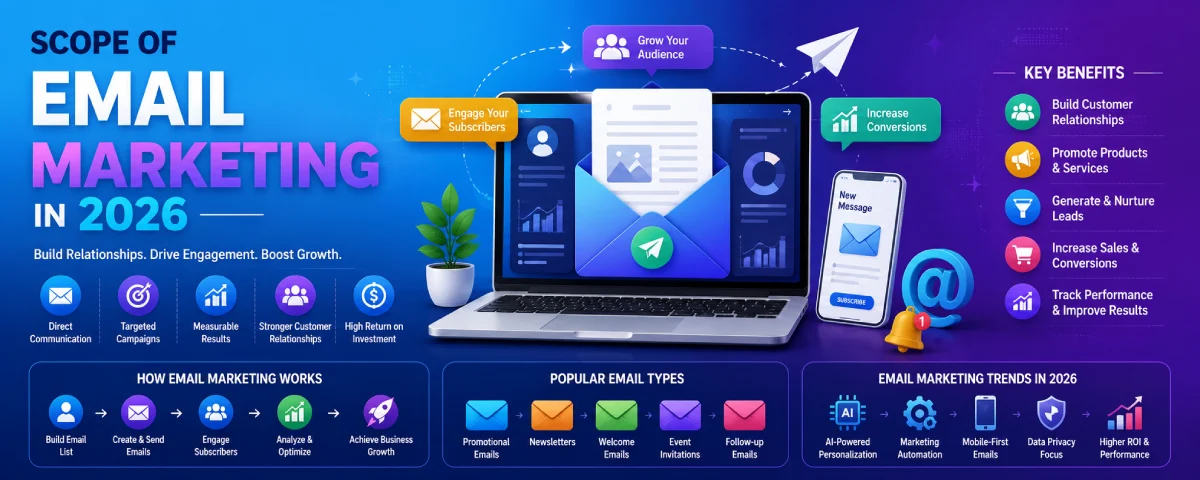
How Email Marketing Works
For how email marketing works, first you gather email addresses from those who show interest on websites, via sign-up forms, newsletter opt-ins, or purchases.
Businesses then send different types of emails, such as:
- Promotional offers
- Product updates
- Newsletters
- Welcome emails
- Event invitations
- Customer follow-ups
The modern email systems also provide for automation and customization of emails based on customer behavior.
Why Businesses Use Email Marketing
Businesses utilize email marketing because it assists them in maintaining their connection with customers and engaging them again.
Common reasons include:
- Promoting products and services
- Generating leads
- Building customer loyalty
- Increasing website traffic
- Supporting sales campaigns
- Sharing business updates
Benefits of Email Communication
Some major benefits of email marketing include:
- Direct communication with customers
- Cost-effective marketing
- Easy performance tracking
- Audience segmentation
- Personalized messaging
- Long-term relationship building
- High return on investment
Traditional Marketing vs Email Marketing
| Traditional Marketing | Email Marketing |
| Higher cost | Cost-effective |
| Broad audience | Targeted audience |
| Hard to track | Easy tracking |
| One-way communication | Personalized communication |
Importance of Email Marketing in Digital Marketing
Email marketing is still among the most valuable elements of digital marketing since it enables companies to develop relationships and communicate directly with consumers.
As opposed to other channels of communication, a business owns its email list and does not have to rely on algorithms when sending messages to the subscribers.
Direct Communication Channel
Email enables businesses to connect directly with their customers through email messages. These messages will go straight into the mail box of the subscribers.
With emails, companies can easily send vital information to their customers.
Customer Relationship Building
Trust needs time, and through email marketing, businesses can stay in touch with their audience all the time.
Regular communication allows businesses to:
- Build trust
- Provide value
- Answer customer needs
- Strengthen relationships
Strong relationships often lead to higher customer loyalty.
Lead Nurturing
Every customer does not buy at once. There are people who take some time to decide on something.
Email marketing is one way that businesses can nurture their leads using information and offers that will lead them into purchasing something.
Brand Awareness
Email marketing allows companies to remain in the memory of the consumers constantly.
Despite the fact that the consumer may not buy anything immediately, constant emails will contribute to brand awareness and recognition.
Customer Retention
Keeping existing customers is often easier than acquiring new ones.
Businesses use email marketing to:
- Share updates
- Offer exclusive deals
- Reward loyal customers
- Encourage repeat purchases
This helps improve customer retention and lifetime value. Many brands combine email campaigns with the Scope of Social Media Marketing to strengthen customer relationships.
Sales Generation
Email marketing will continue being among the most effective marketing tactics used to generate sales.
Businesses use targeted campaigns to:
- Promote products
- Launch new services
- Recover abandoned carts
- Encourage repeat purchases
Since emails can be customized and target specific audiences, their conversion rates exceed those of most conventional marketing techniques.
Key Takeaway
The use of email marketing in digital marketing is very important since it combines all four elements of marketing (direct communication, personalization, building relationships, and selling) in one form of marketing. The growing importance of customer engagement and retention will lead to increased impact of email marketing in the future in 2026.
Current Scope of Email Marketing in 2026
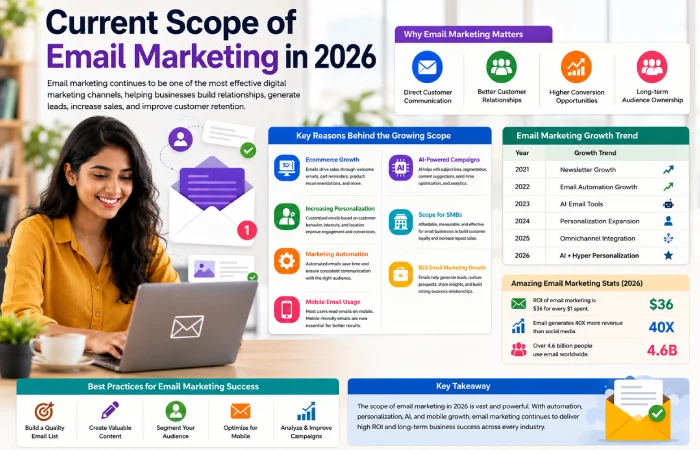
Email marketing has been recognized as one of the best digital marketing channels in 2026.Though there may be alterations that take place in the algorithms of social media websites and search engines, Email Marketing still provides business entities with an easy way to get in touch with their customers directly.
In today’s time, irrespective of the size of the business entity, whether it is a startup, a small shop, or a large ecommerce brand, email marketing becomes an integral part of its growth strategy.
Growing Digital Businesses
The number of e-commerce sites is growing yearly. All kinds of online firms such as ecommerce websites, software as a service firms, educational institutions, healthcare organizations, and services companies use email marketing to interact with their consumers.
Due to fierce competition in the business environment, a company requires inexpensive mediums for direct communication.
Why It Matters
- Direct customer communication
- Better customer relationships
- Higher conversion opportunities
- Long-term audience ownership
Ecommerce Growth Expanding Email Demand
Online shopping continues growing across the world. Ecommerce businesses use email marketing throughout the customer journey.
Common ecommerce email campaigns include:
- Welcome emails
- Cart abandonment emails
- Product recommendations
- Order confirmations
- Promotional campaigns
- Customer retention emails
In most ecommerce businesses, emails are responsible for a substantial part of their total earnings.
Increasing Demand for Personalization
Modern customers expect personalized experiences.
The company should tailor the email based on factors such as:
- Customer interests
- Purchase history
- Browsing behavior
- Location
- Engagement history
The personalized emails are going to be opened, clicked, and converted better than non-personalized emails.
Rapid Growth of Marketing Automation
Automation has transformed email marketing.
Businesses can now automatically send emails based on customer actions.
Examples include:
- Welcome sequences
- Lead nurturing campaigns
- Birthday emails
- Follow-up emails
- Re-engagement campaigns
Automation helps companies save time as well as ensures effective communication.
Mobile Email Usage Continues Rising
Most people now check emails using smartphones.
In this regard, it becomes necessary for companies to develop mobile friendly email marketing strategies.
Important mobile optimization factors include:
- Responsive design
- Short subject lines
- Clear call-to-action buttons
- Fast loading emails
Mobile-first email design is becoming a standard practice in 2026.
AI-Powered Email Campaigns
AI is transforming the way email marketing campaigns are developed and optimized.
AI helps marketers with:
- Subject line generation
- Audience segmentation
- Content recommendations
- Send-time optimization
- Campaign analysis
- Personalization
While AI is beneficial for increasing efficiency, the ingenuity of man should not be undermined.
Scope of Email Marketing for SMBs
Many small and medium enterprises use email marketing due to its affordability and high measurability.
Benefits for SMBs include:
- Low marketing costs
- Better customer retention
- Direct audience access
- Increased repeat sales
- Local customer engagement
Even businesses with small budgets can achieve strong results through email marketing.
B2B Email Marketing Growth
Email remains one of the most important channels in B2B marketing.
Companies use email to:
- Generate leads
- Nurture prospects
- Share industry insights
- Promote webinars
- Build professional relationships
Many B2B companies see email marketing as one of the most effective marketing channels. An email campaign can be implemented together with the Scope of Influencer Marketing .
Email Marketing Growth Trend
| Year | Growth Trend |
| 2021 | Newsletter Growth |
| 2022 | Email Automation Growth |
| 2023 | AI Email Tools |
| 2024 | Personalization Expansion |
| 2025 | Omnichannel Integration |
| 2026 | AI + Hyper Personalization |
Key Takeaway
In the year 2026, email marketing has expanded beyond just promotion through email. The current scope of email marketing involves customer engagement, lead generation, automation, personalization, ecommerce, and relationship building. With the development of AI and automation, it will continue being one of the channels with the highest ROI for digital marketing for many years ahead.
Types of Email Marketing
There are several types of email campaigns which are used by organizations based upon the objectives. The emails can either be for promoting sales or for building up customer relationship. Knowledge of these emails can help businesses in creating more efficient campaigns.
Promotional Emails
The promotional emails are intended for increasing the sales figures by encouraging customer actions. These emails promote the products and services of a company.
Common examples include:
- Seasonal sales
- Limited-time offers
- Product launches
- Discount coupons
- Holiday promotions
Such emails have powerful CTAs that motivate customers to buy. In promotional activities, the Scope of PPC and Paid Advertising is often helped out by lead generation from paid traffic.
Newsletter Emails
Newsletters enable organizations to keep in touch with their subscribers via newsletters.
A newsletter may include:
- Industry news
- Company updates
- Blog articles
- Helpful tips
- Product announcements
Newsletter emails play a big role in keeping the customers engaged and helping maintain brand visibility. Many companies utilize newsletter emails to publish the content produced within the Scope of Content Marketing.
Strong email campaigns often rely on valuable content. Learn more in our Content Marketing Guide.
Welcome Emails
Welcome emails are sent to subscribers as soon as they subscribe to the mailing list or create an account on the website.
These emails usually:
- Introduce the business
- Set expectations
- Share important information
- Offer special discounts
A good welcome email creates a positive first impression.
Transactional Emails
Transactional emails are triggered by customer actions.
Examples include:
- Order confirmations
- Shipping updates
- Payment receipts
- Password reset emails
- Account notifications
They contain valuable information and have very high open rates.
Lead Nurturing Emails
Lead Nurturing Emails can be used to direct your prospects through their purchasing process.
Businesses use these emails to:
- Share useful information
- Explain products or services
- Build trust
- Answer common questions
The goal is to help leads become customers over time.
Re-engagement Emails
Some subscribers stop opening emails or interacting with a brand.
There are times when some subscribers stop engaging with you via emails.
These emails may include:
- Special offers
- Personalized messages
- Feedback requests
- New product announcements
They help improve customer retention and engagement.
Event Invitation Emails
Businesses often use email to promote events.
Examples include:
- Webinars
- Workshops
- Product launches
- Conferences
- Online training sessions
These emails encourage registrations and event participation.
Ecommerce Emails
Ecommerce businesses depend heavily on email marketing.
Popular ecommerce email campaigns include:
- Cart abandonment emails
- Product recommendations
- Order confirmations
- Customer loyalty offers
- Product restock notifications
These emails help to promote sales and enhance customer loyalty. Many ecommerce firms also incorporate Scope of Affiliate Marketing to generate extra conversions.
Email Marketing Types Comparison
| Email Type | Purpose |
| Newsletter | Updates |
| Promotional | Sales |
| Welcome | New Subscribers |
| Transactional | Order Updates |
| Re-engagement | Win Back Customers |
Scope of Email Marketing for SMBs
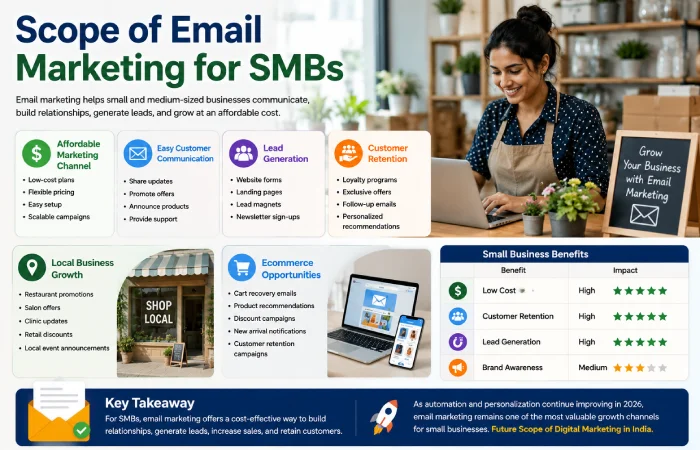
The Scope of email marketing for SMBs (Small and Medium-Sized Businesses) keeps expanding because email is one of the cheapest and most efficient channels of promotion.
Email marketing gives small businesses the opportunity to talk to their customers personally without spending too much money, unlike other types of advertising.
Affordable Marketing Channel
One of the biggest advantages of email marketing for SMBs is affordability.
Most email marketing platforms offer:
- Low-cost plans
- Flexible pricing
- Easy setup
- Scalable campaigns
This allows businesses to start small and expand as they grow.
Easy Customer Communication
Email provides a direct communication channel between businesses and customers.
Small businesses can use email to:
- Share updates
- Promote offers
- Announce new products
- Provide customer support
It ensures that there is continuous communication without being dependent on social networking sites.
Lead Generation
Email marketing assists SMBs in generating and converting leads into customers.
Businesses often collect email addresses through:
- Website forms
- Landing pages
- Lead magnets
- Newsletter subscriptions
These leads can further be converted through email marketing campaigns.
Customer Retention
Retaining existing customers is often less costly than acquiring new customers.
Email marketing assists businesses in customer retention through:
- Loyalty programs
- Exclusive offers
- Follow-up emails
- Personalized recommendations
Effective communication is vital for establishing stronger customer connections.
Local Business Growth
Email marketing can help local businesses connect with their local clients.
Examples include:
- Restaurant promotions
- Salon offers
- Clinic updates
- Retail discounts
- Local event announcements
This helps increase repeat visits and customer loyalty.
Ecommerce Opportunities
The small eCommerce business uses email marketing to generate more income.
Common ecommerce email strategies include:
- Cart recovery emails
- Product recommendations
- Discount campaigns
- New arrival notifications
- Customer retention campaigns
Even small online stores can generate significant results through effective email marketing.
Small Business Benefits
| Benefit | Impact |
| Low Cost | High |
| Customer Retention | High |
| Lead Generation | High |
| Brand Awareness | Medium |
Key Takeaway
The use of email marketing helps small businesses in forming relationships, making new leads, increasing sales, and retaining clients in an inexpensive manner. The Future Scope of Digital Marketing in India will have a strong connection with the growth of email marketing, as improvements in automation and personalization of the email campaigns keep on growing during the year 2026.
Conclusion
Email marketing will remain one of the most productive and affordable types of digital marketing in 2026. Email marketing can be considered quite effective in making relationships, acquiring new customers, making sales, and keeping customers through personalized correspondence. Thanks to the progress in technology, automation, and personalization, the scope of email marketing will continue to grow. This type of marketing is crucial for small businesses, ecommerce websites, and even big companies as it brings excellent results.
To maximize results, many businesses combine email campaigns with paid traffic strategies. Explore our PPC and Paid Advertising Guide to learn more.