

Introduction
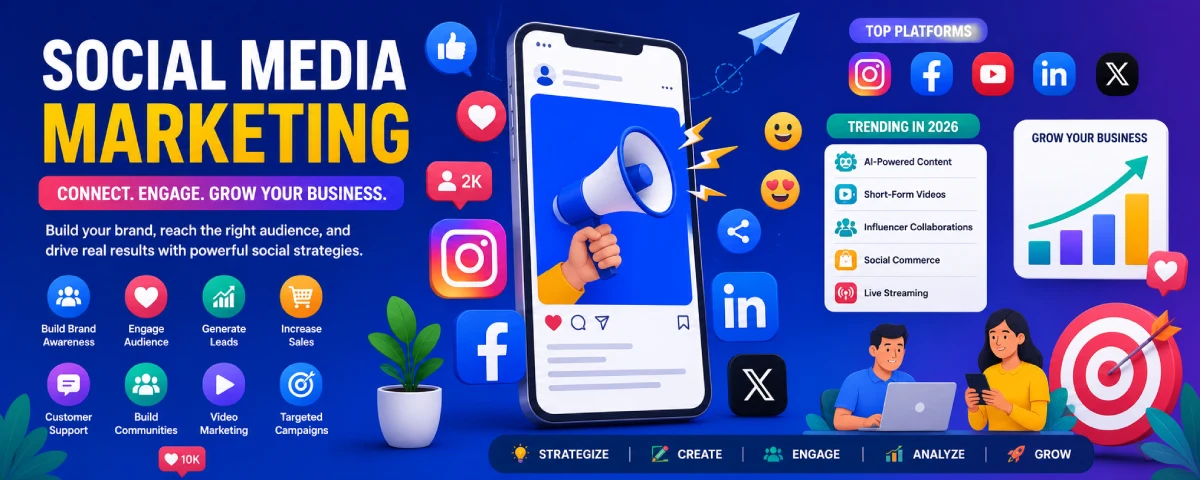
The expanding scope of social media marketing can be seen from the increasing use of social media to engage customers, market products, and increase sales by businesses. It is important that you use tools such as Instagram, YouTube, Facebook, LinkedIn, and X to help you discover products, read reviews, and follow brands, which will cause more business spending on marketing. Social media is responsible for enabling communication, forming communities, and creating brands without considering the size of the organization. In this guide, I will introduce you to some basic concepts related to social media marketing, social media marketing trends in 2026, platforms used in social media marketing, and the significance of social media marketing.
Social media marketing is one of the most rapidly growing branches under the broad scope of digital marketing.
Social media from our scope of digital marketing pillar.
What is Social Media Marketing?
Social media marketing is a method employed by companies to promote their goods and services through social media networks. With social media marketing, firms get the capability to interact with customers, increase brand awareness, and create engagements through social media. HubSpot)
Instead of using conventional modes of advertisement, businesses now utilize social sites to communicate. This mode of interaction is faster, effective, and personal in nature.
A business may use social media to:
- Share updates
- Promote products
- Build brand awareness
- Answer customer questions
- Generate leads
- Increase website traffic
- Build communities
- Improve customer loyalty
The primary aim of social media marketing is ensuring that interaction happens within the right audience for business growth purposes.
How Social Media Marketing Works
Producing suitable content, which would serve as the catalyst to encourage consumers’ participation, is undoubtedly one of the key components in social media marketing.
This content may include:
- Images
- Videos
- Reels
- Stories
- Live streams
- Articles
- Polls
- Product showcases
Organizations can be in a position to develop good relations with their clients by engaging with the content using such features as liking, commenting, sharing, or messaging.
Most social media strategies involve:
- Creating content
- Publishing content
- Engaging with followers
- Running advertising campaigns
- Measuring results
- Improving performance
Social media marketing that works does so by offering value rather than continually trying to sell something.
Why Businesses Use Social Media Marketing
There can be numerous reasons for selecting social media marketing.
Benefits include:
- Better visibility
- Brand recognition
- Audience engagement
- Lead generation
- Customer support
- Product promotion
- Community building
- Sales growth
Also, with social media, firms can be able to get instant feedback and information as regards consumer preferences.
Difference Between Traditional Marketing and Social Media Marketing
| Traditional Marketing | Social Media Marketing |
| One-way communication | Two-way communication |
| Higher cost | Flexible budgets |
| Difficult tracking | Real-time analytics |
| Limited targeting | Advanced targeting |
| Slower feedback | Instant feedback |
| Fixed campaigns | Easily adjustable |
Why Social Media Marketing is Growing in 2026
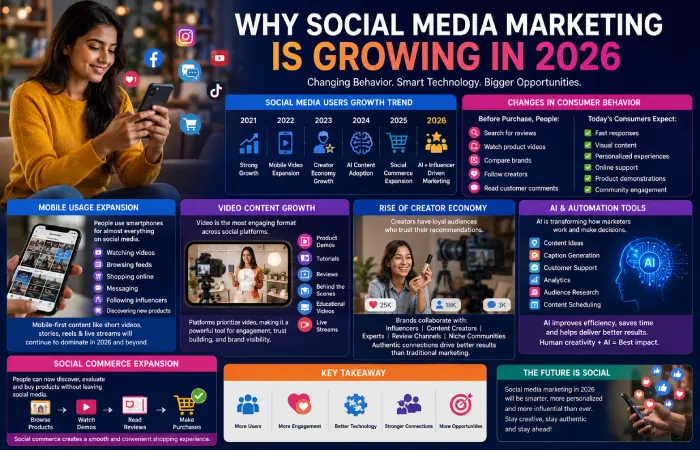
Social media marketing has been growing in popularity due to consumer behavior and technological advancements.
Social Media Users Growth Trend
| Year | Estimated Social Media Usage Trend |
| 2021 | Strong Growth |
| 2022 | Mobile Video Expansion |
| 2023 | Creator Economy Growth |
| 2024 | AI Content Adoption |
| 2025 | Social Commerce Expansion |
| 2026 | AI + Influencer Driven Marketing |
Consumers have become more active online than before.
Several major trends are driving this growth.
Changes in Consumer Behavior
Today’s consumers prefer digital interactions.
Before making a purchase, many people:
- Search for reviews
- Watch product videos
- Compare brands
- Follow creators
- Read customer comments
These facts can all be easily found on any social networking sites.
Consumers today are expecting more from brands, especially social connection.
Customers Prefer:
- Fast responses
- Visual content
- Personalized experiences
- Online support
- Product demonstrations
- Community engagement
Companies that satisfy these requirements frequently create better relations with customers.
Mobile Usage Expansion
Smartphones play a role in how much people use social media.
People usually use their phones to get on social media.
People use their smartphones for a lot of things like
- Watching videos
- Looking at their feed
- Buying things
- Sending texts
- Following famous people
- Finding new things to buy
Because more and more people are using their mobile phones companies are really worried about what is on their mobile phones.
There are some types of things that are made for mobile phones, like
- Short clips
- Short videos
- Stories people tell
- Videos that are tall
- Live videos
The way things are going this trend will keep going into 2026 and after that..
Video Content Growth
People are really into video content these days. It is becoming an important way for people to get information on social networking sites.
Video content is something that individuals like to watch. They prefer it over reading a lot of text.
There are types of video content that are popular. These include:
- Product demonstrations
- Tutorials
- Reviews
- Behind-the-scenes content
- Educational videos
- Live streams
Video content is great for businesses. It helps them do things like increase engagement with their customers. Video content also helps businesses build trust with people. It is a way for them to explain what their products are. Video content can even improve visibility, for businesses.
Many platforms are now giving priority to video content. They are changing their rules to make sure that video content is seen by people. Video content is a deal and it is helping businesses in many ways. Video content is really. It is something that businesses should pay attention to.
Rise of Creator Economy
The creator economy continues growing rapidly.
Creators have formed devoted followings who value their advice.
Consequently, companies are partnering with
- Influencers
- Content creators
- Industry experts
- Review channels
- Niche communities
These collaborations will assist brands in reaching out to consumers through means other than marketing.
AI and Automation Tools
AI has truly made an impact in how media marketing is conducted. It allows for us to connect with people, on social media. We have been utilizing intelligence to improve our social media marketing efforts.
Businesses now use AI tools for:
- Content ideas
- Caption generation
- Customer support
- Analytics
- Audience research
- Content scheduling
AI helps marketers save time and improve efficiency.
Nevertheless, human creativity still matters, as consumers like authenticity.
Social Commerce Expansion
Through social commerce, individuals can make purchases on social media sites.
Customers can now:
- Browse products
- Watch demonstrations
- Read reviews
- Make purchases
Without leaving the platform.
Such an approach facilitates smooth functioning on both sides.
Social Media Industry Growth Trend
| Year | Growth Trend |
| 2021 | Brand Awareness Growth |
| 2022 | Video Marketing Expansion |
| 2023 | Creator Economy Growth |
| 2024 | AI Content Tools |
| 2025 | Social Commerce Growth |
| 2026 | AI + Influencer Marketing |
It undoubtedly demonstrates the evolution that happens in social media marketing due to changes in technology and consumer behavior.
Scope of Social Media Marketing
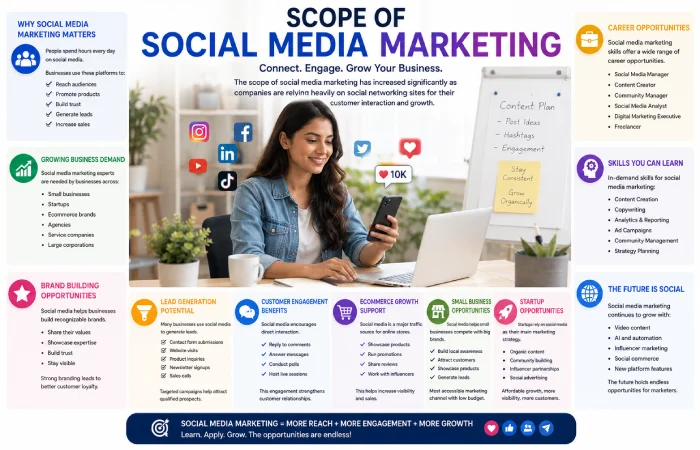
The scope of social media marketing has increased significantly as companies are relying heavily on social networking sites for their customer interaction and growth.
Social networking sites have ceased to be an auxiliary platform for marketing activities. In fact social networking sites now play a role, in bringing in customers for lots of businesses.
Why Social Media Marketing Matters
People spend hours every day on social media.
Businesses use these platforms to:
- Reach audiences
- Promote products
- Build trust
- Generate leads
- Increase sales
As social platform usage continues growing, the demand for social media marketing also increases.
Growing Business Demand
Social media marketing experts are needed by business organizations for managing their profiles, making content, and engaging with their target audience.
This demand exists across:
- Small businesses
- Startups
- Ecommerce brands
- Agencies
- Service companies
- Large corporations
The need for social media skills continues expanding every year.
Brand Building Opportunities
Social media helps businesses build recognizable brands.
Consistent content helps businesses:
- Share their values
- Showcase expertise
- Build trust
- Stay visible
Strong branding often leads to better customer loyalty.
Lead Generation Potential
Many businesses use social media to generate leads.
Examples include:
- Contact form submissions
- Website visits
- Product inquiries
- Newsletter signups
- Sales calls
Targeted campaigns allow businesses to reach out to people who have genuine interest in what they are offering, and such people are known as qualified prospects. Targeted campaigns help businesses identify these qualified prospects.
Customer Engagement Benefits
Social media helps the customers to communicate directly with the firms. This is contrary to other means of communication. Customers find it easy to interact with the firms.
Businesses can:
- Reply to comments
- Answer messages
- Conduct polls
- Host live sessions
This engagement strengthens customer relationships.
Ecommerce Growth Support
Social media has become a major traffic source for online stores.
Businesses often use social platforms to:
- Showcase products
- Run promotions
- Share reviews
- Work with influencers
This helps increase visibility and sales.
Small Business Opportunities
This has been a great help to small firms competing against larger firms through social media marketing.
Even with limited budgets, businesses can:
- Build local awareness
- Attract customers
- Showcase products
- Generate leads
Thus, social media becomes one of the easiest ways to market goods and services.
Startup Opportunities
Startups rely on social media platforms as their main marketing strategy since these provide affordable methods of growth.
Many startups rely on:
- Organic content
- Community building
- Influencer partnerships
- Social advertising
To gain visibility and attract customers.
Major Social Media Platforms for Business
Different social media platforms serve different business goals.
Platform analysis is key to selecting the appropriate marketing method
Instagram Marketing
Instagram is highly popular for visual content.
Businesses use Instagram for:
- Branding
- Product promotion
- Influencer marketing
- Reels
- Stories
It works especially well for lifestyle-focused brands.
Facebook Marketing
Facebook remains valuable for:
- Community building
- Advertising
- Customer communication
- Local business promotion
Many companies make use of Facebook Groups and Pages for customer interaction.
YouTube Marketing
YouTube is one of the best channels for content growth.
Businesses publish:
- Tutorials
- Product reviews
- Educational videos
- Demonstrations
Video content often continues attracting viewers for years.
LinkedIn Marketing
LinkedIn is ideal for professional networking and B2B marketing.
Businesses use LinkedIn for:
- Thought leadership
- Industry updates
- Lead generation
- Professional branding
Pinterest Marketing
Pinterest is useful for:
- Product discovery
- Visual inspiration
- Ecommerce traffic
Many users visit Pinterest while planning purchases.
X Marketing
X helps businesses:
- Share updates
- Participate in conversations
- Monitor trends
- Provide customer support
It remains useful for real-time engagement.
Best Social Media Platforms for Business
| Platform | Best For | Content Type |
| Branding | Reels, Images | |
| YouTube | Long-Term Growth | Videos |
| B2B Marketing | Articles | |
| Community Building | Mixed Content | |
| Product Discovery | Pins | |
| X | Real-Time Updates | Short Posts |
Types of Social Media Marketing
Companies apply various approaches through social media according to their objectives.
Organic Social Media Marketing
Organic marketing revolves around building an audience organically without using any promotional funds.
Examples:
- Regular posting
- Community engagement
- Educational content
- Brand storytelling
Paid Social Media Marketing
Paid marketing utilizes ads to reach specific demographics. Many brands combine social media with the Scope of PPC and Paid Advertising to increase reach and generate faster results.
Benefits include:
- Faster visibility
- Lead generation
- Audience targeting
- Traffic growth
Influencer Marketing
Companies collaborate with producers for promotion of their goods and services.
This approach often increases trust and engagement.
Community Marketing
Community marketing involves the creation of a community that is brand loyal.
Examples include:
- Facebook Groups
- Online communities
- Discussion groups
Video Marketing
Video marketing continues dominating social media platforms.
Popular formats:
- Reels
- Shorts
- Tutorials
- Live videos
Social Commerce Marketing
Social commerce combines social media and ecommerce.
Consumers can find and buy products via social media platforms.
Organic vs Paid Social Media
| Factor | Organic | Paid |
| Cost | Low | Budget Needed |
| Growth Speed | Slow | Fast |
| Trust | Higher | Moderate |
| Reach | Limited | Large |
| Sustainability | Strong | Depends on Budget |
How Social Media Marketing Supports Business Growth
There are many ways in which social media marketing aids business development. It enables businesses to get in touch with their audience. The social media platforms serve as mediums through which businesses can connect with their customers. This enables businesses to make their offerings known to many people.
Brand Awareness
Consistent content helps businesses become more recognizable.
Lead Generation
Social media attracts potential customers interested in products or services.
Customer Support
Businesses can answer questions quickly and improve customer satisfaction.
Community Building
Communities help strengthen customer loyalty and engagement.
Website Traffic Growth
Social media drives visitors to websites, blogs, and landing pages.
Customer Retention
Regular communication helps maintain relationships with existing customers.
Product Promotion
A business can promote its product and benefits through content.
Sales Growth
Higher visibility, trust, and engagement lead to more sales.
Examples of Successful Social Media Marketing
The most effective way of understanding social media marketing would be through examples of firms engaging in such marketing. Even though the specific goals might differ among the companies, social media marketing helps in achieving the targets by
Ecommerce Brand Example
The clothing business can leverage Instagram, Facebook, and short clips for product demonstration. There may be product recommendations, testimonials from users, product launches, and even backstage footage.
Social media helps the store:
- Increase product visibility
- Attract website visitors
- Build customer trust
- Generate sales
Local Business Example
Social media marketing would prove quite suitable for the restaurant business in terms of displaying its products via pictures, reviews, discounts, and events.
Benefits include:
- More local visibility
- Increased customer engagement
- Better online reputation
- More walk-in customers
Service Business Example
A digital agency or consultant company can generate educational information, case studies, and successful stories.
This helps:
- Build authority
- Generate leads
- Improve trust
- Attract potential clients
Personal Brand Example
Social media is widely used by people in order to establish their personal brand and share their industry experience.
Benefits include:
- Better networking
- Career growth
- Speaking opportunities
- Business partnerships
Creator Example
There are people who utilize such sites as YouTube, Instagram, and other short-video websites to promote themselves and make money.
Common income sources include:
- Brand partnerships
- Affiliate marketing
- Sponsored content
- Digital products
Monetize with our affiliate marketing guide.
Career Opportunities in Social Media Marketing
The requirement for experienced people in the realm of social media increases constantly because the organization has the need to employ experts who are able to engage with the community, create content, and interact with the audience.
One of the main advantages of social media marketing is that it offers various career options. Anyone – from students to businesspeople – can find work in this sphere.
Why Career Demand is Growing
Even copywriting is helpful for any content.
As a result, companies need professionals who can:
- Create content
- Manage campaigns
- Build audiences
- Analyze performance
- Improve engagement
The increasing number of organizations that operate on the Internet is resulting in an increased need for social media experts.
Skills-Based Industry
While many occupations have certain educational requirements, social media marketing can be considered skill-based
Employers usually value:
- Content creation skills
- Communication ability
- Creativity
- Platform knowledge
- Marketing understanding
This makes social media marketing accessible to many beginners.
Work Flexibility
Social media marketing offers flexible working options.
Professionals can work:
- Full-time
- Part-time
- Freelance
- Remote
- Agency-based
This flexibility attracts many people to the industry.
Remote Opportunities
Many social media jobs can be performed remotely.
As most tasks are performed on the Internet, specialists can perform their functions remotely.
Freelance Opportunities
Freelancing has become one of the fastest-growing areas of social media marketing.
Freelancers may offer:
- Account management
- Content creation
- Community management
- Social advertising
- Strategy development
Agency Opportunities
Social media specialists are hired by marketing agencies to handle various client profiles.
Working in agencies provides exposure to various industries and marketing practices.
Opportunities for Business Startups
Several individuals employ their social media expertise in starting their own enterprises.
Examples include:
- Content agencies
- Personal brands
- Consulting services
- Ecommerce stores
- Creator businesses
Social Media Manager Job Roles
There are different kinds of specialists for social media marketing.
Businesses with particular demands might employ particular experts.
Social Media Manager
A social media manager oversees overall platform performance.
Main responsibilities:
- Content planning
- Account management
- Campaign coordination
- Performance monitoring
This is one of the most common social media careers.
Community Manager
Community managers focus on audience relationships.
Responsibilities include:
- Responding to comments
- Managing discussions
- Answering messages
- Building engagement
Community management helps strengthen customer loyalty.
Content Creator
Content creators produce materials for social media platforms.
This may include:
- Images
- Videos
- Reels
- Stories
- Captions
The quality of content is generally an important factor in determining whether the campaign is successful or not.
Social Media Strategist
Strategists care about creating marketing campaigns.
Tasks include:
- Audience research
- Content planning
- Campaign development
- Growth strategies
Influencer Marketing Manager
This role focuses on creator partnerships.
Responsibilities include:
- Finding influencers
- Managing collaborations
- Tracking campaign results
- Building relationships
Social Media Analyst
Analysts monitor performance data.
Common tasks:
- Measuring engagement
- Tracking growth
- Reporting results
- Identifying trends
Paid Social Media Specialist
Advertising is the responsibility of paid employees.
Responsibilities include:
- Audience targeting
- Ad creation
- Budget management
- Campaign optimization
Social Media Career Comparison
| Job Role | Main Responsibility |
| Social Media Manager | Manage Accounts |
| Content Creator | Create Content |
| Community Manager | Audience Engagement |
| Influencer Manager | Creator Partnerships |
| Analyst | Performance Tracking |
| Paid Specialist | Advertising Campaigns |
Industries Hiring Social Media Professionals
Social media marketing is an asset in various fields.
Ecommerce
Online stores use social media to:
- Promote products
- Increase traffic
- Generate sales
Education
Educational organizations use social media for:
- Student outreach
- Course promotion
- Community building
Healthcare
Healthcare businesses use social platforms for:
- Awareness campaigns
- Educational content
- Patient communication
Technology
Technology companies use social media to:
- Launch products
- Share updates
- Generate leads
Finance
Financial businesses use social media for:
- Customer education
- Brand awareness
- Lead generation
Real Estate
Real estate businesses use social platforms to:
- Showcase properties
- Generate inquiries
- Build trust
Travel
Travel companies use social media heavily because visual content attracts travelers.
Local Businesses
Local businesses use social platforms for:
- Local awareness
- Customer engagement
- Promotions
Agencies
Marketing agencies continuously hire social media professionals.
Startups
Social media becomes very important for startups since it helps to market oneself with low expenses.
Freelancing in Social Media Marketing
Freelancing is the most appealing area in social media marketing.
Lots of businesses require social media management yet don’t want to hire employees.
Freelance Services
Popular freelance services include:
- Content creation
- Social media management
- Advertising campaigns
- Community management
- Influencer outreach
Getting Clients
Beginners often get clients through:
- Personal networks
- Freelance platforms
- Referrals
- Social media profiles
Building trust is important when starting.
Building a Portfolio
A portfolio helps showcase skills.
You can include:
- Sample posts
- Content designs
- Growth examples
- Campaign results
A strong portfolio often helps attract better clients.
Earning Potential
Freelance income depends on:
- Skills
- Experience
- Client quality
- Service offerings
Professionals who specialize often earn more.
Remote Work Benefits
Freelancing provides several advantages:
- Flexible schedule
- Location independence
- Multiple clients
- Income growth opportunities
Skills Required for Social Media Marketing
A good social media marketer should have the skills to be creative as well as analytical.
Content Creation
Creating valuable content is one of the most important skills.
Examples include:
- Images
- Videos
- Reels
- Stories
- Captions
Businesses often use social media in conjunction with search engine optimization tactics, meaning that the scope of SEO in digital marketing is related to social media.
Copywriting
Good writing helps improve:
- Engagement
- Conversions
- Brand communication
It’s a simple way to create something nice.
Communication Skills
Social media is built around communication.
Professionals often interact with:
- Customers
- Teams
- Influencers
- Clients
Strong communication improves results.
Video Editing
Video continues dominating social platforms.
Basic editing skills can improve:
- Reels
- Shorts
- Tutorials
- Product videos
Graphic Design Basics
Basic design skills help create:
- Social posts
- Banners
- Promotional content
Professional design improves content quality.
Analytics
Data helps marketers understand what works.
Important metrics include:
- Reach
- Engagement
- Clicks
- Conversions
Analytics supports better decision-making.
Audience Research
Understanding audiences helps create more effective content.
Marketers often analyze:
- Interests
- Demographics
- Behaviors
- Trends
AI Tools
AI tools help with:
- Content ideas
- Research
- Scheduling
- Productivity
However, human creativity remains important.
Trend Analysis
Social media changes quickly.
Professionals should monitor:
- Platform updates
- Viral content
- Industry trends
Staying updated helps maintain performance.
Best Tools for Social Media Marketing
These tools can assist social media marketers to be more effective and efficient
Content Creation Tools
Content creation tools help marketers design graphics and visual content.
Common uses:
- Post creation
- Story design
- Marketing materials
Scheduling Tools
Scheduling tools help businesses publish content automatically.
Benefits include:
- Time savings
- Consistency
- Better planning
Analytics Tools
Analytics platforms track performance metrics.
These tools help marketers:
- Measure engagement
- Monitor growth
- Improve campaigns
Social Listening Tools
Listening tools help businesses monitor:
- Brand mentions
- Industry conversations
- Customer feedback
This information supports better marketing decisions.
Video Creation Tools
Video tools help create:
- Reels
- Shorts
- Tutorials
- Product demonstrations
AI Tools
AI-powered tools assist with:
- Idea generation
- Content planning
- Research
- Productivity
Social Media Tool Comparison
| Tool Type | Purpose |
| Scheduling Tools | Plan Posts |
| Analytics Tools | Track Results |
| Design Tools | Create Graphics |
| AI Tools | Generate Ideas |
| Video Tools | Edit Videos |
Advantages and Disadvantages of Social Media Marketing Strategy
Social media marketing, just like any other form of marketing strategy, has advantages and disadvantages.
Advantages
Low Entry Cost
Businesses can start with minimal investment.
Brand Visibility
Social media helps increase awareness and recognition.
Customer Engagement
Businesses can communicate directly with audiences.
Lead Generation
Social platforms help attract potential customers.
Community Building
Strong communities improve customer loyalty.
Faster Feedback
Businesses can quickly learn what customers think.
Flexible Marketing
Campaigns can be adjusted based on performance.
Disadvantages
High Competition
Millions of businesses compete for attention.
Algorithm Changes
Platform updates can affect visibility.
Content Pressure
Consistent content creation requires time and effort.
Negative Feedback
Public criticism can impact brand reputation.
Time Investment
It requires patience to gain a loyal following.
Platform Dependence
Reliance on one platform poses a certain risk.
Advantages vs Disadvantages
| Advantages | Disadvantages |
| Low cost entry | High competition |
| Better visibility | Algorithm changes |
| Customer engagement | Content pressure |
| Lead generation | Negative feedback |
| Community building | Time investment |
| Flexible campaigns | Platform dependence |
Scope of Social Media Marketing: Career Opportunities, Platforms & Future Trends (2026)
Future of Influencer Driven Social Marketing
The inclusion of the element called “influencer marketing” is one of the aspects of social media marketing that will surely be successful. People tend to believe influencers rather than advertisements. Hence, cooperation with influencers is critical.
Previously, the companies used to collaborate with celebrities; however, now the companies prefer collaborating with micro-influencers
Why Influencer Marketing is Growing
- Higher audience trust
- Better engagement rates
- Niche audience targeting
- Authentic product promotion
- Stronger community connections
- Better brand awareness
Growth of Creator Economy
This creator economy will keep on growing because people are creating followers through videos, blogs, podcasts, and posts on social media.
Creators now earn income through:
- Brand collaborations
- Affiliate marketing
- Sponsored content
- Product sales
- Membership communities
- Online courses
Micro vs Macro Influencers
| Influencer Type | Audience Size | Best Use |
| Nano Influencer | Small | Local engagement |
| Micro Influencer | Medium | Niche audiences |
| Macro Influencer | Large | Brand awareness |
| Celebrity Influencer | Massive | Mass exposure |
Businesses are increasingly relying on micro-influencers due to their tendency to create more engagement while requiring less money.
Future of Creator Commerce
Social networking platforms have started integrating elements of e-commerce into their systems. This is done through the use of videos and live-streaming, among other things.
This trend will continue to develop during 2026 and beyond.
Future Trends in Social Media Marketing
Social media technology never stops developing. Those companies which manage to follow these developments regularly benefit from their advantages over their rivals.
AI Generated Content
Artificial intelligence is helping marketers create:
- Content ideas
- Captions
- Hashtags
- Content calendars
- Audience insights
AI does not replace creativity, but it can improve productivity.
AI Customer Support
Many businesses now use AI chatbots for:
- Customer support
- Product information
- Order tracking
- Basic troubleshooting
This helps improve response times.
Social Commerce
Consumers are now buying products through social media.
Some common social commerce activities are:
- Product tagging
- Live shopping
- Creator recommendations
- In-app purchases
Short Form Video Growth
Short videos continue dominating social media engagement.
Popular formats include:
- Reels
- Shorts
- Quick tutorials
- Product demonstrations
- Behind-the-scenes content
Live Streaming
Live video helps businesses connect directly with audiences.
Benefits include:
- Real-time interaction
- Product launches
- Question-and-answer sessions
- Community building
Personalization
Users expect content that matches their interests.
Brands now focus more on:
- Personalized recommendations
- Audience segmentation
- Customized offers
- Behavioral targeting
AR and VR Experiences
Social Marketing will now incorporate Augmented Reality and Virtual Reality.
Examples include:
- Virtual product trials
- Interactive filters
- Virtual showrooms
- Immersive shopping experiences
Future Social Media Trends Comparison
| Trend | Expected Impact |
| AI Tools | Very High |
| Video Content | Very High |
| Social Commerce | High |
| Creator Economy | High |
| Personalization | Growing |
| Live Streaming | Growing |
| AR/VR | Emerging |
Challenges in Social Media Marketing
Social media offers many opportunities, but it also creates challenges.
Declining Organic Reach
Platforms frequently reduce organic visibility.
Businesses often need:
- Better content
- Consistency
- Community engagement
to maintain reach.
High Competition
Millions of posts are published every day.
Standing out requires:
- Unique content
- Consistency
- Strong branding
Algorithm Changes
Social media algorithms change regularly.
Strategies that work today may need adjustments later.
Content Saturation
Users see large amounts of content daily.
Brands must focus on:
- Quality
- Relevance
- Audience value
instead of posting only for volume.
Audience Retention
- Getting an audience is easier than retaining one.
- Brands need to keep offering value all the time.
Increasing Advertising Costs
- Social media ads have become more competitive.
- Careful optimization is needed to remain profitable.
Beginner Roadmap to Learn Social Media Marketing
Students find the prospect of social media marketing overwhelming when they start out. The simple solution would be to learn in steps.
Step 1: Learn the Basics
Understand:
- Social media platforms
- Audience behavior
- Content formats
Step 2: Study Major Platforms
Learn how:
- Instagram works
- YouTube works
- LinkedIn works
- Facebook works
Step 3: Learn Content Creation
Practice:
- Writing captions
- Creating graphics
- Basic video editing
Step 4: Build Sample Projects
Create:
- Demo pages
- Personal projects
- Portfolio examples
Step 5: Learn Analytics
Understand:
- Reach
- Engagement
- Clicks
- Conversions
Step 6: Learn Paid Advertising
Study:
- Campaign setup
- Audience targeting
- Budget management
Step 7: Build a Portfolio
Show:
- Sample work
- Results
- Content examples
Step 8: Apply for Jobs or Freelance Projects
Start with:
- Internships
- Freelance projects
- Entry-level positions
Consistency matters more than learning everything at once.
Common Mistakes to Avoid
Many beginners make similar mistakes.
Common Social Media Mistakes
- Posting without a strategy
- Ignoring analytics
- Buying followers
- Posting inconsistent content
- Using too many platforms at once
- Ignoring audience comments
- Copying competitors completely
- Posting only promotional content
By avoiding these common mistakes, you will see better growth over time.
Troubleshooting Common Social Media Problems
| Problem | Possible Solution |
| Low Spread | Post reliably |
| Low Visit | Progress content quality |
| Slow Growth | Focus on one platform |
| Poor Conversions | Progress calls-to-action |
| Weak Branding | Maintain visual consistency |
| Low Followers | Create valuable content |
| High Unfollow Rate | Reduce excessive promotion |
| Short Video Views | Progress hooks and thumbnails |
Frequently Asked Questions (FAQs)
What is the scope of social media marketing?
The marketing through social media expands in scope as organizations continue using social media to create a good image and facilitate business activities.
Can social media marketing be a worthwhile career choice?
Certainly, as social media marketing is a source of employment, freelancing, telecommuting jobs, and companies.
What is a list of some purposes of the social media manager?
The responsibilities of the social media manager are planning, management of social media accounts, analysis, and audience engagement.
Which social media network is best right for companies?
This entirely depends on the target audience. Social media such as Instagram, YouTube, LinkedIn, and Facebook are some examples of those which are used by companies.
Is social media marketing easy to learn by beginners?
Certainly, since beginners will be able to learn it by taking various training programs.6. Is influencer marketing growing?
Yes, it expands along with brands’ cooperation with creators.
Scale via our influencer marketing guide.
Conclusion
The scope of social media marketing continues to broaden due to the emphasis on visibility and branding by companies. There are many benefits that social media provides for entrepreneurs and professionals in different forms such as content marketing, community management, influencer marketing, and social commerce.
It also presents career prospects for people via employment, freelance work, remote jobs, agencies, and consulting. With the increasing use of AI, videos, creator marketing, and social commerce, it seems that the demand for social media skills will keep rising.
For all individuals, whether students, business owners, freelancers, or marketers, learning social media marketing could provide great prospects in the digital era.
With more investments in online marketing by firms, the scope of social media marketing is increasingly related to the scope of digital marketing, scope of SEO in digital marketing, scope of content marketing, and scope of email marketing.
This growth also supports the Future Scope of Digital Marketing in India as more businesses invest in online marketing.