

Email marketing still is one of the most potent weapons in the marketer’s arsenal. The power of email lies in its ability to get into touch with people who want to communicate with you. Email marketing is an effective strategy that will not only sell but help recover money lost and foster brand loyalty.
Most companies, however, utilize only its potential in part. They send emails now and then, usually in the form of some newsletters or simple promotional material and find themselves disappointed in results. The companies that achieve outstanding and consistent results consider email marketing as an entire system and approach it by building lists, developing strategies, setting up the right automations, using best practices, and protecting deliverability.
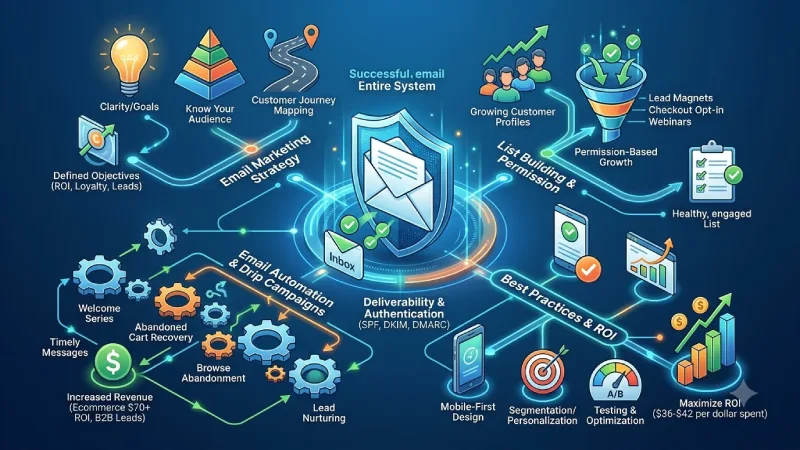
This guide was created as a pillar resource. In it, you will find an overview of all essential aspects of creating an efficient email marketing strategy in simple, but practical terms.
Email Marketing Resource Center
Explore our complete collection of guides covering newsletter design, cold email outreach, email segmentation, A/B testing, welcome email sequences, and abandoned cart campaigns.
Email Marketing Strategy
A sound email policy needs clarity. In the absence of clarity, individuals on teams send emails simply because that is what they are supposed to do, without having any specific intention in mind.
Begin with clear goals
Decide what you want email to achieve. Common goals include:
- Generating revenue through campaigns and automated flows
- Nurturing leads until they are ready to buy
- Onboarding new customers so they get value quickly
- Increasing repeat purchases and customer lifetime value
- Staying useful and top-of-mind with your audience
It is generally true that firms perform well when they choose a single objective and complement it with some other secondary objectives. Having many objectives for a single email does not work out well.
Know your audience
Strong email programs are built on a real understanding of the people on the list. Consider:
- Who they are and what roles or situations they are in
- What problems or desires matter most to them
- How they found you and what they expected when they joined
- Where they are in their relationship with your brand
The above information influences the kind of offers to be made, the tone of communication, frequency of communication, and the nature of the information communicated.
Map emails to the customer journey
People move through different stages. A simple journey might look like this:
- New subscriber
- Engaged lead or prospect
- First-time buyer
- Active customer
- At-risk or inactive customer
The right message depends on the phase. The newcomers require a compelling welcome message. The individuals who have abandoned their cart require a useful reminder. The loyal customers might like loyalty or advanced messages. The importance of the email is because it sends the right message at the right time.
Decide on the right mix of email types
Most healthy programs use a combination of:
- Running campaigns continuously (newsletters, promotions)
- Campaigns set up automatically to trigger under certain criteria (welcome emails, shopping cart abandonment, browse abandonment, order completed automated messaging)Lifecycle/Nurturing campaigns
- Segment-based campaigns for different segments
Most e-commerce businesses depend largely on cart and browse sequences. B2B companies and service providers focus more on nurture and onboarding sequences. It all comes down to how your buyers are going to purchase and use your offering.
Here is a quick comparison for you:
| Business Type | Main Email Focus | Most Important Flows | Typical Goal | |
| Ecommerce | Revenue recovery and repeat purchases | Abandoned cart, browse abandonment, welcome, post-purchase | Increase sales and customer lifetime value | |
| B2B / Services | Lead nurturing and relationship building | Welcome series, nurture sequences, re-engagement | Move leads toward sales conversations | |
| SaaS | Onboarding and retention | Welcome/onboarding, trial conversion, feature adoption, churn prevention | Activate users and reduce churn | |
| Local Business | Staying top-of-mind and driving visits | Welcome, promotions, reminders, loyalty offers | Bring people through the door or to the website |
In view of your awareness of such variations, you will be able to identify the emails that matter more than resorting to a tactic which may not work for you.
Quick research note (2025–2026):
Email still remains one of the most profitable channels in the digital world. According to recent statistics, the return on investment (ROI) from email marketing is estimated at $36-$42 per each invested dollar. Ecommerce businesses with proper email programs may enjoy even better results of $70+ per each invested dollar. Automated emails (welcome, cart recovery, etc.) account for a considerably larger share of revenue than broadcast emails, despite the fact that they represent a minority of all emails being sent.
Set simple guiding principles
Useful principles include:
- Relevance matters more than volume
- Always lead with value
- Respect the subscriber’s attention and time
- Design for mobile
- Measure what connects to real business results
- Keep improving through testing and data
When these ideas guide your decisions, the program stays healthier over the long term.
Email List Building
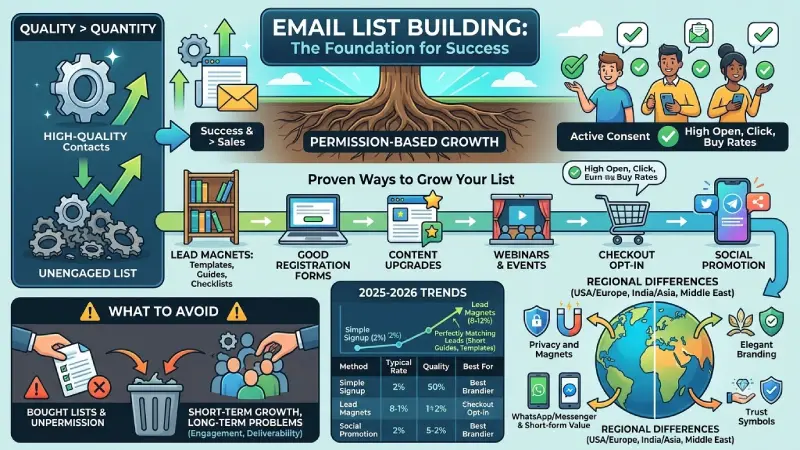
Your list is the foundation of everything else. A high-quality list of people who actually want to hear from you will outperform a large list of unengaged or poorly obtained contacts.
Build with permission
The strongest lists grow through clear consent. People who actively sign up are much more likely to open, click, and buy than contacts added without proper permission.
Proven ways to grow your list
- Good registration forms on your website, especially on high-traffic landing pages
- Led magnets in form of templates, guides, and checklistsOpt-in forms during the checkout processContent upgrades on popular blog posts
- Webinars, live events, and lead generation toolsPromotion of your newsletter on social media and in communities
- Simple referral opportunities for existing subscribers
What to avoid
- Buying email lists
- Adding people without clear consent
- Making the unsubscribe process difficult
- Using misleading language on signup forms
Short-term growth from low-quality sources almost always creates long-term problems with engagement and deliverability.
Focus on quality as well as quantity
Track how new subscribers behave after they join. A smaller list of interested people will usually generate better results than a much larger list of people who never open your emails. Offer real value in exchange for the email address. The better the reason to join, the higher the quality of the list tends to be.
Not all list-building methods perform the same. Here’s a simple comparison of common approaches:
| List Building Method | Typical Conversion Rate | Subscriber Quality | Best For |
| Lead magnet (guide, template, checklist) | 5–12% | High | Most websites and blogs |
| Simple newsletter signup | 1–3% | Medium | Content-focused brands |
| Discount / coupon offer | 8–15% | Medium to High | Ecommerce |
| Content upgrade inside blog posts | 8–15% | High | Blog-driven traffic |
| Webinar or event registration | 15–30%+ | High | B2B and high-ticket offers |
| Checkout opt-in | Varies | High | Existing customers |
Lead magnet performance note:
For the year 2025-2026, perfectly matching lead magnets (such as templates, checklists, and short practical guides) will still be more effective than simple subscription forms like “subscribe to our newsletter.” It has been seen that when businesses move from such simple subscription offers to some lead magnets which are more relevant to their needs, the conversion rate increases from about 2% to 8-12%.
Regional differences worth knowing:
There are different list-building approaches depending on geography. The USA and Europe have an expectation for value exchange (lead magnets/content upgrades) and high privacy concerns. India and some Asian countries prefer mobile-friendly offers with WhatsApp/messenger follow-ups, as well as short-form value such as discounts, useful advice or content in the local language. For the Middle East, trust elements like branding become more important when people decide to provide their emails. Where there is a need for targeting more than one geographical region, it would be advised to modify the offer and sign-up process rather than use just one global form.
Email Automation and Drip Campaigns
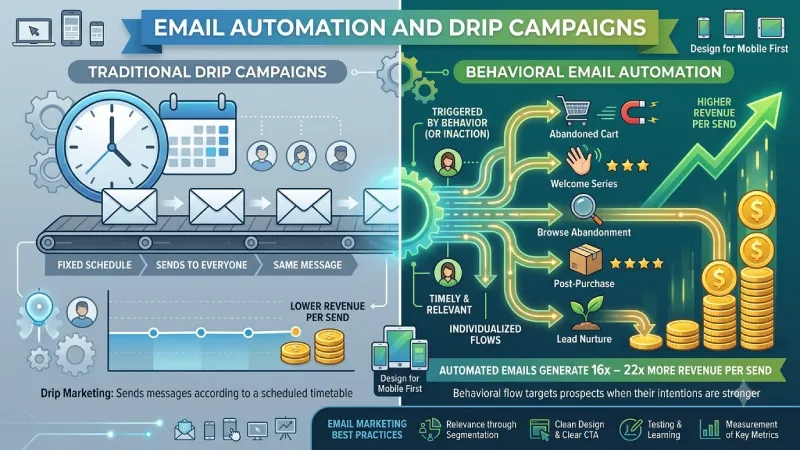
Automation lets you send timely, relevant messages without having to do it manually every time. Behavioral automations in particular often produce a large share of total email revenue.
High-value automations to consider
- Welcome series for new subscribers
- Abandoned cart recovery
- Browse abandonment
- Post-purchase follow-up and review requests
- Re-engagement campaigns for inactive contacts
- Lead nurture sequences
- Onboarding flows for new customers or trial users
These flows work because they respond to what someone actually did (or did not do), rather than sending the same message to everyone on a fixed schedule.
Automated emails consistently generate far more revenue per send than regular one-off campaigns. Here’s a clear comparison based on recent industry data:
| Automation Type | Average Revenue per Email | Priority for Ecommerce | Priority for B2B / Services |
| Abandoned Cart | $3.50 – $3.65 | Very High | Low |
| Welcome Series | $2.65 – $6.16 | High | Very High |
| Browse Abandonment | $1.50 – $2.20 | High | Low |
| Post-Purchase | $0.85 – $1.75 | High | Medium |
| Re-engagement / Win-back | $0.65 – $1.00 | Medium | High |
| Lead Nurture Sequences | Varies | Low | Very High |
Latest research note (2025–2026):
Multiple large studies show that automated emails generate between 16x and 22x more revenue per email than regular broadcast campaigns. In many ecommerce programs, automated flows bring in around 37–41% of total email revenue even though they make up only a small percentage of total emails sent. Welcome series and abandoned cart flows are usually the strongest performers.
This is precisely why most people would advise that you focus on a couple of key automation tasks before launching into numerous campaigns.
How to approach automation
Start with the flows that match your biggest opportunities. For most online stores, welcome and abandoned cart automations come first. For B2B or service businesses, welcome and nurture sequences are usually the priority.
Keep each flow focused. Every email should have one clear job. Avoid making sequences longer than they need to be.
Review performance regularly. Consider open rates, click rates, conversion rates, and the effect on unsubscribes per stage. You will find that small improvements in high traffic workflows lead to significant gains.
Drip campaigns and behavioral flows
While conventional drip marketing sends messages according to a scheduled timetable, behavioral automation is triggered by behavior. Each approach has its place, however, behavioral flow is typically more effective since it targets prospects when their intentions are stronger.
Email Marketing Best Practices
Certain habits consistently separate strong email programs from average ones.
Relevance through segmentation
Sending the same email to your entire list reduces performance. Even basic segmentation — such as separating engaged from inactive subscribers, or customers from non-customers — improves results. More advanced segmentation based on behavior, purchase history, or preferences can improve them further.
Here’s a simple comparison of basic versus stronger email practices:
| Practice Area | Basic Approach | Stronger Approach | Typical Impact |
| Segmentation | Send same email to full list | Segment by behavior, lifecycle, or engagement | Higher opens, clicks, and revenue |
| Design | Desktop-focused layout | Mobile-first, clean, easy to scan | Better click rates on phones |
| Call-to-Action | Multiple competing links | One clear primary CTA | Higher conversion rates |
| Testing | Rarely test | Regular A/B tests on subject lines and CTAs | Steady improvement over time |
| List Management | Keep everyone forever | Regularly clean or re-engage inactive contacts | Better deliverability and engagement |
2026 Benchmarks (approximate industry averages):
- Open rates: often reported between 30–43% (note: these numbers are inflated by privacy protections and should be treated as directional only)
- Click-through rates: typically 0.7–2.1% for regular campaigns; higher for automated emails
- Unsubscribe rates: healthy programs usually stay under 0.2–0.5% per campaign
Regional differences:
Email habits vary by region. In North America and much of Europe, people generally expect clear value and moderate frequency. Mobile-first approach and slightly increased frequency will work well in India and some other Asian markets where the content remains relevant. In the Middle East, trust symbols and right tone will be much more important. In case you are targeting different regions at once, it is advisable to adjust frequency and communication to suit them.
Design and readability
- Design for mobile first
- Keep layouts clean and easy to scan
- Use clear visual hierarchy
- Make buttons large enough to tap easily
- Maintain consistent branding
- Check how emails look in dark mode and in major email clients
Writing style
- Lead with value
- Keep the main point clear
- Write in a natural, conversational tone
- Focus on one primary call-to-action
- Make the next step obvious
Sending frequency
But there is no ideal frequency at all. This will depend upon your audience and the relevance of the emails that you send. Finding the ideal frequency will ensure that your recipients remain engaged but are not overburdened to unsubscribe from them.
Testing and learning
Through constant testing of subject lines, offers, calls to actions, and timings, the email program will always be improving. Test one thing at a time.
Measurement
Pay attention to those measurements which will have an impact on your bottom line: revenue generated via email, conversion rate, list size and attrition, engagement numbers, and deliverability scores. While open rate can give you some direction, do not rely solely on it for making decisions.
Email Deliverability and Open Rates
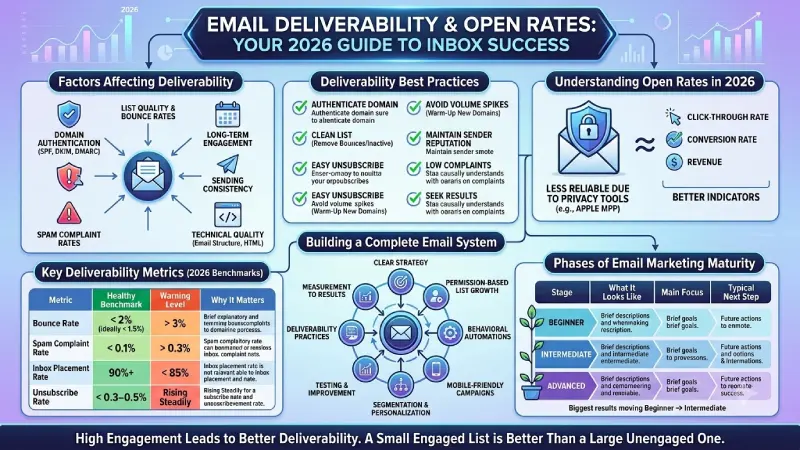
The best content in the world achieves little if it lands in spam or the promotions tab.
Factors that affect deliverability
- Domain authentication (SPF, DKIM, and DMARC)
- List quality and bounce rates
- Long-term engagement patterns
- Spam complaint rates
- Consistency of sending behavior
- Technical quality of the emails themselves
Practices that help deliverability
- Properly authenticate your sending domain
- Clean the list by deleting hard bounces and disengaged subscribers
- Easy unsubscribe option
- Avoid spikes in volume, particularly for new domains
- Maintain your sender reputation and deliverability rate
- Low complaints rateUnderstanding open rates
Open rates have become less reliable due to privacy tools and image blocking. However, they can still provide some value as an indicator, particularly when it comes to comparison of similar campaigns, while the click-through rate, conversion rate, and income give a more accurate perspective.
Here are the key deliverability metrics most teams should watch in 2026:
| Metric | Healthy Benchmark (2026) | Warning Level | Why It Matters |
| Bounce rate | Under 2% (ideally under 1.5%) | Above 3% | High bounces damage sender reputation |
| Spam complaint rate | Under 0.1% | 0.3% or higher | Crossing 0.3% can seriously hurt inbox placement |
| Inbox placement rate | 90% or higher | Below 85% | Shows how many emails actually reach the inbox |
| Unsubscribe rate | Under 0.3–0.5% per campaign | Rising steadily | Signals relevance or frequency problems |
On open rates in 2026:
It is less accurate to use open rates compared to before. Due to privacy protection (especially that of Apple Mail Privacy Protection), it is inflated most of the time; hence, it can only be considered an approximate indicator. Metrics like click-through rate, conversion rate, and revenue are much better to determine the performance level. Most seasoned marketers tend to look at click-through rate more often now.
Regional discrepancies:
Deliverability problems are not universal and consistent around the world. In the USA and Europe, the strict spam filters and privacy protection policies make the quality of the mailing list and authentications matter a lot. In some Asian countries, mobile clients and mailbox providers might cause other placement problems.
Protecting long-term health
High engagement leads to better deliverability. Send targeted messages, keep an appropriate frequency, segment properly, and make sure that your list remains cleaned up on a regular basis. A small engaged list is better off than a large unengaged one.
Building a Complete Email Marketing System
A strong email program in 2026 usually brings these pieces together:
- A clear strategy linked to business goals
- Steady growth of a permission-based list
- Core behavioral automations
- Well-designed and mobile-friendly campaigns
- Thoughtful segmentation and personalization
- Ongoing testing and improvement
- Solid deliverability practices
- Measurement that connects email activity to results
The email experience is more effective when it seems like a valuable component of the interaction and not an intrusion. People remain subscribed when the emails that they receive are relevant and appropriate.
Most email applications go through predictable phases of maturity. Below is a simple guide on how to identify your current phase:
| Stage | What It Usually Looks Like | Main Focus | Typical Next Step |
| Beginner | Occasional newsletters, basic welcome email, limited or no automation | Getting the basics working | Set up a proper welcome series and clean the list |
| Intermediate | Regular campaigns + core automations (welcome, abandoned cart, basic segmentation) | Improving relevance and revenue | Add more behavioral flows and start testing |
| Advanced | Strong segmentation, multiple automated journeys, regular testing, good deliverability monitoring | Optimisation and scaling | Advanced personalisation, predictive sends, deeper analytics |
Most businesses get the biggest jump in results when they move from the Beginner stage to Intermediate — by installing the key automations and improving list quality. Progressing further is about refinement rather than adding complexity for its own sake.
Begin with setting up a good base – good list hygiene, an effective welcome sequence, and proper technical configuration. Next, optimize or set up campaigns and automation processes that will be most influential for your business goals.
As such, when email marketing is analyzed not as a process but as a system, then it becomes evident that it is the most reliable and cost-effective means for growth..
Frequently Asked Questions
- Will email marketing continue to pay off in 2026?
Absolutely! For those businesses that know what they want from email marketing, the channel has been delivering great ROI. One of those marketing channels where you get to be in control of the relationship with your audience.
- How often should I send emails to my list?
Everything is based on the type of audience you have and the value you create for them.
Most brands seem to be doing great with just a few campaigns per month plus behavioral automations.
- Which automation should I build first?
Welcome series is always the first priority for most companies. Abandoned cart flows have the same level of importance for ecommerce brands.
- What steps can I take to improve deliverability?
Domain authentication, keeping the list clean, monitoring engagement rates and complaints, making the unsubscribe process easy and not emailing chronically inactive subscribers.
- Should I prioritize one-off campaigns or automations?
Both strategies have their importance. One-off campaigns allow reaching the entire list at once. Automations react to behaviors and account for a big part of email revenue.
Conclusion
When email marketing is looked at in its totality rather than a set of disconnected emails, the most desirable outcomes are achieved. Make sure you develop good mailing lists, develop valuable emails for your subscribers, automate critical email campaigns, and deliver your emails successfully. Start small, and then work your way up. Remember that the subscriber is the foundation of all email marketing activities. As long as the right strategy is implemented, email marketing will be very reliable and profitable.