

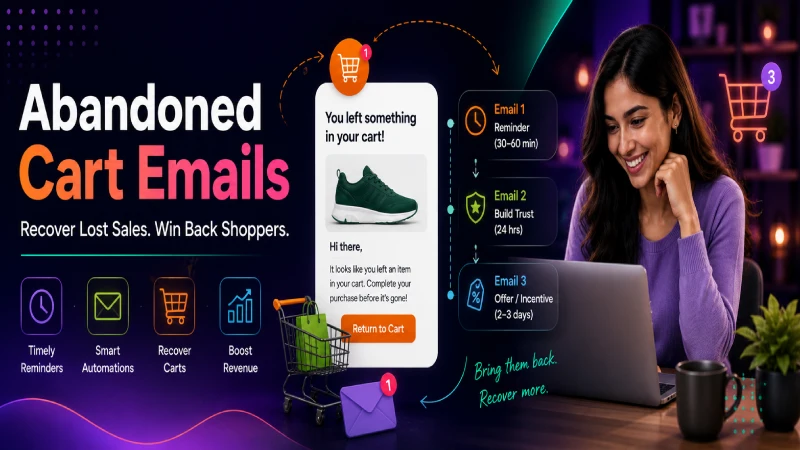
There are many people who place products in their cart but abandon shopping on your website. Either they get distracted or think about comparing prices or they are in a dilemma. The abandoned cart email is a way through which you can attract them back and save revenue for yourself.
If you can manage to send these emails timely and with quality, you will always find yourself generating the most conversions using this automation tool. Below is an explanation of timing of your emails, writing good subject lines, choosing discount or no discount strategy, designing a flow foar your campaign, and adding abandoned browse emails..
For the overarching strategy, read our complete guide on Email Marketing
Abandoned Cart Email Timing
Timing is one of the most important factors in cart recovery success.
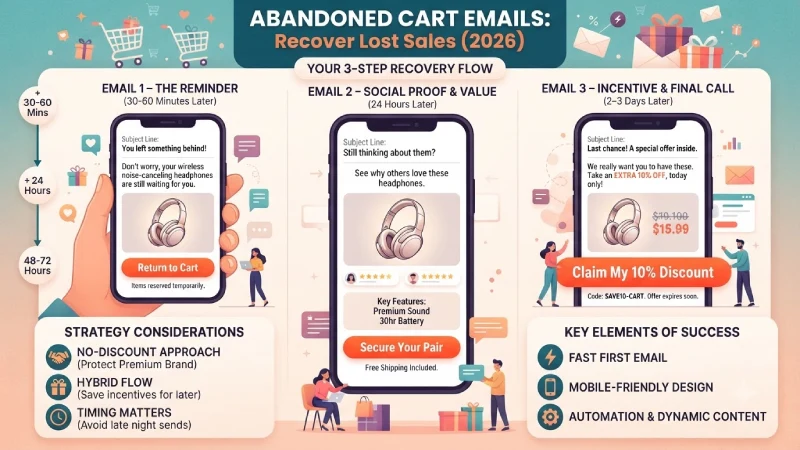
Recommended timing for a standard flow
- First email: 30–60 minutes after abandonment
- Second email: 24 hours later
- Third email: 48–72 hours after the second email
Why this timing works
Sends that are too fast could come across as pushy. Sends that are too late would mean that the consumer had already bought from another company or is no longer interested. The first email gets to the customers when they are still fresh about the products.
Additional timing considerations
- Timing can be adapted according to how long it usually takes you to make a decision. For expensive products, longer intervals can be allowed.
- Don’t schedule emails too late at night or early in the morning.
- Take into account the time difference, if your audience lives in different regions.
- Suspend the sequence if the recipient makes a purchase.
Test out varying delays before sending the first email (for instance, 30 minutes versus one hour versus three hours)
Subject Lines That Recover Carts
The title of the email decides whether or not the email will be read. Strong abandoned cart subject lines feel helpful rather than aggressive.
Effective subject line approaches
| Style | Example | Why It Works |
| Direct reminder | “You left something in your cart” | Clear and straightforward |
| Product-focused | “Still thinking about the [Product Name]?” | Personal and specific |
| Helpful tone | “Need help deciding?” | Low pressure |
| Urgency (used carefully) | “Your cart is reserved for a limited time” | Creates mild scarcity |
| Benefit-oriented | “Complete your order and get free shipping” | Highlights a reason to return |
Subject line tips
- Keep them relatively short so they display well on mobile.
- Use the product name when possible.
- Avoid excessive urgency or all-caps language that feels spammy.
- Test plain reminders against slightly more creative versions.
- Match the tone of your brand.
A simple, clear subject line often outperforms clever ones in cart recovery emails.
Discount vs No-Discount Strategy
Another critical strategic decision involves whether you should apply a discount to your abandoned cart emails.
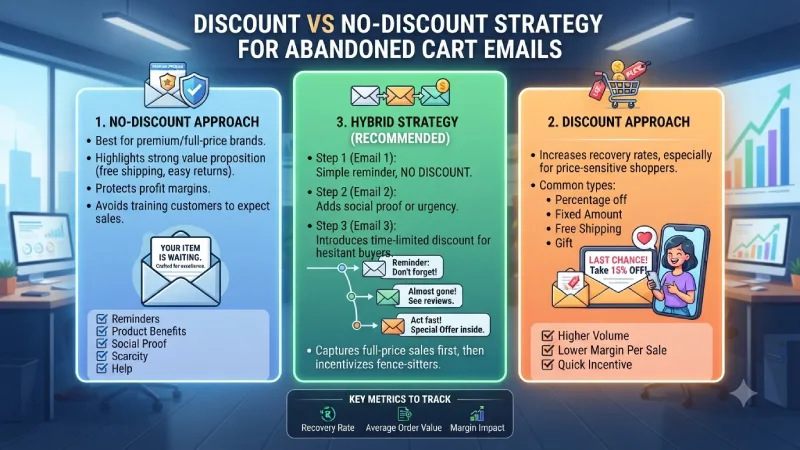
No-discount approach
This works well when:
- Your brand is premium or full-price focused
- You already offer strong value (free shipping, easy returns, guarantees)
- You want to protect margin and avoid training customers to wait for discounts
In a no-discount flow, focus on reminders, product benefits, social proof, scarcity of stock, or help resources.
Discount approach
Discounts may help raise the recovery rate, particularly for price-sensitive individuals. Some common discounts are:
- Percentage off
- Fixed amount off
- Free shipping
- Gift with purchase
Hybrid strategy (often the most effective)
Many stores use a multi-step flow where:
- The first email is a simple reminder with no discount
- The second email adds social proof or urgency
- The third email introduces a time-limited discount
It also enables recovery of some customers without offering a discount but also provides an incentive to those who are still unsure about making their purchase at a later date.
Test how the discount version versus the non-discount version affects your recovery rate, average order value, and margin.
Multi-Step Abandoned Cart Flow
A single email recovers some carts. A short sequence recovers more.
Recommended 3-email flow
Email 1 – The Reminder (30–60 minutes later)
Goal: Bring the shopper back while interest is high.
Content ideas:
- Clear message that items are still in the cart
- Product images and names
- Easy “Return to Cart” button
- Optional support link (“Have questions?”)
Email 2 – Social Proof or Value (24 hours later)
Goal: Reduce hesitation.
Content ideas:
- Customer reviews or ratings for the products in the cart
- Key benefits or differentiators
- Trust signals (returns policy, security badges, guarantees)
- Again, a clear path back to the cart
Email 3 – Incentive or Final Reminder (2–3 days later)
Goal: Convert remaining interested shoppers.
Content ideas:
- Limited-time discount or free shipping (if using incentives)
- Low-stock messaging if accurate
- Last-chance tone without being aggressive
- Simple checkout link
Additional flow tips
- Stop the sequence immediately if a purchase is made.
- Exclude people who have already received a discount recently if you want to protect margins.
- Keep the design clean and mobile-friendly.
- Use dynamic product blocks so the email shows the exact items left behind.
Three emails is the most common and effective length for most stores. Adding a fourth email rarely improves results enough to justify the extra sends.
Abandoned Browse Emails
Abandoned browse (or product viewed) emails are meant for those individuals who have viewed the product but have not put the product into their shopping cart. Such emails come before cart abandonment emails in the conversion funnel and convert at a lower rate.
How browse abandonment differs from cart abandonment
- Intent is lower (they never added to cart)
- Timing can be slightly more relaxed
- Messaging should feel helpful rather than assumptive
Simple browse abandonment approach
- Trigger: Viewed a product page but did not add to cart and did not purchase within a set period (for example 1–24 hours).
- Email content: “Still interested in [Product]?” plus image, key details, and a clear link back to the product.
- Optional second email: Social proof or related products.
Browse emails work best when:
- You have enough traffic to generate meaningful volume
- Product pages are strong
- You avoid over-messaging people who are only casually browsing
Combine browse and cart flows carefully so the same person does not receive too many emails in a short period.
Building an Effective Cart Recovery System
A strong abandoned cart system in 2026 usually includes:
- Fast first email (within an hour)
- Clean, mobile-friendly design with clear product details
- A short multi-step sequence (typically three emails)
- Thoughtful use of discounts (often saved for later in the flow)
- Dynamic product content
- Suppression rules when a purchase occurs
- Regular review of recovery rate, revenue recovered, and unsubscribe impact
Frequently Asked Questions
- How soon should the first abandoned cart email be sent?
Most stores perform well sending the first email 30–60 minutes after abandonment. Test to find the sweet spot for your audience. - Should I always offer a discount in cart recovery emails?
No. Many brands recover a good percentage of carts without discounts. A common approach is to try a reminder first and offer an incentive only in a later email. - How many abandoned cart emails should I send?
Three emails is the standard and usually the most effective number. More than that often brings diminishing returns and higher unsubscribe risk. - What is the difference between abandoned cart and abandoned browse emails?
Cart emails target people who added items to the cart. Browse emails target people who viewed products but did not add them. Cart emails usually convert higher because intent is stronger. - Can abandoned cart emails hurt my brand?
They can if they are overly aggressive, too common, or not well-designed. Remember to keep your tone helpful, be aware of timing, and make it convenient for customers to buy or unsubscribe.
Conclusion
Abandoned cart emails are one of the closest things to “found money” in ecommerce. Shoppers have already shown clear interest. A timely, helpful sequence simply makes it easy for them to finish what they started.
Create your basic flow of three emails if you haven’t done that before. At first, concentrate on such aspects as proper timing, well-crafted subject lines, and the easy way back to the cart for your customer. After that, try testing different incentives, approaches, and browsing abandonments.
Once these emails are perceived by your customers as a helpful reminder rather than a pushy selling attempt, their effectiveness will be much higher.
To take the next step, see our detailed guide on Email Newsletter Design