

However, cold emailing will still work in 2026, provided that it is done right. There is no place for spamming with mass emails anymore. Email boxes are becoming more complicated; people are getting busier; and poor methods are promptly discovered and disregarded.
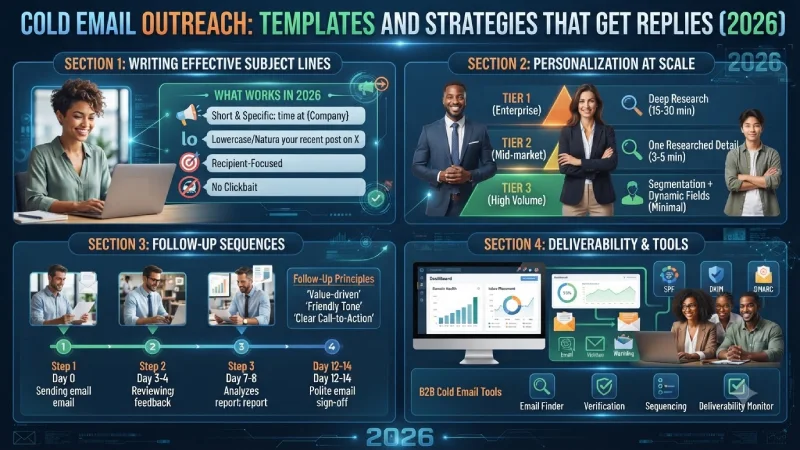
Successful campaigns will be based on relevance, deliverability, and respect for people’s time. Clean lists, relevant messages, personalization when necessary, proper follow-up, and tracking of the right metrics can all be achieved through the right planning and execution.
This guide will contain information on the technical aspects of sending cold email outreach. How to write effective subject lines, engage in personalized outreach at scale, send follow-up messages, and increase deliverability, and use tools that will be useful for B2B marketing.
For the overarching strategy, read our complete guide on Email Marketing
Writing Cold Email Subject Lines
The subject line is the first filter. If it looks like spam or feels irrelevant, the email never gets read.
What Works Better In 2026
- Short and specific (often 3–7 words)
- Lowercase or natural capitalization
- Focused on the recipient or their company, not on you
- Free of hype words, excessive punctuation, and clickbait
Subject Line Approaches That Tend To Perform
| Style | Example | Why It Can Work |
| Specific problem or goal | “onboarding time at {Company}” | Feels relevant and useful |
| Trigger or observation | “saw your Series B announcement” | Shows you did basic research |
| Simple and direct | “quick question about hiring” | Low pressure, easy to open |
| Personalized reference | “{First name} — your recent post on X” | Stands out from mass templates |
What To Avoid
- “Quick question” used on every email (it has become a spam signal)
- All caps or multiple exclamation points
- Fake “Re:” or “Fwd:” lines
- Vague claims like “increase revenue 300%”
The subject should be written once you have understood what your email is about. Try out a few options if you can, but it’s always clarity that comes before creativity.
Personalization at Scale
True one-to-one personalization for every prospect is rarely realistic. The smart approach is tiered personalization that matches effort to potential value.
A Practical Tiering System
| Tier | Account Type | Research Time | Personalization Level | Weekly Volume |
| Tier 1 | High-value / enterprise | 15–30 min | Custom first line + specific reference to their situation | 10–25 |
| Tier 2 | Mid-market | 3–5 min | One researched detail + solid template | 50–150 |
| Tier 3 | Higher volume | Minimal | Strong segmentation + dynamic fields | 200+ |
Useful Personalization Points
- Recent funding, hiring, or product launch
- A specific post, podcast, or interview they did
- A clear problem common in their industry or role
- Technology they use (when relevant and accurate)
- Mutual connections or shared context (used carefully)
One sentence can make a world of difference even if it is only relevant to the body of the email. The idea here is to prove that the email has not been sent out to several thousand people.
Cold Email Follow-up Sequence
Most replies do not come from the first email. A good sequence gives people more than one chance to respond while staying respectful.
A Simple, Effective Sequence Structure
| Step | Timing | Purpose | Length |
| 1 | Day 0 | Personalized opener with clear value | 50–125 words |
| 2 | Day 3–4 | New angle, resource, or proof | 40–80 words |
| 3 | Day 7–8 | Social proof or different pain point | 40–80 words |
| 4 | Day 12–14 | Short, polite breakup email | 20–40 words |
Follow-Up Principles
- The mail should be adding some value in each instance (case study, insight, another question).
- The tone should remain friendly rather than aggressive.
- The e-mail should make it easy to respond by providing an actionable or question-oriented conclusion.
- Wait for completion of the series until there is a new trigger in the future.
- Don’t bombard the person’s inbox with too many e-mails.Many teams find that the second and third emails generate a large share of total replies. Skipping follow-ups leaves results on the table.
Cold Email Deliverability Tips
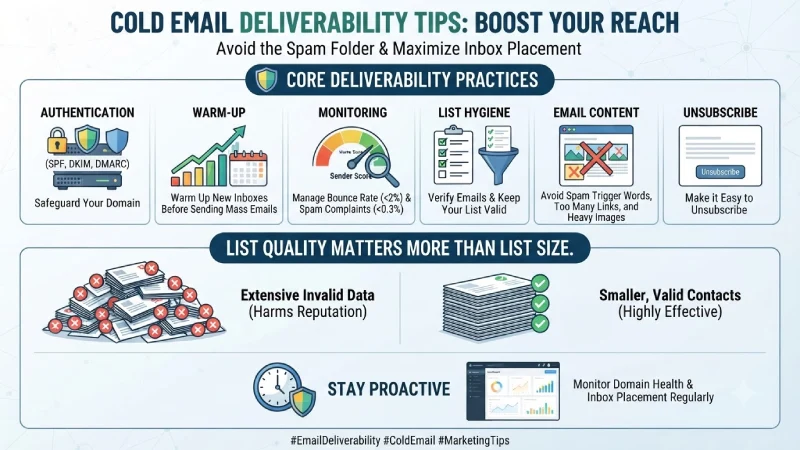
You could write the best email in the entire world; however, it would all be for nothing if it landed in your spam/promotions. Core deliverability practices
- Safeguard your domain (SPF, DKIM, and DMARC).
- Consider using a separate domain or subdomain for cold email than your main corporate domain if you can.
- Warm up new email inboxes before starting mass emailing.
- Manage your bounce rate (keep it below 2% and better yet, below 1.5%).
- Make sure your spam complaints stay well under 0.3%.
- Make sure email addresses are confirmed before you put them into a sequence.
- Do not include spam trigger words or heavy use of images and links in your initial cold email.
- Make it easy to unsubscribe
List quality matters more than list size
Even a smaller number of valid contacts is far more effective than an extensive number of invalid ones. Invalid data impacts sender reputation very quickly.
Monitor your domain health and inbox placement regularly. Deliverability problems are easier to prevent than to fix after they appear.
B2B Cold Email Tools
The use of tools can increase the efficiency of outreach activities, but this depends on having a good strategy.
Common categories of tools
| Category | What It Helps With | Notes |
| Email finding | Locating contact addresses | Accuracy varies; always verify |
| Email verification | Removing invalid and risky addresses | Critical for protecting reputation |
| Sales engagement / sequencing | Building and running multi-step sequences | Look for good deliverability features |
| Personalization research | Gathering trigger events and context | Saves time on Tier 1 and Tier 2 accounts |
| Deliverability monitoring | Checking inbox placement and domain health | Useful for ongoing protection |
How To Choose And Use Tools
- Start with good data and proper domain configuration before using additional software.
- Use tools to facilitate research and sequencing but not for sending greater amounts of lower quality email.
- Check AI generated personalization before sending email. Automation should not replace human judgement.
- Monitor reply rate and appointments booked, not open rates (which are much less accurate than they used to be).
An ideal set of tools is one which will allow you to increase your efficiency without sacrificing the quality. More tools do not necessarily result in better results..
Building a Sustainable Cold Email System
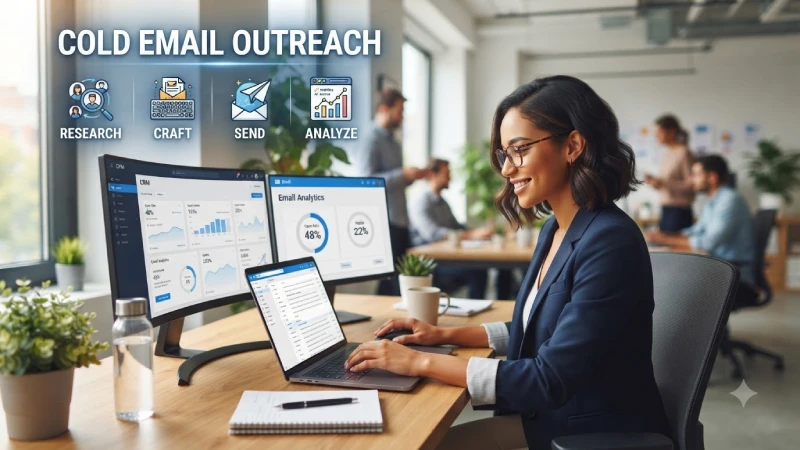
There are some repeatable foundations for successful cold email marketing campaigns in 2026:
- Clear Ideal Customer Profile and targeting
- Verified, high-quality contact data
- Proper domain authentication and warm-up
- Short, relevant messages with tiered personalization
- Thoughtful follow-up sequences
- Ongoing monitoring of deliverability and reply quality
Sending cold emails is not all about the number of messages sent. It is all about beginning the appropriate conversations with the appropriate people. If the content of the email is appropriate, responses follow.
Start small. Test a tight sequence with a well-defined audience. Count the positives, not the sends. Fix things incrementally and piece by piece. Those teams which approach cold emailing as a system and not as a numbers game end up achieving more consistently in the long term.
Frequently Asked Questions
How is the good reply rate for cold email marketing in 2026?
It usually lies within 3-7%. But successful campaigns can bring even more, up to 10%. Do not forget about positive replies and meetings, not just any reply rates.
How many follow-ups should I send?
Three to four total emails (one initial + two or three follow-ups) spaced over 2–3 weeks is a common and effective range.
How important is personalization?
It matters, but it should match the value of the deal. Deep personalization for every prospect is rarely scalable. Tier your effort.
Should I use my main company domain for cold email?
Many teams prefer a dedicated domain or subdomain for outreach to protect the primary domain’s reputation.
What is the biggest reason cold emails fail?
Targeting and Deliverability Problems. Great copy is useless if it is delivered to the wrong audience or gets marked as spam.
To take the next step, see our detailed guide on Email Segmentation.