

Affiliate Marketing: The Complete Guide to Building a Profitable Passive Income Stream (2026)
Affiliate marketing remains one of the most realizable options for creating an online business with passive income potential. You promote certain products and services and earn money when users make purchases from the affiliate links. This option does not require you to have a product yourself or deal with inventories and customer service.
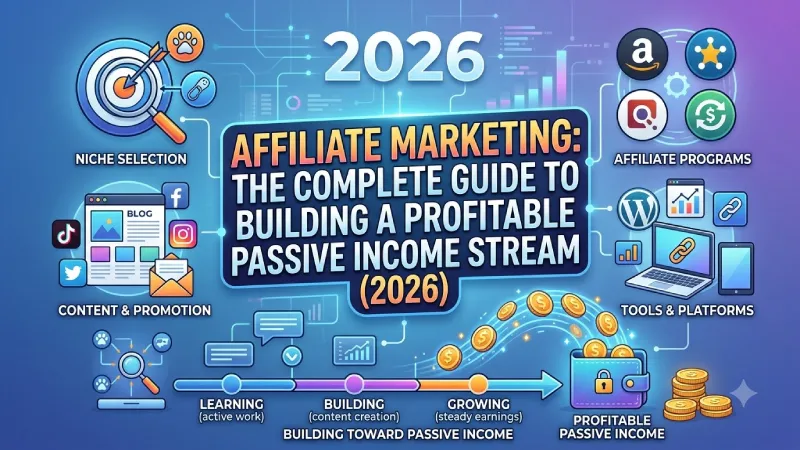
Most people enter with huge expectations and leave after several months since they perceive it as lottery and not as skill. The successful individuals tend to do the contrary – they focus on specific niche, produce relevant content, select the appropriate programs and wait until the results accumulate.
This affiliate marketing guide is written in form of a pillar resource. It covers all necessary information about affiliate marketing itself, good programs to join, choosing the right niches, the tools needed, as well as content and promotion strategies for 2026.
Affiliate Marketing Resource Center
Explore our complete collection of affiliate marketing guides covering beginner strategies, Amazon Associates, ClickBank, Instagram promotion, affiliate SEO, and legal disclosure requirements.
How Affiliate Marketing Works
The concept of affiliate marketing is actually quite simple.
A company needs more clients. To do this, the company allows other individuals, called affiliates, to market its products. Each affiliate receives a unique tracking link, which, when clicked, generates revenue for the company through the affiliates’ commissions.
There are mainly three parties
- The merchant, which is the company owning the product or service,
- The affiliate (you)
- The customer
How the money flows
- You join an affiliate program.
- You get a special link.
- You share the link through content, email, social media, or ads.
- A visitor clicks and buys.
- The sale is tracked.
- You earn a commission.
Common commission types
| Commission Type | How It Works | Best For |
| Percentage of sale | You earn a % of the order value | Physical products, most programs |
| Fixed amount (CPA) | You earn a set amount per sale or lead | Some digital products and services |
| Recurring | You earn commission as long as the customer stays subscribed | Software, memberships, SaaS |
| Tiered | Higher rates when you sell more | Programs that reward top promoters |
Cookie duration matters
Different programs track sales for different lengths of time after the click (the “cookie window”). Amazon is generally quite short (usually 24 hours). Digital product marketplaces offer 30 days, 60 days, or even 90 days. Longer cookies give you more chance to earn if the person does not buy immediately.
Affiliate marketing becomes more passive when your content continues to rank or your audience continues to see your recommendations without you doing daily outreach. The passive part usually comes after the hard work of building traffic and trust.
There is not only one way to do affiliate marketing. The basic principle behind affiliate marketing stays the same but the way people do affiliate marketing is very different from each other.
Main types of affiliate marketing
| Type | How It Works | Best Suited For | Level of Effort |
| Content affiliate | You create blog posts, videos, or reviews and place links inside them | People who like writing or making videos | Medium to High at the start |
| Paid traffic affiliate | You run ads (Facebook, Google, native, etc.) to an offer | People comfortable with testing ads | High (needs budget + testing) |
| Email affiliate | You build a list and promote offers to subscribers | People who want long-term control | Medium (once the list exists) |
| Influencer / social affiliate | You promote products to your audience on Instagram, TikTok, YouTube, etc. | People who are good on camera or social media | Medium |
| Coupon / deal affiliate | You run a site or page focused on discounts and deals | People who like hunting offers | Medium |
Newbies tend to begin with social media or content since these need less cash at first. Traffic generation through payments is relatively fast but requires some cash and tests.
How tracking actually works
When the individual uses the affiliate link to visit, some data is stored on the browser (generally, cookie data), and it is this data that helps the affiliate network or merchant determine which visitor was referred to them by you.
Here are some ways that credits can be assigned:
- Last-click: The last affiliate link the person clicked before buying gets the commission. This is the most common model.
- First-click: The first affiliate who introduced the customer gets the credit, even if the person clicked other links later.
- Multi-touch or linear: Credit is shared across different touchpoints. This is less common in most basic affiliate programs.
Cookie length also matters. Some programs only track for 24 hours. Others track for 30, 60, or 90 days. A longer cookie window gives you more chance to earn if the person does not buy immediately.
This is why two affiliates can promote the same product and see different results — the tracking model and cookie length affect who gets paid.
Realistic expectations about passive income
Affiliate marketing becomes an attractive proposition for many individuals owing to the term “passive.” It becomes important to understand what it really means.
In the beginning, affiliate marketing is not passive. You have to:
- Create content or ads
- Build traffic
- Test offers
- Learn what works
It is only after that, once you have something that keeps on ranking and you have an email list that keeps converting, that your earnings become more passive. But even then, the successful affiliates do some work now and then with updating their older content and link-checking.
Think of it in stages:
- Active stage: You are building the base (content, traffic, list).
- Semi-passive stage: Your existing content and list produce sales with less daily work.
- More passive stage: You have systems in place and only need to maintain and improve them.
However, very few make it to having an absolutely passive income within the first year. Those who come closer to achieving it usually take it as a serious skill and continue to do so until their resources (content + audience) start doing the work for them.
Simple comparison of affiliate business models
| Model | Startup Cost | Speed of Results | Potential to Become Passive | Main Risk |
| Content / SEO | Low | Slow | High | Takes time to rank |
| Paid traffic | Medium–High | Fast | Medium | Ad costs can rise quickly |
| Email list | Low–Medium | Medium | High | Need consistent traffic to grow the list |
| Social media / Influencer | Low | Medium | Medium | Algorithm changes, audience fatigue |
| Coupon / Deal sites | Low–Medium | Medium | Medium | Heavy competition |
Most people do best when they combine two models over time — for example, content + email, or social media + email. Relying on only one channel is riskier.
This knowledge will help you decide which way to go according to your abilities, money, and patience. There is no such thing as one perfect solution. There is just the way you can do it consistently.
It can be pasted right into the article without changing the style.
Best Affiliate Programs
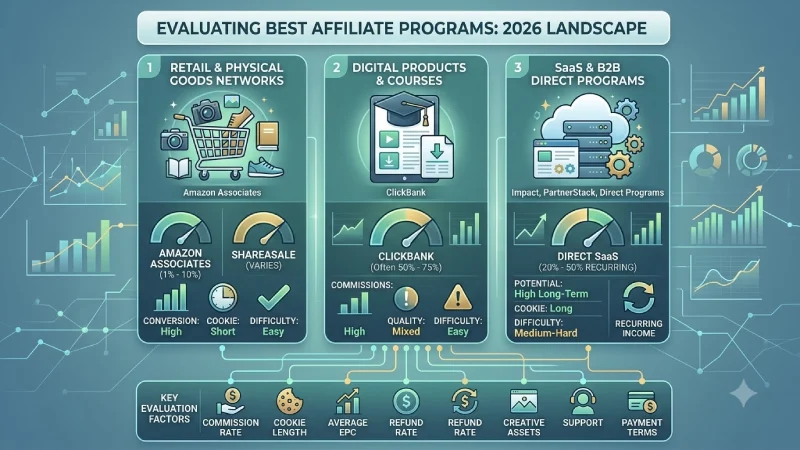
Not all affiliate programs are equal. Some are easy to join but pay little. Other professions pay well but are difficult to enter or to advance within.
Popular and reliable options in 2026
| Program / Network | Best For | Typical Commission | Difficulty to Join | Notes |
| Amazon Associates | Beginners, physical products | 1% – 10% (category based) | Easy | Trusted brand, short cookie |
| ClickBank | Digital products, courses | Often 50% – 75% | Easy | High commissions, mixed quality |
| ShareASale | Wide variety of merchants | Varies | Easy–Medium | Good for many niches |
| Impact | Bigger brands and SaaS | Varies | Medium | Professional platform |
| CJ Affiliate | Established brands | Varies | Medium | Long-standing network |
| Direct SaaS programs | Software tools | 20% – 50% recurring | Medium–Hard | Best long-term potential |
| PartnerStack / similar | B2B SaaS | Recurring | Medium–Hard | Strong for software affiliates |
If you want a deeper look at specific programs, we have dedicated guides on the Amazon Associates program and ClickBank affiliate marketing. This includes details on commissions, joining procedure, selection of products, and tips for each platform.
Choosing the best affiliate programs is one of the key decisions you will have to make. It may sound very appealing to go for affiliate programs offering high commissions, but it is just one of the many factors to consider. You can earn less from a high paying program compared to one offering lower commissions.
How to evaluate an affiliate program
Here are the main things worth checking before you spend time promoting an offer:
| Factor | What to Look For | Why It Matters |
| Commission rate | Percentage or fixed amount | Directly affects how much you earn per sale |
| Cookie length | How long the tracking lasts after a click | Longer cookies give more chance to convert |
| Average EPC | Earnings per click (if the network shows it) | Helps you compare real performance |
| Refund / chargeback rate | How often customers ask for refunds | High refunds reduce your real earnings |
| Creative assets | Banners, email swipes, landing pages, product images | Makes promotion easier and faster |
| Support | How responsive the affiliate manager is | Helpful when you have questions or problems |
| Payment terms | Payment threshold, frequency, and methods | Affects your cash flow |
It is not necessary for you to have excellent results in all segments. However, you do require an appropriate package that will match both your audience and traffic source.
Affiliate networks vs direct programs
There are two major methods for joining affiliate programs:
- Affiliate Networks (ShareASale, CJ Affiliate, Impact, etc.)
In these networks, you will have numerous merchants hosted under the same roof. Once you register in the network, you can join individual programs in it.
Pros of networks:
- Many offers in one dashboard
- Easier tracking and payment in many cases
- Good for testing different products
Cons of networks:
- Commission rates can be lower than direct deals
- Some networks take a cut
- Approval and support quality varies by merchant
- Direct Affiliate Programs
You join the company’s own affiliate program (for example, many SaaS tools or course creators run their own).
Pros of direct programs:
- Often higher commissions
- Sometimes better creative support and closer relationships
- Recurring commissions are more common
Cons of direct programs:
- You have to manage multiple logins and payment systems
- Tracking and reporting can be less consistent
- Some programs are harder to get approved for
Many experienced affiliates use a mix of both. Networks are useful for discovery and variety. Direct programs are often better for long-term, higher-value relationships.
High-ticket vs Low-ticket vs Recurring offers
Not every offer is equal when it comes to effort and earnings.
| Offer Type | Typical Price Range | Commission Style | Pros | Cons | Best For |
| Low-ticket | Under $50 | Percentage or small fixed | Easier to sell, faster conversions | Need higher volume | Beginners, content sites |
| High-ticket | $200 – $2000+ | High percentage or large fixed | Fewer sales needed for good income | Harder to sell, longer decision time | Email lists, trusted audiences |
| Recurring | Monthly/yearly tools | 20–50% of ongoing payments | Builds income over time | Customer can cancel | SaaS, memberships, software |
Low-ticket offers are usually easier for beginners because the buying decision is lighter.
High-ticket offers can produce bigger commissions but need more trust and stronger content.
Recurring offers are often the most attractive long-term because one sale can pay you for many months.
An excellent way of doing things for many people would be to begin by offering low-ticket or medium ticket items in order to build up sales and confidence and later on offer more high-ticket programs.
Should you join many programs or focus on a few?
Initially, it would be a good idea to limit oneself to a few programs (2-4) and sell them properly. It’s difficult to develop high-quality content and see what really works when one has to work with several offers at a time.
As soon as one has traffic and understands one’s audience, new programs can be introduced gradually. The objective is not to make a long list of links to the affiliate programs. The objective is to promote offers that bring money to one’s wallet.
Key takeaway
An affiliate program that has a higher commission percentage is not necessarily the best affiliate program. It is the program that has a good pay scheme, good tracking, good conversion rate, and is relevant to your market. Take time to evaluate programs properly. Promoting fewer, better offers almost always beats promoting everything that accepts you.
How to choose programs
- Look at the commission rate and cookie length
- Check whether the product is something your audience actually wants
- See if the program provides good creatives and support
- Read the terms so you understand what is allowed
- Start with 1–3 programs instead of joining everything
Many successful affiliates use Amazon for easy product coverage and combine it with higher-paying digital or SaaS programs for better earnings per sale.
Affiliate Marketing Niches
Your niche market is one of the most crucial decisions you will have to make. This decision will determine the content you produce, the products you will recommend and your ability to get noticed.
What makes a good niche
- People already spend money in that area
- You can create content about it consistently
- There are affiliate products available
- Competition is not so extreme that a new site has no chance
Niche examples by difficulty and potential
| Niche Type | Competition | Income Potential | Beginner Friendly? | Example Topics |
| Making money online | High | High | Medium | Side hustles, tools, courses |
| Health & fitness | High | High | Medium | Supplements, equipment, programs |
| Personal finance | High | High | Medium | Budgeting, investing, banking |
| Personal development | Medium–High | Medium–High | Yes | Productivity, habits, courses |
| Home & kitchen | Medium | Medium | Yes | Appliances, organizers, gadgets |
| Pet products | Medium | Medium | Yes | Food, toys, accessories |
| Outdoor / camping | Medium | Medium | Yes | Gear, clothing, tools |
| Specific hobbies | Low–Medium | Medium | Yes | Photography, gardening, crafts |
New to affiliate marketing? Begin your journey with our beginner guide on how to select your first niche, create your first site, and make your first sale.
One of the first big decisions that you’ll make is to choose a niche. If you choose well, your content will be easy to produce, and it will be easy to market your product. If not, you could find yourself without any motivation.
How to validate a niche before fully committing
But before you start creating an entire website or writing multiple articles, perform some validation testing to see if:
- There is demand for the products within this niche.
- Is there an affiliate program for the products you wish to promote.
- Are there any blogs, YouTube channels, or social media accounts within the niche.(This shows demand.)
- Can you find keywords related to problems, reviews, and comparisons?
- Can you imagine creating content about this topic for at least 6–12 months?
You do not need perfect answers. You just want enough evidence that real people spend money and look for recommendations in that area.
Evergreen niches vs trend-based niches
| Type | Description | Pros | Cons | Best For |
| Evergreen | Topics people care about year after year | More stable long-term traffic | Can be more competitive | Most beginners |
| Trend-based | Topics that rise quickly because of new interest | Faster early traffic possible | Demand can drop suddenly | Experienced promoters |
Topics like fitness, money management, productivity, pet care, home renovation, etc., which never become obsolete, are less risky for newbies to begin with. Trend niches can be successful as well but are more risky and fast paced.
Passion vs profitability
People advise you to “follow your passion” or “just go for where there is money.” The more realistic way would be to balance both.
When you pick a niche purely for the sake of earning money but do not have any interest at all, you are not going to manage to produce quality content consistently. When you pick up something that you really like but it does not cost anything to others, you won’t be able to make money out of it.
Why micro-niches are often better for beginners
“Health” and “Making money online” are some examples of broader niches. On the other hand, micro-niches are narrower forms of broader niches. They tend to be more rankable and are easier to dominate.
Examples of micro-niches under popular broad niches
| Broad Niche | Micro-Niche Examples |
| Health & Fitness | Home workouts for beginners, knee-friendly exercises, desk-worker mobility |
| Personal Finance | Budgeting for freelancers, saving for first home, debt payoff for beginners |
| Making Money Online | Affiliate marketing for beginners, freelancing with writing, print-on-demand |
| Home & Kitchen | Small kitchen organization, air fryer recipes, apartment-friendly storage |
| Pet Care | Senior dog health, indoor cat enrichment, puppy training basics |
| Productivity | Focus tools for ADHD, simple morning routines, note-taking systems |
By having a micro-niche, you can easily become an authority in this specific niche. Once you have spent a while doing this, you can expand to other areas of expertise as you gain traffic and experience.
Being focused on your niche helps you to easily create content and select products, in addition to gaining credibility among your audience. Sometimes, focusing on clarity is much more important than being big from the beginning.
Country and market differences
Country affects demand and competition. For example:
- Finance-related content, health content, and money-making content are highly competitive and profitable in the USA and UK.
- Low-cost technology, education, and mobile-first content can work well in India and Southeast Asia.
- Europe is another place where the audience’s interest in privacy and payment habits make a difference in converting offers.
- Some places may be dominated by mobile traffic, so offers should work in mobile format.
You don’t have to invent something new. You need a niche that you can stick to.
Affiliate Marketing Tools and Platforms
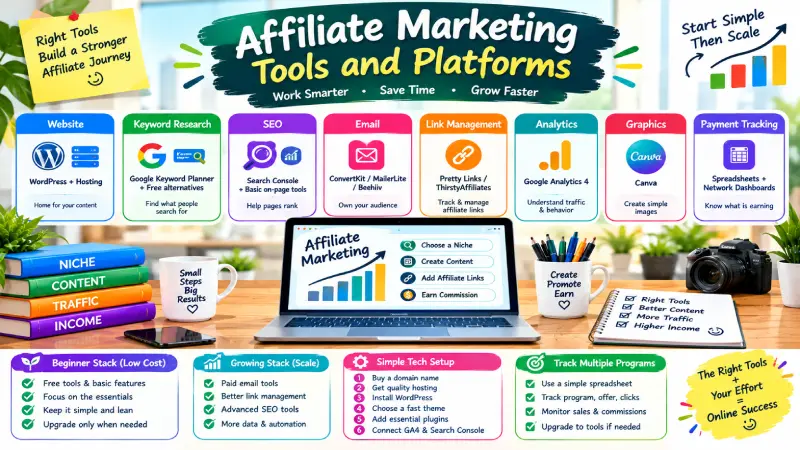
It is not necessary to have many tools from the outset. A small, reliable stack is better.
Essential tools most affiliates use
| Category | Tool Examples | Purpose |
| Website | WordPress + hosting | Home for your content |
| Keyword research | Google Keyword Planner, free alternatives | Find what people search for |
| SEO | Basic on-page tools, Search Console | Help pages rank |
| ConvertKit, MailerLite, Beehiiv | Own your audience | |
| Link management | Pretty Links, ThirstyAffiliates, or simple redirects | Track and manage affiliate links |
| Analytics | Google Analytics 4 | Understand traffic and behavior |
| Graphics | Canva | Create simple images |
| Payment tracking | Spreadsheets or the network dashboards | Know what is earning |
When to add more tools
- Add an email tool once you start getting regular traffic
- Add better tracking when you have multiple offers
- Add paid SEO or content tools only when free options are no longer enough
Many individuals end up spending their money on tools they don’t necessarily require yet. Begin with a basic tool and upgrade later on if there is a limitation that becomes apparent.
There are no reasons for a beginner to have too many tools in his/her arsenal. On the contrary, too many tools will slow a person down and make the process more expensive.
Free vs paid tools
Initially, it is best to stick to free tools. It is possible to construct a website, find keywords, monitor traffic, and conduct linking with little cost. Paid tools come in handy later on when increased speed and performance are required.
What is worth paying for at different stages
- Early stage: Focus on good hosting and a clean theme. Most other tools can stay free.
- Growing stage: Consider paid email tools, better link management, or simple SEO tools once free options start limiting you.
- Scaling stage: Invest in tools that save clear time or give better data across multiple offers.
Beginner stack vs Growing affiliate stack
| Need | Beginner Stack (Low Cost) | Growing Stack (When You Scale) |
| Website | WordPress + reliable hosting + free theme | Same + premium theme or page builder |
| Keyword research | Google Keyword Planner, free tools | Paid SEO tool if needed |
| Link management | Pretty Links (free version) or simple redirects | Premium link manager |
| Free plan of MailerLite or similar | Paid email tool with better automation | |
| Analytics | Google Analytics 4 | GA4 + clearer reporting |
| Graphics | Canva free | Canva Pro if you need more features |
| Commission tracking | Spreadsheets + network dashboards | Spreadsheets or simple tracking system |
Simple tech setup for a new affiliate site
- Buy a domain name.
- Get quality hosting (speed and reliability matter more than fancy features).
- Install WordPress.
- Choose a fast, clean theme.
- Install necessary plug-ins (security, performance, SEO basics, and link building).
- Support Google Analytics and Search Console.
Keep the site light. Too many plugins can slow it down and create problems.
Tracking commissions across multiple programs
While you have promotions from various networks, it becomes difficult to know which one is earning for you. It may not be necessary to go for any advanced tool because a simple spreadsheet with details such as program, offer, clicks, sales and commission can be sufficient in the beginning.
What works well is the tool set up which is going to work for you. Start small and once you have got the basics right, you can consider using other tools as and when the need arises.
Affiliate Content and Promotion Strategies
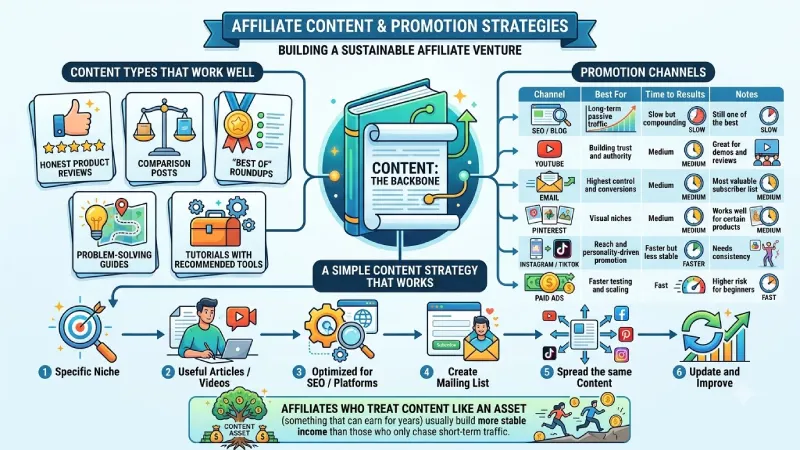
Content is still the backbone of most sustainable affiliate ventures. Promotions are what you do to showcase the content to the right people.
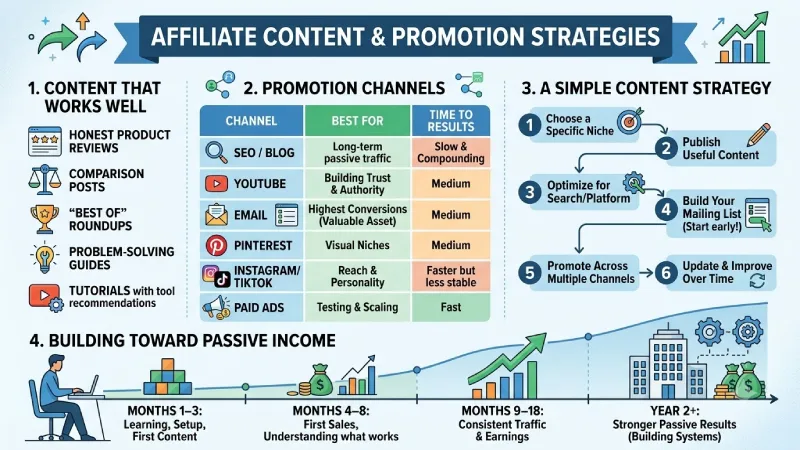
Content types that work well
- Honest product reviews
- Comparison posts
- “Best of” roundups
- Problem-solving guides that mention products naturally
- Tutorials that include recommended tools
Promotion channels
| Channel | Best For | Time to Results | Notes |
| SEO / Blog | Long-term passive traffic | Slow but compounding | Still one of the best |
| YouTube | Building trust and authority | Medium | Great for demos and reviews |
| Highest control and conversions | Medium | Most valuable long-term asset | |
| Visual niches | Medium | Works well for certain products | |
| Instagram / TikTok | Reach and personality-driven promotion | Faster but less stable | Needs consistency |
| Paid ads | Faster testing and scaling | Fast | Higher risk for beginners |
A simple content strategy that works
- Go for a specific niche.
- Write just a few useful articles or videos.
- Make sure your content is optimized for search engines or for your chosen platform.
- Create your mailing list at the very start.
- Spread the same piece of content through various channels.
- Update and improve your best content over time.
The affiliates who treat content like an asset (something that can earn for years) usually build more stable income than those who only chase short-term traffic.
Building Toward Passive Income
True passive income in affiliate marketing is rare at the beginning. Most people trade time for money in the early stages. The passive part comes later when:
- Your content ranks and keeps bringing traffic
- Your email list continues to convert
- You have systems for updating and promoting content without daily hustle
Realistic timeline many people experience
- Months 1–3: Learning, setting up, publishing first content
- Months 4–8: First sales, understanding what works
- Months 9–18: More consistent traffic and earnings
- Year 2+: Stronger passive results if the foundation is solid
Growth seldom happens in a linear fashion. There tend to be periods of calm followed by spurts where content begins to rank and where email lists become alive.
Common Mistakes That Keep People Stuck
- Choosing a niche only for money and then losing motivation
- Promoting too many products without depth
- Creating thin content that does not help anyone
- Ignoring disclosures and program rules
- Expecting fast results and quitting early
- Never building an email list
- Jumping between strategies too often
Not making these errors will give you an edge over many novices.
Final Thoughts
Affiliate marketing will remain one of the simplest ways of doing businesses on the Internet even in 2026. Affiliate marketing does not need a huge amount of money and technical expertise. But what you need is being clear-headed, consistent and patient.
You have to study the principles of this marketing model, select the best programs and niche, use the minimum number of tools and create quality content which will help users to make more informed purchase decisions. Then promote this content consistently and improve it according to your results.
Passive income will become a result of asset building – creating high-quality content, building traffic and developing the audience which trust you. Take this type of marketing as a skill and not a side hustle, and everything will become easier.
It all starts from the basics and grows consistently.
| Cluster | Should you add full content to pillar? | What to do instead |
| Amazon Affiliate Program | No | Add a short mention + link in “Best Programs” |
| ClickBank Affiliate Marketing | No | Add a short mention + link in “Best Programs” |
| Affiliate Marketing for Beginners | No | Add a short mention in “Niches” or near the start |
| Affiliate Marketing on Instagram | No | Add a short mention in “Content & Promotion” |
| SEO for Affiliate Sites | No | Add a short mention in “Content & Promotion” |
| Affiliate Marketing Legal & Disclosures | No | Add a short paragraph near the end |
Frequently Asked Questions
- How much can you realistically earn with affiliate marketing?
Earnings vary widely. Some people make a few hundred dollars a month. Others build full-time incomes. Results depend on niche, traffic, offer quality, and consistency. - Is affiliate marketing still worth it in 2026?
Yes. The fundamentals still work. Competition is higher in popular niches, but useful content and smart program selection continue to produce results. - Do I need a website to start?
A website gives you more control and long-term value, but you can also start with YouTube, social media, or email. Many successful affiliates use a combination. - How long does it take to make the first sale?
Some people make a sale relatively quickly. Most need several weeks to a few months of consistent effort. The first sale is usually the hardest. - What is the best way to start as a complete beginner?
Choose a niche you can stick with, set up a simple site or platform, join one or two beginner-friendly programs, create useful content, and learn one traffic source well.
Conclusion
Affiliate marketing can be discussed extensively as an Internet-based means of making money, and it is certainly true that passivity is among its best qualities. The principle behind affiliate marketing is simple – guide individuals to products that solve their problems and earn commission once a sale is made. It involves finding the right niche, the right programs, producing traffic-worthy content, and consistency.
Stick to the basics, don’t fall prey to the easy solutions that will only cost you time, and treat it as a craft that needs time to develop. This method will still be the most dependable strategy for succeeding in affiliate marketing in 2026.