

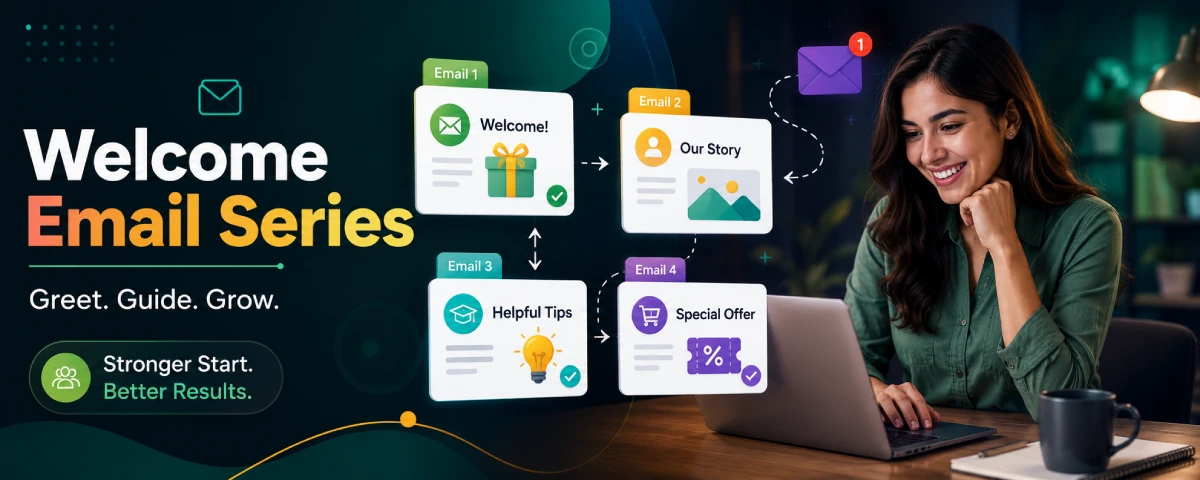
Welcome email series is one of the best performing automated emails to send out. Subscribers tend to be more interested and engaged immediately after they opt in to your mailing list. An effective welcome series capitalizes on that interest to create value, build trust, and convert them into taking an initial action.
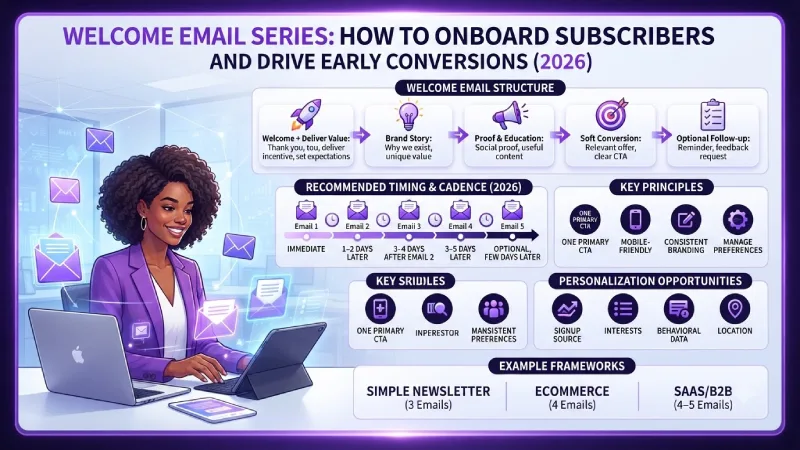
A lot of e-mail marketers continue to send just one “thank you for subscribing” message to the subscribers’ inbox. This is a lost opportunity. An organized mini-series will perform far better.
This guide will help you learn about creating an email sequence, the number of emails that should be in your sequence, timing, personalization, and examples for you to customize and use.
For the overarching strategy, read our complete guide on Email Marketing
Welcome Email Structure
All the emails in this process need to have an intended purpose. Having one purpose for every email will make the process meaningful rather than repetitive.
Core jobs a welcome series can handle
- Confirm the subscription and deliver any promised incentive
- Introduce the brand and set expectations
- Share useful content or education
- Provide social proof
- Encourage a first conversion or next step
A simple and effective structure
| Main Purpose | What to Include | |
| 1 | Welcome + deliver value | Thank you, deliver lead magnet or offer, set expectations |
| 2 | Brand story or key value | Why you exist, what makes you different, useful insight |
| 3 | Proof or education | Customer stories, popular content, how-to value |
| 4 | Soft conversion or next step | Relevant offer, product highlight, or clear CTA |
| 5 | Optional follow-up | Reminder, additional resource, or feedback request |
You don’t necessarily require five emails. This format can be extended or reduced based on the length of your sales process and target audience.
Key principles for every email
- One primary call-to-action
- Clear and scannable layout
- Mobile-friendly design
- Consistent branding
- Easy way to manage preferences or unsubscribe
Your first email will be your most opened email ever. Make sure that it provides immediate value.
Number of Emails in a Welcome Series
For most brands, 3 to 5 emails prove highly effective. Such an interval is long enough to create awareness but not too long to bore the customer.
Guidelines by situation
- Simple newsletter or content-focused list: 2–3 emails often work well.
- Ecommerce: 3–5 emails is common, especially when an offer or product discovery is involved.
- SaaS or higher-consideration products: 4–6 emails can help with onboarding and education.
- Short sales cycle: Fewer emails with a faster pace.
- Longer consideration period: Slightly longer series with more educational value.
What happens with too few or too many
- One email rarely builds enough trust or context.
- Too many emails in the sequence (7+) may be too much for the audience if they’re not highly pertinent to the content.
- There’s no better length than the amount of time it normally takes a newly subscribed lead to do something significant.
Use 3 or 4 emails initially. Reassess your performance after a few weeks and change things accordingly. It is simpler to add another email later on which could be of use than reversing the effects of too many emails.
Timing and Cadence
Timing has a big impact on engagement.
Recommended timing approach
| Suggested Timing | Reason | |
| 1 | Immediately (or within a few minutes) | Highest attention right after signup |
| 2 | 1–2 days later | Stays top of mind without feeling pushy |
| 3 | 3–4 days after Email 2 | Gives space while maintaining momentum |
| 4 | 3–5 days later | Allows time for earlier emails to work |
| 5 | Optional, a few days after Email 4 | Final value or gentle conversion push |
Practical timing tips
- Send the first e-mail as soon as you confirm.
- Schedule the e-mails on different days if possible to avoid sending many on the same day without reason.
- Take into account what type of audience you have (B2B/ConsumerWatch engagement data. If opens drop sharply after a certain email, the gap or content may need adjustment.
- Other systems use behavioral triggers (such as waiting until the recipient opens the previous message before sending the next email). Use these when they improve relevance.
The goal is to stay present while the subscriber still remembers why they joined, without becoming annoying.
Personalization in Welcome Emails
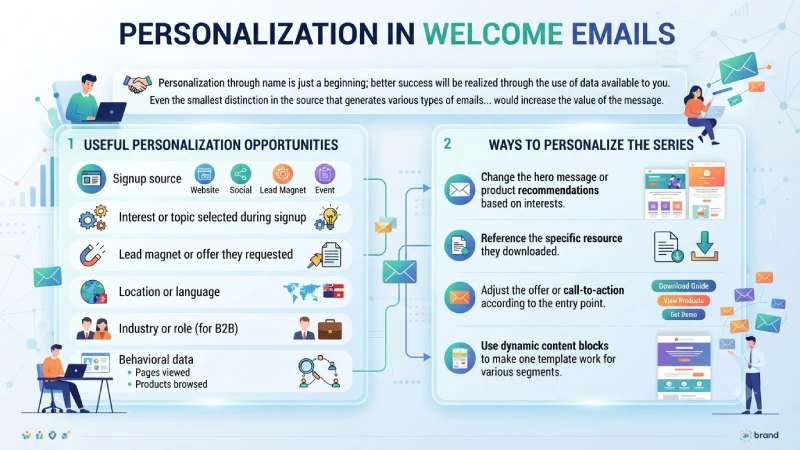
Personalization through name is just a beginning; better success will be realized through the use of data available to you.
Useful personalization opportunities
- Signup source (website, social, lead magnet, event)
- Interest or topic selected during signup
- Lead magnet or offer they requested
- Location or language
- Industry or role (for B2B)
- Behavioral data if available early (pages viewed, products browsed)
Ways to personalize the series
- Change the hero message or product recommendations based on interests.
- Reference the specific resource they downloaded.
- Adjust the offer or call-to-action according to the entry point.
- Use dynamic content blocks to make one template work for various segments.Even the smallest distinction in the source that generates various types of emails (for example, contacting the individual using one particular guide instead of just signing up for the newsletter) would increase the value of the message.
One should not forget the significance of having the default option for the individuals who do not have extra data.
Welcome Email Examples
Here are practical example frameworks you can adapt.
Example 1: Simple 3-Email Content / Newsletter Series
- Email 1 (Immediately): Greeting + delivery of promised content + expectations of what emails they would be getting.
- Email 2 (After 2 days): Send them your best work of content and explain the importance of it.
- Email 3 (After 5 days): Send them an interesting story from the background of your brand or company and get them to perform a simple action such as responding.
Example 2: Ecommerce 4-Email Series
- Email 1 (Immediate): Welcome + deliver discount or gift + show a few bestsellers.
- Email 2 (Day 1–2): Brand story or “why we exist” + social proof.
- Email 3 (Day 4): Product education or “how to choose” content.
- Email 4 (Day 7): Reminder of the offer or a gentle conversion-focused message.
Example 3: SaaS / B2B 4–5 Email Series
- Email 1: Welcome + deliver lead magnet + quick start tip.
- Email 2: Core problem you solve + short case study or result.
- Email 3: Educational content that demonstrates expertise.
- Email 4: Customer story or social proof.
- Email 5: Clear next step (book a demo, start trial, or reply with questions).
These are starting points. The best series reflects your specific offer, audience, and the action you most want new subscribers to take.
Building a Welcome Series That Works
A strong welcome email series in 2026 usually includes:
- An immediate first email that delivers value
- A short sequence of 3–5 emails with clear individual purposes
- Sensible spacing between messages
- Personalization based on available data
- A definite approach towards achieving a conversion or even more engagement
- Consistent checking of open rate, click rate, and conversion rate
Welcome series is usually the highest revenue generation automation per email sent. This will set the tone for the entire relationship. If your new subscribers feel welcomed, informed and respected, then they will be more inclined to continue and become customers.
Begin with a basic three-email series if you don’t have one already. Make sure that your first email comes out immediately and fulfills the promise made. Then you can build on the series using actual performance metrics.
With a great welcome series, casual subscribers become your brand ambassadors who love, trust and respect you, and then there is nothing to prevent you from achieving success using email marketing.
Frequently Asked Questions
How Many Emails Should There Be in a Welcome Series?
The majority of companies get good results with between 3 and 5 emails in their welcome series. This is where you can start.
When should the first welcome email be sent?
As quickly as possible after signup — ideally within a few minutes. Immediate delivery captures attention while interest is highest.
Should every welcome email include an offer?
Not necessarily. The first email should deliver promised value. Later emails can introduce offers when it feels natural and relevant.
How long should the entire welcome series last?
Typically 7 to 14 days for most businesses. Longer consideration cycles may justify a slightly extended sequence.
What is the most important email in the series?
First impression: The first one. It will have the highest open rates and establish expectations for all the following emails. Be clear and valuable.
To take the next step, see our detailed guide on Abandoned Cart Emails.