

Introduction
Businesses are changing the way they manage daily operations. In the past, companies relied heavily on manual labor and documentation where workers performed repetitive processes manually. In the present times, the use of AI and automation has enabled them to process things quickly and more effectively.

This shift is becoming an important part of digital transformation strategies.
AI and automation in business do not only help large companies. Automations mean the applications of software used in small businesses, start-ups, online stores, health care firms, banks, and other service providers.
Simply put, automation is all about process management, while artificial intelligence gives the machines learning capabilities and helps in decision making.
In 2026, businesses are using AI and automation for:
- Customer support
- Marketing automation
- Invoice generation
- Inventory management
- Fraud detection
- Business analytics
- Employee management
- Scheduling systems
- Data analysis
- Workflow automation
The AI-driven technology is employed by companies for enhancing customer satisfaction levels, reducing expenses, and achieving fast growth in business.
Many modern businesses now depend on:
- AI chatbots
- Automated email systems
- Predictive analytics
- Recommendation engines
- Smart reporting systems
- AI-powered customer insights
- Workflow automation platforms
AI requires proper preparation in order to achieve its full potential. Do not focus only on the technical aspects. Businesses have to take into account employee training, cybersecurity, workflow improvement, and automation.
This paper introduces the concepts of AI and automation in business in simple words. The following topics will be discussed: business automation, AI tools, applications of machine learning, RPA, AI-driven decision-making systems, advantages and disadvantages, comparison, industry trends, etc.
How AI and Automation Support Digital Transformation Strategies

AI and automation are related to digital transformation strategies in that many businesses employ automation technologies in their efforts to upgrade their operational processes, enhance customer engagement, and reduce mundane tasks.
Digital transformation doesn’t only involve software acquisition or going digital. Digital transformation also involves improving business processes through the use of technology.
AI and automation help businesses:
- Improve workflow efficiency
- Reduce operational delays
- Analyze business data faster
- Improve customer support
- Increase productivity
- Automate repetitive work
- Improve decision-making
Many companies combine:
- cloud computing
- automation platforms
- business analytics
- customer management software
- AI-powered tools
to create more efficient digital operations.
As businesses become more modernized, the integration of AI and automation in business processes becomes inevitable.
What is Artificial Intelligence in Business?
Artificial intelligence in business can be defined as computer-based systems which are capable of analyzing, understanding, learning, and decision making from information.
From the IBM Artificial Intelligence guide, artificial intelligence allows computers to perform human activities such as learning, reasoning, and problem solving.
AI systems assist businesses in performing operations that would require human analysis.
Examples include:
- Customer support chatbots
- Recommendation systems
- Fraud detection
- Predictive analytics
- Voice assistants
- Automated reporting
- Personalized marketing
AI systems are capable of handling a great deal of information at speeds much higher than any human could.
For example:
In an ecommerce firm, AI systems can make product suggestions based on customer activities and previous purchases.
A financial company may use AI systems to detect suspicious transactions automatically.
AI does not completely replace employees. AI enables employees in many firms to perform their activities more efficiently and reduces tedious activities that would have taken much of their time.
What is Business Automation?
In business automation, the machine performs recurring tasks without humans.
Automation saves time and ensures consistency in operations.
Businesses automate many daily activities such as:
- Invoice generation
- Attendance tracking
- Customer support replies
- Appointment scheduling
- Email marketing
- Inventory updates
- Report creation
- Payroll processing
Automation systems usually follow predefined workflows and instructions.
For example:
When a customer places an order online, automation software may:
- generate the invoice
- update inventory
- send confirmation emails
- notify delivery teams
without requiring manual processing.
Difference Between AI and Automation
Although AI and automation are connected, they are not exactly the same.
| Feature | Automation | Artificial Intelligence |
| Main Purpose | Repetitive task handling | Smart analysis and decision support |
| Learning Ability | No | Yes |
| Data Analysis | Limited | Advanced |
| Workflow Type | Rule-based | Data-driven |
| Flexibility | Lower | Higher |
| Examples | Email automation | AI chatbots |
| Human-like Decisions | No | Sometimes |
Automation performs recurring tasks whereas AI performs analysis and prediction.
Why Businesses Are Adopting AI and Automation
Companies are turning to AI and automation due to the requirement of rapid response.
Customers now expect:
- Faster responses
- Better online support
- Personalized experiences
- Faster delivery
- Better communication
- Real-time updates
Traditional manual systems often create delays and inefficiencies.
Businesses also face pressure from:
- rising operational costs
- increased competition
- remote work management
- growing customer expectations
- large amounts of business data
AI and automation help businesses improve efficiency while reducing repetitive manual work.
Main reasons businesses adopt automation include:
- faster operations
- lower administrative workload
- improved productivity
- reduced human errors
- better customer experience
- improved reporting
- scalability
Benefits of AI and Automation in Business
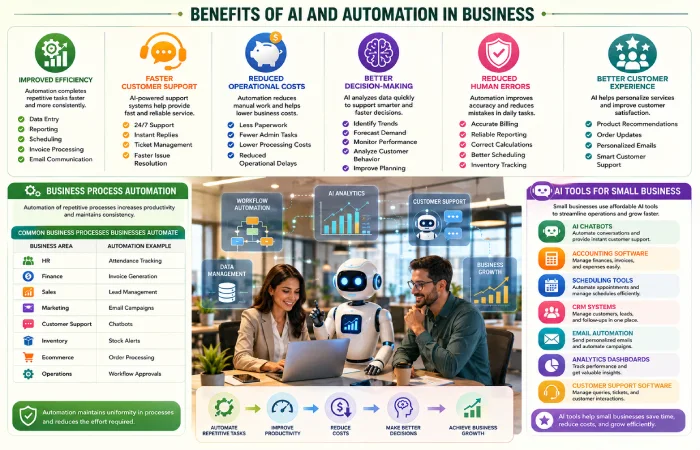
Improved Efficiency
One of the biggest advantages of automation is operational efficiency.
Businesses spend less time on repetitive activities such as:
- data entry
- reporting
- scheduling
- invoice processing
- email communication
Automation systems complete tasks faster and more consistently.
Faster Customer Support
AI chatbots and support systems can be of great help in such cases.
Businesses can provide:
- 24/7 support
- instant replies
- automated ticket management
- faster issue resolution
This improves customer satisfaction.
Reduced Operational Costs
Automation reduces the effort of doing routine work.
Businesses may reduce costs related to:
- paperwork
- repetitive administrative tasks
- manual processing
- operational delays
Automation also helps employees focus on higher-value work.
Better Decision-Making
AI systems help businesses analyze large amounts of information quickly.
Businesses use AI to:
- identify trends
- forecast demand
- monitor performance
- analyze customer behavior
- improve planning
Better data analysis supports smarter business decisions.
Reduced Human Errors
Manual processes often create mistakes.
Automation systems improve consistency in:
- billing
- reporting
- calculations
- scheduling
- inventory tracking
This reduces operational risks.
Better Customer Experience
AI systems help businesses personalize services and communication.
Examples include:
- product recommendations
- automated order updates
- personalized marketing emails
- smart customer support
Enhancing the experience of a customer usually increases trust and retention of the customer.
Business Process Automation
Business process automation is the improvement of processes using automation.
Automation of repetitive processes in the company leads to increased productivity.
Common Business Processes Businesses Automate
| Business Area | Automation Example |
| HR | Attendance tracking |
| Finance | Invoice generation |
| Sales | Lead management |
| Marketing | Email campaigns |
| Customer Support | Chatbots |
| Inventory | Stock alerts |
| Ecommerce | Order processing |
| Operations | Workflow approvals |
Automation maintains uniformity in processes and reduces the effort required.
AI Tools for Small Business
Small businesses are increasingly using affordable AI tools to improve operations.
Many small companies use:
- AI chatbots
- accounting software
- scheduling tools
- CRM systems
- email automation platforms
- analytics dashboards
- customer support software
Small enterprises usually resort to practical means of assistance that do not involve significant expenses but help with daily business activity.
How Small Businesses Use AI Differently
Simple automation techniques are applied by small firms compared to large corporations.
Examples include:
- WhatsApp automation
- online booking systems
- inventory alerts
- digital billing
- social media scheduling
- customer communication automation
Small organizations always strive for practicality, economy, and improved efficiency in their daily operations.
Machine Learning Use Cases in Business
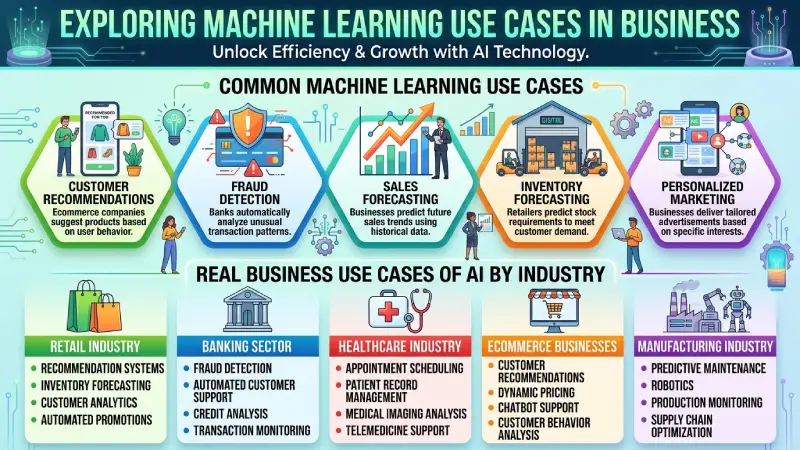
Machine learning is one of the branches of artificial intelligence technology.
Businesses use machine learning for many purposes.
Common Machine Learning Use Cases
Customer Recommendations
Ecommerce companies recommend products based on customer behavior.
Fraud Detection
Banks analyze unusual transaction patterns automatically.
Sales Forecasting
Businesses predict future sales trends using historical data.
Inventory Forecasting
Retailers predict stock requirements based on customer demand.
Personalized Marketing
Businesses show personalized advertisements based on customer interests.
Real Business Use Cases of AI
Retail Industry
Retail businesses use AI for:
- recommendation systems
- inventory forecasting
- customer analytics
- automated promotions
Banking Sector
Banks use AI for:
- fraud detection
- automated customer support
- credit analysis
- transaction monitoring
Healthcare Industry
Healthcare organizations use AI for:
- appointment scheduling
- patient record management
- medical imaging analysis
- telemedicine support
Ecommerce Businesses
Ecommerce companies use AI for:
- customer recommendations
- dynamic pricing
- chatbot support
- customer behavior analysis
Manufacturing Industry
Manufacturers use automation and AI for:
- predictive maintenance
- robotics
- production monitoring
- supply chain optimization
Robotic Process Automation (RPA)
Robotic Process Automation refers to robots or bots performing monotonous activities in offices.
RPA systems follow predefined rules to complete digital tasks automatically.
Common RPA Tasks
- Data entry
- Invoice processing
- Form handling
- Payroll processing
- Report generation
- Email sorting
- File transfers
RPA helps businesses reduce repetitive administrative work.
AI-Driven Decision Automation
Businesses now use AI systems to support automated decision-making.
The decision-making systems driven by AI analyze large volumes of data pertaining to businesses and give suggestions automatically.
Examples include:
- sales forecasting
- customer risk analysis
- inventory prediction
- marketing optimization
- fraud alerts
These systems help businesses make faster operational decisions.
AI vs Traditional Business Operations
| Traditional Operations | AI-Driven Operations |
| Manual reporting | Automated analytics |
| Human-only customer support | AI chat support |
| Manual scheduling | Automated scheduling |
| Delayed reporting | Real-time insights |
| Reactive decisions | Predictive analysis |
| Repetitive manual tasks | Workflow automation |
Industries Using AI and Automation the Most
| Industry | Common AI Usage |
| Retail | Recommendation systems |
| Banking | Fraud detection |
| Healthcare | Patient management |
| Manufacturing | Predictive maintenance |
| Ecommerce | Customer analytics |
| Logistics | Route optimization |
| Education | Personalized learning |
| Marketing | Automated campaigns |
How AI Improves Customer Experience
Customer experience has become very important for modern businesses.
AI helps businesses improve customer satisfaction through:
- faster responses
- personalized communication
- automated support
- recommendation systems
- order tracking updates
Businesses making use of artificial intelligence in their customer services can operate effectively and communicate better with the clients.
AI and Automation for Remote Work
Remote and hybrid work increased the importance of automation systems.
Businesses now use:
- cloud collaboration tools
- workflow automation
- AI scheduling assistants
- digital communication systems
- project management platforms
Such applications help employees be more productive regardless of where they are.
Challenges of AI and Automation
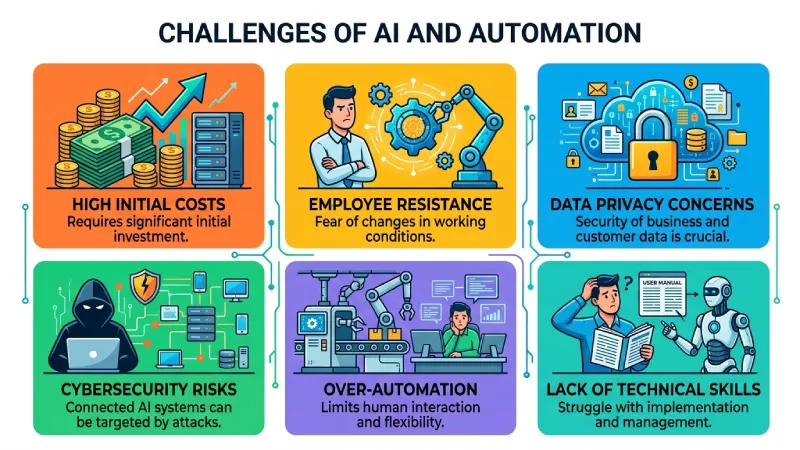
However, there are certain issues associated with the use of artificial intelligence.
High Initial Costs
Some advanced AI systems require significant investment.
Employee Resistance
Employees may fear any changes in their working conditions.
Data Privacy Concerns
Security of business as well as customer data needs to be guaranteed.
Cybersecurity Risks
Connected AI systems can be targeted by cyber-attacks.
Over-Automation
Automation might limit human interaction and flexibility.
Lack of Technical Skills
Some companies will struggle with implementation and management of the system.
Common Mistakes Businesses Make
Automating Poor Workflows
Automation cannot fix inefficient business processes.
Buying Expensive Systems Too Early
Businesses sometimes purchase advanced tools they do not actually need.
Ignoring Employee Training
Employees must understand how automation systems work.
Poor Security Planning
Weak cybersecurity creates major operational risks.
Depending Entirely on AI
Businesses still need human oversight and decision-making.
Cybersecurity and AI Systems
Businesses using AI systems should focus heavily on cybersecurity.
Important practices include:
- strong passwords
- multi-factor authentication
- regular software updates
- employee training
- backup systems
- access management
Cybersecurity should become part of every automation strategy.
Ethical Concerns Around AI in Business
Businesses should use AI responsibly.
Some concerns include:
- employee monitoring
- customer privacy
- biased algorithms
- over-dependence on automation
Adopting AI responsibly usually entails the use of both automation and human supervision.
Future of AI and Automation in Business
There is rapid growth of AI and automation across all industries.
Future trends may include:
- smarter AI assistants
- advanced automation platforms
- predictive analytics
- autonomous workflows
- AI-powered customer support
- intelligent business analytics
- hyperautomation systems
AI-based operations are expected to play a greater role in businesses in the future.
Growth of AI and Automation in Recent Years
| Year | Major Trend |
| 2020 | Remote work automation growth |
| 2021 | Cloud-based AI expansion |
| 2022 | AI chatbot growth |
| 2023 | Workflow automation increase |
| 2024 | AI productivity tools expansion |
| 2025–2026 | Advanced business automation |
Country-Wise AI and Automation Trends
| Country | Major Focus |
| United States | Enterprise AI analytics |
| China | Smart manufacturing |
| Japan | Robotics and automation |
| Germany | Industrial automation |
| Singapore | Smart business systems |
| United Kingdom | Financial AI technologies |
How to Measure AI Automation Success
Businesses should monitor automation performance regularly.
Important indicators include:
- reduced operational costs
- faster customer support
- higher productivity
- fewer manual errors
- improved employee efficiency
- better customer satisfaction
Performance tracking helps businesses improve automation strategies over time.
Frequently Asked Questions (FAQs)
What is AI in business?
AI in business refers to those computer systems which are able to analyze information, spot patterns, and help to run the business operations.
What is business automation?
Automated business refers to the employment of technology in conducting repetitive tasks in an automatic manner.
Is there room for small businesses to adopt artificial intelligence?
Many small firms make use of affordable artificial intelligence for customer services, accounting, scheduling, and marketing purposes.
What is Robotic Process Automation?
Robotic Process Automation implies the utilization of specific software robots for automating regular office activities.
How does AI help with customer service?
This is made possible by using chatbots, automated customer support, personalization, and fast response rates.
What are the usual risks associated with the use of AI?
The usual risks refer to the cybersecurity risk, privacy issues, bad implementation, and too much automation.
Is automation replacing workers?
Automation usually helps to complete the routine tasks, but decisions are always made by people.
Conclusion
AI and automation are becoming more central to digital activities today. The use of automation technology and AI systems is intended to improve performance, reduce tedious work, deliver high-quality customer service, and facilitate decisions based on data.
Automation technology allows businesses at all levels of development to manage their operations in a more efficient way and to implement long-term digitalization strategies.
However, the proper use of AI technology requires a thorough approach, including such factors as cybersecurity, planning, and training of employees. It is crucial not to be fixated only on technological solutions.
Businesses which combine human competence with advanced AI and automation technology tend to reach efficiency and successful growth.