

Introduction
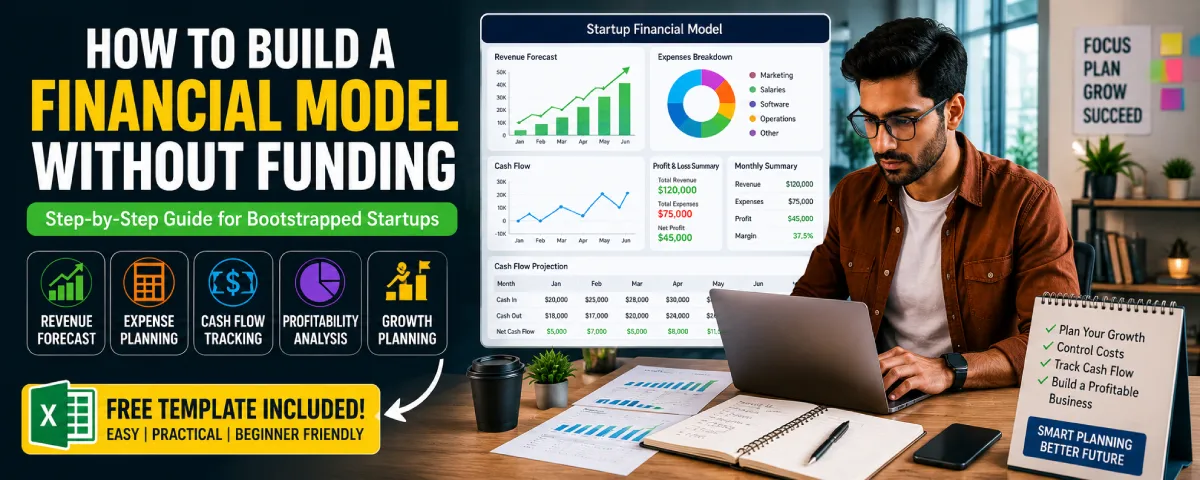
Building a financial model without outside funding may sound difficult at first, but most bootstrapped startups begin with very simple planning.
The creation of a financial model will help you as an entrepreneur make sense of how the movement of money could look like in your business in the future. For a detailed explanation of financial modeling concepts, see Investopedia’s guide. You can use the information gathered to gauge sales figures, costs, cash flows, and profitability before making any major business decisions.
Financial modeling becomes especially critical in the case of bootstrapped companies since there is no outside capital to cover any potential mistakes. This idea will form the basis of Startup Bootstrapped Financial Modeling.
As a rule, the funds used for financing your enterprise are those gained from personal savings, business earnings, and profits.
Fortunately, a business model of a startup doesn’t have to be complex. A simple spreadsheet can actually serve as one.
How to Build a Financial Model Without Funding
The first step in building a financial model is understanding why the business needs one in the first place.
For bootstrapped startups, a financial model is not mainly used to impress investors. It is mostly used to help founders make smarter business decisions with limited money and resources.
A basic financial model aids in gaining insight into the financial performance of the venture through time. It enables the founder to ascertain if the venture is overspending, making adequate sales, and handling its finances efficiently.
Many founders start financial planning after facing problems like:
- Running low on cash
- Increasing business expenses
- Slow customer growth
- Poor budgeting
- Unclear profit margins
A financial model helps reduce these problems by giving founders a clearer financial picture of the business.
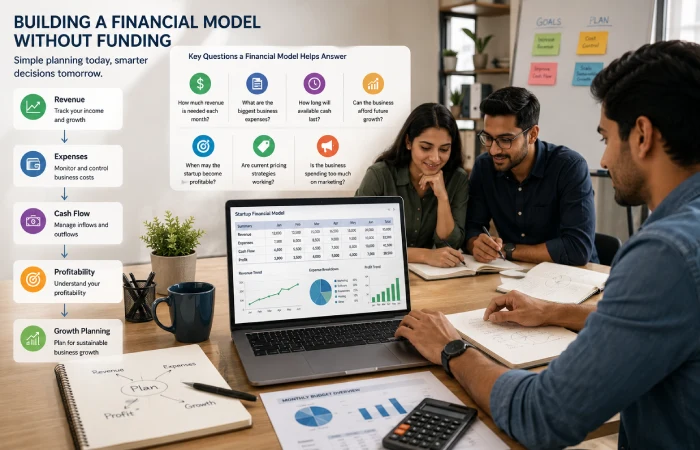
A startup financial model should help answer practical questions such as:
- How much revenue is needed each month?
- What are the biggest business expenses?
- How long will available cash last?
- Can the business afford future growth?
- When may the startup become profitable?
- Are current pricing strategies working?
- Is the business spending too much on marketing?
Rather than striving for perfect predictions, entrepreneurs must ensure that their predictions are accurate by relying on what information is available to them.
Many early-stage startups begin with simple financial planning rather than advanced forecasting.
Most beginner financial models include:
- Revenue estimates
- Expense tracking
- Cash flow planning
- Profit calculations
- Monthly growth targets
This type of simple planning is often enough during the early stages of building a startup.
Most successful startups have had very simple spreadsheets at the beginning of their business operations.
Why Simplicity Matters
Another common mistake that startups do is using spreadsheets that have complex formulas even at the early stages of the startup.
This causes a lot of problems and confusions.
Simple financial models are usually easier to:
- Update regularly
- Understand quickly
- Share with team members
- Adjust when business conditions change
The best method for most bootstrapped businesses is realistic planning rather than detailed forecasting.
Simple Startup Financial Flow
Revenue
↓
Expenses
↓
Cash Flow
↓
Profitability
↓
Growth Planning
This basic structure helps founders understand how money moves through the business step by step.
Simple Founder Example
A small online startup may earn revenue through product sales or freelance services.
At the same time, the business may spend money on:
- Marketing
- Website hosting
- Software tools
- Freelancers
- Payment processing fees
Without financial planning, expenses can increase faster than revenue.
A simple financial model helps founders estimate:
| Planning Area | Why It Matters |
| Revenue | Tracks business growth |
| Expenses | Helps control spending |
| Cash Flow | Prevents cash shortages |
| Profitability | Shows business stability |
| Growth Planning | Supports future expansion |
A simple spreadsheet would help founders make more informed decisions and reduce unnecessary financial stress as the company grows.
Bootstrapped Startup Budget Template
A startup budget template is really helpful for founders because it lets them put all their expected income and business expenses in one place. This makes it easier for them to see everything, at once. Founders can use a startup budget template to get an idea of where their money is going. The startup budget template helps founders keep track of their business expenses and expected income.
Simple Startup Budget Example
| Category | Monthly Estimate |
| Revenue | $5,000 |
| Marketing | $800 |
| Software Tools | $300 |
| Freelancers | $1,000 |
| Website & Hosting | $200 |
| Miscellaneous | $400 |
| Estimated Profit | $2,300 |
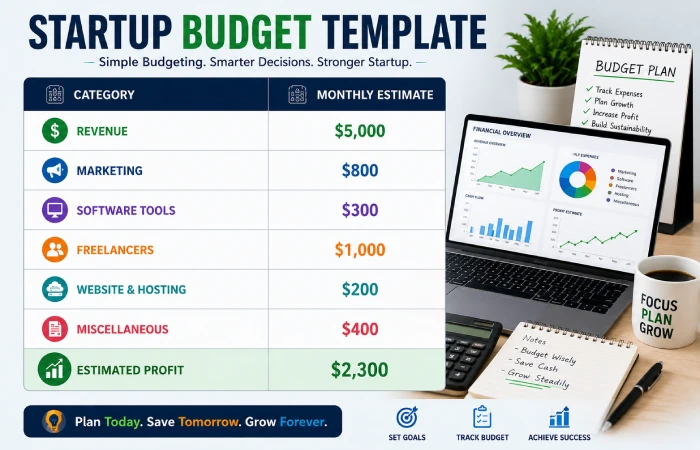
This startup budget template provides a simple overview of expected revenue, business expenses, and estimated profit. Founders can use a budgeting framework like this to monitor spending, improve cash flow management, and make better financial decisions as the business grows.
Such a simple budgeting tool would give founders an indication of the financial stability of their business.
Such a simple budgeting tool would give founders an indication of the financial stability of their business.
It is common practice among bootstrap startups to have their budget reviewed monthly.
Fixed vs Variable Expenses
| Fixed Expenses | Variable Expenses |
| Rent | Advertising |
| Internet Bills | Shipping Costs |
| Software Subscriptions | Sales Commissions |
| Insurance | Transaction Fees |
Knowing the difference between fixed costs and variable costs really helps people who start companies control the money they spend. This is because they can make choices about how to use the money they have. Fixed costs are things that always cost the same like rent for an office. Variable costs are things that can change, like the cost of making a product. When founders understand the difference, between fixed costs and variable costs they can make a plan to spend their money wisely.
Steps to Create a Startup Financial Model
Most startup financial models are built step by step.
Estimate Revenue
Start by estimating how much money the business may generate each month. Founders can improve forecast accuracy by learning more about Revenue Projections for Bootstrapped Startups.
This may include:
- Product sales
- Service revenue
- Subscription income
- Consulting revenue
Founders should use realistic assumptions instead of aggressive growth estimates.
List Business Expenses
The next step is estimating business costs.
Common startup expenses include:
- Marketing
- Software subscriptions
- Freelancers
- Internet and hosting
- Payment processing fees
- Office expenses
Cautious expense tracking leads to lower unnecessary expenditures. Founders often apply Expense Forecasting for Lean Startups strategies to cut costs and generate profits.
Track Cash Flow
Cash flow shows how money moves into and out of the business.
Many startups fail because they run out of cash, even if revenue is growing.
Cash Flow Example
| Cash Inflows | Cash Outflows |
| Customer Payments | Salaries |
| Product Sales | Marketing Costs |
| Subscription Revenue | Software Expenses |
| Service Income | Supplier Payments |
Effective cash flow management can help startups overcome hard times when their business is sluggish. A step-by-step manual on Cash Flow Modeling for Bootstrapped Startups will come in handy for founders.
Calculate Profitability
Profitability shows whether the business is earning more money than it spends.
Simple Formula:
Profit = Revenue – Expenses
This helps founders understand whether the business model is sustainable long term. Founders can also use Break-Even Analysis for Bootstrapped Startups to identify when revenue may cover all business expenses.
Plan Future Growth
With revenue, expenses, and cash flow understood, the founders can start planning their expansion.
Growth planning may include:
- Hiring employees
- Increasing marketing budgets
- Launching products
- Expanding services
- Investing in software
By planning financially, a startup can develop in a controlled manner without putting any unnecessary financial strain on itself. Integrating predictions with scenario planning for bootstrapped startups will enable the founders to anticipate various business possibilities.
Tools You Need to Get Started
Many founders believe they need expensive software to build financial models, but many Financial Modeling Tools for Bootstrappers are affordable or even free.
In reality, most startups begin with simple tools.
Popular Financial Modeling Tools
| Tool | Best For |
| Google Sheets | Free startup budgeting |
| Microsoft Excel | Advanced financial planning |
| Notion | Simple planning and tracking |
| Wave Accounting | Small business accounting |
| QuickBooks | Expense tracking |
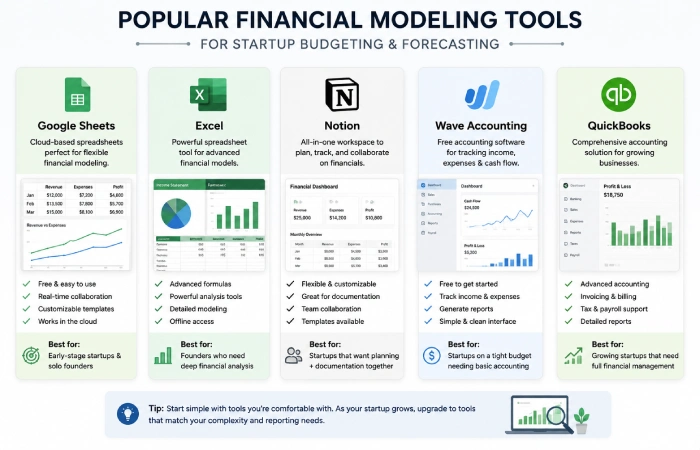
For most early-stage startups, Google Sheets or Excel is usually enough.
Simple tools are easier to manage and update regularly.
Advanced Tips for Startup Budget Templates
Once the founders have gained some understanding about simple budgeting practices, the logical follow-up would be to enhance their ability to do accurate budgeting. Not necessarily does advanced budgeting require any fancy budgeting software.
Separate Fixed and Variable Costs
One of the most important budgeting strategies is the segregation of fixed and variable expenses.
Fixed expenses do not typically vary each month, but variable expenses fluctuate depending on business performance and sales.
This makes it easier to:
- Control spending
- Predict future expenses
- Identify unnecessary costs
- Plan for slow business periods
Use Conservative Revenue Estimates
Many early-stage founders overestimate future sales.
A better approach is using conservative revenue assumptions. This helps create more realistic financial plans and reduces the risk of overspending.
It is often safer to underestimate revenue and overestimate expenses during the early stages of business growth.
Track Budget vs Actual Performance
A budget becomes more useful when founders compare estimated numbers with actual results.
This helps identify:
- Spending problems
- Revenue gaps
- Unexpected expenses
- Areas where the business performs better than expected
A simple monthly review can improve budgeting accuracy over time.
Add Emergency Cash Reserves
Many startups face unexpected expenses.
Including an emergency reserve inside the budget template helps founders prepare for:
- Revenue slowdowns
- Delayed customer payments
- Emergency business costs
- Seasonal sales changes
Even a small reserve can improve financial stability.
Plan for Taxes Early
Some founders forget to include taxes in their budget planning.
As revenue grows, tax obligations can become significant.
Budget templates should include estimated:
- Business taxes
- GST or sales tax
- Payment processing fees
- Professional service costs
Planning for taxes early helps avoid financial pressure later.
Create Multiple Budget Scenarios
Advanced founders often create more than one version of the budget.
Common examples include:
- Best-case scenario
- Expected scenario
- Worst-case scenario
This helps founders prepare for uncertainty and make better decisions during changing business conditions.
Review Budgets Regularly
A startup budget should evolve as the business changes.
Most founders review budgets monthly or quarterly to:
- Update revenue assumptions
- Adjust expenses
- Improve forecasting accuracy
- Track business growth
Regular reviews make financial planning much more reliable.
Use Simple Tools First
Many founders believe advanced budgeting requires complex financial software.
In reality, simple tools like Google Sheets or Excel are often enough during the early stages.
The most important part is consistency, not complexity.
An easily made budget that is frequently updated will prove more beneficial compared to a complex financial plan that the founders abandon after a couple of weeks.
Best Practices for Using a Startup Budget Template
A budgeting framework that the founders continuously use proves to be far more practical compared to the one developed only once for the sake of doing it.
The goal of a startup budget is not perfection. The goal is improving financial visibility and helping founders make better decisions over time.
Update the Budget Every Month
One of the most important budgeting habits is regular updates.
Company revenues, expenses, and circumstances continue to change over time. If the budget is not revised, its usefulness is bound to wane.
Monthly reviews help founders:
- Track financial progress
- Identify spending problems
- Adjust revenue expectations
- Improve future planning
Use Realistic Numbers
Some founders create budgets using overly optimistic assumptions.
This can create financial pressure later.
A better approach is using realistic estimates based on:
- Current sales performance
- Historical business data
- Market conditions
- Actual operating costs
Conservative budgeting usually creates stronger financial stability.
Track Every Major Expense
Even small recurring costs can become significant over time.
Founders should track important expense categories such as:
- Marketing
- Software subscriptions
- Freelancer payments
- Office expenses
- Payment processing fees
- Website hosting
Expense tracking enables the entrepreneur to discover unnecessary spending areas.
Separate Business and Personal Finances
Many early-stage founders mix personal and business expenses.
This creates confusion and makes budgeting less accurate.
Having different bank accounts and expense tracking systems makes the company’s finances easier to manage.
Monitor Cash Flow Alongside the Budget
A business may appear profitable while still struggling with cash shortages.
This is why founders should monitor both:
- Budget performance
- Actual cash flow
Cash flow management is much more important for bootstrap businesses because such companies have no money.
Prepare for Unexpected Costs
Unexpected expenses are common in startups.
Examples include:
- Emergency software purchases
- Marketing changes
- Equipment repairs
- Delayed customer payments
It is better to include an emergency fund within the budget to help stabilize business.
Keep the Budget Simple
Complicated budgets are often difficult to maintain.
Most early-stage startups only need a simple structure that includes:
- Revenue estimates
- Fixed expenses
- Variable expenses
- Profit estimates
- Cash reserves
Simple systems are easier to update consistently.
Review Budget vs Actual Results
Comparing estimated numbers with actual results helps founders improve budgeting accuracy.
This process helps identify:
- Overspending
- Revenue gaps
- Incorrect assumptions
- Areas of business improvement
This results in effective financial planning.
Using Budget as a Decision Tool
Startup budgets must be able to aid decision-making rather than just recording figures.
Founders can use budgeting to evaluate:
- Hiring decisions
- Marketing investments
- Product launches
- Expansion plans
- Software purchases
This helps reduce unnecessary financial risk.
Start Simple and Improve Gradually
Many successful startups begin with very basic budgeting systems.
Founders do not need advanced financial software immediately. A basic spreadsheet that is consistently updated may suffice in the early phases.
With expansion, the budget could be made much more complex, containing further forecasts and financial planning capabilities.
Reviewing & Updating Your Model
A financial model should not stay unchanged for long periods.
Business conditions change constantly.
Examples include:
- Revenue changes
- Rising expenses
- Customer behavior changes
- Marketing performance
- Seasonal sales trends
Because of this, founders should review financial models regularly.
Recommended Review Schedule
| Business Stage | Review Frequency |
| Early Startup | Monthly |
| Growing Startup | Monthly or Quarterly |
| Stable Business | Quarterly |
Updating the model regularly helps improve accuracy and supports better business decisions.
Common Beginner Mistakes
Many first-time founders make similar financial planning mistakes.
Common mistakes include:
- Overestimating revenue
- Ignoring small expenses
- Poor cash flow tracking
- Overspending on marketing
- Creating overly complicated spreadsheets
Simple and realistic planning usually works better for bootstrapped startups.
Final Thoughts
Building a model for your business without any outside funding does not have to be hard.
A basic spreadsheet can actually help you keep track of your revenue control your expenses keep an eye on your cash flow and plan for growth in a way.
When you are starting a business with your money financial modeling is more about making good business choices with the little resources you have than trying to impress investors.
Having an realistic financial model can help your business lower risk do a better job with budgeting and become stronger, over time.
With the growth of the enterprise, entrepreneurs can also consider Bootstrapped Startup Valuation Methods to comprehend their business worth and its potential for growth.
Frequently Asked Questions (FAQs)
What is a startup financial model?
Start-up Financial Model is a method by which the entrepreneur estimates his future income, expenses, cash flow, and profit.
Can I build a financial model without investors?
Yes. Many bootstrapped startups create financial models using simple spreadsheets without outside funding.
What is the best free tool for financial modeling?
Google Sheets is one of the most popular free tools for startup financial planning.
How often should financial models be updated?
Most startups review and update financial models monthly.
Why is cash flow important for startups?
Cash flow helps businesses pay expenses and continue operating during slow periods.
Do startups need complicated financial models?
No. Simple financial models are usually enough for early-stage startups.
What are common financial modeling mistakes?
Common mistakes include unrealistic revenue forecasts, poor cash flow management, and overspending.