


What is Bootstrapped Financial Modeling
Bootstrapping financial modeling involves developing projections of a startup’s financial performance in the future but without external funding. Rather than seeking venture capital funds, the founders generally depend on personal finances, revenues from operations, or earnings in order to scale up their venture.
As such, a financial model is basically an instrument used by founders to project revenues, expenditures, cash flow, and profitability based on realistic assumptions about future business performance. According to the Corporate Finance Institute, financial modeling helps businesses forecast future financial results and support decision-making processes
While bootstrapped financial modeling does not aim at making accurate future predictions, its main purpose is to aid founders in making wise financial decisions, managing cash efficiently, and minimizing risks associated with running the business.
For bootstrapped startups, fFinancial planning becomes even more important because resources are limited. This is one of the core principles of startup bootstrapped financial modeling, where founders must carefully manage every dollar. Since there is no outside funding available to cover mistakes, founders need to manage spending carefully and protect cash flow.
In fact, even a simple spreadsheet containing estimated revenues and expenditures could function as a financial planning tool for a start-up.

Why Financial Modeling Matters for Bootstrapped Startups
Bootstrapped startups usually operate with tighter budgets than funded companies. Because of this, founders must understand how money moves through the business.
A financial model helps founders:
| Financial Area | Why It Matters |
| Revenue Forecasting | Estimates future sales growth |
| Expense Planning | Helps control business spending |
| Cash Flow Tracking | Prevents cash shortages |
| Profitability Analysis | Shows when the business may become profitable |
| Growth Planning | Supports smarter expansion decisions |
Financial modeling also ensures that the entrepreneurs remain grounded. People who start their businesses entrepreneurs, are usually very hopeful about what they are doing.. If entrepreneurs become too hopeful and do not think about what is really possible they can get into financial trouble. Financial modeling helps entrepreneurs take a look at the things they believe and make decisions based on financial numbers rather than how they feel about things. Financial modeling is important for entrepreneurs to make decisions about their financial situation. Entrepreneurs use modeling to think carefully about their business and make smart choices, about money.
Financial Modeling vs Accounting
Many startup founders confuse financial modeling with accounting, but they are different.
| Financial Modeling | Accounting |
| Focuses on future planning | Focuses on past financial records |
| Uses forecasts and assumptions | Uses completed financial transactions |
| Helps with business decisions | Helps with reporting and taxes |
| Estimates future performance | Records past activity |
Accounting tracks what already happened in the business.
Financial modeling focuses on what may happen in the future.
For example:
- Accounting records last month’s expenses
- Financial modeling estimates future expenses and cash flow
Both are important, but they serve different purposes.
Founder’s Guide to Financial Modeling Basics
Many first-time founders think financial modeling is complicated or only useful for accountants and investors. In reality, most startup financial models begin with very simple estimates and basic business planning.
A financial model is simply a way to understand how money may move through the business in the future.
For bootstrapped startups, financial modeling is less about impressing investors and more about making practical business decisions with limited resources.
A founder may use a financial model to answer questions such as:
- Can the business afford to hire employees?
- Should marketing spending increase?
- How long will current cash reserves last?
- When may the company become profitable?
- Is the current pricing strategy sustainable?
- Can the startup survive slower sales periods?
- How much monthly revenue is needed to cover expenses?
Founders should no longer have to guess about the future but rather create financial plans to ensure that their business can function effectively.
Why Financial Planning Matters for Founders
Startups fail due to poor financial planning despite having good products.
Businesses with great ideas can find themselves failing because of increased expenditure and cash flow problems.
Financial modeling helps founders:
| Planning Area | Why It Helps |
| Revenue Planning | Sets realistic sales goals |
| Expense Tracking | Helps avoid overspending |
| Cash Flow Management | Prevents cash shortages |
| Profit Planning | Shows when business may become profitable |
| Growth Planning | Supports safer expansion decisions |
A simple financial model gives founders a clearer picture of the business before making important financial decisions.
Simple Financial Modeling Flow
Business Revenue
↓
Business Expenses
↓
Cash Flow
↓
Profitability
↓
Growth Planning
This simple process helps founders understand how money moves through a startup business step by step.
Simple Founder Example
A small online startup may earn $4,000 per month from customers.
At the same time, the business may spend money on:
- Marketing
- Software subscriptions
- Freelancers
- Website hosting
- Business tools
Without financial planning, founders may spend too much too quickly.
A simple financial model helps estimate:
- Monthly expenses
- Expected profits
- Future cash needs
- Business sustainability
This allows founders to make better financial decisions before problems appear.
Simple Comparison: Founder With Model vs Without Model
| Founder With Financial Model | Founder Without Financial Model |
| Tracks cash flow regularly | Ignores cash movement |
| Plans future expenses | Reacts to problems later |
| Uses realistic growth estimates | Uses guess-based assumptions |
| Controls spending carefully | May overspend too early |
| Understands profitability goals | Unclear financial direction |
This does not mean financial models must be perfect. Even a basic spreadsheet can improve planning and help founders build a more stable business.
Core Components of a Startup Financial Model
Most startup financial models include five important components.
1. Revenue Forecasting
Revenue forecasting estimates future business income.
Founders use:
- Product pricing
- Customer growth
- Sales targets
- Market demand
Simple Revenue Example
| Month | Customers | Revenue |
| January | 50 | $2,000 |
| February | 70 | $2,800 |
| March | 90 | $3,600 |
Revenue forecasts help founders set goals. When I want to dig I look at Revenue Projections for Bootstrapped Startups to create more accurate sales forecasts for my startup.
2. Expense Forecasting
Expense forecasting estimates future business costs.
Fixed Expenses
These remain mostly stable:
- Rent
- Software subscriptions
- Internet bills
- Insurance
Variable Expenses
These change as the business grows:
- Marketing costs
- Shipping fees
- Sales commissions
- Transaction fees
Expense Comparison Table
| Fixed Expenses | Variable Expenses |
| Office Rent | Advertising Costs |
| Software Tools | Shipping Charges |
| Internet Bills | Transaction Fees |
| Insurance | Sales Commissions |
Expense planning prevents startups from spending too much money. Planning budgets in detail is discussed in the book Expense Forecasting for Lean Startups, where the aim is to control expenses while growing the business.
3. Cash Flow Forecasting
Cash flow forecasting tracks how money moves into and out of the business.
Many startups fail because they run out of cash, even if sales are growing.
Cash Flow Includes
| Cash Inflows | Cash Outflows |
| Customer Payments | Salaries |
| Product Sales | Marketing Costs |
| Service Revenue | Software Expenses |
| Subscription Income | Supplier Payments |
Cash flow management helps in dealing with tough situations in businesses. The book referred by many entrepreneurs for proper cash flow management is known as Cash Flow Modeling for Bootstrapped Startups.
4. Break-Even Analysis
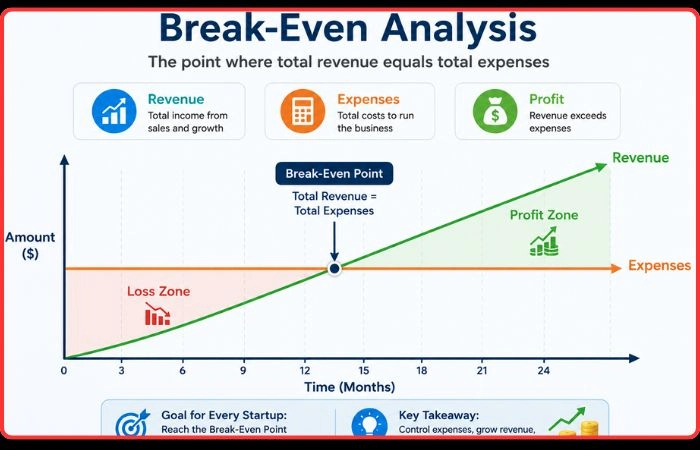
Break-even analysis provides an insight into when the venture will begin turning a profit.
Break-even is achieved when total revenue equals total costs.
Break-Even Example
| Monthly Expenses | Revenue Needed to Break Even |
| $2,000 | $2,000 |
| $5,000 | $5,000 |
| $8,000 | $8,000 |
This helps founders create more realistic financial goals. A detailed guide to calculating profitability can be found in Break-Even Analysis for Bootstrapped Startups.
5. Growth Planning
Growth planning focuses on future business expansion.
Founders use financial models to plan:
- Hiring employees
- Increasing marketing budgets
- Launching products
- Expanding services
- Investing in software
Growth planning helps startups expand carefully without creating unnecessary financial pressure. Combining growth forecasts with Scenario Planning for Bootstrapped Startups can help founders prepare for both positive and negative business outcomes.
Why Bootstrapped Modeling Differs from VC Modeling
Not all startup financial models are built the same way.
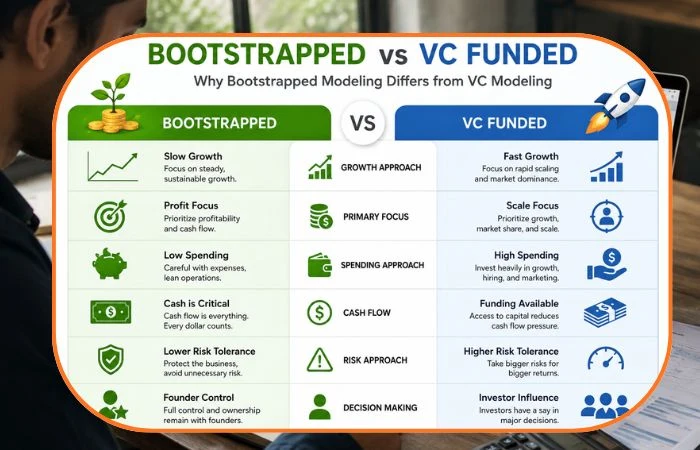
A bootstrapped startup operates using personal savings or business-generated income, while VC-funded startups grow using investor funding.
Because of this, financial priorities are very different.
Bootstrapped vs VC Startup Comparison
| Area | Bootstrapped Startup | VC-Funded Startup |
| Funding | Self-funded | Investor-funded |
| Growth Speed | Gradual | Fast |
| Profit Focus | Early profitability | Future profitability |
| Spending Style | Controlled | Aggressive |
| Risk Level | Lower | Higher |
| Cash Importance | Extremely important | Important |
 Bootstrapped founders usually focus on:
- Cash flow management
- Expense control
- Sustainable growth
- Early profitability
VC-funded startups often focus more on:
- Fast customer growth
- Market expansion
- Large team scaling
- Aggressive marketing
Both approaches are different because the businesses operate under different financial conditions.
Financial Modeling Trends in 2026
Startups in 2026 will be more concerned about profit margins and cash flows than rapid expansion.
Increased software costs, advertisements, and uncertainties will cause more financial planning to become necessary among founders.
Because of this, many bootstrapped businesses now use simple financial models to:
- Protect cash reserves
- Reduce unnecessary spending
- Improve profitability
- Build sustainable growth strategies
This trend has made financial modeling more valuable for startups than ever before. Many founders are also adopting Financial Modeling Tools for Bootstrappers to automate forecasting and reporting processes.
Common Beginner Mistakes to Avoid in Bootstrapped Financial Modeling
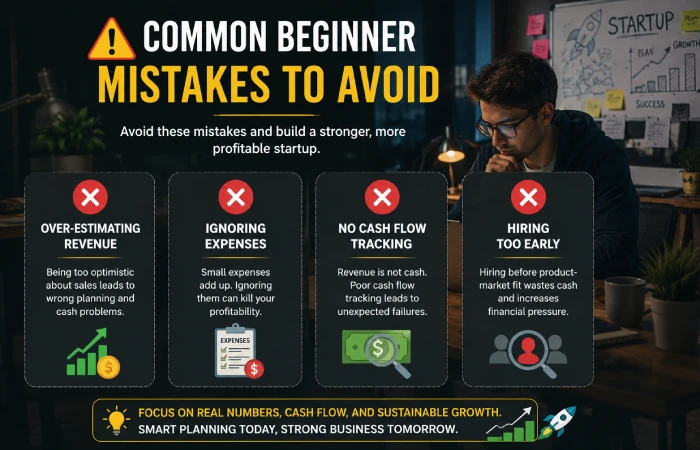
Many first-time founders make simple financial modeling mistakes during the early stages of building a startup.
Overestimating Revenue
Many beginners expect sales to grow too quickly.
Better Approach
- Use realistic estimates
- Start with smaller growth assumptions
- Update forecasts regularly
| Unrealistic Forecast | Realistic Forecast |
| Rapid growth expectations | Gradual customer growth |
| Aggressive projections | Conservative planning |
| Profit too quickly | Sustainable progress |
Ignoring Small Expenses
Small costs can grow quickly over time.
Examples include:
- Subscription tools
- Transaction fees
- Taxes
- Marketing software
Tracking all expenses improves budgeting accuracy.
Not Tracking Cash Flow
Some founders focus only on revenue and profit.
However, cash flow often determines whether a startup survives.
Common Cash Flow Problems
| Problem | Business Impact |
| Low cash reserves | Difficulty paying bills |
| Delayed customer payments | Cash shortages |
| High monthly expenses | Financial pressure |
| Poor budgeting | Business instability |
Creating Complicated Financial Models
Many beginners believe financial models must be large spreadsheets with advanced formulas.
In reality, simple models usually work better for early-stage startups.
A basic model with:
- Revenue estimates
- Expense tracking
- Cash flow projections
- Profit calculations
is often enough in the beginning.
Not Updating Forecasts
Business conditions change regularly.
Total revenue, total costs, and the behavior of customers can vary through time.
Monthly forecast update enhances the level of precision in financial management planning.
Simple Startup Financial Model Example
| Category | Monthly Estimate |
| Revenue | $5,000 |
| Marketing Costs | $800 |
| Software Tools | $300 |
| Freelancers | $1,200 |
| Miscellaneous Expenses | $400 |
| Estimated Profit | $2,300 |
This kind of model really helps founders figure out if their business has enough money to stay afloat. The business model is very important for founders to understand if the business is financially stable. Founders need to know if their business is financially stable.
Important Financial Metrics for Founders
Tracking important financial metrics can improve business decisions.
| Metric | Purpose |
| Monthly Revenue | Tracks sales growth |
| Burn Rate | Measures monthly spending |
| Cash Runway | Shows how long cash may last |
| Gross Profit Margin | Measures profitability |
| Customer Acquisition Cost | Tracks marketing efficiency |
These numbers help founders understand business performance more clearly.
Final Thoughts
However, bootstrapped financial modeling is not an exclusive tool available only to the world of finance. This is a useful method that helps founders better understand the financial aspect of their business.
It is possible to estimate revenues, costs, cash flow, profits, and growth, which will allow one to make better decisions and eliminate unnecessary financial risks.
The financial model doesn’t have to be overly complex, although with time founders may also find it beneficial to learn about Bootstrapped Startup Valuation Methods.
A normal spreadsheet would help in budgeting and cash flow management as well, which plays an important part in sustaining the business.
For the entrepreneur doing things on their own and making good business and financial plans usually work out better, than trying to grow fast. The entrepreneur should focus on bootstrapping. The entrepreneur should make sure to have good business and financial planning. This is what works for the entrepreneur.
Frequently Asked Questions (FAQs)
What is bootstrapped financial modeling?
Bootstrapped financial modeling is the process of estimating future business performance for startups that grow without outside investment.
Why is financial modeling important for startups?
Financial modeling helps founders plan revenue, manage expenses, track cash flow, and make better business decisions.
Is financial modeling only for large startups?
No. Even small startups can benefit from simple financial models.
How is budgeting different from financial modeling?
While budgeting involves planning expenses, financial modeling determines business performance including income, cash flow, and profits.
How often should startups update financial models?
Many startups review and update financial models monthly or quarterly.
Why is cash flow relevant to bootstrapped companies?
Cash flow enables the company to cover costs and keep running without relying on external funding.
What is break-even analysis?
Break-even analysis assists founders to determine when the company’s revenues can cover costs.
Can startups use Excel or Google Sheets for financial modeling?
Yes. Many early-stage startups use simple spreadsheets to create financial models.
What are common financial modeling mistakes?
Common mistakes include unrealistic revenue forecasts, poor cash flow tracking, overspending, and ignoring small expenses.
Do bootstrapped startups need financial models?
Yes. Financial models help bootstrapped founders manage limited resources more effectively and plan future growth carefully.