


The majority of new businesses spend months randomly posting on five different sites and wonder why things are not working out for them. The only businesses that succeed choose one or two websites where their customers hang out, post consistently with valuable content, and regard social media as a conversation platform.

Here is a practical playbook for 2026 that’s crafted for entrepreneurs and small businesses without a marketing team.
For the overarching strategy, read our complete guide on Startup Marketing.
Top Social Media Websites for Startups
You don’t have to be everywhere. Being mediocre on four platforms loses to being strong on one.
Here’s a clear breakdown by business type:
| Platform | Best For | Strengths | Weaknesses | Ideal Stage |
| B2B SaaS, services, enterprise | Decision-makers, organic reach still works, high-intent | Slower content cycle, less visual | Pre-seed to Series B | |
| TikTok | Consumer apps, DTC, awareness | Massive organic reach, algorithm favors new accounts | Can feel chaotic, younger skew | Seed and growth |
| Visual products, lifestyle, e-com | Strong storytelling, Reels + shopping | Organic reach declining | Seed through growth | |
| X (Twitter) | Tech, founders, real-time | Fast conversations, build-in-public | Noisy, lower average engagement | Early to growth |
| Niche communities, trust | High trust recommendations, low cost | Strict rules, slow to scale | Any stage |
Rule of thumb in 2026:
- Selling to businesses → start with LinkedIn.
- Selling to consumers → start with TikTok or Instagram.
- Introduce the second platform only when you have created a reproducible process with the first one.
The social B2B leads are still generated mainly by LinkedIn. TikTok continues to give new accounts a real shot at reach if the content hits. Instagram is still robust for visual brands but needs more consistency in visual content.
Marketing on Social Media for Start-Ups
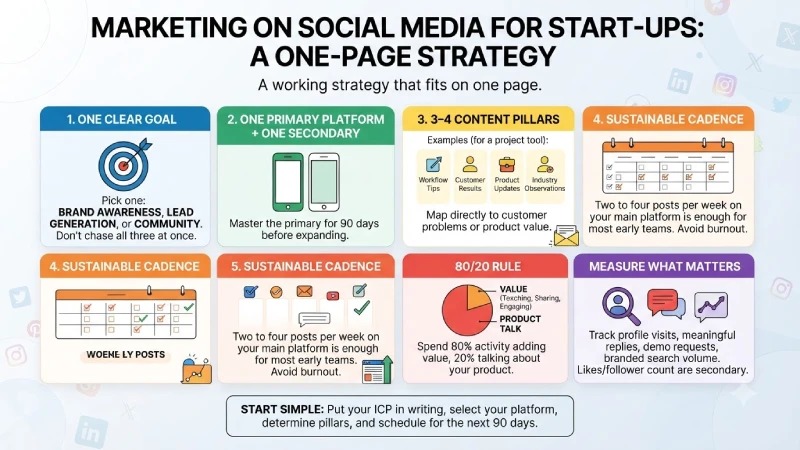
A working strategy fits on one page.
- One clear goal Pick one: brand awareness, lead generation, or community. Don’t chase all three at once.
- One primary platform + one secondary Master the primary for 90 days before expanding.
- 3–4 content pillars These should map directly to customer problems or your product’s value. Example for a project tool: workflow tips, customer results, product updates, industry observations.
- Sustainable cadence Two to four posts per week on your primary medium is sufficient for most nascent teams. Posting daily is only effective if you have a process and a person to manage that process without getting exhausted.
- 80/20 rule Spend 80% of your activity adding value (teaching, sharing, engaging). Spend 20% talking about your product.
- Measure what matters Track profile visits from your ideal customer, meaningful replies, demo requests influenced by social, and branded search volume. The likes and number of followers don’t matter.
Start simple. Put your ICP in writing, select which platform they’re on, determine the pillars, and get yourself on a realistic schedule for the next 90 days.
LinkedIn Marketing for Start-up’er
LinkedIn will be the most ROI-efficient form of social media for B2B start-ups in 2026.
LinkedIn offers business the means by which to reach their target audience and form business connections.
What actually works:
- Founder accounts outperform company pages. People follow people. Company pages get lower organic reach.
- Post 2–4 times per week. Consistency beats volume. Three strong posts beat seven average ones.
- Formats that perform well: short native videos, document carousels (guides and frameworks), text posts with a clear point of view, and real customer stories.
- Engagement is half the game. Use 15-20 minutes per day to comment on content posted by individuals in your target accounts. This often drives more profile visits than your own posts.
- Comment CTAs work better than link CTAs. Asking people to comment a word or their industry, then sending the link in DMs or replies, boosts both reach and conversion.
A simple weekly pattern many founders use:
- Monday: Teaching post (problem + practical fix)
- Wednesday: Story or customer result
- Friday: Observation or framework
Optimize your individual profile as if it were a landing page: clear headline, solid about us section, featured content that leads to an offer.
Markering TikTok for Start-ups
There are no more dances in TikTok alone. By the year 2026, TikTok will become one of the most popular social media sites to locate your content.
Practical approach for startups:
- Post 3–5 times per week if you can sustain it. Quality and consistency matter more than daily output.
- Hook in the first 1–3 seconds. People decide fast whether to keep watching.
- Talk to the camera. Authentic founder or team videos outperform polished ads for most early-stage brands.
- Formats: Quick tips, behind the scenes, problem-solution demonstrations, customer feedback, and trends when applicable to your brand.
- Batch creation. Film several videos in one session so posting doesn’t eat your whole week.
Realistic growth expectations (consistent posting):
- Month 1: Learning the platform, 200–1,000 followers possible
- Month 3: 1,000–5,000 if content resonates
- Month 6: 5,000–20,000+ with a few stronger videos
Although TikTok Shop is gaining its relevance in product brand promotion, the key thing here is that you need to have organic content at first before proceeding with paid ads.
Social Media Content Calendar for Startups
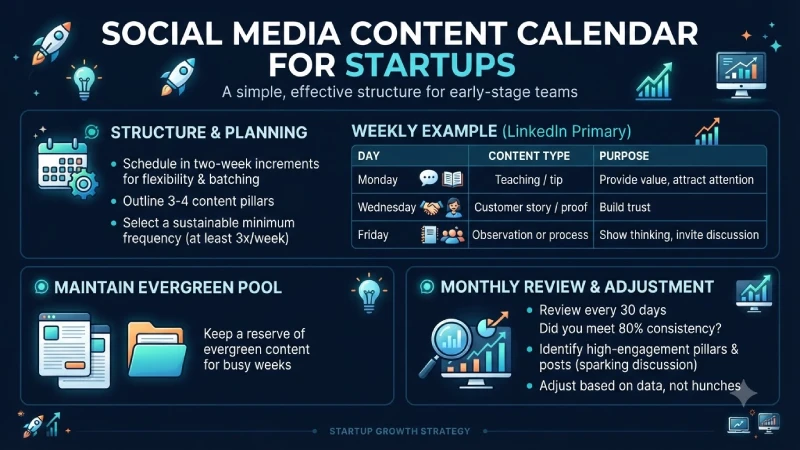
A calendar only works if it’s simple enough that you’ll actually use it.
Recommended structure for early-stage teams:
- Schedule in two-week increments. Long enough to batch content creation, but short enough to remain flexible.
- Outline 3-4 content pillars.
- Select the lowest frequency that will allow you to sustain consistency for 90 days (minimum 3 times per week on your channel).
Creation of content should be in batches weekly or biweekly.
Simple weekly example (LinkedIn primary):
| Day | Content Type | Purpose |
| Monday | Teaching / tip | Provide value, attract attention |
| Wednesday | Customer story / proof | Build trust |
| Friday | Observation or process | Show thinking, invite discussion |
Maintain a pool of evergreen blog posts which will always come handy for weeks where you find yourself occupied.
Every 30 days review:
- Did you post at least 80% of your intended posts?
- Which pillar received the highest engagement?
- Are there any posts that sparked discussion or demonstration?
Use data rather than make assumptions when modifying the formula.
Frequently Asked Questions
How many platforms should the startup utilize?
Just start with one. Become a pro at using it for at least 90 days. Add the second course if you feel that you can score good marks in the first one. It’s always better to be very good at one course than being average in four.
Will LinkedIn be still useful for B2B marketing in 2026?
Yes, it will. This platform will still provide the highest return on investment for B2B startups. The accounts of the founders (not company pages) perform best in combination with daily engagement with the content posted by other users.
What is the frequency of my posts to be made on LinkedIn and TikTok?
- LinkedIn: 2-4 posts a week are sufficient.
- TikTok: 3-5 posts a week, but you need to maintain good quality. You can post daily only if you have a system in place and won’t get exhausted.
Do I need elaborate videos or graphics?
No. The founder or the team talking about a problem, solution, and process on the phone video works better than any advertisement.What should I track instead of likes and followers? Focus on:
- Profile visits from your ideal customers
- Meaningful comments and replies
- Demo or meeting requests influenced by social
- Branded search volume
Likes and follower count are secondary.
How soon can I expect to see results?
All groups give off signals within the first 30-60 days because of their consistent actions (profile views, reactions, and certain interaction). To have a significant effect on your pipeline, it will take 3 to 6 months. Stopping too soon is the number one reason why it doesn’t “work.”
Company pages versus personal founder accounts – which should I use?
If you are a startup, personal founder accounts almost always come out on top. People follow people.
Final Reality Check
Consistency and relevance will prove to be more effective on social media platforms rather than perfection and good production. It is imperative that you identify where your buyer persona is present and then bring relevant content to them two to four times a week. In addition, engage with authenticity and monitor all the discussions that will come out of it, and do the same for 90 days.
Please do let me know if there are any particular aspects that you want me to discuss further (such as how to write a post on LinkedIn or KPIs per platform).
To take the next step, see our detailed guide on SEO for Startups