Very few websites will ever rank for anything relevant since most of them fail to get the basics right and go after the keywords that they stand no chance at ranking for. It is very important to look at SEO from a startup’s perspective as a compound and long-term approach.
This is a guide written for 2026, for founders with limited budget and bandwidth.
For the overarching strategy, read our complete guide on Startup Marketing.
Startup SEO Checklist
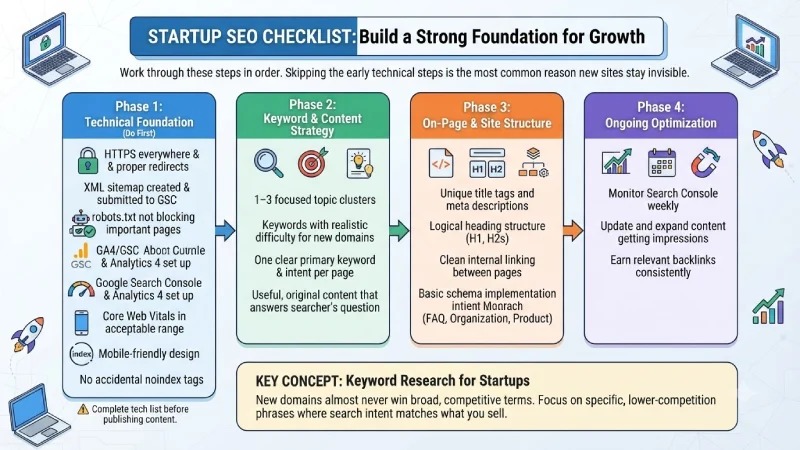
Do these in sequence. Skipping the initial steps is the main reason why new websites remain hidden.
Technical foundation (do first)
- HTTPS everywhere with proper redirects
- XML sitemap created and submitted to Google Search Console
- robots.txt not blocking important pages
- Google Search Console and Google Analytics 4 set up
- Core Web Vitals in acceptable range (especially on mobile)
- Mobile-friendly design that actually works on real phones
- No accidental noindex tags on live pages
Keyword & content
- 1–3 focused topic clusters (not 10 scattered topics)
- Keywords with realistic difficulty for a new domain
- One clear primary keyword and intent per page
- Useful, original content that answers the searcher’s real question
On-page & structure
- Distinct title tags and meta descriptions
- Logical headings (single H1, clear H2s)
- Clean internal linking between related pages
- Basic schema where it makes sense (FAQ, Organization, Product)
Ongoing
- Monitor Search Console weekly for indexing and query data
- Update and expand content that starts getting impressions
- Earn a small number of relevant backlinks consistently
Complete the technical list before publishing content. A fast, crawlable site is the base everything else sits on.
Keyword Research for Startups
New domains almost never win broad, competitive terms. Focus on relevant keywords that have low competition and match your product line.
Practical process:
- Create a realistic list of problems that your product solves based on what your customers tell you during sales calls, support calls, and interviews.
- Take advantage of free tools such as Google Autocomplete, People Also Ask, Google Keyword Planner, and Google Search Console.
- Filter hard. Look for keywords with:
- Manageable difficulty (under ~30 in most tools for brand-new sites)
- Clear commercial or problem-solving intent
- At least some search volume (even 50–300 monthly searches can be valuable early on)
- Check the actual search results. If you see Reddit threads, forums, thin content, or newer sites ranking, the keyword is often winnable.
Start with low- and mid-funnel keywords (comparison, alternative, “best X for Y,” how to implement) before moving onto other keyword types, as these will have a higher conversion rate and are not as competitive.
Map every keyword to one page. No more than ten objectives can be placed on a single page.
On-Page SEO Best Practices
The on-page actions depend solely on you and can grant you an easy win.
For every important page:
- Title tag: Original title tag less than ~60 characters, containing the primary keyword, designed for clickability.
Meta description: Relevancy and motivation for the click in the concise meta description (Google might change it, but it’s good to have anyway).
URL: Short, all lowercase, hyphenated, with keywords. Avoid long query strings or dates in URL for blogs.
Headings: H1 tag that defines the topic. Organize the content through H2s and H3s based on the sub-questions.
Content: Start with an obvious answer or value proposition. Make sure to cover the whole topic. Provide actual data, examples, or steps.
Images: Compress them, give relevant filenames and alt text. - Internal Links: Internal linking is the process of creating links to other relevant pages on your website. It helps both your users and search engines comprehend your website’s architecture. You can learn more about it from Google SEO documentationn.
- FAQ section: Useful for users and often helps with featured snippets or AI overviews.
In 2026, it is beneficial to arrange the content in such a way that the first 40-60 words of important paragraphs will respond to the heading. Answer engines and AI summaries love quotable content.
Link Building for Startups
You can never allow yourself to compete with major brands in buying links; you should just focus on quality.
Some realistic and effective low-budget methods include:
- Develop content (either a database, a tool, comparison or a guide) that will be really useful to other people so that they will want to link to it.
- Ask for links for any brand mentions that do not have them yet (Google Alerts will help you with that).
- List your site on appropriate niche directories, tools listing pages, and startup directories (more quality than quantity here).
- Guest posts and expert contributions to blogs where your potential customers visit (more about relevancy than domain rating).
- Broken link building and resource page outreach in case you have something to offer.
Digital PR and thought leadership of the founder. - Product reviews on Capterra, G2, or niche review websites.
It’s always advisable to go for a consistent stream of contextual links rather than large spikes of traffic. The few links from websites in the same niche have more impact than numerous irrelevant ones.
Technical SEO for New Websites
Technical problems are the silent killers of new websites. Sort them out at the start to give all your content an equal opportunity.
Priority checklist:
| Area | What to Check / Fix | Why It Matters for New Sites |
| Crawlability | robots.txt, XML sitemap, no accidental noindex | Google must be able to find and index pages |
| Indexing | Search Console coverage report, submit key pages | Only indexed pages can rank |
| Speed & Core Web Vitals | LCP, CLS, INP (especially mobile) via PageSpeed Insights | Page experience is a ranking factor |
| Mobile experience | Real-device testing, responsive design | Google indexes mobile-first |
| HTTPS & security | Valid certificate, HTTP → HTTPS redirects | Basic trust signal |
| URL structure | Clean, consistent, keyword-friendly | Helps both users and crawlers |
| Canonicals | Proper tags on similar or parameter-based pages | Prevents duplicate content issues |
| Structured data | Basic schema (Organization, FAQ, Product, Article) | Helps search engines understand the page |
Do free crawls (Screaming Frog or alike) prior to release and every time there is a significant update. Prioritize and correct any critical errors initially. More often than not, startups’ websites lose more traffic due to technical issues than due to poor content.
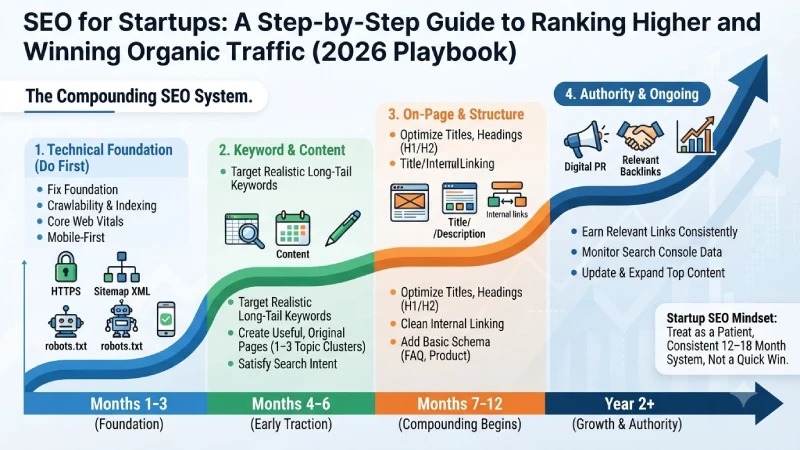
Realistic Timeline Months 1-3: Technical base + target page #1. Months 4-6: Rankings for long tail keywords + consistent traffic. Months 6-12: Compounding starts if consistent. Year 2+: Increased authority + more keywords.
Conclusion
SEO is slow at the start and powerful later. The startups that treat it as a 12–18 month system usually pull ahead of those who expect results in 30 days and quit.
Use the technical checklist and single topic cluster approach to start off with. Create pages that will be helpful to users and get some relevant backlinks, and just continue optimizing according to Search Console information. This is the recipe for success in organic search for a new website regardless of its budget and domain authority.
Do you need a downloadable checklist or an example of keyword research spreadsheet? Just ask.
To take the next step, see our detailed guide on Email Marketing for Startups.