


The approach to content in many startups is not a serious one at all. Companies post when they want to, search for any keyword, and ask themselves why nothing works. The ones that actually grow treat content as a quiet, compounding system that brings in leads and builds real authority without burning cash on ads every month.
Here is a proven approach, based on research findings, of how to achieve success in 2026. It concentrates on effective strategies for the startup phase of a company.
For the overarching strategy, read our complete guide on Startup Marketing.
Strategy of Content Marketing for Startups
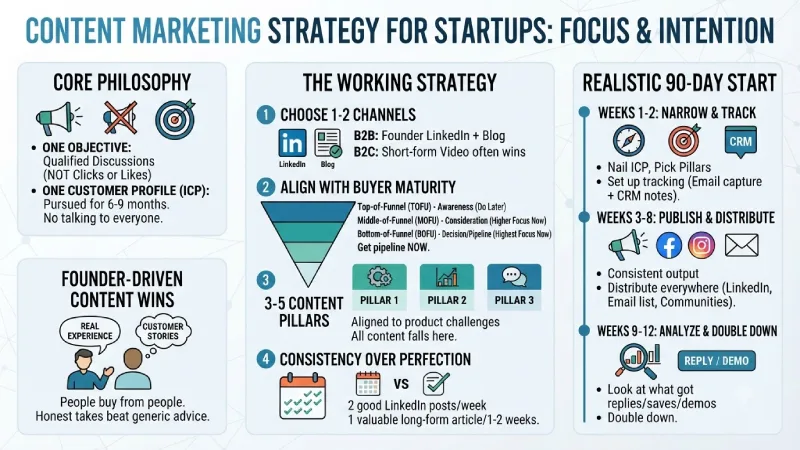
There will be only one main objective: to create qualified discussions, not clicks or likes. There should be one customer profile that will be pursued for 6–9 months. Trying to talk to everyone dilutes everything.
A working strategy that keeps showing results:
- Choose 1–2 channels maximum. For most B2B startups that’s founder LinkedIn + a focused blog. For consumer products, short-form video often wins earlier.
- Align your content marketing approach with the buyer’s level of maturity. In the early phases, place an increased focus on bottom-of-the-funnel content, as well as middle-of-the-funnel content, as you require the pipeline now. Awareness content at top-of-funnel can follow later when you have some momentum.
- Have 3–5 content pillars, aligned directly to the challenges your product tackles. All your content should fall under one of those pillars.
- Make consistency your priority over perfection. It’s better to have two good LinkedIn posts a week + one valuable long-form article every 1–2 weeks than to publish sporadic “perfect” content.
Founder-driven content will perform better than brand content for startups. People buy from people. Your real experience, customer stories, and honest takes travel further than generic advice.
Realistic 90-day start
- Weeks 1–2: Nail ICP, pick pillars, set up simple tracking (email capture + basic CRM notes).
- Weeks 3–8: Publish consistently and distribute every piece (LinkedIn, email your tiny list, relevant communities).
- Weeks 9–12: Look at what got replies, saves, or demos and double down.
Best Content Types for Startups
Not every format delivers equal results when you’re resource-constrained. Focus on what converts and compounds.
| Content Type | Why It Works for Startups | Best Use | Effort Level |
| Founder LinkedIn posts | Builds trust fast, drives warm outbound | Weekly authority + engagement | Low–Medium |
| Long-form how-to / guides | Ranks over time, educates buyers | SEO + lead magnets | Medium |
| Case studies / customer stories | Social proof that shortens sales cycles | Bottom of funnel | Medium |
| Comparison / alternative pages | Captures high-intent searchers | Decision stage | Medium |
| Short-form video / clips | High engagement, easy to repurpose | Awareness + distribution | Medium |
| Newsletter / email course | Owned channel, nurtures leads | Ongoing relationship | Low–Medium |
Video remains one of the highest-effectiveness formats (many teams rate it 90%+ effective). You don’t need fancy production — phone videos of you explaining a customer problem or walking through a process work fine. Case studies stay one of the most reliable B2B formats because buyers still look for proof that someone like them got results.
Blogging for Startup Growth
The blog can be one of the most profitable tools for the future if treated not as an individual entry but as a system.
Key realities in 2026:
- New domains struggle with broad, competitive keywords. Target specific, lower-competition phrases your buyers actually search (or ask AI tools).
- Structure posts so the first 40–60 words of each section directly answer the heading. AI overviews and answer engines pull short, clear passages.
- Try to go for depth that is useful (1,500+ words on important subjects). The posts that are longer and well-structured get more traffic and backlinks.
- Internal linking and topic clusters matter. One strong pillar page supported by related cluster articles signals authority better than scattered posts.
Practical blogging rhythm for a small team:
- Outline 8–10 posts around one pillar before writing the first one.
- Publish 1–2 quality posts every two weeks.
- Keep older blog posts updated with new information or examples at least once every few months — both the search engine and the AI will appreciate it.
- Your blog post must always have the next step included at the end.
Blogging alone is slow. Pair it with distribution so the content actually reaches people while search rankings build.
Content Marketing on a Budget
You can run a solid content engine with almost no cash if you’re willing to put in the time.
Zero or near-zero budget approach
- Free Tools: Google Search Console, Keyword Planner, free AI to assist with the first draft (followed by extensive editing using your own voice), Canva, Mailchimp Free Plan.
- Founder writes or heavily edits everything. Your specific knowledge is the advantage.
- Not more than 2 to 3 top-notch items each month.
Repurpose ruthlessly: The one article becomes 3 to 5 LinkedIn posts, emails, videos, and a checklist. - Engage with 3 to 5 online communities, where your prospects may be found, instead of dispersing yourself thinly.
When you have some amount of money ($500 to $2,000 per month), invest in freelance services once in a while, SEO tools, and promotion of your top performing content. The biggest budget mistake is acting like a bigger company too early — spreading thin across too many channels or formats.
Content Marketing KPIs for Startups
Vanity metrics (raw traffic, likes, impressions) feel good but rarely predict revenue. Track what actually moves the business.
Leading indicators (first 30–60 days)
- Profile visits or site visits from your ICP
- Saves, meaningful comments, and replies
- Email signups from target segment
- Content-assisted conversations or demo requests
Pipeline indicators (60–180 days)
- Opportunities where content was first touch or a clear assist
- Win rate difference between content-touched deals and others
- Cost per qualified lead from organic content vs other channels
- Newsletter growth and engagement from the right people
The Real Growth Curve (What Most Founders Miss)
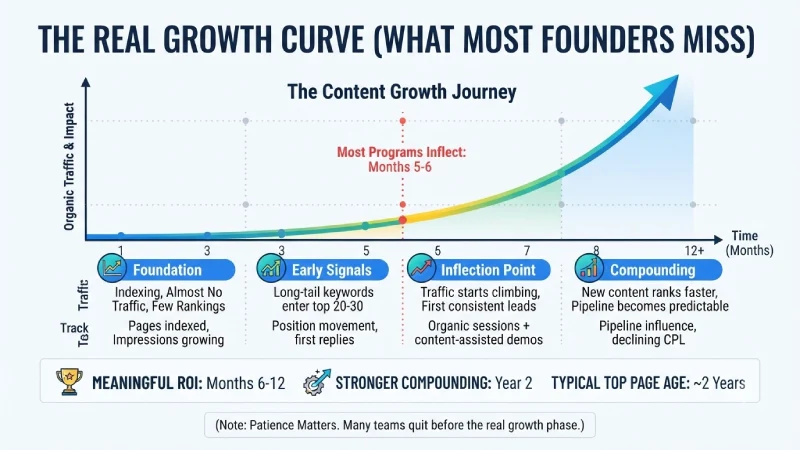
Content does not grow in a straight line. It follows a clear curve that frustrates many teams who quit too early.
Typical timeline for startups that stay consistent:
| Phase | Months | What Usually Happens | What You Should Track |
| Foundation | 1–3 | Indexing, almost no traffic, few rankings | Pages indexed, impressions growing |
| Early signals | 3–5 | Some long-tail keywords enter top 20–30 | Position movement, first replies |
| Inflection point | 5–7 | Traffic starts climbing, first consistent leads | Organic sessions + content-assisted demos |
| Compounding | 8–12+ | New content ranks faster, pipeline becomes more predictable | Pipeline influence, declining CPL |
Most programs see the real inflection between months 5–6. Early signals appear in months 3–4. Meaningful ROI usually shows between 6–12 months, with stronger compounding in year 2. The typical top-ranking page is around two years old — that’s why patience matters.
Quick Regional Notes (If You’re Targeting Multiple Markets)

Content preferences are not the same everywhere:
- US / North America: Direct and ROI driven. Longer form guides and comparative pages work well.
- Europe: Longer decision cycles, stronger focus on trust, compliance (GDPR), and relationship. Softens harsh “Book a Demo Now” language.
- India and much of Asia: Greater focus on video, use of mobile phones, peer recommendations (WhatsApp group conversations, YouTube video explanations) and even regional languages when English is understood.Trust chains are more important than search rankings alone.
If you operate globally, begin with a single key market and adjust the voice and structure rather than developing totally different plans right away.
F&Q
How long will it actually take before I see results from content marketing?
Typically, startups receive their first signals (responses, saves, a couple of demos) from months 3 to 5. A notable impact on the sales pipeline happens from months 6 to 12 with consistency. Quitting in the fourth month is the most frequent mistake behind the failure of content marketing.
What comes first: SEO or LinkedIn?
For most B2B startups, the priority should be the founder’s LinkedIn page and targeted blogging. LinkedIn brings faster feedback and warm communication. SEO builds up over time. For consumer brands, short video formats are usually more effective in the beginning.
How many content pillars should I use?
The optimal number of content pillars is 3–5. Less than three sounds repetitive. More than five weakens focus and reduces consistency.
Can I use AI to create content?
Yes, however, only for rough drafts and outlines. It still needs to sound like yours, and buyers know how generic AI-generated texts sound.
Bottom line
Start small. Select one pillar, one main mode of operation, and an achievable rhythm for the week going forward in the next 90 days. Write like a human that really understands the issues that confront your prospects. Measure the conversations and pipeline, not just the pageviews. That’s how content stops being “marketing work” and starts becoming a real growth engine.
Is there any area that you would like me to expand further? This may include budgets, sample post structures, and country-specific variations. Please tell me which of them you find most useful for your readers.
To take the next step, see our detailed guide on Social Media Marketing for Startups.