


Introduction
Technology keeps changing how business operates, how work is done, and how customers access various goods and services. In 2026, there will be increased chances to start a tech company using artificial intelligence, cloud computing, automation, cybersecurity, fintech, and digital health technologies. All these technologies are not only opening up new markets but also addressing some of the current challenges faced by startups.
For the overarching strategy, read our complete guide on Startups.
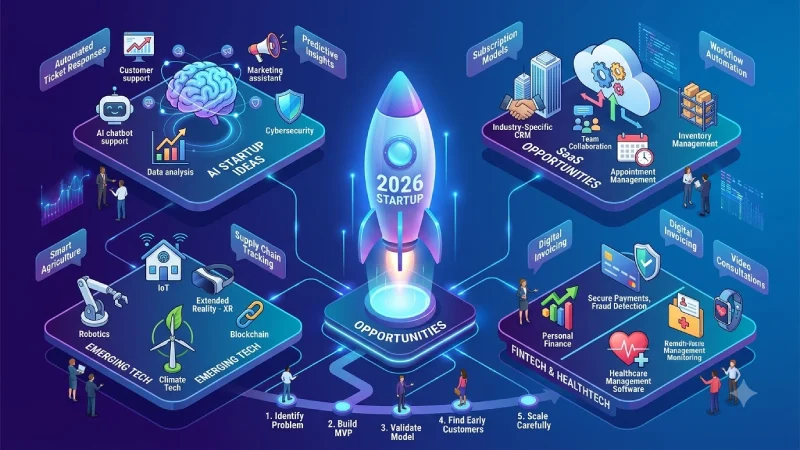
Not all good ideas of starting up tech companies involve inventing new technology. Some of the best ideas have been realized through use of existing technologies for solving specific problems in particular industries or customer needs.
The guide examines the top tech startup ideas for 2026 including opportunities in AI and SaaS, Emerging technology trends businesses, fintech and healthtech ideas and the process of launching a successful technology startup.
AI Startup Ideas for 2026
There are many opportunities that have been created by artificial intelligence in virtually every industry. There are several ways that entrepreneurs can take advantage of this technology.
AI Customer Support Platform
Build an AI‑enabled customer service system that will allow companies to answer queries and help their customers around the clock. The AI‑enabled customer service system should be able to respond to questions at any time.
Potential features include:
- AI chatbots
- Automated ticket responses
- Knowledge base integration
- Multilingual support
- Human agent handoff
The platform may target particular sectors such as e-commerce, healthcare, education, or financial sector.
AI Marketing Assistant
Create a platform that helps small businesses manage their marketing activities.
Possible features include:
- Content generation
- Social media planning
- Email campaign creation
- SEO suggestions
- Audience analysis
A niche-focused AI marketing tool can be easier to spot and stand out compared to a general-purpose platform.
AI Data Analysis Tool
Business produce many data but lack data analysts for their work. An AI-powered analytical tool will make it easy to convert such complicated datasets into understandable insights.
Features could include:
- Automated dashboards
- Natural-language data queries
- Trend identification
- Forecasting
- Business reports
AI Cybersecurity Solution
Create AI-based tools that assist organizations to detect suspicious activities and any security threats.
Potential services include:
- Threat detection
- Anomaly monitoring
- Automated alerts
- Security reporting
- Employee security training
AI Education Platform
Construct an adaptive learning environment that creates personalized instruction for each individual learner.
It could provide:
- AI tutors
- Personalized study plans
- Automated quizzes
- Homework assistance
- Progress tracking
AI Video and Audio Tools
Digital content generation leads to chances for applications that allow the creation of media in an efficient manner.
Potential products include:
- AI video editing
- Automatic subtitles
- Audio cleanup
- Video summarization
- Content repurposing
SaaS Startup Ideas for New Founders
SaaS allows new entrepreneurs to provide their software in the form of subscription services. The problem is that it is not necessary to develop a software for all people but just for a specific target audience.
Industry-Specific CRM
Build a customer relationship management platform designed for one industry.
Examples include:
- CRM for real estate agencies
- CRM for law firms
- CRM for recruitment companies
- CRM for healthcare providers
- CRM for marketing agencies
A specialized CRM can offer features that general platforms may not provide.
Team Collaboration Software
Create a simple platform for remote and hybrid teams.
Useful features may include:
- Task management
- Team messaging
- File sharing
- Project tracking
- Workflow automation
Appointment Management SaaS
Develop scheduling software for businesses that rely on appointments.
Target customers could include:
- Clinics
- Salons
- Consultants
- Tutors
- Fitness professionals
Inventory Management SaaS
Help small retailers and e-commerce businesses monitor stock levels and manage orders.
Potential features include:
- Inventory tracking
- Low-stock alerts
- Supplier management
- Sales reports
- Automated purchasing suggestions
Compliance Management Platform
Businesses operating within regulated industries should manage their policies and documentation.
A SaaS platform could help organizations:
- Track compliance tasks
- Manage documentation
- Schedule audits
- Monitor deadlines
- Generate reports
SaaS Startup Comparison
| SaaS Idea | Target Market | Revenue Model |
| Industry CRM | Specialized Businesses | Monthly Subscription |
| Team Collaboration | Remote Teams | Per-User Pricing |
| Appointment Software | Service Businesses | Monthly Plans |
| Inventory Management | Retailers | Subscription |
| Compliance Platform | Regulated Industries | Subscription |
Emerging Tech Business Opportunities
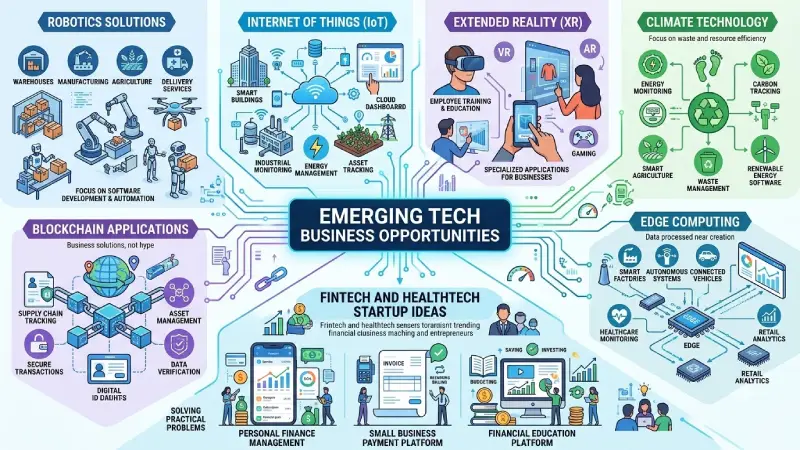
Apart from AI and SaaS, there are some other new technologies that offer chances to entrepreneurs.
Robotics Solutions
Businesses can develop robotics solutions for:
- Warehouses
- Manufacturing
- Agriculture
- Healthcare
- Delivery services
Instead of pouring money into building robots, companies would be better off concentrating on developing software.
Internet of Things (IoT)
IoT startups can connect physical devices and collect useful data.
Potential applications include:
- Smart buildings
- Industrial monitoring
- Agriculture
- Energy management
- Asset tracking
Extended Reality (XR)
Virtual and augmented reality technologies can support:
- Employee training
- Education
- Gaming
- Virtual events
- Product visualization
Startups can build specialized applications for businesses rather than competing directly in consumer hardware.
Climate Technology
Technology can help organizations reduce waste and improve resource efficiency.
Startup opportunities include:
- Energy monitoring
- Carbon tracking
- Smart agriculture
- Waste management
- Renewable energy software
Edge Computing
Edge computing is a type of computing where data is processed near the point of creation. This offers an advantage for sectors that need quick data processing.
Potential applications include:
- Smart factories
- Autonomous systems
- Connected vehicles
- Healthcare monitoring
- Retail analytics
Blockchain Applications
Blockchain technology can support business applications involving:
- Digital identity
- Supply chain tracking
- Asset management
- Secure transactions
- Data verification
Founders should focus on solving practical problems rather than adopting blockchain simply because it is a trending technology.
Fintech and Healthtech Startup Ideas
Fintech and healthtech are two sectors where technology can address important real-world challenges.
Fintech Startup Ideas
Personal Finance Management
Create an app that helps users:
- Track spending
- Create budgets
- Monitor subscriptions
- Set financial goals
Small Business Payment Platform
Create payments methods that suit small businesses and independent professionals.
Potential features include:
- Digital invoicing
- Payment processing
- Recurring billing
- Expense tracking
Financial Education Platform
Build an educational platform that helps users learn about:
- Budgeting
- Saving
- Investing
- Credit management
Fraud Detection Technology
Develop software that helps financial institutions identify unusual transactions and potential fraud.
AI and machine learning can be used to analyze patterns and detect suspicious activity.
Healthtech Startup Ideas
Telehealth Platform
Create digital tools that connect patients with healthcare professionals remotely.
Features could include:
- Video consultations
- Appointment scheduling
- Digital records
- Secure messaging
Healthcare Management Software
Build software that helps clinics manage:
- Patient appointments
- Records
- Billing
- Staff schedules
Remote Patient Monitoring
Develop technology that helps doctors keep track of patients from away using connected devices. This technology lets doctors watch patients without needing them on site.
Mental Wellness Platform
Create digital tools that provide:
- Guided wellness programs
- Meditation resources
- Stress management
- Professional support connections
Health Data Management
Create robust platforms to allow users and care professionals to manage health-related information effectively.
Remark: Noteworthy: Fintech and HealthTech companies have various regulations concerning security and privacy issues. Consequently, it is vital for the founders to know everything about the legalities in these fields prior to entering
How to Build a Successful Tech Startup from Scratch
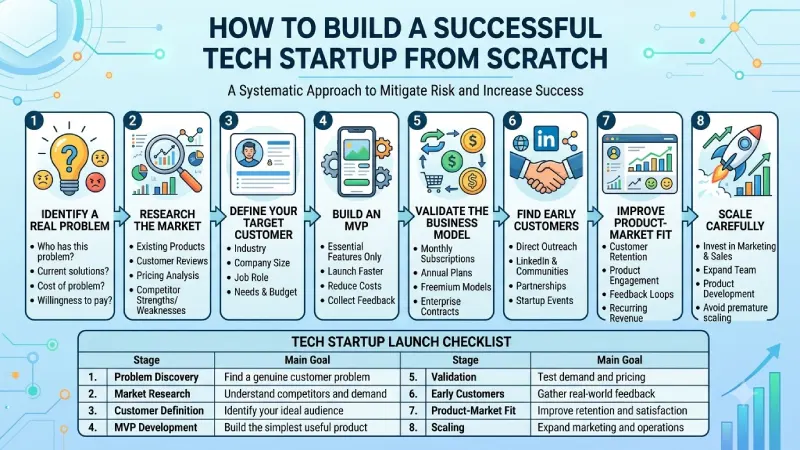
A good idea alone is not enough, for establishing a technology business. A new technology business needs a plan that keeps you safe and ensures success.
Step 1: Identify a Real Problem
Start by identifying a specific problem that customers experience regularly.
Ask:
- Who has this problem?
- How are they solving it today?
- How much does the problem cost them?
- Would they pay for a better solution?
Step 2: Research the Market
Study your target audience and competitors.
Analyze:
- Existing products
- Customer reviews
- Pricing
- Competitor strengths
- Competitor weaknesses
Look for gaps that your startup can address.
Step 3: Define Your Target Customer
Avoid trying to serve everyone at the beginning.
Create a clear customer profile based on:
- Industry
- Company size
- Job role
- Needs
- Budget
A narrow target audience helps product development to be more precise.
Step 4: Build an MVP
Develop Minimum Viable Product. The Minimum Viable Product must include the basic features that will address the core problem.
An MVP allows you to:
- Launch faster
- Reduce development costs
- Collect feedback
- Test customer demand
Step 5: Validate the Business Model
Determine how your startup will generate revenue.
Common models include:
- Monthly subscriptions
- Annual plans
- Usage-based pricing
- Transaction fees
- Freemium plans
- Enterprise contracts
Step 6: Find Early Customers
Start with a small group of potential customers.
You can reach them through:
- Direct outreach
- Industry communities
- Partnerships
- Content marketing
- Startup events
Early customers can provide valuable feedback before you scale.
Step 7: Improve Product-Market Fit
Use customer feedback and usage data to improve your product.
Focus on:
- Customer retention
- Product engagement
- Conversion rates
- Customer satisfaction
- Recurring revenue
Step 8: Scale Carefully
Once you have consistent demand, invest more in:
- Marketing
- Sales
- Product development
- Customer support
- Team expansion
Avoid scaling too quickly before confirming that your business model works.
Tech Startup Launch Checklist
| Stage | Main Goal |
| Problem Discovery | Find a genuine customer problem |
| Market Research | Understand competitors and demand |
| Customer Definition | Identify your ideal audience |
| MVP Development | Build the simplest useful product |
| Validation | Test demand and pricing |
| Early Customers | Gather real-world feedback |
| Product-Market Fit | Improve retention and satisfaction |
| Scaling | Expand marketing and operations |
FAQ
What could be some of the most interesting startup ideas for the technology industry in 2026?
They could range from numerous, but some of the most common would include AI-based solutions (like chatbots, marketing assistants, data analysis tools), unique SaaS software solutions, fintech solutions, healthtech solutions, IoT, and climate tech solutions. The most successful idea is the one which solves a very concrete pain point of some customer segments.
Does it have to be an invention of brand new technology?
No. Many of the best startups simply use already existing technology in a smart way to solve an existing problem within a particular industry/customer segment.
What is the right approach to begin with?
Find out the problem, talk about it with your future customers, create MVP with basic features, find early adopters without spending a lot of resources on development or promotion.
Niche or general?4. Should my product be niche or general?
Almost always niche wins. CRM for real estate agents or AI tool for e-commerce companies is easier to sell and differentiate then universal platform for all industries.
Conclusion
Tech industry keeps showing good potential for entrepreneurs in 2026. There are numerous emerging technologies such as AI, SaaS, cybersecurity, fintech, healthtech, IoT, robotics, etc. which give room for startup companies capable of addressing particular problems.
Not all innovative tech company ideas are difficult ones but the ones that help solve a specific customer issue and have a business model that brings profit. Selecting a niche, checking whether there is any demand for the product and developing an MVP can help decrease the risks in the beginning of entrepreneurship journey.
No matter what type of product or solution your company will be working on, whether it will be some AI app or niche SaaS software, emerging technologies still keep showing their potential for business.
To take the next step, see our detailed guide on startup ideas by industry