


So hey, you have probably been planning to start something of your own for quite some time. You are tired of the current routine at work or you are looking for greater freedom and opportunities. Or maybe you have seen something on the internet and you decided you can do it yourself.
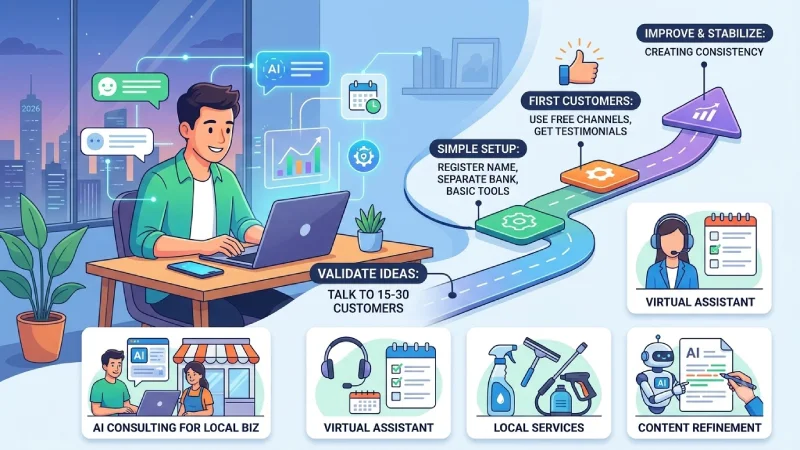
Yes, you are definitely not alone in having these types of ideas. I have talked to many founders for the first time, and all of them shared certain worries. Where do I start? Am I choosing the wrong idea? How much capital do I need? Am I going to look like a fool after failing?
Well, this guide is written for all of you in 2026. No complicated terminology. No inspirational talks on how to hustle more. Just pure practice with simple tips, risk-free approaches, how to validate your idea, step-by-step guide and typical beginner mistakes.
I will try to be brief. Sometimes things may look a little bit messy since real-life business is messy itself. It is okay. Nothing works perfectly in real life.
Just one last thing from me: most of the failures of first-time founders happen not because of a bad idea but because of lack of
For the overarching strategy, read our complete guide on Startups
Why 2026 Is Actually a Good Time for Beginners
- Things have changed. AI tools make a lot of work faster and cheaper. You can start many businesses with a laptop and a few hundred dollars. Remote work is normal. People are used to buying services and products online from individuals, not just big companies.
- Looking at the numbers: Around 20-22% of new businesses in the US close in the first year. By year five it’s closer to half. This is quite frightening, but business services and low-cost business models tend to perform well compared to large products or technology ventures. Beginners do not fare as well as repeat performers (about 18% against 30% for repeat performers), but this gap is closed when starting small.
- AI consulting and related services are exploding. The AI consulting market was about $16.4 billion in 2024 and is projected to grow at over 35% a year for years. Virtual assistant work is also strong, with solid growth projected. Freelancing and gig-type services keep expanding too.
- In places like India, setup is often cheaper and faster than in the US or Europe. In the US or Europe you might deal with more paperwork and higher costs, but customer willingness to pay is usually higher. Asia-Pacific has been growing fast in many service categories. The point is — your location matters less than it used to if you go online or local services.
- Enough background. Let’s get into the useful parts.
Easy Startup Ideas for First-Time Founders
These are examples of things that newbies are beginning with at this very moment. I have selected those which do not require years of expertise, huge amounts of money, or any tech team. Almost all can begin with less than $1,000. Some even under $200.
- AI-assisted services for small businesses
AI is something that local businesses and solopreneurs know about but have no clue about how to use. You ensure that the fundamentals are clear by assisting them in setting up AI tools. Initial cost: mostly for tool subscriptions (per month $20 to $100).
How it works: Offer a free or cheap audit first. Show them one clear improvement. Charge for setup and monthly support.
Realistic early earnings: $500-2,000/month once you have a few clients. Top people go higher with retainers.
Why does it work for beginners? You do not have to know everything about AI. Just get yourself good at 3-4 tools. - Virtual assistant or specialized admin help
Managing emails, scheduling, research, social media posts, or accounting for busy professionals.
Cost: next to nothing except a computer and access to the internet.
Website: Upwork, Belay, or contact local businesses and coaches directly.
Income: $20-50+ per hour, depending on skills and geographic location. The income can go up to $2,000-$4,500 per month.
Suggestion: specialize (real estate VAs, podcast VAs, e-commerce VAs). - Content cleanup and refinement
The company utilizes artificial intelligence in writing blogs, social media, video content, and email but requires human intervention to ensure that the content sounds authentic. This requirement increased drastically from 2025 to 2026. Cost: Low.
Earnings: project-based or retainers. Good rates because quality still matters. - Local service businesses
Cleaning services, power washing, mobile detail services, junk removal, pet sitting, or handyman services.
These score well on low risk and speed to first money. Equipment can start used and modest.
Many people clear a few thousand a month once they get a routine and some reviews. - Print-on-demand or simple digital products
Designs on shirts, mugs, or digital downloads (planners, templates, checklists). No inventory.
Cost: mostly design tools and ad testing.
Slower to first real money than services, but more passive later. - Niche freelancing with your existing skills
Writing, graphic design, video editing, social media marketing, tutoring, or accounting. Use AI to speed yourself up and charge normal human rates.
This is still one of the fastest ways to first dollars.
Here’s a simple comparison table I put together from recent data and common ranges:
| Idea | Startup Cost | Time to First Money | Scalability | Main Risk | Best For |
| AI consulting / setup | Under $500 | 2-6 weeks | High | Standing out | People comfortable learning tools |
| Virtual assistant | Under $300 | Days to weeks | Medium | Trading time | Organized people |
| Local cleaning / detailing | $500-2,000 | Weeks | Medium-High | Physical work / scheduling | Hands-on folks |
| Content cleanup / writing | Under $200 | 1-4 weeks | Medium | Competition | Strong writers/editors |
| Print-on-demand | Under $300 | 1-3 months | High | Ads and design | Creative types |
| Specialized freelancing | Under $200 | Days to weeks | Medium | Client acquisition | Anyone with a skill |
Services usually win for beginners who need income soon. Product ideas take longer but can grow without your constant time.
Pick something close to skills or interests you already have. Starting completely cold is harder.
Beginner-Friendly Business Ideas with Low Risk
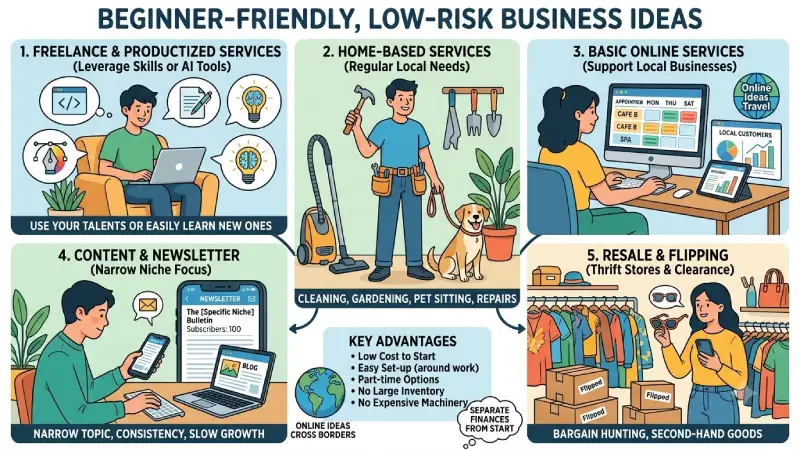
Low risk means there is little startup costs. It is easy to put into place without getting in the way of your work. If it does not work you can undo what you did. The people you are trying to reach buy a product that is connected to this one.
Top low-risk picks right now:
- Freelance or productized services based on skills which you have or can learn through AI.
- Home-based services in your area which people require regularly (cleaning, gardening, pet sitting, small fix-it jobs).
- Basic online services like scheduling appointments for local businesses or research about their customers.
- Content or newsletter in a narrow niche if done consistently (slow money, but low initial investment).
- Resale and flipping (used goods, thrift store, clearance) if bargain hunting is your thing.
They do not involve large amounts of stock, costly machinery, lengthy leases, or even hiring staff initially. They are mostly suited for part-time operations.
Country differences matter a bit. In the US and Western Europe, customers pay more for convenience and quality services. In India and parts of Asia, lower costs and large local markets make service and digital ideas attractive, and registration is often cheaper and faster. Online ideas travel well across borders.
Risk is not zero anywhere. Many companies fail because of cash flow issues .It is vital to make sure that business and personal finances are completely separated right from the start.
How to Validate a Startup Idea as a Beginner

This is the part most people skip, and it’s why so many struggle.
Validation is the process of confirming that the problem exists among the target group and that the customers will pay for the solution.
Simple process that works:
- Write down the problem clearly. Who has it? How painful is it? How do they solve it now? Be specific. “Busy local service businesses struggle with inconsistent follow-up and missed appointments” is better than “people need better scheduling.”
- Talk to 15-30 real potential customers. Not friends who will be nice. Actual people in your target group. Ask about how they do things now, their frustrations, what they have tried before, and what is consuming their time or resources. Do a lot more listening than talking. Don’t pitch your idea early.
- Look for willingness to pay. A landing page with a waitlist or pre-order option is good. Even better: get a few people to pay a small deposit or buy a manual version of the service (you do it by hand at first — “concierge MVP”).
- Check the numbers roughly. Is the market big enough for the life you want? How many potential customers are there? What do similar services charge?
- Run a cheap test. Offer the service manually to 5 people. Or run a small ad and see if people click and inquire. Or post in relevant groups and measure real interest (not just likes).
If people only say “sounds interesting” but won’t take action, the signal is weak. Real money or clear commitments matter more than compliments.
This process can take 2-4 weeks and cost almost nothing. It saves you months of building the wrong thing. Many sources keep repeating the same truth: no market need is still one of the top reasons startups fail.
Do this even for “obvious” ideas. Markets change.
Step-by-Step Guide to Launching Your First Startup
Here’s a practical sequence that fits most beginner ideas in 2026.
Week 1-2: Choose and validate
Pick 1-2 ideas that match your skills, time, and risk tolerance. Do the customer conversations. Decide based on evidence, not just excitement.
Week 2-3: Basic setup
- Register a simple business name if needed (rules vary by country — often cheap and fast online).
- Get a separate bank account or at least track money clearly.
- Create basic tooling: emails, simple website or Linktree, invoicing (there are lots of free tools for that), and AI tooling, if there is any.
- Create simple offers: your services, price, and how to start.
Week 3-4: Get the first customers
- Use free or cheap channels first: personal network, local Facebook/Nextdoor groups, LinkedIn, relevant online communities, Google Business Profile for local services, Upwork/Fiverr for online services.
- Give a good offer in terms of your first client discount or trial version to get a testimonial.
- Do it right. Over communicate. Get feedback and referrals.
Month 2-3: Improve and stabilize
- Keep an eye on what works (sources of leads, complaints, compliments).
- Then increase your rates after proving what works.
- Create easy procedures which don’t need to be continually reinvented (templates, checklists, automation).
- Strive for consistency (profit weekly, profit monthly), and then scale or quit your day job.
Ongoing
Keep talking to customers. Watch cash closely. Don’t hire or buy fancy stuff until the numbers clearly support it.
Most people who reach steady income did the unsexy work of talking to customers and delivering reliably week after week. The fancy branding and perfect website can come later.
Common Mistakes Beginner Entrepreneurs Make
I’ve seen these over and over. Avoid them and your odds go up a lot.
- Skipping validation and building too much too soon.
- Running out of cash or mixing personal and business money. Cash flow issues show up in a huge percentage of closures.
- Pricing too low out of fear, then resenting the work.
- Trying to do everything alone for too long or hiring the wrong people too early.
- Chasing every shiny new idea instead of finishing and improving one.
- Ignoring the boring stuff: basic tracking of money, simple contracts, taxes.
- Comparisons of oneself with success stories that emerge out of nowhere on social media (most of these do not reflect reality).
- Rapid growth based on minimal traction (producing more items, opening new branches, hiring more employees).
- Not specializing enough — trying to serve everyone makes marketing and delivery harder.
- Giving up right before the consistency starts paying off.
First-year failure rates hover around 20-22% overall. Many of those are preventable with better early checks and tighter money management.
Frequently Asked Questions
How much money do I really need to start?
Many solid beginner options start under $500 or even under $200. Services are usually cheapest. Product ideas cost more if you need inventory or ads. Have a small buffer for living expenses if you’re going full-time.
Can I start while keeping my job?
Yes, and for most people that’s the smarter way. Many of the ideas above work with 10-15 focused hours a week at first.
How long until I make real money?
Services can produce first dollars in days or weeks. Building something more passive often takes months. Possible starting earning range for hard work and part-time effort would be a few hundred dollars per month up to thousands a month depending on how it goes.
Is AI going to replace these ideas?
AI is creating more demand for human help in setup, cleanup, strategy, and specialized services than it’s killing for beginners right now. Use the tools instead of competing against them.
What if I live outside the US?
Many online and service ideas work globally. Local services depend on your area. Setup costs and taxes differ — India and some European digital options can be quite affordable.
Do I need a fancy website or logo first?
No. A clear offer, way for people to contact you, and ability to deliver matter more at the start.
What about funding or investors?
For most beginner ideas, bootstrap. Outside money comes with pressure and loss of control. Prove the idea first.
How do I know when to quit an idea?
If after doing a true validation and a true test (customer interviews + sending some products), the signals are still poor and you’re not gaining anything valuable, then don’t hesitate to leave. Don’t give up just because it’s difficult during week three.
Conclusion
2026 will be an easier year than ever to launch your first venture, if you make it straightforward and test smartly. Winning newcomers choose an easy idea, speak with real prospects quickly, deliver reliably and spend wisely.
The idea itself isn’t required to be perfect or expensive. You should have a clear problem, proof of demand and readiness to adapt according to feedback received.
Choose one business opportunity described in this cluster. Speak with several potential clients this week. Provide something small. Watch what happens.
Almost every good business is started exactly like that – not with a splash but with real conversations and first paying client.
If you struggle with any part of the process or need more details regarding certain topic mentioned above, check other articles of this cluster on the same website. They cover various profitable angles, low cost opportunities, internet businesses, technological ventures and specific industries.
Go out there and start something small. The only way to learn is to do it. You can do it.
To take the next step, see our detailed guide on profitable startup ideas.