


Look, most people chase revenue. Big numbers sound good. But revenue without margin is just a busy job that leaves you tired and broke. I’ve seen it too many times. Someone builds a store doing $30k a month and takes home almost nothing after ads, product costs, and refunds. Meanwhile the quiet consultant or AI automation person doing half that revenue is actually banking real money.
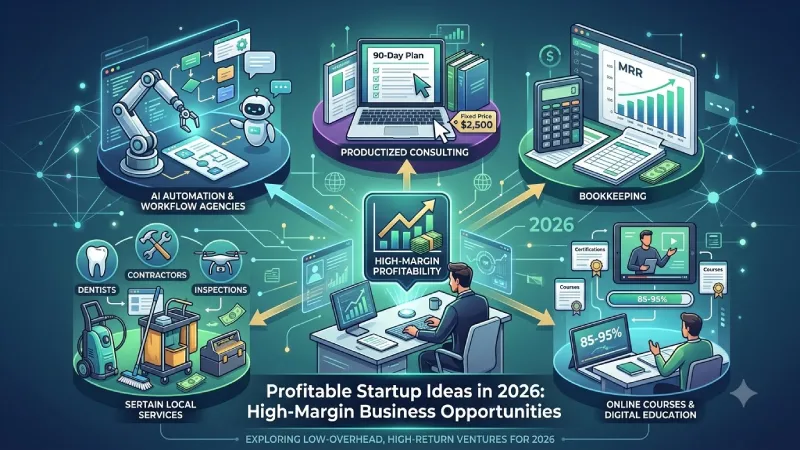
This piece is about the second kind of business. The ones that keep more of every dollar. High margin. Lower overhead. Better chance of real profit in 2026.
I’m not going to pretend every idea here will make you rich. Nothing does that. But the patterns are clear from what is actually working right now. Service businesses with almost no cost of goods. Digital products. Narrow vertical tools. Certain local services that people pay for without shopping around too hard.
Let’s get into it.
For the overarching strategy, read our complete guide on Startups
Most Profitable Startup Ideas for 2026
Here is what keeps showing up when you look at actual margins and how fast people get to profit.
AI automation and workflow agencies
Businesses still do not know how to use AI properly. They try ChatGPT, get mediocre results, and give up. Someone who can come in, map their actual processes, and set up reliable systems charges $2,000 to $10,000 a month in retainers. Gross margins often land between 60% and 85%. Net can stay high if you do not hire a big team too early. Demand is strong because the labor savings are real and easy to show.
Productized consulting or specialized advisory
Take one skill you already have — SEO for a specific industry, financial modeling for startups, compliance help, operations for trades — and sell it as a fixed package instead of hourly. “90-day SEO action plan for $2,500” instead of “$150 an hour.” Margins run 40-60% net in many cases because overhead is basically your laptop and software. This is one of the cleanest ways to make money if you already know something useful.
Bookkeeping and accounting for small businesses
Every small business needs clean books. Recurring monthly fees of $300 to $800+ per client. Software costs are low. Margins commonly 50-70% or better once you have a handful of clients. Sticky revenue. Clients do not leave easily if you do good work.
Online courses and digital education in regulated or high-stakes niches
Continuing education for people who need credits (real estate, nursing, accounting, certain trades) or practical skill courses that solve expensive problems. Gross margins can hit 85-95% after the course is made. The hard part is creating something good and getting the first students. After that the cost to deliver is almost nothing.
Vertical SaaS or simple tools for underserved industries
Software for pest control companies, tattoo studios, small contractors, dental offices — places big software companies ignore. Gross margins in SaaS average around 77%. Net takes longer because you have to build and support it. But once it works, adding customers does not add much cost.
Certain local service businesses
Clean commercial jobs, pressure washing, mobile detailing, handyman services. Low margin jobs, but money comes in quickly and overhead remains low if you are smart about starting out. There is always demand. And some guys make routes that pay off for years to come.
Here is a rough comparison of the better options right now:
| Business Type | Typical Gross Margin | Net Margin Range | Startup Cost Feel | Time to First Profit | Notes |
| AI automation agency | 60-85% | 50-75% | Very low | Weeks to a couple months | High demand, needs delivery skill |
| Productized consulting | 80-90% | 40-60% | Very low | Fast | Best if you already have expertise |
| Bookkeeping / tax services | 60-75% | 30-55% | Low | 1-3 months | Recurring and sticky |
| Online courses (good niche) | 85-95% | 70-85% | Low to medium | 3-6+ months | High once built |
| Vertical SaaS | ~77% | 20-35% | Medium to higher | Longer | Scales well later |
| Digital marketing agency | 50-75% | 20-40% | Low | 1-3 months | Competitive |
| Commercial cleaning / pressure washing | 40-60% | 25-45% | Low to medium | Weeks | Physical but reliable |
Numbers come from operator reports and industry data floating around in 2026. Your actual results will depend on pricing, how well you deliver, and how controlled your costs stay.
Observe the trend. The biggest margins tend to result from the sales of skills, tool access, or knowledge rather than physical goods that must be purchased, stored, and delivered.
High-Margin Business Ideas with Low Overhead
Low overhead is the quiet killer of stress. When your fixed costs are tiny, every new dollar of revenue has a better chance of becoming profit.
Best examples right now:
- Any form of consulting or specialized freelancing you can productize
- Bookkeeping and basic financial services
- AI setup and ongoing automation support
- Digital products (templates, Notion systems, prompt packs, mini-courses, checklists)
- Content and copywriting services, especially if you use AI to increase output without dropping quality
- Niche newsletters or membership communities once they get traction
These businesses mostly need a computer, internet, some software subscriptions, and your time. No warehouse. No big team at the start. No expensive equipment.
Compare that to something like a regular retail store or a food business. Inventory, rent, staff, spoilage, returns — the overhead eats margin fast. Many of those businesses run on single-digit net margins and live or die by volume.
In 2026 the tools make low-overhead even easier. AI handles first drafts, research, basic design, and customer replies. You still need judgment and quality control, but the pure labor hours drop.
One practical tip: track your real costs from day one. Software, ads, contractor help, your own time valued at some reasonable rate. A lot of people think they have high margins until they actually write the numbers down.
Scalable Startup Ideas for Long-Term Profit
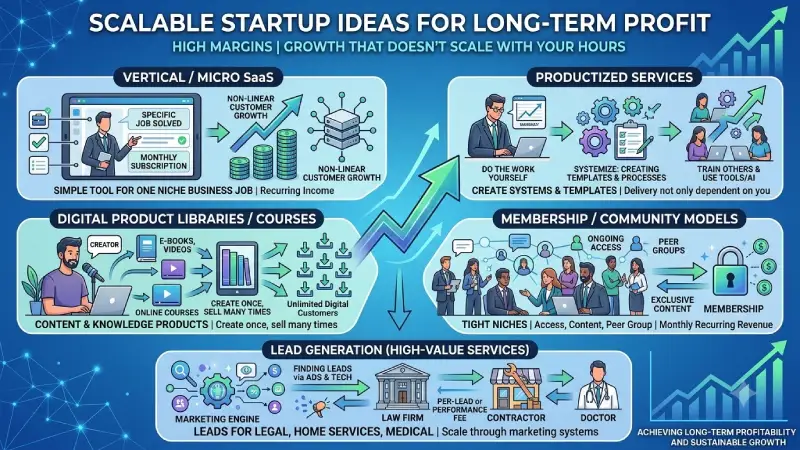
High margin is good. High margin that can grow without your hours growing at the same rate is better.
Scalable options that still make sense for individuals or small teams:
Vertical or micro SaaS
Build a simple tool that solves one painful job for one type of business. Charge monthly. Once the product works and support is manageable, adding customers does not require linear hiring. Growth rates in good vertical SaaS have been solid. The trade-off is it usually takes longer to get to revenue than pure services.
Productized services that can be partially systemized
You start by doing the work yourself. Then you create templates, checklists, and eventually train other people or use tools so the delivery does not depend only on you. Some AI automation agencies and specialized marketing shops have done this well.
Digital product libraries or course platforms
Create once, sell many times. Add new products over time. The limit is mostly marketing and reputation, not production capacity.
Membership or community models in tight niches
People pay monthly for access, ongoing content, or peer group. Harder to start than people admit, but once the community has value it can stick around for years.
Lead generation for high-value local or professional services
Finding leads for law firms, contractors, doctors, and other people offering home services; compensation can be done either per lead or on a performance basis. The business can scale through ads and technology provided it makes economic sense.
Scaling does not work in: pure hourly freelancing without systems in place, customization of everything from scratch for every client, and businesses where your physical presence is required on a daily basis without any means of leveraging others.
However, it is crucial to mention that while talking about profit in the long run, one may refer to any or both of these aspects.
Niche Business Ideas with Strong ROI
Big markets are congested and price sensitive. Niches tend to allow higher prices and lower customer acquisition costs since the people who need your products already experience the problem.
Examples that have been working:
- AI tools or services specifically for dentists, accountants, real estate agents, or contractors
- Bookkeeping only for e-commerce sellers or only for therapists
- One professional compliance / continuing education content
- Professional cleaning (medical offices, short-term rentals, post-construction)
- Applications to perform a specific task or pursue a specific hobby (Project Management Notion System applications, Wedding Planner Applications, etc.)
- Niche products with high perceived value, such as jewelry, custom accessories, or home solutions where customers don’t automatically choose the most inexpensive option
A strong ROI in this case generally implies two things: the customers will spend more or more time shopping, and it will not be too costly to acquire them in relation to their price.
One way of looking at it: If you can land yourself a client through $200 worth of effort and charge him/her $150 per month over a period of a year with low delivery costs, the numbers make sense regardless of the size of volume. For a number of other large companies, however, the large volume is required for making such profits.
How to Evaluate the Profitability of a Startup Idea
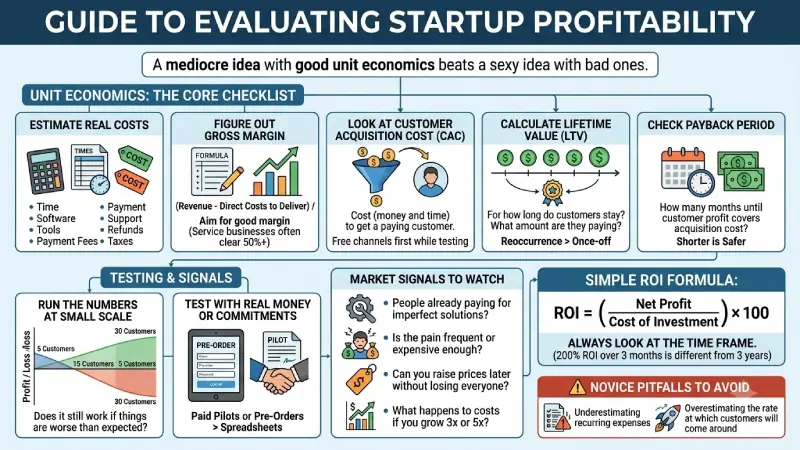
This part matters more than the list of ideas. A mediocre idea with good unit economics beats a sexy idea with bad ones.
Here is a practical way to check:
- Estimate real costs to deliver
Not just the obvious ones. Include your time, software, tools, payment fees, ads, support, refunds, taxes. Be honest. - Figure out gross margin
(Revenue minus direct costs to deliver) / Revenue. Aim for something that leaves room after your other expenses. Many service businesses clear 50%+ gross. Physical product businesses are often lower. - Look at customer acquisition cost (CAC)
How much does it cost, in money and time, to get a paying customer? Free channels first is smart while testing. - Calculate lifetime value (LTV) roughly
For how long do the customers stay? What amount are they paying? Reoccurrence is definitely better than once-off payments. - Check payback period
How many months until the profit from a customer covers what it cost to get them? Shorter is safer, especially early. - Run the numbers at small scale
What does profit look like with 5 customers? With 15? With 30? Does it still work if things are a bit worse than expected? - Test with real money or real commitments before going deep
A few paid pilots or pre-orders tell you more than any spreadsheet.
Other signals worth watching:
- Do people already pay for imperfect solutions to this problem?
- Is the pain frequent or expensive enough that solving it feels worth money?
- Can you raise prices later without losing everyone?
- What happens to costs if you grow 3x or 5x?
Simple ROI formula people use:
ROI = (Net Profit / Cost of Investment) × 100
But always look at the time frame. A 200% ROI in three months is different from 200% over three years.
Many novices tend to underestimate recurring expenses and overestimate the rate at which customers will come around.
A Few Real-World Notes for 2026
AI has changed the game for both opportunity and competition. It lowers the cost to deliver many services, which is good for margins if you use it well. It also means more people can offer similar services, so differentiation and actual results matter more.
Cash flow still kills businesses. High margin does not help if the money comes in late and expenses come in early. Get deposits or monthly retainers when you can.
Location still plays a role. In higher-cost countries you can often charge more. In lower-cost places your own expenses are lower and certain service businesses have huge local demand. Online ideas travel better than most people expect.
Do not neglect taxes, insurance, and contracts. These are dull topics unless something goes wrong.
Frequently Asked Questions
What is actually the most profitable type of business to start in 2026?
From the numbers floating around, specialized services and productized expertise still lead for most individuals — especially AI-related automation, bookkeeping, and consulting in a tight niche. Digital products and vertical tools can get there too but usually take longer.
How much profit margin should I aim for?
It depends on the model. Many healthy service businesses run 20-40%+ net after everything. Software can go higher at scale. Physical product businesses often live on less. The important part is that the margin supports the life you want and leaves room for mistakes and growth.
Are high-margin businesses harder to start?
Sometimes yes, sometimes no. The skill or trust barrier can be higher. But the capital barrier is often lower, which is why they suit people who do not want to (or cannot) put up big money.
Can these work part-time at first?
Most of the service ones can. That is how a lot of people start. The ones that need heavy building (certain software or big course libraries) are harder to do well in small scraps of time.
What if I do not have a special skill yet?
Choose a skill that is in high demand, or begin with a simple service while you gain skills.. Or partner with someone who has the skill. Starting from absolute zero is possible but slower.
Is dropshipping or general ecommerce still worth it?
It can work in the right niche with strong margins and branding, but average results are tougher than the service models above. Ad costs and competition are real. Many people do better treating it as a testing ground rather than the main plan.
Closing Thoughts
Profitability is not magic. It usually comes from keeping costs low relative to what customers will pay, solving a problem people already feel, and not scaling chaos.
The ideas that keep winning in 2026 for individuals and small teams are the ones where your main cost is your brain and your systems, not inventory or big overhead. AI automation help, specialized bookkeeping, productized consulting, good digital products, and certain local services sit in that zone.
Pick something close to skills or knowledge you already have or can get good at reasonably fast. Run the simple numbers. Talk to a few real potential customers. Deliver something small and get paid. Then improve.
This approach may lack the glamour of the flashy business decks but it’s how most of the people actually end up having successful businesses.
If you are interested in learning more about cheap solutions, Internet only strategies, or approaches to industries discussed separately, the other articles in this series have covered these issues from other perspectives. They can be read independently.
Now go crunch some numbers for the idea which grabbed your attention.
To take the next step, see our detailed guide on low-cost startup ideas