

The LinkedIn network will continue to be the best B2B marketing platform in 2026. The decision-makers are present there on a daily basis. They study the vendors, listen to industry news, and judge people as well as organizations.
Businesses who will succeed in LinkedIn marketing will look at this network as a system and not just some platform where one can randomly publish something or send out invitations to connect. They will build their personal profiles, post helpful content on a regular basis, use Sales Navigator to reach out to people accurately, and launch targeted ads if needed.
For the overarching strategy, read our complete guide on Social Media.
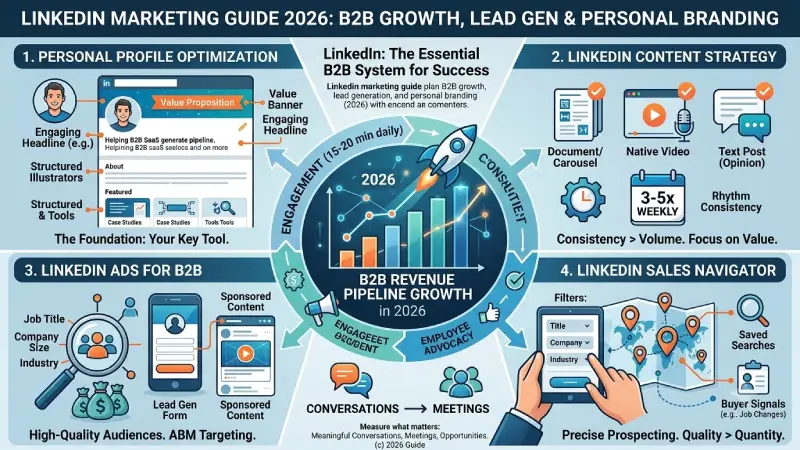
This guide is focused on the practice of LinkedIn marketing in business.
LinkedIn Profile Optimization
The profile is the foundation. This is what will attract people once they check out your posting or your comment. Even though you get a lot of people visiting your profile page, it is not going to matter if your profile page is not impressive.
Personal profile (most important for B2B)
Personal profiles receive much higher organic exposure than corporate profiles – typically five times as much. Founders, CEOs, and subject-matter experts must consider their personal profiles to be their key tools.
Key sections to optimize:
- Profile photo: Clear, professional, friendly headshot. Smile. Good lighting.
- Banner image: Use this space. Show your value proposition, a key result, or what you help people achieve. Don’t leave the default blue banner.
- Headline: Searchable and ubiquitous. Don’t just list your job title.
- Who you help is B2B SaaS companies. What result you deliver is pipeline. Credibility is proven through experience. “Helping B2B SaaS companies generate pipeline through LinkedIn | Founder at [Company]”
- About: Create a story that grabs attention. Explain who you help. Talk about the problems you fix for them. Describe how you do your job. Add a push for them to take action. Use words that people searching for solutions might type.
- Featured: Show your content. Share a case study. Offer a tool. Link to a booking page. This part gets a lot of attention.
- Experience: Focus, on the difference you make. Explain how your work changes things. Don’t just list what you do.
- Skills & Endorsements: Name the abilities that customers look for. Ask others to back you up on those skills.
Complete every section. Incomplete profiles get less visibility in search and weaker content distribution.
Company page
Useful for the sake of credibility and for serving as the base, but it must not be relied upon for carrying the primary content. It needs to be updated constantly, along with an About page, a banner, and Featured content. Employees should be encouraged to follow the blog.
LinkedIn Content Strategy
The content is where your attention and trust come from on a massive scale. The algorithm for the year 2026 takes into account variables like relevance and engagement other than numbers.
What performs well right now
| Format | Why It Works | Best Use Case |
| Document / carousel posts | High engagement, easy to save and share | Frameworks, checklists, step-by-step guides |
| Native video | Strong dwell time and reach | Short insights, demos, personal stories |
| Text posts with clear POV | Builds authority and discussion | Industry opinions, lessons learned |
| External links | Often reduce reach significantly | Use sparingly or put link in comments |
Practical content guidelines
- Post 3–5 times per week from personal profiles. Consistency matters more than daily volume.
- Focus on 2–3 core topics that match your expertise and your buyers’ problems. Stay in your lane long enough for the algorithm to understand who you are for.
- Write for dwell time. Strong opening lines, clear structure, and useful takeaways keep people reading.
- Saves are a powerful signal. Create content people want to come back to or share with their team.
- External links in the main post often hurt reach. Put the link in the first comment or use a soft CTA (“Comment ‘guide’ and I’ll send it”).
Simple weekly rhythm many B2B founders use
- Monday: Teaching or framework post
- Wednesday: Personal story, lesson, or customer result
- Friday: Observation, trend take, or question that invites discussion
Engage actively for 15 to 20 minutes each day. Give comments on postings by people on the target accounts that you are following. This generally results in more visits to your profile than your own posts.
LinkedIn Ads for B2B
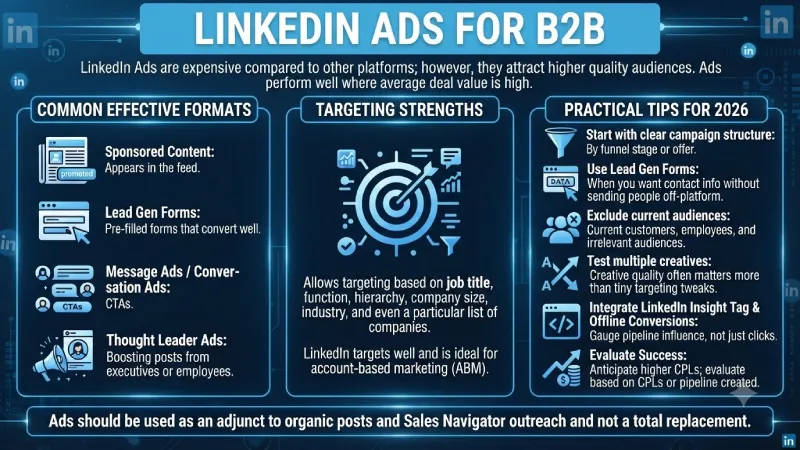
LinkedIn Ads are expensive in comparison to other platforms; however, they do attract higher quality audiences. The ads perform well where the value of average deals is high.
Common effective formats
- Sponsored Content (appears in the feed)
- Lead Gen Forms (pre-filled forms that convert well)
- Message Ads / Conversation Ads
- Thought Leader Ads (boosting posts from executives or employees)
Targeting strengths
LinkedIn allows targeting based on job title, function, hierarchy, company size, industry and even a particular list of companies. LinkedIn targets well and is ideal for account-based marketing.
Practical tips for 2026
- Start with clear campaign structure (by funnel stage or offer).
- Use Lead Gen Forms when you want contact information without sending people off-platform.
- Exclude current customers, employees, and irrelevant audiences.
- Test multiple creatives. Creative quality often matters more than tiny targeting tweaks.
- Integrate the LinkedIn Insight Tag and, whenever possible, offline conversions so that you can gauge pipeline influence rather than clicks alone.
- Anticipate cost per leads (CPL) costs to be higher than on Facebook or Google in most B2B verticals. Evaluate success based on CPLs or pipeline created.
Ads should be used as an adjunct to organic posts and Sales Navigator outreach and not a total replacement.
LinkedIn Sales Navigator
Sales Navigator is the paid prospecting tool built for serious B2B outreach. It gives advanced search filters, lead and account lists, saved searches, and better visibility into buying signals.
Core ways teams use it effectively
- Create specific lists based on filters such as designation and experience, company size and industry, geographics, and recent activities.
- Save your searches to receive weekly alerts on new contacts that match your requirements (recent job changes will be particularly useful).
- Create Account Lists for target companies, then search for the right personas inside those accounts.
- Use Spotlights and activity filters to prioritize people who are active or have recently changed roles.
- Track leads and accounts so your outreach stays organized.
Best practices
- Create an Ideal Customer Profile prior to list building.
- Always put quality before quantity. It is always better to have a small but focused list than a big messy one.
- Use Sales Navigator along with custom connection messages and follow-up sequences based on value.
- Do not try to sell in the first message. Show your interest first.
Sales Navigator pays for itself when it consistently helps book meetings that turn into pipeline. One or two extra deals per quarter usually covers the cost for most B2B teams.
LinkedIn Lead Generation Tactics
The strongest LinkedIn lead generation systems combine several approaches:
- Organic content → engagement → conversation Post useful content → engage with target accounts → turn profile visits and comments into DMs and meetings.
- Outbound with Sales Navigator Build targeted lists → send personalized connection requests → follow up with value → book calls.
- LinkedIn Ads Use Lead Gen Forms or traffic campaigns to capture interest from people you haven’t reached organically yet. Especially useful for ABM and scaling proven offers.
- Advocacy by employees and founders Make sure important personnel in your organization post content and become engaged. Their networks will likely be more effective than the company’s.
Practical daily/weekly habits that compound
- 15–30 minutes of strategic engagement (commenting on ICP posts)
- Consistent content from personal profiles
- Regular review of Sales Navigator alerts and saved searches
- Simple CRM tracking of LinkedIn conversations so nothing falls through the cracks
Measure what matters: number of views from target accounts, meaningful conversations initiated, meetings secured, and opportunities created. Number of followers and likes are secondary.
Putting It All Together
A pragmatic implementation of LinkedIn for most B2B firms in 2026 would be:
- Optimized personal profiles for founders and key experts
- Consistent, focused content (3–5 posts per week)
- Daily engagement with target accounts
- Sales Navigator for precise prospecting
- Selective LinkedIn Ads to amplify what already works
- Clear process for turning conversations into meetings
You don’t need to do everything at full intensity on day one. Start with profile optimization and consistent content. Add engagement habits. Then layer in Sales Navigator and ads once the foundation is solid.
LinkedIn rewards people who show up with useful ideas and treat others like professionals. Do that consistently for a few months and the platform becomes one of the most reliable sources of B2B pipeline available.
Frequently Asked Questions
Should I focus on my personal profile or the company page? Personal profiles. They receive significantly more organic reach and engagement. Use the company page mainly for credibility and amplification.
How many times should I post to LinkedIn?
Three to five times a week is ideal. It’s better to be consistent for longer periods than to do many posts every day.
Is LinkedIn Ads worth the higher cost? Yes, when your deal size is high enough to justify the CPL and you can measure pipeline impact. It works best alongside strong organic activity.
Do I need Sales Navigator?
If you do regular B2B outreach, yes. Because of the features like advance search, saved list and intention signals, it becomes extremely efficient when compared to the free one.
How long does it take to see results from LinkedIn marketing? Profile and content improvements can generate more profile visits and conversations within a few weeks. Consistent pipeline impact usually takes 2–4 months of steady activity.
To take the next step, see our detailed guide on TikTok Marketing.