

Every business knows that they “should be on social media.” Almost none take it seriously enough to actually act like it’s a growth channel. They post sporadically, hop from platform to platform, follow trends, and ask themselves why things aren’t compounding.
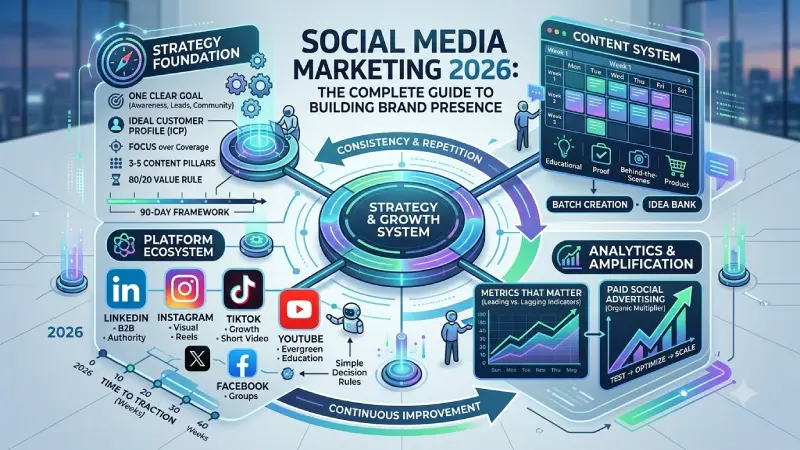
The brands that build presence in 2026 just follow a much more straightforward and disciplined path. They figure out the right platforms, create a proper strategy, provide useful content consistently, track the right metrics, and only promote using paid channels when it adds value to what’s already happening organically.
This guide is the definitive guide on this topic. It contains everything you need to know about creating a social media marketing strategy, the best platforms for your business, content planning that won’t kill you, important metrics to pay attention to, and how to promote yourself through paid channels in a smart way.
Social Media Marketing Strategy
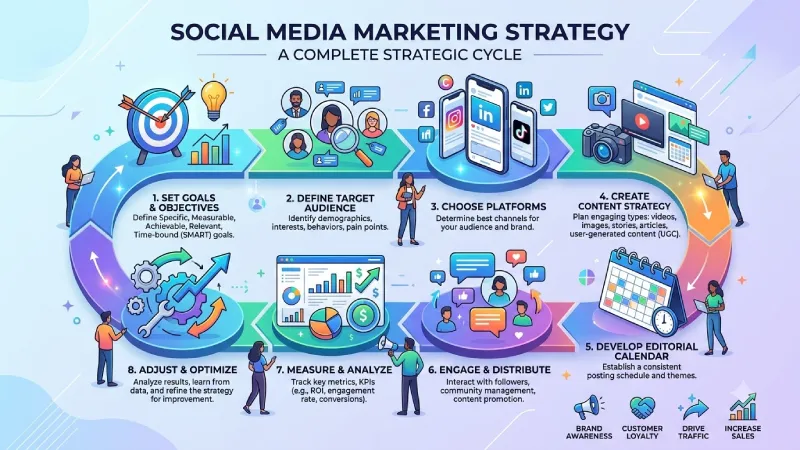
A proper social media strategy should fit in one page. When one needs 40 pages to outline a strategy, then it becomes difficult to implement.
Start with one clear goal
Pick the primary outcome you want over the next 6–12 months. Common options:
- Brand awareness (more people recognizing your name)
- Lead generation or sales
- Community and loyalty
- Hiring or employer branding
- Customer support and retention
Chasing all goals simultaneously will lead to disorganized efforts and poor outcomes. Decide on one goal to chase, and the other goals can follow secondarily.
Know exactly who you are talking to
Write down your ideal customer in plain language. Include:
- What problems they care about
- Where they already spend time online
- What kind of content they actually stop for
- What makes them trust a brand
This profile should guide every platform choice, content idea, and tone decision.
Choose focus over coverage
An average performance on five platforms can never compare with excellence on just one or two platforms. Most companies achieve more success by excelling on one particular platform for at least 90 days before introducing another platform.
Build around content pillars
Pick 3–5 themes that align perfectly with the issues your customers have or what your product is all about. All posts need to come under one of those themes. It keeps your posts relevant and helps you plan better.
Decide on a sustainable cadence
Be consistent, not intense. Posting two to four times per week on your primary social network is sufficient for most start-up and intermediate organizations. The key to daily posting is having a legitimate system and enough time to keep up the standards.
Apply the 80/20 rule
Allocate 80% of your efforts to value adding (knowledge, insights, conversation initiation) and leave 20% to speak about your products and offers. People enjoy following pages that add value for them instead of trying to sell to them.
Simple 90-day framework
- Weeks 1-14: Fine-tuning ICP, selecting primary platform, developing pillars and optimizing profiles.
- Weeks 15-60: Posting regularly, engaging regularly and collecting early results.
- Weeks 61-90: Focusing on what works, letting go of what doesn’t work, and deciding if secondary platform is needed.
The implementation is successful only when the team can successfully put their plans into action over several months after its launch.
How to Turn the One-Page Strategy into Weekly Actions
Only then will the strategies start making sense once implemented in your weekly schedule. Once you have completed creating an objective, target audience, communication channel, pillars of content, and schedule of posting, do not forget to implement everything in a weekly to-do list.
An efficient weekly routine is as follows:
- Monday – analysis of top posts from the previous week and identification of successful content
- Tuesday to Thursday – content creation and scheduling for the following week (batching is preferable)
- Every day – 20-40 minutes devoted to interaction with comments, related accounts, and conversations
- Friday – quick overview of visits, saves, and any incoming messages/leads
- Once a month – taking a bird’s eye view on your progress and modifying pillars/cadence accordingly
With the strategy converted into smaller and repetitive activities on a weekly basis, it will be much easier to achieve consistency.
Common Strategy Mistakes That Kill Consistency
Many teams start with good intentions and then lose momentum. These are the most common strategy mistakes:
- Setting too many goals at the same time
- Choosing platforms based on personal preference instead of audience behaviour
- Creating content pillars that are too vague
- Planning an unrealistic posting schedule
- Ignoring engagement and only focusing on broadcasting
- Changing the entire strategy every few weeks instead of giving it time to work
The most straightforward techniques are the ones that typically outlast the first month.
Strategy Differences: B2B vs B2C
The basic principles remain constant, but the focus varies.
| Aspect | B2B Focus | B2C Focus |
| Primary Goal | Trust, authority, lead generation | Awareness, desire, community, sales |
| Best Platforms | LinkedIn first, then YouTube or X | Instagram, TikTok, YouTube, sometimes Facebook |
| Content Style | Educational, insight-driven, professional | Visual, emotional, entertaining, lifestyle |
| Tone | Clear, helpful, credible | Friendly, relatable, energetic |
| Main KPI Examples | Profile visits from ideal buyers, inbound leads, demo requests | Saves, shares, website clicks, sales influenced |
Patience and depth is what B2B marketing requires. B2C marketing rewards speedier experimentation and creativity in terms of story-telling.
Goal → Platform → Content Style → Main KPI
| Main Goal | Best Platform Fit | Content Style | Main KPI to Watch |
| Brand Awareness | Instagram, TikTok, YouTube | Short, memorable, shareable | Reach, shares, profile visits |
| Lead Generation | LinkedIn, YouTube | Educational + clear next step | Profile visits, link clicks, leads |
| Community & Loyalty | Instagram, Facebook, LinkedIn | Conversations, stories, user content | Comments, saves, repeat engagement |
| Product Sales | Instagram, TikTok, Facebook | Product demos, proof, offers | Website clicks, conversions |
| Hiring / Employer Brand | LinkedIn, Instagram | Culture, team stories, values | Profile visits, applications |
This table will ensure that there is consistency within the strategy. The postings should be relevant to the overall objective and the key performance indicator (KPI).
How Strategy Should Evolve After the First 90 Days
The first 90 days is all about learning. After that, everything has to be simpler not more complicated.
Ask these questions at the 90-day mark:
- What content pillars received the greatest traction?
- Which platform do we feel most comfortable with and provides the best conversations?
- Are there any business indications already showing (profile visits from our ideal customers, direct messages, website traffic)?
- What do we feel is unsustainable and should be simplified?
Your responses should assist you in sharpening your pillars, figuring out how often you should post, and whether you need another platform altogether. Bear in mind that a good strategy gets easier, not harder.
Best Social Media Platforms for Business
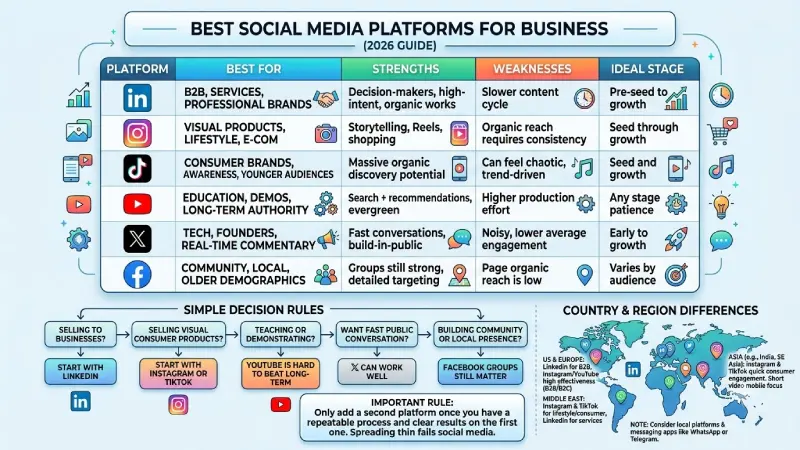
Not every platform will work for every company, however. It all depends on where your potential clients hang out and what sort of content you can generate.
High-level comparison for 2026
| Platform | Best For | Strengths | Weaknesses | Ideal Stage |
| B2B, services, professional brands | Decision-makers, high-intent, organic still works | Slower content cycle | Pre-seed to growth | |
| Visual products, lifestyle, e-com | Storytelling, Reels, shopping | Organic reach requires consistency | Seed through growth | |
| TikTok | Consumer brands, awareness, younger audiences | Massive organic discovery potential | Can feel chaotic, trend-driven | Seed and growth |
| YouTube | Education, demos, long-term authority | Search + recommendations, evergreen | Higher production effort | Any stage with patience |
| X (Twitter) | Tech, founders, real-time commentary | Fast conversations, build-in-public | Noisy, lower average engagement | Early to growth |
| Community, local, older demographics | Groups still strong, detailed targeting | Page organic reach is low | Varies by audience |
Simple decision rules
- Selling to businesses → start with LinkedIn
- Selling visual consumer products → start with Instagram or TikTok
- Teaching or demonstrating → YouTube is hard to beat long-term
- Want fast public conversation → X can work well
- Building community or local presence → Facebook Groups still matter
Only add a second platform once you have a repeatable process and clear results on the first one. Spreading thin is one of the most common reasons social media feels like it “doesn’t work.”
Deeper Platform Notes for 2026
It remains the best platform for most B2B businesses. The platform excels particularly well when there is a need to engage with decision makers or when professional services are at stake. It is more practical to build organic reach through this platform than through many others.
Remains the most powerful platform for all forms of visual branding, eCommerce, lifestyle, and service brands that can show their capabilities. The Reels are still driving discovery, but the Stories and the bio link are vital for conversion. It always pays to have consistency in visuals and personality on the platform.
TikTok
Best for those looking for quick organic reach and don’t mind using short videos. Best used by consumer brands, younger audiences, and companies that have the capacity to create authentic content. It can get rather chaotic, but consistency is important here.
YouTube
Platform based on longevity of authority. This platform is great for educating people, demonstrations of products, and tutorials. Even though the longevity is not as fast as TikTok and Instagram, longevity may be able to overcome that problem.
X (Twitter)
Helpful when instant communication is needed; useful for founder brands, technology, and fast industries. It favors clarity of views and regular attendance over quality production.
Still applicable to communities, local business owners, and the older generation. Organic reach through pages is low, but Groups and targeted advertising remain effective.
Country and Region Differences
Platform performance is not the same everywhere.
- Whereas in the US and many European countries LinkedIn tends to be the clear choice for B2B, in both B2B and B2C, Instagram and YouTube are highly effective.
- Whereas in many regions in Asia (including India and Southeast Asian markets), Instagram and TikTok tend to offer the quickest way to engage consumers, short video on mobile works extremely well.
- Whereas in the Middle East region Instagram and TikTok work extremely well for consumer and lifestyle brands, LinkedIn is an essential platform for professional services.
- Local social media platforms and messaging apps like WhatsApp or Telegram also have to be considered in certain markets.
Never go by the worldwide ratings and do a check of where your particular clientele actually hangs around.
Platform vs Best Content Format vs Time to Traction
| Platform | Best Content Formats | Average Time to See Meaningful Traction | Notes |
| Carousels, short text posts, documents, native video | 4–8 weeks | Consistency compounds | |
| Reels, carousels, Stories | 3–6 weeks | Visual style matters | |
| TikTok | Short native videos | 2–5 weeks (can be faster) | Volume + trend awareness helps |
| YouTube | Long-form + Shorts | 2–6 months | Strongest long-term asset |
| X | Short text, threads, quick takes | 3–6 weeks | Personality-driven |
| Groups content, simple video, posts | Varies widely | Community focus works best |
These timelines assume consistent posting and reasonable content quality. Results come faster when the content matches what already performs on that platform.
When It Makes Sense to Add a Second Platform
Add a second platform only when these conditions are true:
- You have a repeatable posting and engagement process on the first platform
- You are seeing clear early signals (profile visits, saves, comments, website clicks, or conversations)
- You have enough capacity to maintain quality on both platforms
- The second platform reaches a meaningfully different or additional part of your audience
A rule of thumb that works well is to stick at least 90 days at full effort on the first platform before branching out elsewhere. Premature spreading of effort is probably the most frequent cause of feeling busy without achieving anything.
Social Media Content Calendar
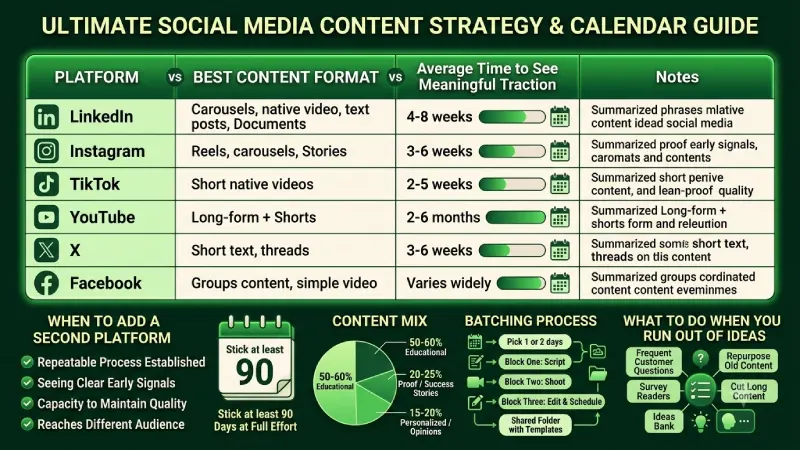
A content calendar is only useful if it is simple enough that the team actually uses it.
Recommended structure for most teams
- Plan in two-week or four-week blocks
- Base everything on your 3–5 content pillars
- Set a minimum posting frequency you can maintain for 90 days
- Batch creation instead of creating everything the day it needs to go out
Basic weekly example (one primary platform)
| Day | Content Type | Purpose |
| Monday | Educational / tip | Provide value, attract attention |
| Wednesday | Story, result, or proof | Build trust |
| Friday | Observation or question | Invite discussion |
Stories or Shorts can occupy the remaining days of the week as well as any other engagement content as per the platform.
Practical tips that prevent burnout
- Keep a running idea bank so you never start from zero
- Batch film or design on specific days
- Create templates for recurring formats
- Leave room for timely or reactive content
- Review the calendar every 30 days and adjust based on real performance
The purpose of a calendar is not to be perfect. The purpose is to decrease decision fatigue and increase consistency.
How to Build a 30-Day Content Calendar Step by Step
The perfect calendar doesn’t have to be overly complex. Here is what you should do:
- You should establish your 3-5 content pillars.
- Your posting schedule must be established (e.g., thrice per week).
- An empty spreadsheet or Notion file must be opened where a table containing columns such as Date, Platform, Pillar, Type of Content, Idea for Post, Status, and Link will be made.
- At least 30 days ahead should be started, and pillars must be distributed.
Fill in ideas of posts for each one of them.
Also, keep some flexible slots for reactive posts.
Have a look at the whole month prior to creation.Doing this once every month (or every two weeks) removes most of the daily stress of “what should we post today?”
Batching Process That Works for Small Teams
One of the best things that you can do on social media is batching. Rather than sharing information on a day-to-day basis, allocate times for it.
A simple batching process:
- • Pick 1 or 2 days in a week (or in every 2 weeks) to create content.
- • In Block One, write the whole script for your content.
- • In Block Two, shoot everything that you need.
- • In Block Three, do the editing and scheduling and also prepare additional materials (Stories, carousels, etc.).
- • Have a shared folder with templates, brand materials, and old high-performing posts so that you always have something to start with.
- .
Even a two-person team can stay consistent with this system if the batching days are protected.
Example Content Pillars + Post Ideas
| Content Pillar | Example Post Ideas | Best Format Examples |
| Educational / Tips | “3 mistakes to avoid when…”, “How to fix…”, quick how-to | Carousel, short video, text post |
| Proof / Results | Customer story, before-after, simple case study | Carousel, Reel, Story sequence |
| Behind-the-scenes | Day in the work, process, team moment | Story, short Reel |
| Product / Offer | Feature explanation, use case, limited offer | Reel, carousel, static post |
| Personality / Opinion | Personal observation, hot take, lesson learned | Text post, Reel, Story |
Having ready examples under each pillar makes filling the calendar much faster.
How to Mix Educational, Proof, and Personality Content
This combination will make the account both relevant and interesting. The good rule that most teams use is:
- 50–60% Educational or useful posts
- 20–25% Proof, success stories, testimonials
- 15–20% Personalized posts, behind-the-scenes, opinions
Such a formula will help you be relevant without being boring and too promotional. Feel free to change the proportions depending on the audience’s reaction, but don’t drop one of the post types completely.
What to Do When You Run Out of Ideas
Running out of ideas is normal. When it happens, use these quick methods:
Having no ideas is common, but you can do these tricks when this situation occurs:
- Find the most frequent customer questions and develop blog posts from them.
- Use your best old blog posts and create new and extended versions of them.
- Survey your readers about what they would like to know.
- Cut one lengthy content piece into small blog posts.
- Maintain an “ideas bank” document on your cell phone, adding new ideas that may come up in conversation or work..
Most idea shortages come from trying to invent something completely new every time. Recycling and reshaping good ideas is not only acceptable — it is efficient.
The content calendar should be used as a dynamic tool as opposed to a static one. Make it simple, do it in batches, have the right balance of different types of content, and adjust it using the performance data. Such an approach will make consistency achievable even by small teams.
Social Media Analytics and KPIs
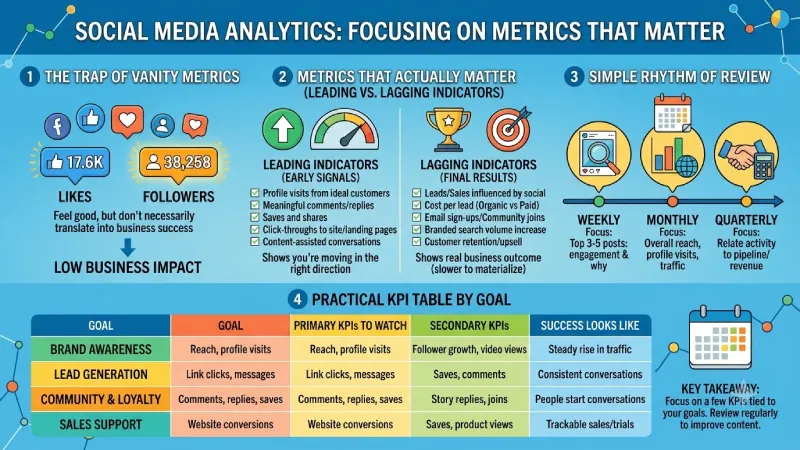
Most organizations are measuring the wrong metrics. Likes and followers feel good, but don’t necessarily translate into business success.
Metrics that actually matter
Leading indicators (early signals):
- Profile visits from ideal customers
- Meaningful comments and replies
- Saves and shares
- Click-throughs to your site or landing pages
- Content-assisted conversations or demo requests
Pipeline and business indicators (later signals):
- Leads or sales influenced by social
- Cost per qualified lead from organic vs paid
- Email sign-ups or community joins from social
- Branded search volume increases
- Customer retention or upsell influenced by community
Simple rhythm of reviewing
- Weekly – see what content got the most engagement and why
- Monthly – see overall reach, profile visits, traffic
- Quarterly – relate activity to the pipeline/revenue
Vanity metrics can be tracked, but they must not be the only metric to use. Concentrate on the metrics that demonstrate true interest and movement in the business.
Leading vs Lagging Metrics Explained Simply
Not every number tells you the same kind of story.
Leading metrics are early signals. They show whether you are moving in the right direction before the final business result appears. Examples include profile visits from the right people, saves, meaningful comments, shares, and link clicks.
Lagging metrics are the final results. This may include leads, sales, demo bookings, or revenue generated due to social media. These metrics are important but are generally slow in being realized.
A healthy approach is to watch leading metrics weekly so you can improve quickly, and review lagging metrics monthly or quarterly to judge real business impact.
Practical KPI Table by Goal
| Main Goal | Primary KPIs to Watch | Secondary KPIs | What Success Starts to Look Like |
| Brand Awareness | Reach, profile visits, shares | Follower growth, video views | Steady rise in profile visits and shares |
| Lead Generation | Link clicks, profile visits from ideal buyers, inbound messages | Content saves, comments | Consistent website clicks and conversations |
| Community & Loyalty | Comments, replies, saves, repeat engagement | Story replies, community joins | People regularly start conversations |
| Sales Support | Website clicks, conversion from social traffic | Saves, product page views | Trackable sales or trials from social |
Pick one key performance indicator that suits your objective and focus on it. Juggling many indicators at once will most likely cause confusion.
How to Review Performance Without Getting Lost in Data
Keep the review process simple:
- Weekly: Examine the top 3-5 posts. See why those posts did better than the other posts.
- Monthly: Assess all activity on your profile including clicks and engagement trends.
- Quarterly: Try to tie the activity into tangible business outcomes such as leads, sales or discussions.
Identify one or two learnings and one action plan that you will put in place. Beware of the tendency to just verify the numbers everyday and do nothing..
Realistic Benchmarks in 2026
Depending on your industry, number of followers, and platform, this may be different, but here are some examples of average times that you can use as a guide:
- Organic post engagement rate: 1–3% for most posts is good; greater than 3–4% is great.
- Profile visits: This is good news if you see a steady growth in profile visits every week and even from those that resemble your ideal customers.
- Saves and shares: This can be more important than likes. Just having a few of these means your content is really good.
- Clicks on the link: This is more important compared to the number of clicks in the initial stages.
Comparison should not be made between numbers and large influencer accounts. Comparison should be made between present performance and past performance.
When Vanity Metrics Are Okay (and When They Mislead)
The vanity metrics like the number of likes and followers in total are not entirely useless. They provide a quick indication of the reach and momentum. The trouble begins when vanity metrics become the primary scorecard.
The vanity metrics can serve as the soft indicators alone. It will mean that if the likes are increasing but there is no increase in visits to the profile, saves, and conversations, the content could be fun but ineffective. You should always choose the metrics that reflect genuine interest and business activity rather than vanity metrics.
Clear metrics allow making informed decisions. Concentrate on a few metrics that are connected with your objective, look at them regularly, and use them to make the content for the next month even better.
Social Media Advertising
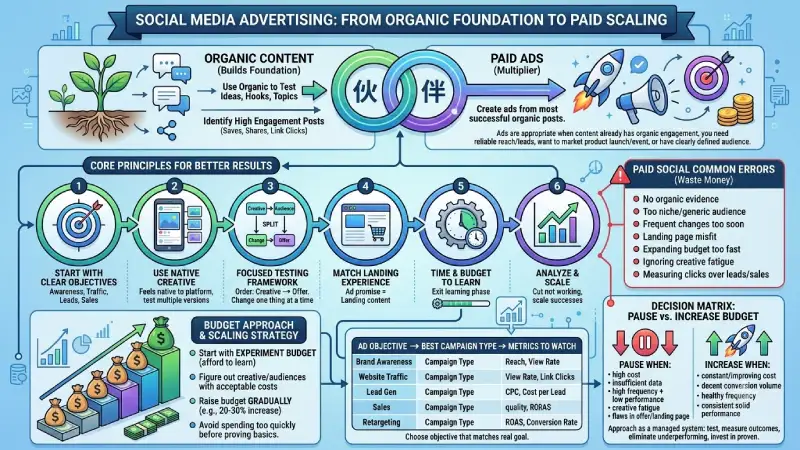
Organic content builds the foundation. Ads let you scale what already works and reach specific people faster.
Advertising is appropriate when
- Your content already has organic engagement
- You require reliable reach or leads
- You wish to market a certain product, service launch, or event
- You are marketing to a clearly defined audience
Core principles for better results
- Start with clear campaign objectives (awareness, traffic, leads, sales)
- Use creative that feels native to the platform
- Test multiple versions instead of betting everything on one ad
- Match the landing experience to the ad promise
- Give campaigns enough time and budget to exit the learning phase
- Cut what is not working and scale what is
Ads work best as a multiplier, not a replacement for a weak organic presence. The strongest accounts usually run both: consistent organic content plus selective paid amplification
Budget approach for most businesses
Start with an experiment budget that you can afford to learn from. When you have figured out creative and audiences that bring acceptable costs, start raising your budget gradually. Don’t repeat the all-too-common mistake of spending too quickly before proving the basics..
Organic + Paid: How They Should Work Together
Organic content and paid advertising make good companions, rather than independent entities. Organic content helps you realize what will work on your audience. Advertising enables you to invest more money in the techniques and formats that are already working.
A practical way to combine them:
- Use organic posts for testing ideas, hooks, and topic options.
- Learn which posts have high save rates, share rates, comments, and link clicks.
- Create advertisements from the most successful organic posts.
- Use ads to connect with fresh audiences and retarget existing ones.
If the paid campaigns are created on top of successful organic campaigns, the output tends to be more consistent, and there will be less of a learning curve associated with it.
Simple Testing Framework for Ads
Most wasted ad budget comes from testing too many things at once or not testing at all. Keep tests focused.
Test in this order:
- Creative – Different hooks, visuals, or opening lines.
- Audience – Broader versus narrower targeting, or different interest groups.
- Offer / Message – Different angles or calls-to-action once creative and audience are working.
One thing at a time should be changed in your marketing strategies. Ensure you allocate enough time and money for testing in order to make sure that either the test was a failure or it succeeded. Make notes on your findings in order to develop better future campaigns.
Paid Social Common Errors That End Up Wasting Money
- Launching campaigns without any prior evidence from organic posts that the content is resonating
- Creating too niche or too generic audience at the beginning of campaigns
- Frequent changes of campaigns before leaving the learning phase
- Landing page content doesn’t fit the promise made by ads
- Expanding budget too soon when the campaign just started to collect data
- Not paying attention to frequency and creative fatigue
- Measuring performance via clicks instead of leads or sales
Avoiding these mistakes usually improves results more than finding a secret targeting trick.
Ad Objective → Best Campaign Type → What to Measure
| Ad Objective | Best Campaign Type / Focus | Main Metrics to Watch |
| Brand Awareness | Reach or Video Views campaigns | Reach, video view rate, brand lift signals |
| Website Traffic | Traffic campaigns | Link clicks, cost per click, on-site behaviour |
| Lead Generation | Lead form or Conversion campaigns | Cost per lead, lead quality, conversion rate |
| Sales / Purchases | Conversion campaigns with proper tracking | Cost per purchase, ROAS, conversion rate |
| Retargeting | Custom audiences of engagers or site visitors | Conversion rate, cost per result |
Choose the objective that matches your real goal. Promoting a lead magnet with a traffic objective, for example, often produces lower-quality results than using a proper conversion or lead objective.
When to Pause vs When to Increase Budget
Consider turning ads off or pausing when:
- The cost per result remains way too high compared to your goals despite having sufficient data
- The frequency is high and performance is declining
- The creative is definitely fatigued
- The offer or landing page contains flaws that should be fixed
Consider increasing your budget when:
- The cost per result is constant or even improving
- You have a decent number of conversions to have confidence about your data
- The frequency is still healthy
- The same creative and audience are delivering solid performance on a consistent basis
Increase the budget gradually. Going from one day to 100% more in budget is generally more risky than a 20-30% increase in budget every time you try. Paid social is the most effective when approached as a managed system: test, measure outcomes, eliminate underperforming offers and invest more into what is proven to work.
Creating an Efficient Social Media System
This is what a realistic and sustainable social media system for most companies will look like in 2026:
- One objective and one Ideal Customer Profile
- One primary platform (with an additional secondary platform only once the first one is running)
- 3 to 5 content pillars, which relate to customers’ pain points
- Content calendar and batch creation processes
- Daily or almost daily engagement, not just broadcasting
- Weekly and monthly analysis based on meaningful metrics
- The use of paid advertising to boost successful content and offers
Social media channels reward those teams, which consistently provide valuable content and consider their social media channels as conversation spaces and not free billboard space.
You don’t have to be present everywhere. You have to be present where you can be effective. Use the social media platforms where your customers are present, create content for them, measure what drives the business forward, and constantly improve your performance.
Continue repeating the above process for 6 months to one year and then you will stop seeing social media as something tedious but rather a source of growth.
Frequently Asked Questions
- How many social media platforms should a business use? Most businesses get better results by mastering one primary platform for at least 90 days before adding a second. Being strong on one platform beats being average on four or five.
- How often should we post? Two to four quality posts per week on the main platform is enough for most teams. Consistency over long periods matters more than daily volume.
- What is the biggest mistake businesses make with social media? Spreading effort across too many platforms, tracking vanity metrics, and posting product-focused content without first providing value.
- Do we need to run ads to succeed on social media? No. Many businesses grow effectively with organic content alone. Ads become useful when you want to scale proven content or generate more predictable results.
- How long does it take to see real results? Early signals (engagement, profile visits, conversations) often appear within 30–60 days of consistent effort. Meaningful pipeline or brand impact usually takes 3–6 months or longer, depending on the industry and execution quality.
Conclusion
Social media works best when it is treated as a system rather than a series of random posts. The businesses that build real presence in 2026 are not the ones chasing every new trend or trying to be active on every platform. They are the ones that choose a clear goal, pick the right platform for their audience, create useful content consistently, pay attention to the numbers that matter, and use ads only when they can multiply what is already working.
You do not need a complicated strategy or a large team to make progress. You need focus, a realistic posting rhythm, and the discipline How long does it take to see real results? to keep going long enough for the results to compound. Start with one primary platform, build a simple content process, engage like a human, and review your performance regularly. Over time, the effort becomes easier and the impact becomes clearer.
Social media rewards clarity and consistency more than perfection. Choose where your customers already spend time, show up with content that helps them, and keep improving based on what the data shows. Done this way, social media stops feeling like a chore and starts becoming a reliable part of how your brand grows.