

Introduction
Productivity software is helpful in making work easy, efficient, and organized in firms. These software programs are vital to any firm in 2026. Whether it is about project management, document collaboration, or automating everyday activities, business productivity software makes the work of employees easier. This guide provides information about the best business productivity tools that are necessary for business efficiency.
For the overarching strategy, read our complete guide on Productivity Tools
What Are Business Productivity Tools?
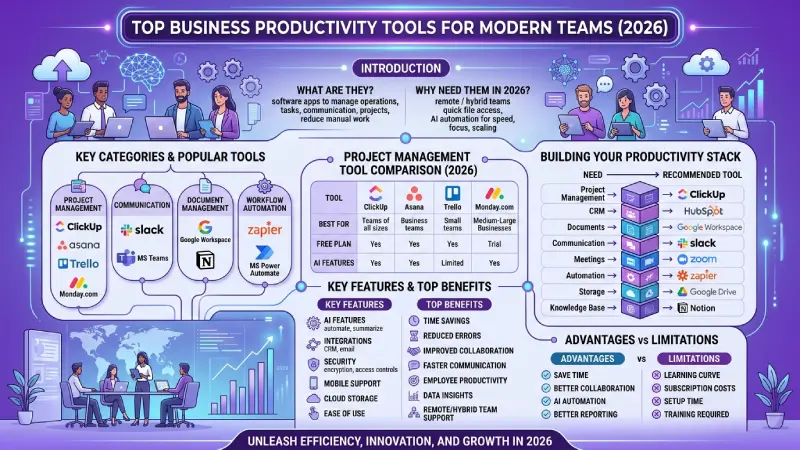
Productivity applications for businesses refer to software that is used by companies to facilitate the running of their business activities efficiently. They make business activities easy, foster communication, project organization, and minimize the workload of the employees. Productivity applications help in avoiding use of multiple applications in managing business affairs.
Various business productivity tools exist. Tools for project management help the team members in assigning the tasks and meeting the deadlines. Tools for communication help in communicating with the employees via chats and virtual meetings. These include document management software which helps manage documents via their creation, sharing and storage in the cloud. Workflow automation tools ensure there is never duplication of effort in any procedure through sending emails, record-keeping, and creating reports.
Why Businesses Need Productivity Software in 2026
By 2026, firms will be working in an environment that is more digitized than ever. With remote/hybrid teams becoming more common among companies, collaboration software becomes a requirement to perform work-related activities. Employees should have easy access to documents, projects, and communication channels regardless of their current location.
Another big driver for firms when it comes to buying productivity software includes artificial intelligence. Tools powered by artificial intelligence can help with automating routine actions, preparing summaries of meetings, generating reports, organizing one’s schedule, and other activities including content creation.
In addition to this, productivity software helps companies with managing their projects better, decreasing human error rates, improving customer satisfaction, and making smarter decisions based on real-time data.
Benefits of Using Business Productivity Tools
Productivity tools for businesses have numerous benefits that can enhance efficiency in various activities within the business. Some of these include efficient communication, project management, and task completion.
Some of the biggest benefits include:
- Enhanced teamwork through real-time communication.
- Better project management with task assignment and deadlines.
- Increased productivity of employees through reduction of duplicate work.
- Time saving through automation of tasks.
- Faster and more organized communication across departments.
- Secure document storage and easy file sharing.
- Better decision-making using reports and business insights.
- Support for remote and hybrid teams through cloud-based access.
- Reduced operating costs by automating routine processes.
- Greater flexibility as businesses grow and expand.
Selecting the correct business productivity tools helps the company achieve efficient workflows and better collaboration in order to increase productivity within the company.
Business Productivity Tools Comparison
| Tool | Category | Best For | Free Plan | AI Features |
| ClickUp | Project Management | Teams of all sizes | Yes | Yes |
| Asana | Task Management | Business teams | Yes | Yes |
| Trello | Task Organization | Small teams | Yes | Limited |
| Monday.com | Workflow Management | Medium and large businesses | Trial | Yes |
Project Management Productivity Tools
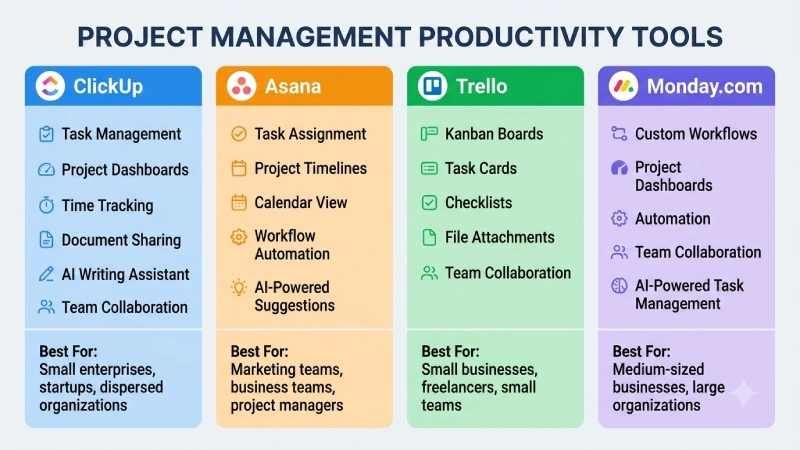
The purpose of project management software is to make it easier for organizations to plan and execute projects effectively. Project management software enables the managers to delegate tasks and deadlines and even monitor the work and enhance collaboration among the team members. In addition, project management software enables users to access everything related to work in one place. There are many project management software with AI functionality.
ClickUp
ClickUp is one of the widely utilized project management tools. It combines task management, document management, goal setting, time management, and collaboration in one platform.
Key Features
- Task management
- Project dashboards
- Time tracking
- Document sharing
- AI writing assistant
- Team collaboration
Best For
Small enterprises, startups, dispersed organizations, and growing companies.
How to Use ClickUp
- Create a ClickUp workspace.
- Add your team members.
- Create projects and task lists.
- Assign tasks to employees.
- Set deadlines and priorities.
- Track progress using dashboards.
- Use AI features to create summaries and improve productivity.
Asana
The creation and management of projects and tasks can be done through Asana. The software offers an easy-to-use platform for managing projects.
Key Features
- Task assignment
- Project timelines
- Calendar view
- Workflow automation
- AI-powered task suggestions
Best For
Marketing teams, business teams, and project managers.
How to Use Asana
- Create a new project.
- Add tasks and deadlines.
- Assign work to team members.
- Track project progress.
- Use automation to reduce manual work.
Trello
Organization of projects is done using a visual board approach by Trello. This is where tasks are arranged on cards which undergo various processes of a project.
Key Features
- Kanban boards
- Task cards
- Checklists
- File attachments
- Team collaboration
Best For
Small businesses, freelancers, and small project teams.
How to Use Trello
- Create a new board.
- Add lists for each project stage.
- Create task cards.
- Assign team members.
- Move cards as work progresses.
- Add due dates and attachments.
Monday.com
The Monday.com application is an excellent project and workflow management tool that helps businesses organize projects and workflows in their departments.
Key Features
- Custom workflows
- Project dashboards
- Automation
- Team collaboration
- AI-powered task management
Best For
Medium-sized businesses, large organizations, and teams managing multiple projects.
How to Use Monday.com
- Create a workspace.
- Build a project board.
- Add tasks and assign team members.
- Set timelines and deadlines.
- Automate repetitive tasks.
- Monitor progress with dashboards and reports.
Such management tools may help a firm operate in an organized manner and be a team player in undertaking its tasks.. The decision of picking which one to use is determined by factors like team size and organizational needs among others.
Choosing the Right Business Productivity Stack
A business productivity stack refers to a set of applications used together for the smooth running of the day-to-day activities of the business. Unlike in the past where businesses used only one software application to perform all their duties, companies now use various applications for project management, communication, file sharing, meetings, and automation.
Business Productivity Stack
| Business Need | Recommended Tool |
| Project Management | ClickUp |
| CRM | HubSpot |
| Documents | Google Workspace |
| Communication | Slack |
| Meetings | Zoom |
| Automation | Zapier |
| Storage | Google Drive |
| Knowledge Base | Notion |
Features to Look for in Business Productivity Tools
It is imperative to consider whether your software program contains all the features you require before opting for it.
- AI Capabilities: Aid in automation of processes, content creation, and increasing efficiency.
- Integration: Integration of the software with CRM, e-mail, cloud, and other business software.
- Security: Secures business information through encryption and access rights to users.
- Mobility: Makes it possible for the employees to work anywhere through mobile applications.
- Cloud Storage: Provides facility to store and access information from any device.
- Usability: Select software that is easy to use and learn.
Benefits of Business Productivity Tools
Productivity tools for business can be helpful to organizations in optimizing their day-to-day business activities as well as making sure that employees perform at their best.
The major advantages are as follows:
- Gain time through automation.
- Cut down manual work and errors.
- Foster better cooperation among team members.
- Boost communication speed and efficiency.
- Enhance the productivity of employees.
- Generate reports and measure company performance.
- Help remote and flexible workers with cloud access.
Advantages and Limitations
| Advantages | Limitations |
| Save time | Learning curve for new users |
| Better collaboration | Subscription costs |
| AI automation | Setup and configuration time |
| Better reporting | Employee training may be required |
Frequently Asked Questions
What are business productivity tools?
Productivity software for businesses is an application used to improve efficiency in managing projects, communication, documents, and other business-related activities.
Which business productivity tool is best?
This will depend on the needs of your organization. The commonly used applications include ClickUp, Slack, Google Workplace, HubSpot, and Zapier.
Are business productivity tools free?
Most software packages provide free accounts with basic functionality and advanced functionalities in paid editions.
What is workflow automation?
Workflow automation is where software is used to undertake repetitive tasks such as emailing, record creation and task allocation
Which tools work best for remote teams?
Working remotely would be made easier by using tools such as Slack, Zoom, Google Workspace, ClickUp, and Notion.
How do productivity tools improve teamwork?
These tools will aid communication, file sharing, project management, and tracking of progress all from one place.
Conclusion
Productivity tools for businesses increase the productivity of teams through better communication, project management, and automation of processes. The way to go is to opt for those productivity tools that meet your business requirements and complement each other as a whole productivity suite rather than use one single app. With further development of AI technology, productivity tools for businesses will only grow more efficient.
To take the next step, see our detailed guide on developer productivity tools.