

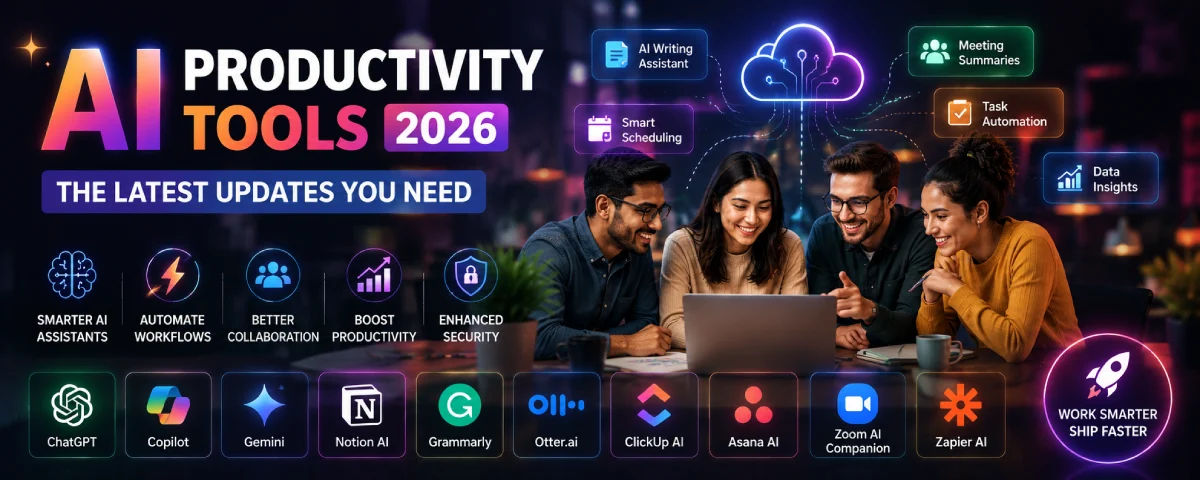
In 2026, the workplace is being reshaped by AI productivity tools. These tools automate repetitive tasks, enhance collaboration, and generate content while saving time. There is little that these tools cannot assist with. From writing and meetings to planning and task automation, the potential for increased efficiency is endless. This guide will help you understand the most innovative AI productivity tools, recent innovations, and how to select the best tools for your workplace.
For the overarching strategy, read our complete guide on Productivity Tools.

Top AI Productivity Tool Updates This Year
Advancements in AI productivity tools have heightened efficiency, resourcefulness, and helpfulness, peaking in 2023. The tools are tailored to boost company productivity. These tools are built with the latest technology to aid the workforce with task automation, collaborative tools, and increased user satisfaction.
Smarter AI Assistants
Artificial Intelligence Assistants are capable of doing more than ever. Breaking down large tasks and understanding complex instructions is now a simple prompt. AI Assistants organize emails, create and summarize instructions, and even write and summarize reports.
Key improvements include:
- Better response accuracy
- Faster content generation
- Improved task management
- More natural conversations
- Better understanding of user instructions
AI Built into Everyday Apps
Perhaps one of the most significant advancements in this year’s technology is the integration of AI directly into various workplace applications. Users are no longer required to switch from one application to another to use the capabilities of AI.
AI is commonly integrated into:
- Email applications
- Project management software
- Document editors
- Team collaboration platforms
- CRM systems
- Calendar and scheduling tools
This creates a smoother workflow and saves valuable time.
Improved Workflow Automation
Automation has become more intelligent in 2026. AI tools can now complete repetitive business tasks with little or no manual effort.
Examples include:
- Automatically sending follow-up emails
- Creating project tasks
- Updating customer records
- Scheduling meetings
- Organizing files
- Generating weekly reports
These automations help employees focus on more important work.
Better AI Writing Features
Writing assistants continue getting better each year. Current AI programs are capable of producing top-notch content while preserving the writer’s style of writing.
They help with:
- Business emails
- Blog posts
- Meeting notes
- Marketing content
- Product descriptions
- Social media posts
Many tools also provide grammar corrections, tone suggestions, and content summaries.
Smarter Meeting Assistance
AI meeting tools now do much more than record conversations. They automatically create organized summaries, identify action items, and assign follow-up tasks.
New meeting features include:
- Live transcription
- Automatic note-taking
- Meeting summaries
- Speaker recognition
- Action item tracking
- Calendar integration
These features improve communication and reduce manual note-taking.
Better Collaboration Features
As remote and hybrid teams increase in number, the new AI tools have become much more collaborative.
Teams can:
- Edit documents together
- Share AI-generated summaries
- Track project progress
- Receive real-time updates
- Communicate instantly
These improvements help teams stay connected regardless of location.
Advanced Data Analysis
AI productivity tools now analyze business data much faster than traditional software.
They can provide insights into:
- Sales performance
- Customer behavior
- Employee productivity
- Marketing campaigns
- Financial trends
- Project performance
Business leaders can use these insights to make faster and better decisions.
Personalized AI Recommendations
Modern AI tools learn from user behavior and provide personalized suggestions.
For example, AI can recommend:
- Priority tasks
- Meeting times
- Workflow improvements
- Frequently used documents
- Productivity tips
These guidelines will assist in keeping the users organized and working efficiently.
Stronger Security and Privacy
As more businesses adopt AI, software providers have improved security features.
Recent updates include:
- Better data encryption
- Multi-factor authentication
- User access controls
- Secure cloud storage
- Privacy management tools
These features help protect sensitive business information.
Easier Integration with Business Software
Modern AI tools now connect with many popular business applications.
Common integrations include:
- Project management tools
- CRM software
- Cloud storage platforms
- Email services
- Calendar applications
- Communication platforms
Connected systems reduce duplicate work and improve overall productivity.
Why These Updates Matter
These most recent changes to AI productivity tools allow firms to save costs on human resources and advance the speed and efficiency with which they work. Employees spend less time blocked by repetitive tasks that inhibit the ability to think and work creatively and more time solving problems, serving customers, and growing the business. Updates to AI tech will definitely make productivity enhancements for the workplace in 2026 and later, but the most significant early effects will likely be seen in the next few months.
Top AI Productivity Tools in 2026
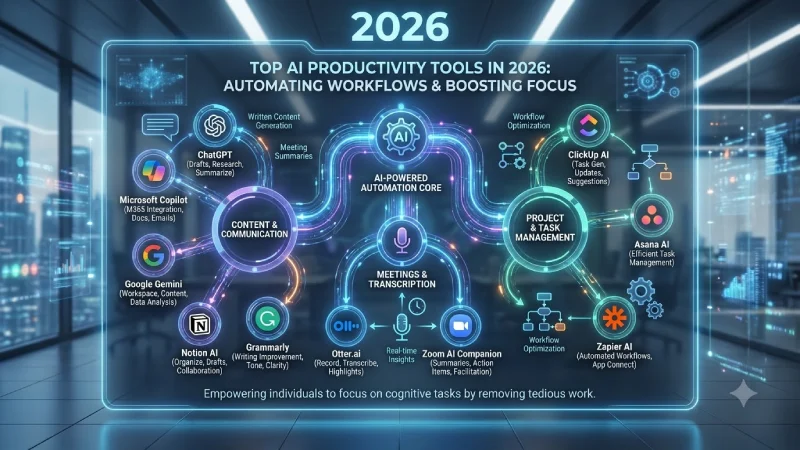
AI productivity tools have the potential to impact work at both an organizational and an individual level. By removing tedious work through automation, people are allowed to focus on tasks that require more cognitive effort. Many of the currently popular AI tools incorporate automation for the generation of written content, the creation of summaries for meetings, as well as the management and automation of tasks and workflows.
ChatGPT
ChatGPT is an AI tool that is helping people draft emails, reports and written content, as well as brainstorm, research and summarize. ChatGPT is a helpful tool that is highly popular among employees, business owners, marketers, students and software developers.
Microsoft Copilot
Microsoft Copilot is an application that aims to make you productive through its integration into Microsoft 365 applications such as Microsoft Word, Excel, Outlook, and Teams. The application enables the generation of drafts in Microsoft Word, analysis of the spreadsheet content, and summarization of meetings and emails.
Google Gemini
Google Gemini is a machine learning program incorporated into Google’s applications such as Google Workspace, Google Mail, Google Sheets, and Google Meet. Google Gemini is used to create written content, assist with research, draft emails and analyze data.
Notion AI
Notion AI is an AI assistant embedded within the Notion app. Notion AI is used to create and organize work, summarize and draft written content, and develop team workspaces and collaboration.
Grammarly
Grammarly is an AI productivity tool that is focused on the improvement of writing. Grammarly checks for the rules of writing and provide tips for clarity and tone. Grammarly also provides AI suggestions.
Otter.ai
Otter.ai is a tool that is able to record meetings, transcribe meetings, create summaries of meetings and highlight key points of discussions.
ClickUp AI
ClickUp is a project management tool that uses AI to assist project managers in generating task descriptions, updates and discussions as well as providing organizational suggestions.
Asana AI
Asana is a tool for managing projects that employs artificial intelligence in helping the team manage tasks efficiently.
Zoom AI Companion
Zoom AI Companion is an assistant embedded within Zoom to help virtual meetings. Zoom AI Companion drafts meeting summaries and action items and helps facilitate meeting discussions.
Zapier AI
Zapier is a tool used setter up automated workflows by connecting business apps.
AI Productivity Tools Comparison Table
This gives readers a quick overview and increases engagement.
| AI Tool | Best For | Main Features | Free Plan | Best Users |
| ChatGPT | Writing & Research | Content creation, coding, brainstorming | Yes | Businesses, Students |
| Microsoft Copilot | Microsoft 365 | Word, Excel, Outlook AI | Limited | Office Users |
| Google Gemini | Google Workspace | Email, Docs, Research | Yes | Google Users |
| Notion AI | Notes & Projects | Writing, summaries, documentation | Limited | Teams |
| Grammarly | Writing | Grammar, tone, rewriting | Yes | Writers |
| Otter.ai | Meetings | Transcription, summaries | Yes | Remote Teams |
| ClickUp AI | Project Management | Task creation, workflow | Limited | Businesses |
| Asana AI | Team Management | Task automation | Limited | Teams |
| Zoom AI Companion | Meetings | Meeting summaries | Paid | Businesses |
| Zapier AI | Automation | Workflow automation | Yes | Small Businesses |
How to Choose the Right AI Productivity Tool
Before selecting an AI productivity tool, consider:
- Your business needs
- Team size
- Budget
- Ease of use
- Integration with existing software
- AI features
- Security and privacy
- Customer support
The most productive AI tool is the one that matches your working style and allows you and your team to save time and improve efficiency.
To take the next step, see our detailed guide on sales productivity tools
AI Productivity Tools for Meetings
AI Productivity Tools for Meetings
One reason business meetings are now reportedly more productive than ever is the introduction of AI productivity tools. AI has the ability to record a meeting, take notes, and organize the most relevant information all on its own. Team members are even enabled to participate in the meeting even more by letting the AI tool do all the manual work of typing what is pertinent.
Speech recognition, meeting synopsis, action item identification and task assignment are all features of many different AI meeting tools. Some of the tools even automate the scheduling and reminders of the meetings themselves by linking to various calendars and project management apps. This streamlines the communication process of a meeting and keeps everyone up to date.
AI meeting tools like Otter.ai, Zoom AI Companion, Microsoft Copilot and Google Gemini are all meeting collaboration tools companies are integrating to automate processes and manual work.
How to Adopt New AI Productivity Tools
Utilization of AI productivity tools is a multi-step process. The first step is to identify time-sucking tasks such as email composition, report writing and meeting management. The second step is to implement a business specific, employee friendly tool.
Basic training in the use and benefits of the tool should be given to the employees of the small trialing group. The trialing group should be limited to one department. Organizational productivity should then be monitored and employee feedback should be collected to determine the need for adjustments to the tool use.
Planning and training are essential to using AI productivity tools within a business to save time, strengthen collaboration among employees and increase the productivity of the employees. AI generated content should be reviewed and security policies should be followed prior to using the content to protect the sensitive content of the business.
Frequently Asked Questions
What are AI productivity tools?
The AI productivity tools can be described as software programs that are capable of performing certain operations using artificial intelligence and improving efficiency in business processes.
Which AI productivity tool is best in 2026?
There are some very common artificial intelligence productivity tools that will be prevalent in 2026. Some of these tools include ChatGPT, Microsoft Copilot, Google Gemini, Notion AI, Grammarly, and ClickUp AI.
Are AI productivity tools free?
Most AI software has a version for free use. Companies that want more sophisticated options can go for premium plans.
How do AI productivity tools improve business efficiency?
These machines perform repeated operations, enhance communication, create reports, arrange meetings, and assist workers to finish tasks quicker.
Can small businesses use AI productivity tools?
Yes. There are many AI productivity tools which cater to startups and small businesses. Some even have free versions that make them cost-effective for startups.
Are AI productivity tools secure?
The most reliable AI productivity software is equipped with security measures including encryption of data, permissions of users, and multi-factor authentication.
Conclusion
By 2026, there will be several businesses that take advantage of AI productivity tools. Because of automation of repetitive tasks through the use of these tools, working will become more cooperative and productive. More amazing things can be done through specialized AI tools for different purposes. Improved writing, enhanced meeting management, and tasks and workflow automation, help save time and increase productivity through AI tools. In today’s world of business, irrespective of the company size or field of operation, any business can actually choose the necessary tools to survive and be efficient in the digital world.