


Humans tend to forget the facts. They remember the story. This is where storytelling comes in content marketing to make it compelling and interesting enough for people to engage with it and take action.
Marketing content tends to be superficial — facts, features, tips, and lists. Practical,. Easy to forget. That is where storytelling comes in to give context and give your audience reasons to engage with storytelling.
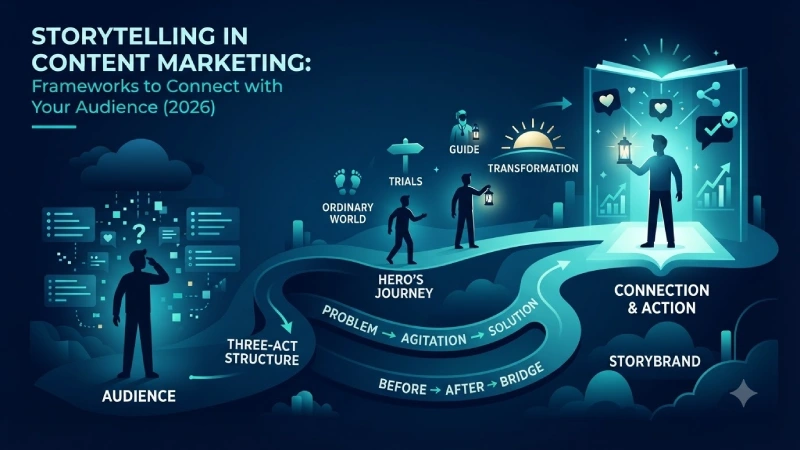
This guide shows you how to use storytelling in content marketing in 2026. It talks about popular brand storytelling methods. You will learn how to apply the Hero’s Journey. It gives tips for creating connections, with your audience. You will also find ways to improve your case study stories. Lastly it covers how to design landing pages that use stories to drive results.
Brand Storytelling Frameworks
I believe a brand story is more than a story, about how it started. A brand story is a story that tells about your identity, values and purpose. A brand story convinces people to listen to you.
The Three-Act Structure
- Act 1: Setup (the world and the problem)
- Act 2: Confrontation (the struggle and the turning point)
- Act 3: Resolution (the reality, after the solution)
I have seen this structure work really well, for brand films about pages, long‑form posts and presentations. The structure keeps everything engaging.
Problem → Agitation → Solution
Start with the problem your audience faces. Make the cost of inaction clear. Then introduce your approach as the way forward. Direct and effective for sales-oriented content.
Before → After → Bridge
Show the painful before state. Paint a clear after state. Explain the bridge that takes the audience from before to after. I think this approach is very useful for landing pages and case studies.
Story Brand (character-focused)
Position customer, as hero. Brand is guide that helps customer succeed. This keeps focus on audience of company.
Key elements most strong brand stories include
- A clear protagonist (usually the customer)
- A meaningful problem or desire
- Stakes (what happens if nothing changes)
- A guide or method (your brand)
- A transformation or result
- A moral or belief that ties it together
I think consistency matters more than drama. Brand stories feel real and brand stories are repeated across channels, in forms.
- Hero’s Journey in Marketing
The Hero’s Journey is a classic story structure that maps surprisingly well to marketing.
Simplified stages for marketing use
- Ordinary World – The customer’s current situation
- Call to Adventure – The problem or opportunity appears
- Refusal or Doubt – Hesitation, fear, or obstacles
- Meeting the Guide – Your brand or solution enters
- Trials and Challenges – The process of change
- Transformation – The result and new capability
- Return – The customer’s new normal, often with a message for others
How to apply it
- In case studies: follow the customer’s journey from problem to result.
- In brand films or about pages: show the larger mission as a journey.
- In email sequences: structure the series as stages of transformation.
- In product content: frame the user’s experience as moving from struggle to mastery.
Even a shorter version. Problem, guide, transformation. It gives a sense of a story, rather than just a set of characteristics. The story should have a problem to solve. A guide shows how to solve it. A transformation shows what happens after. That is more, than a list of features. That is a story.
I find the real strength of the Heros Journey is that it allows the audience to see themselves in the hero. I see the brand, as guide the helper, not the star. I see the brand staying in the background not taking the spotlight.
Emotional Storytelling Techniques
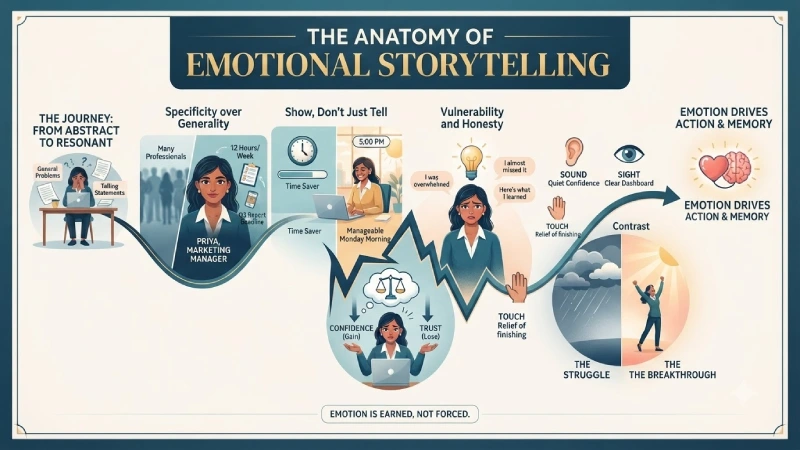
Emotion is what makes a story stay with you. Logic might make you agree. Emotion is what makes you remember and act.
Useful emotional techniques
Specificity over generality
“A marketing manager named Priya who was spending 12 hours a week on reports” is more powerful than “many professionals waste time on reporting.”
Actions speak louder than words
Rather than stating “our product is time-saving,” narrate the Monday mornings which were once so challenging but have now become more manageable.
Stakes and tension
Make clear what the person stands to lose or gain. Tension keeps people reading or watching.
Vulnerability and honesty
Sharing real struggles (without overdoing it) builds trust. Perfect stories feel less believable.
Show do not just tell.
Of saying ‘our tool saves time’ describe the Monday morning used to feel overwhelming and now feels manageable.
Contrast
Before-and-after, expectation versus reality, or struggle versus breakthrough creates natural emotional movement.
Tips to apply in practice
Find out what emotion you are trying to evoke in your audience. Is it relief, hope, trust, sense of belonging, or urgency? Ensure that your story evokes that emotion. Mixing up the core emotion or failing to convey it will reduce its effect.
Emotion works best when it feels earned by the story, not forced on top of it.
- Case Study Storytelling
Case studies are among the popular content forms when Case studies are told as stories rather, than as dull reports.
Weak case study structure
Company background → Solution features → Results numbers
Stronger story-driven structure
- The Situation – Who was the customer and what was their world like?
- The Problem – What specific pain or goal created urgency?
- The Stakes – What would happen if they did nothing?
- The Journey – What did they try? Where did they get stuck? How did they decide?
- The Solution in Action – How was the product or service used in real life?
- The Result – Clear outcomes, ideally with numbers and human impact
- The Lesson or New Reality – What changed for them going forward?
Extra tips for better case studies
- Use the customer’s real language when possible.
- Include obstacles and doubts — they make the win more credible.
- Balance metrics with human outcomes (time back, confidence, reduced stress, career impact).
- Keep the focus on the customer’s transformation, not your product features.
- Add a clear next step for the reader who sees themselves in the story.
A well-told case study lets prospects try the transformation on themselves before they buy.
- Story-Driven Landing Pages
Most landing pages start by listing features or a plain headline. Story-driven pages start with a story making the offer feel both relevant and inevitable.
Elements of a story-driven landing page
- Hook that sets the scene – A relatable problem or desire in the first lines
- Tension or cost of inaction – Why the status quo is painful
- Turning point – The insight or decision that opens a new path
- Guide and method – How your offer helps (positioned as the bridge)
- Proof through story – Short customer stories or specific examples
- Clear transformation – What life or work looks like after
- Call to action – The next step feels like the natural continuation of the story
Simple page flow example
- Relatable opening problem
- Agitation and stakes
- Introduce the better way
- Show how it works (briefly)
- Customer story or proof
- Address remaining doubts
- Strong, story-aligned call to action
Extra pointers
- Use the words that your customers use.
- Keep the story focused on one transformation.
- Support the story with pictures that show the before and after or the journey.
- Test story‑led headlines, against feature‑led headlines; story headlines often win on connection and conversion.
A landing page that is more story-like than brochure-like generally works better.
Putting Storytelling into Practice
There is no need for you to be a writer of novels. What you need to do is add humanity to your content.
Start small:
- Take one existing case study and rewrite it with clearer situation, stakes, and transformation.
- Turn one blog post into a short story-style narrative.
- Add a brief customer journey story to a landing page.
- Use the Hero’s Journey stages to outline the next brand video or email sequence.
The goal is to connect. When people see their challenges and dreams shown in your words they look longer trust faster and think of you when they need to make a choice.
Telling stories is not just extra. It is one of the ways to make your words important, to the people you want to reach.
Frequently Asked Questions
- Do I need a dramatic founding story for brand storytelling?
No. Many effective brand stories focus on the customer’s journey or a core belief about the work. The founding story is optional. - How long should a marketing story be?
As long as it needs to be to create emotion and clarity — and no longer. Short stories often outperform long ones in marketing contexts. - Can storytelling work in B2B content?
Yes. B2B buyers are still human. Stories about professional struggles, career risk, team results, and personal relief perform very well. - How do I avoid making stories feel manipulative?
Stick to truth. Use real customer experiences, honest stakes, and genuine results. Authenticity is what makes stories persuasive over time. - Where should I start if storytelling feels unfamiliar?
Begin with case studies. They already contain real characters, problems, and results. Strengthening the narrative structure there builds the skill quickly.
Conclusion
Facts get forgotten. Stories stick. That is why storytelling still matters in content marketing in 2026.
No fancy stories about an intriguing background or a tangled plotline are required of you. What you should demonstrate is real-world issues, real risks, and real-world transformation in terms of what people would experience. Regardless of whether it’s a before/after comparison, the Hero’s Journey, or a case study-style narrative, the aim of all three storytelling types remains one and the same.
Start small. Rewrite one case study with clearer stakes and transformation. Add a short customer journey to a landing page. Shape the next email sequence or video around a simple story arc. I keep the focus on the customer as the hero. I keep the focus, on the brand as the guide.
When people see their struggles and hopes people will stay focused, on your content longer. People will trust you quickly and people will remember you when people need to act.
Storytelling is not decoration. Storytelling is one of the dependable ways to make your content truly matter.
To take the next step, see our detailed guide on Blog Content Strategy .