


It’s a very straightforward answer why most blogs do not succeed. Bloggers write in a spontaneous way. They post whenever they please, target some keywords just for fun, and pray that Google will somehow notice them. After several months, their blog is just a chaotic mess of posts that nobody wants to read.
The blogs that actually grow treat content like a system. They decide what to write based on real audience needs and search demand. They plan in advance. They write with both readers and search engines in mind. They promote what they publish. They also know what to measure so that they will keep improving.
For the overarching strategy, read our complete guide on Content Marketing.

Below is a step-by-step guide for a blog content strategy that will be effective in 2026. It includes such stages as planning and ideation, creation of the editorial calendar, writing content that can rank, promoting your blog and its content and measuring results in a proper way to bring more value to your business.
Blog Content Planning and Ideation
Quality content is born even before a single page is written. You should have a clear understanding of whom you write to and what problems matter for them
Start with your audience and goals
Explain who your dream target audience is using simple language. What problems do your target audience face? What questions do they ask Google? What frustrations arise during sales or support meetings? What can build trust with them?
Next, figure out what role the blog will play. Will it be mostly for generating organic traffic? For lead generation? Sales support? Creating niche authority? When you clearly define one purpose, everything else becomes much easier to decide.
Use topic clusters instead of random posts
By 2026, individual blog posts won’t get rankings on competitive terms. Search engines value topical authority.
- One strong pillar page that covers a broad topic thoroughly
- Multiple supporting posts that go deep on specific sub-topics
- Clear internal links between them
For example, a pillar on “content marketing strategy” could be supported by posts on editorial calendars, content ideation methods, measuring ROI, and repurposing.
Practical ways to generate ideas
- Look at what your customers actually ask
- Check Google autocomplete and “People Also Ask”
- Review Search Console data for queries you already get impressions on
- Study competitor content that ranks (and look for gaps)
- Mine sales and support conversations
- Watch industry forums, Reddit, and LinkedIn discussions
Always maintain an idea bank. Once that idea pops into your head, you should make sure to document it through title, keyword, and purpose of search.
Prioritize ruthlessly
Not every idea deserves to be written. Score potential topics by:
- Search demand and ranking difficulty
- Business relevance (how close it is to your offer)
- Ability to create something better or more useful than what already ranks
- Potential to support other content in a cluster
Narrow down to those areas where you actually add value and where ranking is possible considering your domain authority.
Creating a Blog Editorial Calendar
An editorial calendar transforms good intentions into regular publishing. Otherwise, most organizations end up operating under feast or famine.
Keep the calendar simple but complete
A useful calendar usually includes:
- Publish date
- Working title
- Primary keyword / search intent
- Content pillar or cluster it belongs to
- Status (idea, outlined, writing, editing, scheduled, published)
- Owner
- CTA or goal for the post
- Notes on promotion or repurposing
Notion, Google Sheets, Airtable, and even a content management tool may be used for that purpose. The main thing is the tool itself and the habit of using it.
Plan at different time horizons
Many effective teams work with four layers:
- Annual: high-level themes and big pillar topics
- Quarterly: specific clusters and campaigns
- Monthly: exact titles and deadlines
- Weekly: production and publishing workflow
This prevents the calendar from becoming either too rigid or too reactive.
Realistic publishing cadence
However, more does not mean better. Many effective blogs thrive on 2-4 posts each month, particularly when the posts are well-researched and effectively promoted. More will only make sense where quality and promotion remain at a high level.
Give yourself room to adjust according to current trends, but keep your schedule. It is consistency that matters in everything.
Batch the work
Outline several posts at once. Research in batches. Write in focused blocks. Edit on separate days. Batching reduces context-switching and makes the process less draining.
Writing SEO-Friendly Blog Posts
SEO-friendly is not about keyword stuffing. SEO-friendly in 2026 will be to write something that is actually useful and can be easily understood by search engines and artificial intelligence.
Match search intent
Prior to writing, check out the most recent hits on your chosen search query. Are they how-tos, list posts, reviews, or opinions? Your post needs to meet that need, hopefully even better.
Structure for both humans and machines
- Clear H1 that matches the main topic
- Logical H2 and H3 headings to divide the content into sections
- Small paragraphs with lots of white space
- Answers to the questions asked at the beginning of each part (good for featured snippets and AI summary)
- Original examples, data, or experience whenever possible
On-page basics that still matter
- Primary keyword in the title (of course), first 100 words, and at least one heading
- Metatags that get your link clicked
- Descriptive URL
- Internal links to related posts and your pillar pages
- External links to credible sources when relevant
- Optimized images with descriptive file names and alt text
Depth and usefulness win
Such thin pieces are no longer able to compete for valuable keywords. The one which answers the user’s question in depth usually performs better. This doesn’t imply adding unnecessary information. It means addressing the subject appropriately.
Include your personal experience, examples, or insights into the subject. Generic AI-style content will be recognized and usually doesn’t do well.
Update older posts
Refreshing existing blog posts is one of the most ROI-effective things to do. Refresh statistics, examples, weak content areas, and even post titles.Many posts regain or improve rankings after a solid refresh.
Blog Content Promotion Strategies
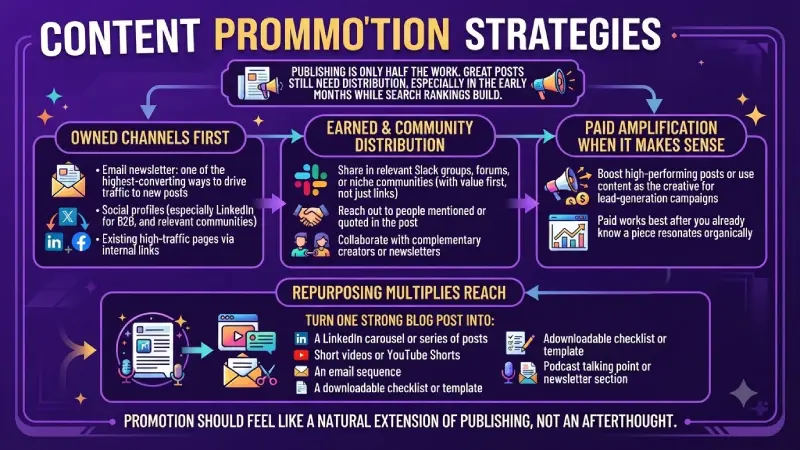
Publication is not everything; great posts require distribution too, especially during the first few months when rankings improve.
Owned channels first
- Email newsletter: one of the most converting ways to get traffic from your posts
- Social network profiles (LinkedIn for B2B, and communities where appropriate)
- Existing high-traffic pages via internal links
Earned and community distribution
- Join in Slack communities, forums or any relevant niche sites (value first, no just links please)
- Contact those who have been referenced in the article
- Collaborate with complementary creators or newsletters
Paid amplification when it makes sense
Boost high-performing posts or use content as the creative for lead-generation campaigns. Paid works best after you already know a piece resonates organically.
Repurposing multiplies reach
Turn one strong blog post into:
- A LinkedIn carousel or series of posts
- Short videos or YouTube Shorts
- An email sequence
- A downloadable checklist or template
- A podcast talking point or newsletter section
Promotion should feel like a natural extension of publishing, not an afterthought.
Measuring Blog Performance
Traffic alone is a weak scoreboard. A post can get thousands of visits and still produce no business value.
Metrics worth tracking
Leading indicators:
- Impressions and average position in Search Console
- Click-through rate from search
- Organic sessions and engaged sessions
- Time on page / scroll depth
- Internal link clicks and pages per session
Business indicators:
- Leads or demo requests influenced by blog content
- Email sign-ups from blog CTAs
- Assisted conversions in your analytics
- Ranking progress for target keywords
- Performance of refreshed vs new posts
Simple review process
- Weekly: Check new posts for early indexing and engagement
- Monthly: Review top and underperforming pages, identify refresh candidates
- Quarterly: Consider the total organic growth, lead generation, and cluster results.
Ensure that your Google Search Console and Google Analytics 4 are properly configured and create dashboards for convenience in viewing the statistics.
When a blog post fails to perform as expected, always remember to analyze first and then do something about it. Is the problem related to ranking, click through, or retention?
Building a Sustainable Blog System
A strong blog content strategy in 2026 usually includes:
- Clear audience and primary business goal
- Topic clusters built around real search demand and customer problems
- A simple but consistent editorial calendar
- Thorough, useful posts written for both readers and search
- Active promotion and repurposing
- Regular measurement and content refreshes
You do not need to publish every day. Content that is valuable needs to be produced consistently, backed by proper distribution, and optimized using data.
Start with one solid cluster. Plan the pillar and 6–10 supporting posts. Write and promote them properly. Measure what happens. Then expand.
Blogging still works. It simply rewards those teams who take it for a system and not for a publishing game.
Frequently Asked Questions
How many blog posts should I write monthly?
Virtually all businesses will get by just fine writing 2-4 high-quality blog posts every month
How long should one blog post be in 2026?
As long as it takes to answer a question fully and provide related information. The standard practice for the most useful blog posts is having word counts that vary between 1,500 and 3,000 plus words.
Does AI search make blogging obsolete now?
Not at all. In-depth and comparative type of content will remain to perform better compared to automated summaries.
Should I write more posts or update my existing ones?
Do both! Writing more blog posts increases topical coverage while updating existing good blog posts can be done quicker to get additional traffic.
How much time do I need for my new blog to start showing some results?
Low competition keywords will show up in the results of Google within a few months. Real traffic and leads usually come within 6-12 months, sometimes longer.
Conclusion
A successful blog does not consist of sporadic posts or keyword trends. Instead of this, a good blog is made up of clearness, consistency, and thoughtfulness towards readers. Through proper planning, writing, marketing and measurement, you would be able to make your blog a worthwhile asset to your business. Start small and simple but eventually build it up.
To take the next step, see our detailed guide on Video Content Marketing.