

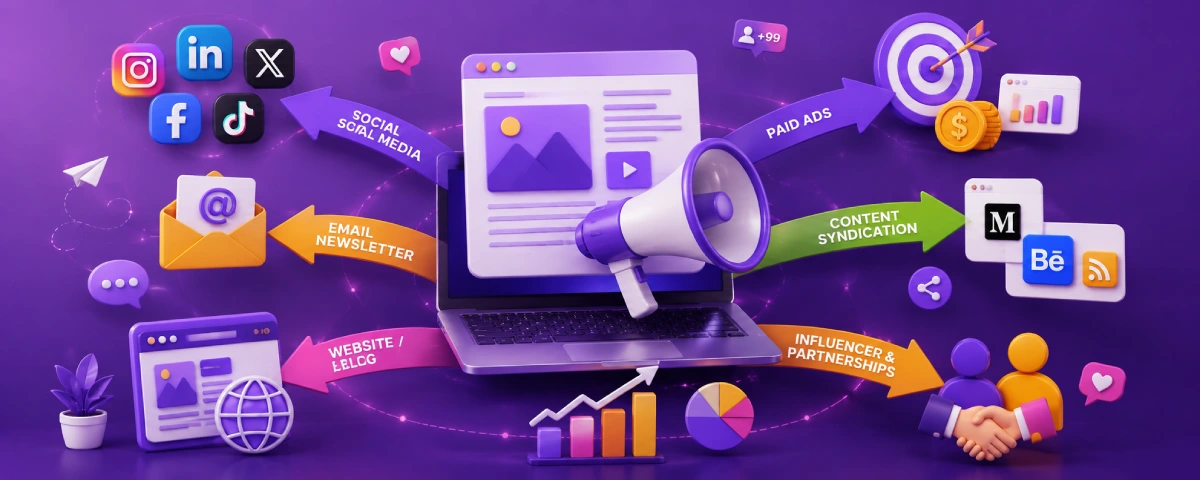
Content creation is often my move but alone it will not help me reach my goals. For content to truly matter content must find its audience. Content distribution is what brings content to the people so they can see it.
Some organizations continue to take distribution for granted by merely publishing their article and posting the link once on social media. The teams that get consistent results build a simple distribution system that uses owned, earned, and paid channels together.
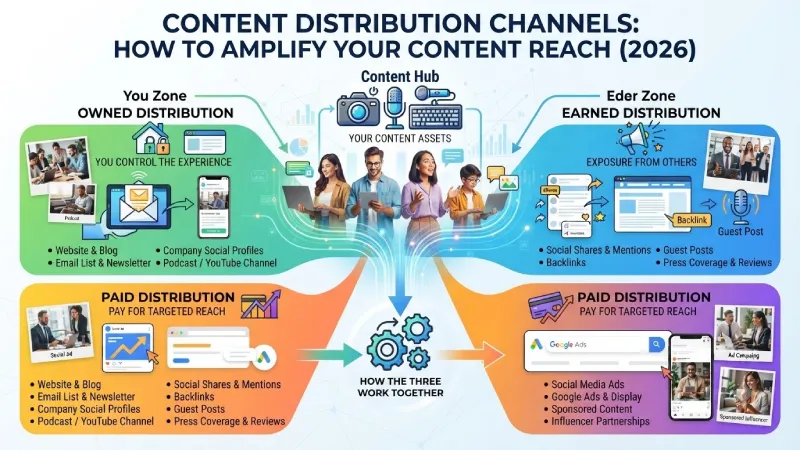
This guide will help you understand the major channels through which content gets distributed in 2026. You will find information on the difference between owned, earned, and paid distribution channels, the use of social media for content distribution, the importance of email as a channel, and content syndication.
Owned vs Earned vs Paid Distribution
Every way products get to customers falls into one of three types. Knowing the differences helps you create a mix. Being clear, about the differences helps you create a mix. Each type has its strengths and weaknesses. Understanding each type helps you create a mix.
Owned distribution
These are channels you control.
Examples:
- Your website and blog
- Email list and newsletters
- Company social media profiles
- Podcast, YouTube channel, or other media you own
- Mobile app or community platform
Strengths: You control the experience, the data, and the relationship. Results compound over time.
Limitations: Growth depends on your ability to attract and keep an audience.
Earned distribution
This is exposure you receive from others without paying for it directly.
Examples:
- Social shares and mentions
- Backlinks from other websites
- Guest posts or podcast interviews
- Press coverage and reviews
- Word-of-mouth and community recommendations
Strengths: High trust and credibility. Can expand reach significantly.
Limitations: Harder to control or predict. Takes time to build.
Paid distribution
You pay to put your content in front of specific people.
Examples:
- Social media ads (Meta, LinkedIn, TikTok, etc.)
- Google Ads and display campaigns
- Sponsored newsletters or content
- Native advertising and paid syndication
- Influencer paid partnerships
Strengths: quick focused and can grow easily once Strengths discover what works.
Limitations: Costs money continuously. Performance depends on creative and targeting quality.
How the three work together
The best strategies usually begin with owned channels—where you create and share your content. Then they use earned methods to help that content spread naturally. Finally they apply paid amplification to the content that’s already performing well. If you depend on one of these approaches you miss out on a lot of growth.
Social Media Distribution
Social media remains one of the popular methods, for sharing content. However the number of people who see posts without paying for promotion changes a lot depending on the platform and the kind of content being shared.
Platform strengths for distribution (2026)
| Platform | Best Content Types | Organic Reach Reality | Best For |
| Articles, carousels, text posts, documents | Still relatively strong for B2B | Professional audiences | |
| Reels, carousels, Stories | Reels favored | Visual and lifestyle brands | |
| TikTok | Short native videos | High discovery potential | Younger and consumer audiences |
| X (Twitter) | Short insights, threads, commentary | Fast but noisy | Tech, news, real-time topics |
| Groups, native video, community posts | Page reach often low | Communities and local | |
| YouTube | Long-form + Shorts | Strong for search and recommendations | Evergreen and educational |
Practical social distribution tips
- Make sure the content fits each platform of sharing the same thing on every site.
- Start with something or an interesting hook. Just sharing a link usually doesn’t work well.
- Use the formats that’re native to each platform (like carousels on LinkedIn, Reels or Shorts for finding new content and Threads for more detailed thoughts).
- Respond to comments. Take part in conversations that matter. Sharing gets better when people talk back.
- Post new content, than one time but in different ways (for example share a main idea one day and a quote or number another day).
- Find out which platforms bring visitors and sales then focus on those.
- Social works best as part of a system, not as the only distribution method.
Email as a Distribution Channel
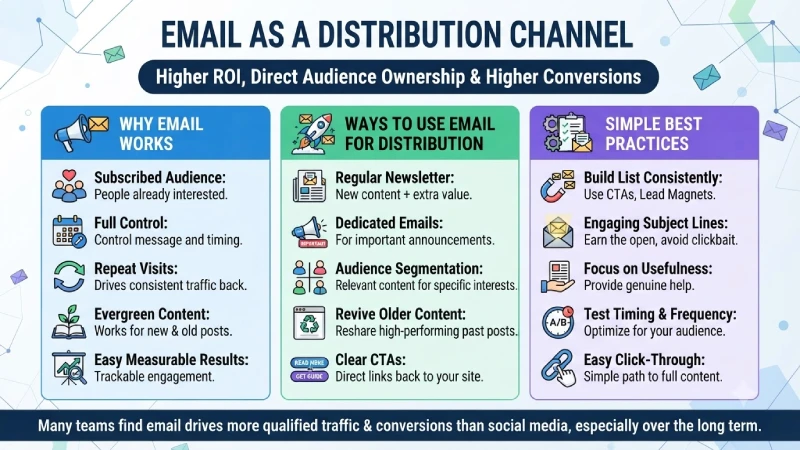
Email remains one of the highest-ROI distribution channels available. You own the relationship, delivery is direct, and conversion rates are usually much higher than social media.
Why email works so well for content
- People who join your list have already shown interest.
- You control the message and the timing.
- It drives repeat visits to your content.
- It performs well for both new posts and older evergreen pieces.
- Results are relatively easy to measure.
Ways to use email for distribution
- Send a regular newsletter that features new content plus extra value.
- Create dedicated emails when you publish something important.
- Segment your list so people receive content relevant to their interests.
- Use email to revive older high-performing posts.
- Include clear but natural calls-to-action that lead back to your site or next step.
Simple best practices
- Build the list consistently (blog CTAs, lead magnets, webinars, etc.).
- Write subject lines that earn the open without being clickbait.
- Keep the focus on usefulness. People stay subscribed when the emails help them.
- Test send times and frequency for your specific audience.
- Make it easy to click through to the full content.
Many teams find that email drives more qualified traffic and conversions from content than social media does, especially over the long term.
Content Syndication Networks
Content Syndication refers to posting your content in various websites. Through content syndication, your content will be accessed by people who otherwise would not have known about it. Content Syndication allows your message to reach further beyond your own website. You can use places to put your content so more people can read it. This method can help you connect with groups of readers. It’s all, about getting your work out to people through other peoples websites or services.
Common syndication approaches
- Republishing articles on platforms that allow it with proper canonical tags used when needed
- Sharing condensed versions or excerpts, in industry newsletters and publications
- Using branded content or partner sites
- Distributing through content discovery or native platforms
- Sharing via community newsletters and curated roundups
Benefits
- Extends the life and reach of content you have already created
- Can generate referral traffic and new audience members
- Supports brand awareness in relevant niche communities
- Sometimes leads to backlinks or further earned coverage
Important considerations
- Always clarify rights and canonical settings to avoid duplicate content issues.
- Choose partners and platforms that connect with your target audience.
- Monitor referral traffic and look at the conversions that happen after that to see what is effective.
- Put attention on working with good partners instead of spreading out everywhere.
Syndication works especially well for evergreen guides, research, and strong opinion or educational pieces.
Paid Content Amplification
Paid amplification means putting money behind content to increase its reach quickly. It works best when used selectively.
When paid amplification makes sense
- Paid amplification makes sense when the content already performs on its own.
- It is useful when the content already performs organically.
- Paid amplification helps you reach an audience faster for a launch a campaign or a time‑sensitive topic.
- It lets you target job titles, interests or look‑alike audiences.
- Paid amplification is a choice when organic distribution alone moves too slowly to meet your goals.
Common paid amplification methods
- Boosting high-performing organic posts
- Running traffic or engagement campaigns that send people to the content
- Using content as the creative in lead-generation campaigns
- Sponsored content placements and newsletter sponsorships
- Retargeting people who previously engaged with your content
Practical approach
- Let organic performance identify winners when possible.
- Start with modest budgets to test creative and audiences.
- Match the landing experience to the ad promise.
- Measure beyond clicks — track time on page, sign-ups, and assisted conversions.
- Scale what delivers acceptable cost per result and pause what does not.
Paid advertising works best when it helps good content reach people. It should not be used of good content. If the content is not strong to begin with adding money to it usually does not make it better.
Building a Complete Distribution System
A practical content distribution system in 2026 usually includes:
- Strong owned foundation (website/blog + email list)
- Consistent, platform-native social distribution
- Active efforts to earn shares, mentions, and links
- Selective syndication to relevant third-party channels
- Paid amplification focused on high-priority content
- Regular review of which channels drive traffic, engagement and conversions
I do not have to stay active on every channel. I need a mix that reliably puts my content in front of the right people so that my content reaches the right people.
I think you should begin by strengthening your owned channels, email. Next you should add distribution that matches where your audience already spends time. Finally you should layer in earned opportunities and paid support where the return justifies the effort and cost.
Content distribution is not about shouting louder. It has everything to do with putting relevant information into the places where those who need it will find it.
Frequently Asked Questions
What is the highest-ROI content distribution channel?
Email consistently ranks among the highest-ROI channels because you control the relationship and conversion rates are usually strong. Website or blog content also grows over time through search.
Should I distribute every piece of content to every channel?
No. Pick channels that fit the content type and the audience. A long technical guide may do better on email and LinkedIn while a short visual tip may do better on Instagram or TikTok.
How soon should I start paid amplification?
Only after you have some signal that the content resonates or when you have a clear business reason to speed up reach. Testing budgets first reduces risk.
Is content syndication still safe for SEO?
Yes when handled carefully. Use tags where suitable pick reputable partners and aim to add reach instead of creating duplicate content problems.
How do I know which distribution channels are working?
Track referral traffic, engagement, email click-through rates, conversion rates, by source and assisted conversions. Over time the data shows which channels deserve focus.
Conclusion
Great content creation is just one step; distribution is the actual delivery of the content to those who can benefit from it. Those who continue to deliver are those who have built distribution not as a one-off but as a process.
Develop a robust owned platform, particularly your website and email list, be present on the social media channels that you know your audience is active on, take any opportunities to earn distribution and amplify only if the content has proven itself successful or if there is a need for speed. You don’t have to do everything; just keep repeating what works to get your content distributed effectively.
Focus on what attracts your target audience and give it even more attention going forward.
To take the next step, see our detailed guide on Content Repurposing.