

For any brand nowadays, videos have become a necessity. Videos are viewed in order to gain knowledge, do research on products, get entertained, and choose people to trust. If created effectively, videos connect quicker than words and can generate traffic, leads, and sales for years.
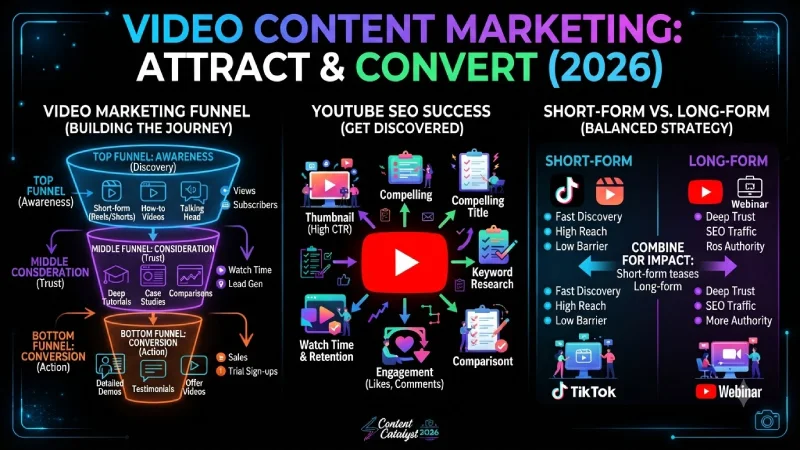
The issue is that much video content is produced without a strategic framework. Unorganized videos posted sporadically do not deliver much impact. However, the ones that deliver results treat video as a system. They select the appropriate formats, map videos to the buyer journey, optimize for visibility, find the balance between short and long form videos, and adopt technologies that do not complicate production.
This guide talks about a systematic approach towards video marketing content in 2026. It highlights the types of video, creation of a basic video funnel, YouTube SEO, short vs long form video, and production tools.
Types of Video Content
Not all videos are made equal. The selection of the correct kind of video will play a major role in achieving your objective.
Common video types that work for businesses
| Type | Best Used For | Typical Length | Example Use Case |
| Explainer / How-to | Teaching and SEO | 5–15 minutes | “How to set up a content calendar” |
| Product demo | Showing how something works | 3–10 minutes | Walkthrough of key features |
| Customer story / case study | Building trust and proof | 4–12 minutes | Real results from a client |
| Behind-the-scenes | Humanizing the brand | 1–5 minutes | Day in the life or process videos |
| Talking-head / opinion | Personal branding and thought leadership | 5–20 minutes | Founder sharing industry insights |
| Short-form (Shorts, Reels, TikTok) | Discovery and reach | 15–60 seconds | Quick tip or hook into longer video |
| Webinar or live | Deeper education and lead generation | 30–60+ minutes | Live training or Q&A |
| Testimonial | Social proof | 1–3 minutes | Customer speaking about results |
Most companies benefit from concentrating on three to five formats that fit their target market and budget. Trying to cover all the formats results in inconsistency.
How to choose
- If your audience searches for solutions → prioritize how-to and explainer videos
- If trust is a big barrier → lean into customer stories and behind-the-scenes
- If you need fast discovery → make short-form a regular habit
- If you sell a complex product → demos and longer educational videos help
Match the format to the job you want the video to do.
Video Marketing Funnel
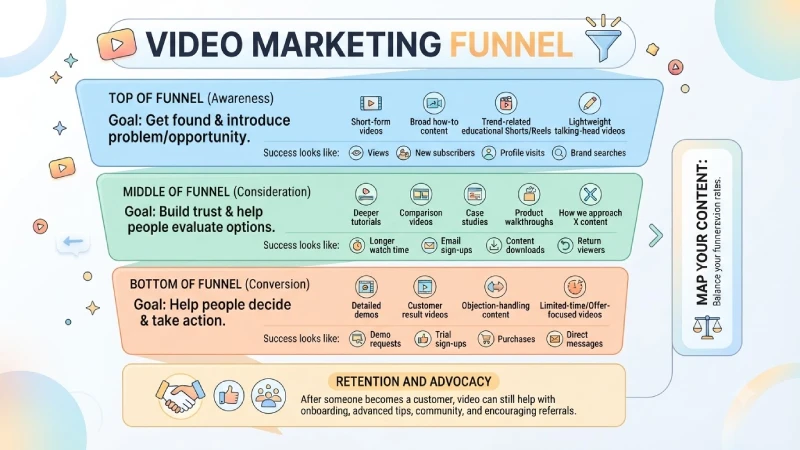
The use of video should be able to cover the entire process from stranger to customer and not remain isolated.
A simple video funnel
Top of funnel (Awareness)
Goal: Get found and introduce the problem or opportunity.
Best formats: Short-form videos, broad how-to content, trend-related or educational Shorts/Reels, lightweight talking-head videos.
Success looks like: views, new subscribers, profile visits, brand searches.
Middle of funnel (Consideration)
Goal: Build trust and help people evaluate options.
Best formats: Deeper tutorials, comparison videos, case studies, product walkthroughs, “how we approach X” content.
Success looks like: longer watch time, email sign-ups, content downloads, return viewers.
Bottom of funnel (Conversion)
Goal: Help people decide and take action.
Best formats: Detailed demos, customer result videos, objection-handling content, limited-time or offer-focused videos.
Success looks like: demo requests, trial sign-ups, purchases, direct messages.
Retention and advocacy
After one becomes a client, video can still be used to onboard, train in advance, create a community, and obtain referrals.
Make sure your videos are well-placed on this map. What we’ve found is that most companies actually have an excess of top-of-the-funnel videos and very few decision-making videos.
YouTube SEO for Video
YouTube is a platform where one can not only watch videos but also conduct searches. It would be wrong to see it merely as a platform for posting files.
Core ranking factors that matter in 2026
- Click-through rate (thumbnail + title)
- Watch time and audience retention
- Title, Description, and Content’s Relevance to Search Query
- Viewers’ Engagement (Number of Likes, Comments, Shares, Playlist Additions)
- Session Time and Viewing Behavior Post-Content Viewing
Practical YouTube SEO checklist
- Research real search terms your audience uses on YouTube (not just Google)
- Place the keyword at the start of the title if it is appropriate to do so.
- Formulate a strong, benefit-driven title that wins the click.
- Make sure the thumbnail attracts attention and sets the right expectations.
- Write a full description with the main points, timestamps, and relevant links
- Speak key topics clearly in the video (YouTube uses the audio transcript)
- Add cards and end screens to keep people on your channel
- Create playlists that group related videos
- Link related videos together with internal links in descriptions
Thumbnails and titles are high-leverage
An effective thumbnail and title can increase the click-through rate by two or three times more than an ineffective thumbnail and title. Experiment with thumbnails and titles; many highly successful channels are equally concerned with packaging as they are with producing good content.
Consistently upload videos and give your videos time. YouTube tends to test new videos with a smaller audience before rolling out the video widely.
Short-form vs Long-form Video
Both formats have clear strengths. The best strategy for most brands uses both.
Short-form video (Shorts, Reels, TikTok-style)
Strengths:
- High discovery potential
- Lower production barrier
- Fast feedback loop
- Good for hooks, tips, and personality
Best for:
- Reaching new audiences
- Testing ideas quickly
- Driving traffic to longer content or profiles
- Staying top-of-mind
Limitations:
- Harder to explain complex topics fully
- Shorter shelf life for individual videos
- Monetization per view is usually lower
Long-form video (YouTube, webinars, detailed tutorials)
Strengths:
- Builds deeper trust and authority
- Better for SEO and evergreen traffic
- Higher watch time and stronger relationship
- Easier to include stronger calls-to-action and storytelling
Best for:
- Education and demos
- Case studies and thought leadership
- Converting interested viewers into subscribers or leads
- Long-term organic traffic
How to combine them effectively
- Use short-form to attract attention and test topics
- Turn strong short-form ideas into full long-form videos
- Cut long-form videos into multiple short clips for distribution
- End short videos with a clear next step (watch the full version, subscribe, visit a link)
- Let performance data decide which topics deserve deeper treatment
One strategy that works well is writing long form on a regular schedule such as weekly or bi-weekly, and short form a few times each week.
Video Content Production Tools
No fancy Hollywood production is required to make videos work for you; all that is needed is the correct equipment.
Planning and scripting
- Notion, Google Docs, or specialized software for writing outlines
- Shot lists and basic bullet-point scripts (exact wording scripts tend to sound unnatural)
Recording
- Mobile phones (smartphones are more than sufficient for all the content nowadays)
- Low-end webcam or mirrorless camera for improved talking head videos
- Budget lavaliere or USB microphones (good audio is more important than 4K resolution)
- Ring lights or basic key lights for improved lighting
Editing
- CapCut – strong free/low-cost option, especially for short-form
- DaVinci Resolve – powerful free option for longer videos
- Adobe Premiere Pro or Final Cut Pro – professional standard when you need more control
- Descript – excellent for text-based editing and removing filler words
Thumbnails and graphics
- Canva or Figma for thumbnails and simple graphics
- Photoshop if you need more advanced control
Hosting and distribution
- YouTube for long form and Shorts
- LinkedIn, Instagram, TikTok, and X for short form native uploads
- Loom for short videos internally and/or externally
Repurposing and workflow
- Tools that help clip long videos into shorts
- Scheduling tools that support video posts
- A simple shared folder structure for raw footage, project files, and final exports
Start simple. Many successful YouTube channels started off using just a telephone, daylight, and free software. Improve equipment only when there is a clear bottleneck in the existing equipment.
Building a Practical Video System
A sustainable video content marketing system in 2026 usually includes:
- Clear goals and audience understanding
- A mix of video types mapped to the funnel
- Consistent packaging (titles and thumbnails)
- Regular short-form for discovery + long-form for depth
- Basic but reliable production tools and workflow
- Promotion and repurposing so videos keep working after publish
- Monthly review of retention, traffic, and conversions
You do not have to post everyday. You need an achievable flow that you can sustain for many months; you need content that can help your viewers and enough distribution to reach the right viewers.
Begin with one form of video that you can perform exceptionally. Write posts regularly for 90 days. Analyze your audience retention graph and responses. Proceed from thereon.
Video favors consistency and clarity over perfection. Work on making your viewers better, deliver your videos in a manner that they will be clicked, and just show up.
Frequently Asked Questions
Is there a need for me to invest in professional equipment to launch my video marketing strategy?
No, there is not. All that is required is just having an updated phone camera and sound recording equipment, in addition to ensuring that the lighting is appropriate.
How often should I post videos?
If your videos are long-form content, then once a week or twice a week can be a great choice for most businesses. For short-form videos, posting several videos a week would work well if quality doesn’t decline.
Should I choose YouTube or short-form platforms?
It all depends on your business goals. Short-form videos can help you get discovered faster. Long-form videos can bring you more search traffic and build more trust.
How long should my videos be?
However long it takes to provide value — but no longer. Short form content is most effective in the 60-second range whereas long form content is often effective for between 8 and 20 minutes.
How do I determine if my video content is performing?
However, do not be myopic to just concentrate on views. Instead, keep track of your engagement, clicks from the thumbnails, traffic to your website, sign-ups through email, and even the leads/sales generated by your videos.
To take the next step, see our detailed guide on SEO Content Writing.