

Introduction
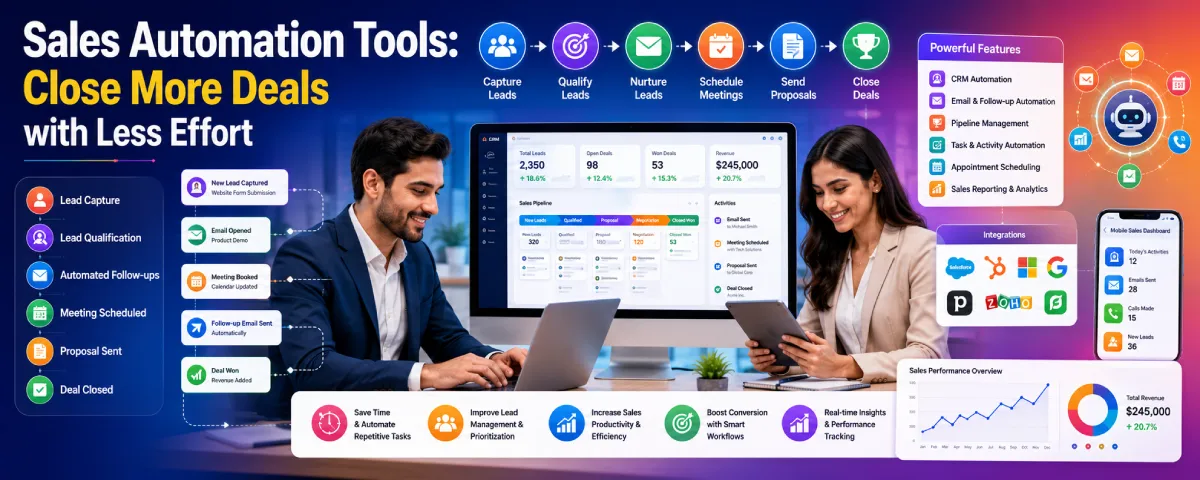
Sales Automation Software today’s sales reps juggle many tasks such as lead management, customer interaction, follow-up, proposal submission, meetings, and CRM entries on a daily basis. As companies grow, it becomes hard to do all the processes manually.
Sales personnel mostly find themselves engaged in doing lots of paperwork rather than attending to clients.
This is where sales automation tools become valuable.
Sales automation software is quite useful for salespeople. They assist them in activities such as customer search and emailing them. In addition, sales automation software assists in maintaining the customer database and management of the sales process.
It makes things easy for salespeople. Sales automation software enables sales teams to work smartly and communicate with customers in an effective manner. This implies that they are able to manage prospective customers who want to purchase their products as well as interact with customers. Sales automation software is useful in making a list of progression and scheduling meetings.
In 2026, all kinds of businesses implement sales automation to boost productivity, conversions, and sales processes.
This guide is dedicated to explaining sales automation software, its features, advantages, top software, lead generation automation tips, CRM capabilities, pipeline management software, and future developments in the area of sales.
Sales automation from our automation tools pillar.
What Are Sales Automation Tools?
Sales automation tools are software that helps with sales tasks. They automate things, like data entry and customer follow-ups.
These tools help businesses:
- manage leads
- automate follow-ups
- update CRM records
- track customer activity
- monitor sales pipelines
- schedule appointments
- generate reports
Sales automation really assists in reducing a lot of tasks. This results in having time for sales personnel to interact with people and make connections. It also allows sales personnel to concentrate on making the deal, which forms an important part of their job. It is really beneficial for sales personnel as it enables them to do what they do best. That is, to interact with people, establish connections, and ultimately make more sales deals.

How Sales Automation Works
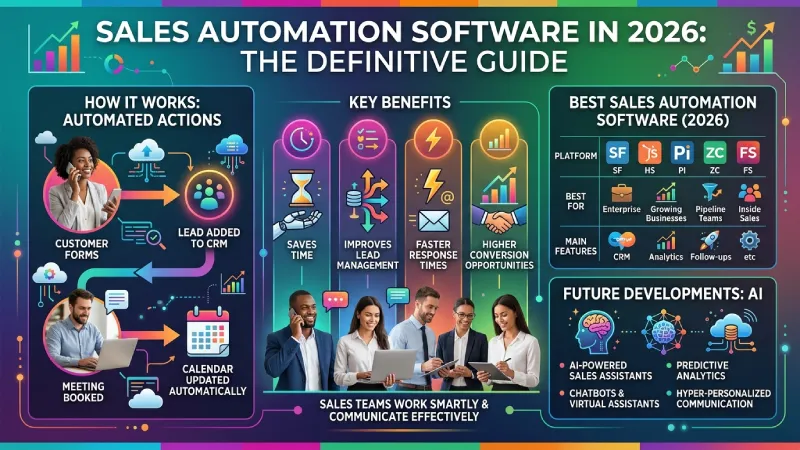
Sales automation systems collect customer information and automate tasks based on sales activities, lead behavior, or predefined workflow rules.
For example:
| Sales Activity | Automated Action |
| Customer fills contact form | Lead added to CRM |
| Lead opens email | Sales notification triggered |
| Meeting booked | Calendar updated automatically |
| Proposal sent | Follow-up reminder scheduled |
| Deal completed | CRM pipeline updated |
Automation helps businesses respond faster and manage sales operations more efficiently.
Why Businesses Use Sales Automation Tools
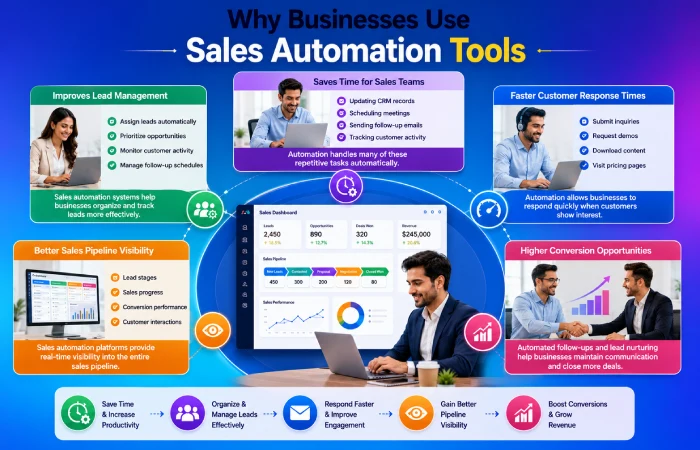
Automations for sale are used by companies in order to automate their sales activities.
Automation in sales helps organizations to achieve more in terms of their sales activities while doing fewer repetitive things. This feature of automation in sales is highly beneficial because automation of sales increases productivity of sales teams. They don’t have to perform manual tasks anymore.
Saves Time for Sales Teams
Sales representatives often spend hours:
- updating CRM records
- scheduling meetings
- sending follow-up emails
- tracking customer activity
Automation handles many of these repetitive tasks automatically.
Improves Lead Management
Sales automation systems help businesses organize and track leads more effectively.
Teams can:
- assign leads automatically
- prioritize opportunities
- monitor customer activity
- manage follow-up schedules
Faster Customer Response Times
Automation allows businesses to respond quickly when customers:
- submit inquiries
- request demos
- download content
- visit pricing pages
Faster communication improves conversion opportunities.
Better Sales Pipeline Visibility
Sales automation platforms provide real-time visibility into:
- lead stages
- sales progress
- conversion performance
- customer interactions
This helps managers monitor team performance more effectively.
Higher Conversion Opportunities
When you use automation to follow up with people and help them along the way it is a lot easier for companies to stay in touch, with customers during the time they are trying to make a sale. This is really helpful because automation of follow-up and nurturing makes the sales process simpler for organizations to manage and stay on top of things.
This increases the likelihood of closing a deal.
Best Sales Automation Software in 2026
Various companies employ varying sales automation systems according to their organizational size and sales needs.
| Platform | Best For | Main Features |
| Salesforce | Enterprise sales management | CRM, analytics, automation |
| HubSpot Sales | Growing businesses | CRM and sales automation |
| Pipedrive | Pipeline management | Visual sales tracking |
| Zoho CRM | Affordable CRM automation | Lead and workflow automation |
| Freshsales | Customer engagement | AI-based sales assistance |
| Close CRM | Inside sales teams | Communication automation |
| Monday Sales CRM | Team collaboration | Workflow automation |
| Copper CRM | Google Workspace users | Integrated CRM workflows |
When you are looking at software options, for your company you need to think about a few things. Businesses should look at the software they are considering and compare them to see what programs they can work with. They should also think about the reports they can get from the software. If it is easy to use.
Leads come from marketing automation tools
Sales Pipeline Automation
Sales pipeline automation is a help to companies. It makes managing people who’re interested in what they have to offer a lot easier. These people are like customers and they go through many steps before they actually buy something.
When you use sales pipeline automation you do not have to update the status of these potential customers. The automation system does that for you. It looks at what the potential customersre doing and then it moves them to the next step, in the sales pipeline automation process. This way companies can use sales pipeline automation to make their work easier and focus on things.
Common Pipeline Stages
| Pipeline Stage | Purpose |
| Lead Capture | Collect customer information |
| Qualification | Evaluate lead quality |
| Follow-Up | Continue communication |
| Proposal | Share pricing or solutions |
| Negotiation | Discuss deal terms |
| Closing | Finalize the sale |
Automation helps businesses cut down on delays and keep communication steady.
HubSpot says that automated sales pipelines are great, for managing leads following up with them and keeping track of sales progress as customers move through the buying process.
Benefits of Pipeline Automation
Businesses using sales pipeline automation often improve:
- response times
- lead organization
- sales forecasting
- team productivity
- customer follow-up consistency
The pipeline automation process allows management to detect bottlenecks and better evaluate the sales performance.
Lead Generation Automation
Lead generation automation refers to the process of attracting and managing the potential clients by means of automation processes.
Automation tools collect leads from:
- websites
- landing pages
- advertisements
- webinars
- social media campaigns
The system then organizes and routes leads automatically.
Common Lead Generation Automation Features
| Feature | Purpose |
| Lead capture forms | Collect customer information |
| Automated follow-ups | Continue customer communication |
| Lead scoring | Identify high-quality leads |
| CRM synchronization | Organize customer records |
| Email sequences | Nurture prospects automatically |
Follow up with email automation tools.
Lead Scoring Automation
Some sales automation platforms use AI and behavioral tracking to score leads based on:
- engagement
- website visits
- email activity
- purchase intent
This helps sales teams focus on the most valuable opportunities first.
CRM Sales Automation Features
Sales Automation involves Customer Relationship Management or CRM which plays a significant role in sales automation. It is the tool used by organizations to manage their customers and sales.
CRM automation provides a support tool to organizations in that they are able to manage their customer relationship in an efficient manner.
This is through the use of CRM where CRM automation supports organizations in their customer relationships.
Common CRM Automation Features
Contact Management
Stores customer information and communication history.
Automated Follow-Ups
Schedules reminders and email communication automatically.
Activity Tracking
Monitors:
- emails
- meetings
- calls
- customer engagement
Sales Forecasting
Generates sales predictions using customer and pipeline data.
Workflow Automation
Automates repetitive CRM tasks and sales activities.
Benefits of CRM Sales Automation
CRM automation helps businesses:
- improve organization
- reduce manual updates
- increase productivity
- maintain customer communication
- improve reporting accuracy
Sales Automation for Small Business
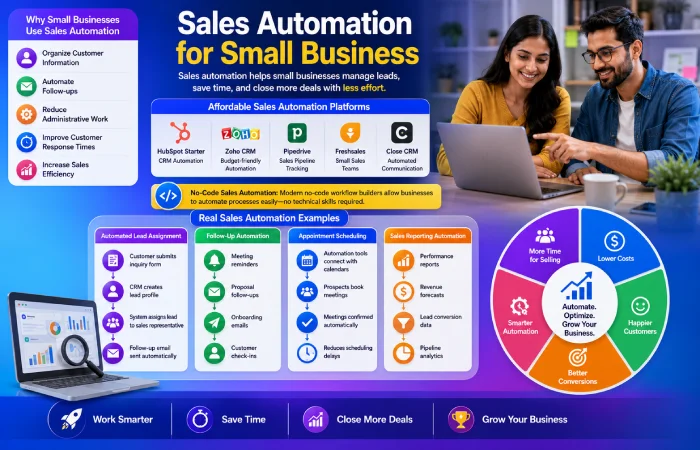
businesses usually do not have a lot of people on their sales teams and they do not have a lot of resources to work with. Sales automation is really helpful for Small Business because it makes managing leads and talking to customers a lot easier, for Small Business.
Why Small Businesses Use Sales Automation
Small businesses use automation to:
- organize customer information
- automate follow-ups
- reduce administrative work
- improve customer response times
- increase sales efficiency
Affordable Sales Automation Platforms
| Platform | Best For |
| HubSpot Starter | CRM automation |
| Zoho CRM | Budget-friendly automation |
| Pipedrive | Sales pipeline tracking |
| Freshsales | Small sales teams |
| Close CRM | Automated communication |
No-Code Sales Automation
Modern sales tools now provide no-code workflow builders that allow businesses to automate processes without technical knowledge.
This helps startups and smaller companies adopt automation more easily.
Real Sales Automation Examples
Practical examples help businesses understand how sales automation improves operations.
Automated Lead Assignment
When customers submit inquiry forms:
- CRM creates lead profile
- system assigns lead to sales representative
- follow-up email is sent automatically
This improves response speed.
Follow-Up Automation
Sales systems automatically send:
- meeting reminders
- proposal follow-ups
- onboarding emails
- customer check-ins
This helps maintain consistent communication.
Appointment Scheduling
Automation tools connect with calendars and allow prospects to book meetings automatically.
This reduces scheduling delays.
Sales Reporting Automation
Platforms generate:
- performance reports
- revenue forecasts
- lead conversion data
- pipeline analytics
This reduces manual reporting work.
Common Sales Automation Mistakes
Businesses sometimes implement sales automation incorrectly.
Over-Automating Customer Communication
Too much automation can make communication feel impersonal.
Sales teams should balance automation with genuine human interaction.
Poor CRM Data Management
Incorrect customer data reduces automation accuracy and reporting quality.
Ignoring Lead Quality
Generating more leads is not useful if businesses fail to qualify prospects properly.
Using Complex Systems Too Early
Small businesses sometimes purchase advanced enterprise software they do not fully use.
Businesses should choose platforms that match operational needs.
Sales Automation vs Manual Sales Processes
| Manual Sales Processes | Automated Sales Processes |
| Manual lead tracking | Automated CRM updates |
| Delayed follow-ups | Faster communication |
| Limited pipeline visibility | Real-time sales tracking |
| Manual scheduling | Automated appointments |
| Time-consuming reporting | Instant analytics |
Future of Sales Automation
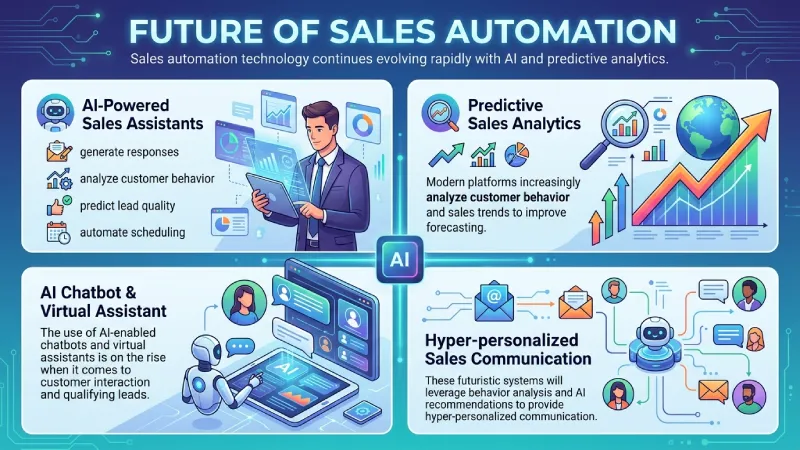
Sales automation technology continues evolving rapidly with AI and predictive analytics.
AI-Powered Sales Assistants
AI tools now help sales teams:
- generate responses
- analyze customer behavior
- predict lead quality
- automate scheduling
Predictive Sales Analytics
Modern platforms increasingly analyze customer behavior and sales trends to improve forecasting.
AI Chatbot & Virtual Assistant
The use of AI-enabled chatbots and virtual assistants is on the rise when it comes to customer interaction and qualifying leads.
Hyper-personalized Sales Communication
These futuristic systems will leverage behavior analysis and AI recommendations to provide hyper-personalized communication.
Frequently Asked Questions
What is sales automation software?
Sales automation software aims at automating sales-related tasks like updating the CRM system, lead management, follow-up, and pipeline management.
Who uses sales automation?
Sales automation is utilized by start-ups, e-commerce businesses, SaaS firms, agencies, B2B firms, and enterprises engaged in sales processes.
What is sales pipeline automation?
Sales pipeline automation takes care of leads automatically as they go through various stages of the sales process.
Are sales automation tools costly?
Various cost-effective solutions are provided by different platforms for entrepreneurs and budding businesses.
What is the difference between CRM and Sales Automation?
The CRM system handles the customer details, while the Sales Automation System handles the sales process.
Conclusion
The sales automation software will help businesses optimize their sales processes and customer management in 2026.
Whether it is related to lead generation and CRM automation, pipeline management, and predictive analysis, automation software enables sales teams to concentrate on establishing relations and closing sales rather than doing routine administrative tasks.
By applying sales automation, businesses can benefit from faster response times, better organization of customer information, and scalability of the sales process.
In the future, the sales automation will be even more important for businesses due to advancements in artificial intelligence and automation technologies.