

The writing of content for Google is not about fooling its algorithm. Rather, it is all about understanding what the users are looking for, creating the perfect page to suit their needs, and ensuring that the content is clear to both man and machine.
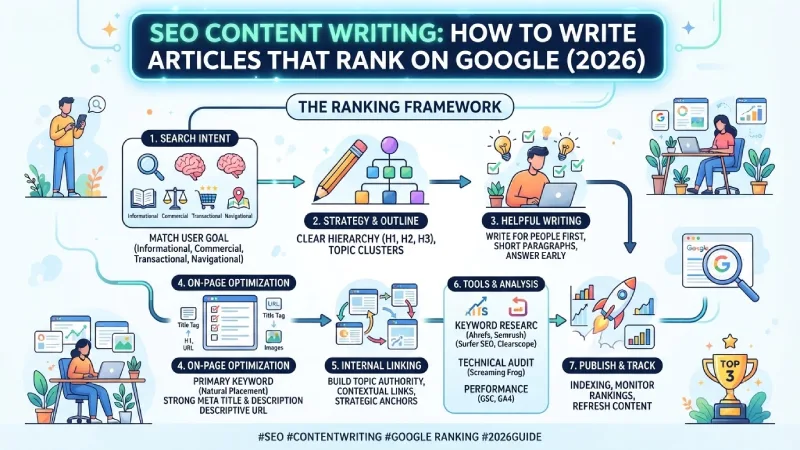
In most cases, SEO is considered something to be done in the last minute; that is, writing takes place before the optimization aspect. The writers that usually rank highly do the total opposite because they consider the search intent first, structure their content, perform on-page SEO right, link well, and use tools to help instead of making decisions for them.
This guide will explain technical SEO content writing in the year 2026. This guide contains all the information related to on-page SEO, search intent, writing of meta title and description, internal linking, and other SEO tools.
On-Page SEO for Writers
On-page SEO is what you have direct control of on the page. For writers, this is the most high-leverage since no technical developers are needed to help here.
Core on-page elements that still matter
| Element | Best Practice in 2026 | Why It Matters |
| Title tag | 50–60 characters, primary keyword near the front | Strong relevance and click signal |
| H1 | One clear H1 that matches the main topic | Tells Google and readers the main subject |
| URL | Short, descriptive, keyword-inclusive | Clarity and usability |
| First 100–150 words | Include primary keyword naturally | Early relevance signal |
| Headings (H2, H3) | Logical hierarchy, descriptive | Improves scannability and structure |
| Images | Descriptive file names + alt text | Accessibility and image search |
| Internal links | Contextual links to related pages | Helps discovery and topical authority |
Practical writing habits
- Always write for the reader. The ranking will be temporary without useful information.
- Utilize your primary keyword in appropriate areas such as the title, introduction, one to two headers, and conclusion.
- Use words and phrases that are often used in conversation instead of just using simple keywords.
- Please write paragraphs that’re easy to understand and give them proper headings so that the artificial intelligence system can easily understand what is being said.
- State the answer, to the question first then elaborate on it.
Do not over-stuff your article with keywords. The advanced searching engines know how to detect forced articles.
Search Intent and Content
Search intent is the reason behind a query. Matching intent is one of the biggest ranking factors that writers can control.
The four main types of search intent
| Intent Type | What the Searcher Wants | Best Content Approach |
| Informational | To learn or understand | Guides, how-tos, explanations |
| Commercial | To compare options before deciding | Comparisons, “best of” lists, reviews |
| Transactional | To take action (buy, sign up, contact) | Product pages, pricing, demos |
| Navigational | To find a specific site or page | Brand or login-focused pages |
How to identify intent
Check out the leading webpages ranking for your targeted keyword. The type that dominates (guide, list, comparison, product page) is indicative of the dominant intention. Also look at the “People Also Ask” box and related searches.
How to satisfy intent
- Informational searches require full answers with examples.
- Commercial searches require balance and decision support.
- Transactional searches require direction and assurances.
- Mixed-intent searches might require multiple parts addressing various stages.
With the alignment of your format and content to the searcher’s expectations, rankings will be positively affected.
Writing Meta Titles and Descriptions

While the meta titles and descriptions may not affect the ranking of the specific page in search results, their effects on the user’s decision of clicking the link are extremely significant.
Meta title best practices
- Ensure the text is, under sixty characters to fit screens.
- If you can place the keyword early in the meta title.
- It should be precise rather than generic.
- Also, add a benefit or a year if applicable such as “2026 Guide”.
Meta description best practices
- This page offers information, about [keyword] including tips, guides and resources to improve your understanding.
- Find advice and examples that make learning easier.
- Use the keyword naturally for search results.
- Use a soft call to action if it makes sense (“Learn how”, “See examples”, “Get the steps”).
- Write unique descriptions for each significant page.
Remember that the title and description are your ad on Google. Your job is to convince users to click.
Internal Linking Strategy
Internal links are amongst the least used SEO techniques. They help the search engines understand the architecture of your website, pass authority, and ensure that readers move from page to page on your site.
Why internal links matter
- They help new pages get discovered and indexed faster.
- They show topical relationships between pages.
- They pass relevance and authority signals.
- They improve user experience by guiding readers to related information.
Practical internal linking guidelines
- Place the link directly within the content where it fits naturally not at the end as a list.
- Make sure the text. The anchor. Clearly explains what the linked page is, about.
- This helps people understand where the link leads before they click.
- Do the linking from the high-quality pages to the other new or important pages that you would like to boost.
- The use of the right amount of links, normally between 2 and 5 contextual links for every 1,000 words is the magic formula.
- The topic cluster concept includes links from the pillar pages to the supporting pages and vice versa.
Orphaned pages (pages without any links within the site pointing to them) should be avoided as well. In addition, over-linking using general anchor texts such as “click here” should be avoided.
A good practice would be to always link to newly created posts from some other old posts, 2-4 links, whenever a new post is published.
Content Optimization Tools
Tools can hasten your research and help you recognize gaps, but they should aid rather than substitute good writing.
Useful categories of tools
| Tool Type | What It Helps With | Examples of Popular Options |
| Keyword & SERP research | Understanding demand and competition | Google Keyword Planner, Ahrefs, Semrush, free Google tools |
| Content optimization / scoring | Comparing your draft to top-ranking pages | Surfer SEO, Clearscope, Frase, NeuronWriter |
| Writing & editing | Drafting, rewriting, clarity | Google Docs + Grammarly, Hemingway, AI assistants used carefully |
| Technical checks | Titles, metas, headings, links | Screaming Frog, Site audits in Ahrefs/Semrush |
| Performance tracking | Rankings, traffic, engagement | Google Search Console, Google Analytics 4 |
How to use tools wisely
- Employ research tools before you write in order to identify intent and associated topics.
- Employ optimization tools to test coverage once you have a well-developed draft, rather than trying to stuff in all suggested keywords.
- Do not degrade your content just because you want to improve some tool’s metric.
- Concentrate most of your effort on original insights, proper structure, and value.
- Tools won’t help you do that.You don’t need anything beyond free tools (Google Search Console, Google Analytics, Google Docs) initially.
- Paid tools will come into play when you start publishing content and require fast research and competitive analysis.
Putting SEO Content Writing into Practice
A reliable process for writing content that can rank looks like this:
- Choose the key phrase and intention behind the search.
- Analyze the competitor pages and write down their pros and cons.
- Make an organized structure with proper headings.
- Prepare a complete, informative draft that serves the reader well.
- On-page optimization (title, meta, headings, introduction, and images).
- Add strong internal links.
- Edit for clarity and flow.
- Publish and submit for indexing if needed.
- Track performance and refresh the content later when opportunities appear.
SEO content writing requires patience and utility. A single high-quality and well-written article that proves helpful for the user is more likely to be successful than five articles stuffed with keywords.
Always try to solve the problem of your prospect better than anyone else. This can be done through on-page SEO in order to showcase your utility.
Frequently Asked Questions
What should the word count be for my SEO article?
Use many words as necessary to cover the main question and any related questions. Ranking pages usually have word counts, between 1,500 and 3,000 words or more but the quality of the information must come first.
Will I have to employ a content optimization tool to rank?
No. Many pages rank well without them. Tools can help you spot missing topics, but clear writing and intent matching are more important.
How important are meta descriptions for ranking purposes?
Meta descriptions do not have any effect, on rankings. However meta descriptions help improve the click‑through rate.
How many internal links should I add to a new article?
A natural number is usually 3–8 contextual links, depending on length and available relevant pages. Quality and relevance matter more than quantity.
How often should I update SEO content?
Review the performing and the declining pages every few months. Updating statistics, expanding thin sections, and improving examples can recover or improve rankings with less effort than creating new content.
Conclusion
In summary, successful writing of high-quality content in 2026 that will rank on Google remains about just one thing – solving the searcher’s problems better than anybody else is able to do. If he/she knows about his/her requirements, makes a proper page, covers the topic fully, and performs on-page optimization correctly, it will not take much time for him/her to get a better ranking position.
Although SEO tools can help him/her in doing the research faster and know about the missing things, they cannot replace good writing. It is necessary for him/her to discover the question, address it in full and ensure the readability of the page. That is all that is required for him/her to have a chance to get noticed when it really matters.
To take the next step, see our detailed guide on Content Distribution Channels.